
LAWC-303 · Lesson 3 of 12 · 20 min
Deposits, failed deals and remedies
▶ Video coming soon A video version of this lesson is on the way.
Ingleby opens the third class with two sentences on the board. 'The buyer cannot close.' 'The seller will not close.' She tells the class that in a rising market, the second sentence fills the court lists, and in a falling market, the first one does. After the market for Toronto-area pre-construction condominiums and investment houses cooled in 2023 and 2024, Ontario courts heard a steady stream of claims by sellers against buyers who could not or would not complete. This lesson covers what happens to the deposit, how damages are measured, when a court will order specific performance and how the duty to mitigate shapes all of it.
The nature of a deposit
A deposit is money paid by the buyer when the agreement is made, to be credited against the price on closing and forfeited if the buyer fails to complete. It is old law. The English courts held in the nineteenth century that a deposit is a guarantee that the buyer means business, and that a buyer who repudiates the contract cannot recover it. The Ontario Court of Appeal restated the principle in Benedetto v. 2453912 Ontario Inc., decided in 2019. The buyer had signed a 7 million dollar agreement for three Toronto houses 'in trust for a company to be incorporated, without personal liability,' paid 100,000 dollars in deposits, then announced two weeks before closing that he would not proceed and asked for his money back. The Court held that the deposit was separate from the buyer's obligations under the agreement and was forfeited on his repudiation. The 'no personal liability' language protected him against a damages claim, but not against losing the deposit. The Court described a deposit as an ancient invention of the law designed to motivate parties to carry through with their bargains.
The key feature of a true deposit is that the seller may keep it without proving any loss. In this respect deposits are an exception to the rule against penalties, which normally prevents a party from recovering a pre-set sum on breach that bears no relation to the actual damage. The exception has limits. A payment called a deposit that is really a large part payment of the price may be treated as part payment, which a defaulting buyer may be able to recover subject to the seller's damages. And a court has a statutory power to relieve against forfeiture.
In a residential deal, the deposit is usually held in trust by the listing brokerage. Under the rules made under the Trust in Real Estate Services Act, 2002, the brokerage may release it only in accordance with the agreement, a written direction signed by both parties, or a court order. When a deal collapses, the brokerage almost always refuses to release the deposit to either side until the parties sign a mutual release or a court decides, and an application to the Superior Court for an order releasing the deposit is a common first step in litigation.
Relief from forfeiture
Section 98 of the Courts of Justice Act gives the court power to grant relief against penalties and forfeitures on such terms as are just. In Redstone Enterprises Ltd. v. Simple Technology Inc., 2017 ONCA 282, the buyer of a Brantford warehouse had paid 750,000 dollars in deposits, including 450,000 to extend the closing, toward a price of just over 10 million dollars, and then could not obtain financing or a federal licence for its planned business. The trial judge let the seller keep only part of the deposits because the seller had not proved any damages. The Court of Appeal reversed. It held that the buyer must show both that the forfeited sum is out of all proportion to the seller's damages and that it would be unconscionable for the seller to keep it. The absence of evidence of loss does not make forfeiture unconscionable. Considering sophisticated parties of equal bargaining power, a deposit of about seven percent of the price and a ready and willing seller, there was nothing exceptional about the case, and the seller kept the full deposit.
Relief remains possible. In Pleterski (Re), 2024 ONCA 711, a case arising from the bankruptcy of a man the media called the 'Crypto King,' the Court of Appeal upheld relief from forfeiture of a 500,000 dollar deposit on a 5.5 million dollar commercial property. The deposit had been paid with money misappropriated from investors, and the seller had resold the property for more than the original price. The Court emphasized that unconscionability must be assessed in the full commercial context, and the Supreme Court of Canada dismissed an application for leave to appeal in April 2025. Hannah Kowalczyk notes the contrast. 'In Redstone the seller suffered no proven loss and still kept everything. In Pleterski the seller also suffered no loss and had to give the money back.' Ingleby agrees that the difference lies in who would bear the loss of relief: a sophisticated commercial buyer that simply failed to perform, or defrauded investors whose money the trustee in bankruptcy was trying to recover.
Damages when the buyer defaults
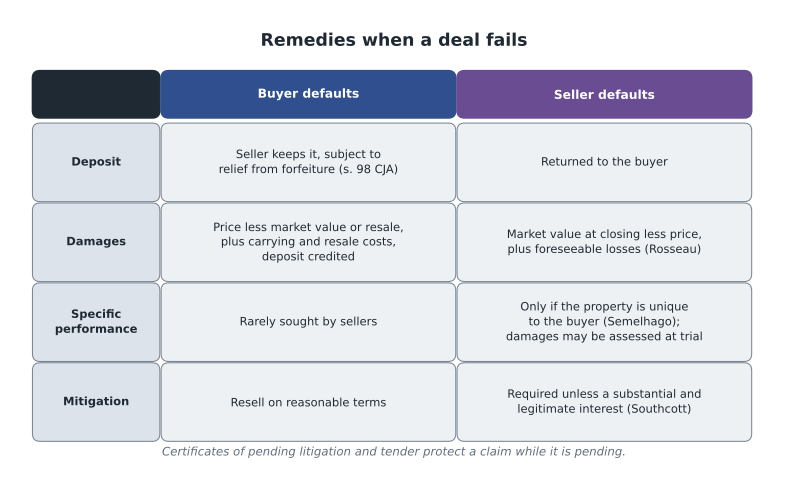
When a buyer wrongfully fails to close, the seller may accept the repudiation, terminate the agreement, keep the deposit and sue for damages. The normal measure is the difference between the contract price and the market value of the property at the date of breach, usually the closing date, plus consequential losses that were reasonably foreseeable, such as carrying costs and the costs of resale, less the deposit, which is credited against the damages. Where the seller resells promptly on reasonable terms, courts often treat the resale price as the best evidence of market value. A seller who holds out for an unrealistic price, or lets the property sit empty for a year, may find that the court measures damages by the value it could have obtained with reasonable efforts.
Arjun works through a variation on the Larkin Crescent file on the board. Suppose that after waiving their conditions, Ines and Devon's bank withdraws its approval when Devon loses his job, and they cannot close. Harold Abara relists, and two months later sells to another buyer for 600,000 dollars. He paid 4,500 dollars in extra property tax, insurance and utilities while the house was empty, and a further 3,000 dollars in legal fees for the second sale. His loss is 40,000 dollars on price and 7,500 dollars in costs, or 47,500 dollars. He keeps the 30,000 dollar deposit, which is credited against that loss, and can sue the buyers for the remaining 17,500 dollars. If he had resold for 650,000 dollars, he would have suffered no loss on price, and the question would become whether he may keep the whole deposit anyway, which under Redstone he usually may.
Damages when the seller defaults
When the seller refuses to close, the buyer recovers the deposit and may claim damages. The normal measure is the difference between the market value of the property at the closing date and the contract price, plus reasonably foreseeable consequential losses, such as the extra cost of financing or temporary accommodation. In The Rosseau Group Inc. v. 2528061 Ontario Inc., 2023 ONCA 814, a developer had agreed to buy land at a price per developable acre, and the seller improperly terminated. The trial judge awarded more than 11 million dollars based on the profit the developer expected to earn from a future subdivision. The Court of Appeal set the award aside. The normal measure is presumptive and is not easily displaced; market value at closing already reflects the land's highest and best use, including its development potential, and a buyer's hoped-for profit is not a separate head of damages unless the buyer can show something that the market value does not capture, such as land assembled with adjacent property the buyer already owned.
Specific performance
A buyer of land once had specific performance almost as of right, on the theory that every piece of land is unique. In Semelhago v. Paramadevan, [1996] 2 SCR 415, the Supreme Court rejected that assumption. Sopinka J. observed that residential and commercial properties are often bought as investments or as one choice among many similar units, and that specific performance should not be granted as a matter of course without evidence that the property is unique to the extent that a substitute would not be readily available. Semelhago also held that a buyer who reasonably elects specific performance may have damages in lieu assessed as of the date of trial, which can be much larger in a rising market.
After Semelhago, uniqueness is a question of fact. Courts look at the property's physical features, its location and its particular significance to the buyer. In THMR Development Inc. v. 1440254 Ontario Ltd., the Court of Appeal ordered specific performance of the purchase of a mixed commercial and residential building in Port Perry, because the evidence showed that no suitable alternative property existed in the area and the buyer had been trying to acquire this one for years. Investment property is not excluded from specific performance; the buyer simply has to prove uniqueness. In residential cases, buyers who want a particular house near a family member, a school or a workplace sometimes succeed, while buyers of standard subdivision homes or condominium units usually do not.
Sophie asks why the buyer would not always ask for specific performance just in case. The answer lies in mitigation. In Southcott Estates Inc. v. Toronto Catholic District School Board, 2012 SCC 51, a single-purpose development company sued for specific performance of a land purchase and did nothing to find substitute land. The Supreme Court held that a plaintiff is excused from mitigating only if it has a substantial and legitimate interest in specific performance, which generally requires showing that money would not be a complete remedy because the property has special value. Southcott had bought the land as an investment, could not show uniqueness, and its failure to mitigate reduced its damages to a nominal amount. A buyer who claims specific performance without a real basis therefore risks losing both remedies.
Practical tools
Several procedural tools matter in failed deals. A buyer who claims an interest in the land can ask the court for leave to register a certificate of pending litigation under section 103 of the Courts of Justice Act, which warns anyone dealing with the property of the claim and effectively prevents a sale to someone else. Courts consider whether the claim raises a triable issue about an interest in land and balance the equities, including whether damages would be adequate. Because a certificate can tie up a property for years, a party who obtains one without a proper basis may be ordered to pay damages.
The doctrine of tender also matters. When one party says it will not close, the other may treat the agreement as repudiated, but must decide whether to accept the repudiation and claim damages, or to affirm the agreement and insist on performance. A party who affirms must remain ready, willing and able to close, and usually proves it by tendering on the closing date: delivering, or offering to deliver, the documents and funds required. Tender is not necessary if the other side has clearly repudiated, but a prudent lawyer often tenders anyway to remove any argument.
Theo, the practical one, asks what most of these disputes actually look like. Ingleby says that in her practice, most ended with a negotiated release: the defaulting buyer agreed to let the seller keep the deposit and pay part of the shortfall, or the parties split the deposit to avoid litigation costs. The law sets the bargaining positions. Knowing the law is what lets a lawyer advise a client that a settlement offer is reasonable.
Worked problem
Harold changes his mind
Reverse the earlier variation. After the conditions are waived, Harold Abara decides he does not want to move after all, and his lawyer tells the buyers' lawyer that he will not close. Comparable bungalows on Larkin Crescent have risen to about 675,000 dollars. Ines and Devon want the house, which is a five-minute walk from the school where Ines teaches and two streets from her mother, who needs regular help. What are their options?
Show solution
- Recover the deposit. The 30,000 dollars must be returned to the buyers whatever else happens; the brokerage will want a direction signed by both sides or a court order.
- Decide whether to accept the repudiation or affirm. If they want the house, they should affirm and tender on the closing date, showing they are ready, willing and able to close.
- Assess specific performance under Semelhago. The property is not unique merely because it is land, but its proximity to Ines' work and her mother's home is evidence that a substitute would not be readily available to these buyers.
- Protect the claim. Seek leave to register a certificate of pending litigation so that Harold cannot sell to someone else while the claim is pending.
- Mitigate sensibly under Southcott. If the uniqueness argument is weak, they should look for a comparable home; if it is strong, their substantial and legitimate interest in specific performance may excuse them from buying elsewhere.
- Quantify damages in the alternative: about 35,000 dollars on price, measured at closing under Rosseau, or possibly more if damages in lieu of specific performance are assessed at trial, plus foreseeable consequential losses such as extra rent.
Common mistakes
MistakeTelling a seller it must prove damages before it can keep a deposit.
InsteadA true deposit is forfeited on the buyer's default without proof of loss; the buyer bears the burden of proving both disproportion and unconscionability to obtain relief.
MistakeAssuming land is always unique, so specific performance is automatic.
InsteadSemelhago requires evidence that the property is unique so that a substitute is not readily available.
MistakeClaiming specific performance and ignoring mitigation.
InsteadUnder Southcott, only a plaintiff with a substantial and legitimate interest in specific performance is excused from mitigating.
MistakeMeasuring a buyer's damages by the profits it planned to make from developing the land.
InsteadRosseau confirms that the normal measure is market value at closing less the price, which already reflects development potential.
Practice problems
Work each problem on paper first, then reveal the answer to check.
State the two parts of the Redstone test for relief from forfeiture of a deposit.
Show answer
The buyer must show that the forfeited sum is out of all proportion to the seller's damages and that it would be unconscionable for the seller to retain it.
What did Benedetto decide about a buyer who signed "without personal liability"?
Show answer
That the deposit was separate from the buyer's obligations under the agreement, so the limitation did not prevent forfeiture of the deposit on his repudiation.
What is a certificate of pending litigation and when may it be registered?
Show answer
A notice registered on title, with leave of the court under section 103 of the Courts of Justice Act, warning others of a claim to an interest in the land; the court considers whether there is a triable issue and the balance of equities.
Summary and key terms
- A true deposit is forfeited on the buyer's default without proof of loss, as Benedetto confirmed; it is an exception to the rule against penalties.
- Relief from forfeiture under section 98 of the Courts of Justice Act requires disproportion and unconscionability (Redstone) and is exceptional, though available in cases like Pleterski.
- Damages are normally measured by the difference between the contract price and market value at the closing date, with foreseeable consequential losses; Rosseau rejected a lost-profits award.
- Specific performance requires proof of uniqueness after Semelhago, and Southcott limits the excuse from mitigation to plaintiffs with a substantial and legitimate interest in it.
- Certificates of pending litigation, tender and negotiated mutual releases are the practical tools of failed deals.
- Deposit
- A sum paid on signing as a guarantee of performance, credited on closing and forfeitable on the buyer's default.
- Relief from forfeiture
- An equitable and statutory power to relieve a party from losing money or property on breach where forfeiture would be disproportionate and unconscionable.
- Specific performance
- An order requiring a party to carry out the contract, available only where damages are inadequate.
- Mitigation
- The duty of an injured party to take reasonable steps to reduce its loss.
- Certificate of pending litigation
- A court-authorized notice on title of a claim to an interest in the land.
- Tender
- An unconditional offer to perform, usually by delivering documents and funds on the closing date.
Lesson quiz · 5 questions
Score 60% or more to complete this lesson.
Create a free account to save your progress, take quizzes and earn a certificate.