
LAWC-303 · Lesson 4 of 12 · 20 min
Title systems: Registry, Land Titles and title fraud
▶ Video coming soon A video version of this lesson is on the way.
Professor Lionel Asante, who taught first-year property, joins Ingleby for the fourth class. He spent six years as in-house counsel for a title insurer before teaching, and Ingleby has invited him to talk about the claims he saw. He begins by reminding the class of a file from LAWC-113: a fraudster using forged identification in Ruth Holloway's name registered a transfer of the Holloway farm to a nominee called Gary Lund, who then mortgaged it to a private lender for 400,000 dollars. 'In first year we asked who wins,' Asante says. 'Today we ask what each lawyer in that chain should have done differently, and what a lawyer for Ines and Devon must do so that it never happens to them.'
Two systems
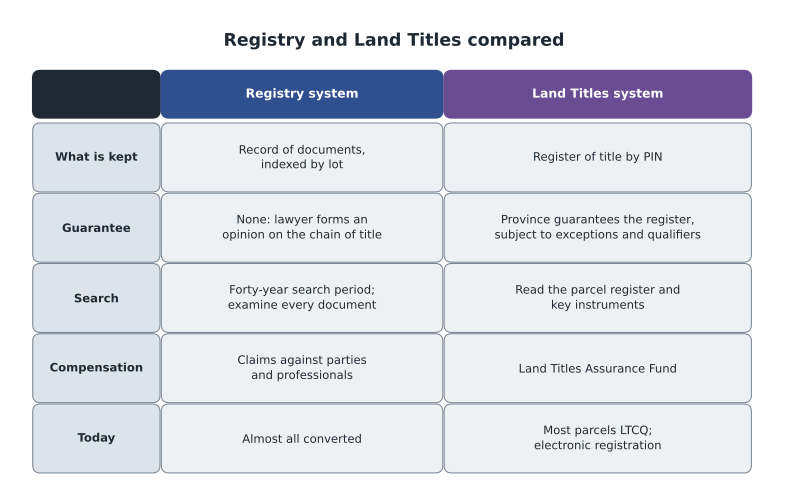
Ontario has had two land registration systems for well over a century. The Registry system, governed by the Registry Act, is a public record of documents. Each deed, mortgage, easement and other instrument is registered against the lot it affects, and the province keeps an index of what has been registered. But the province does not say who owns the land. The lawyer must search the chain of documents for the statutory search period, usually forty years under Part III of the Registry Act, examine each document to see whether it validly passed title, and form an opinion. Priority among competing interests depends on the order of registration, subject to the rule that a party with actual notice of an earlier unregistered interest may be bound by it. The Supreme Court held in United Trust Co. v. Dominion Stores Ltd., [1977] 2 SCR 915, that actual notice alone is not the same as fraud, and the case is still cited in debates about the effect of notice in registry systems.
The Land Titles system, governed by the Land Titles Act, is a Torrens system, named after the nineteenth-century South Australian reformer Robert Torrens. The province maintains a register of title for each parcel, organized by property identification number, or PIN. The parcel register shows who owns the land and lists the registered interests that affect it. Theodore Ruoff, a twentieth-century English registrar, described three principles of such a system: the mirror principle, that the register accurately reflects the title; the curtain principle, that a buyer need not look behind the register into the history of the title; and the insurance principle, that someone who loses because the register is wrong is compensated by the state.
Between the 1980s and the early 2000s, Ontario converted almost all Registry parcels to Land Titles under a project associated with the Province of Ontario Land Registration Information System, known as POLARIS. Most converted parcels carry the designation Land Titles Conversion Qualified, or LTCQ. The conversion was made on the basis of a forty-year search, and the resulting title is qualified: it remains subject to certain interests that existed at conversion, including possessory title claims that had matured by the conversion date, as well as most of the usual statutory exceptions in section 44 of the Land Titles Act, such as rights of the Crown, public highways, leases of three years or less with actual occupation, and municipal liens for unpaid taxes. One benefit of conversion was that the LTCQ qualifier does not carry forward most contraventions of the subdivision control provisions of the Planning Act that occurred before conversion, so a searcher of an LTCQ parcel generally looks for Planning Act problems only after the conversion date. Parcels that were brought into the system through a full application process, called Land Titles Absolute, carry fewer qualifiers.
Electronic registration is now mandatory across Ontario. Lawyers search and register through Teraview, the software provided by Teranet under the Electronic Land Registration Services Act, 2010. A document is not signed with a pen. Instead, the lawyer for each party electronically signs the document using a personal security package, making statements on the client's behalf, for example that the transferor is not a non-resident, that the spousal consent requirements are met, or that the transfer complies with the Planning Act. Since June 2025, the province's system has automatically certified routine transfers and discharges that meet its rules, so that registry staff can focus on unusual documents.
Indefeasibility
The central promise of a Torrens system is that the register can be relied on. The hard question is what happens when the register is changed by fraud. Two models exist. Under immediate indefeasibility, an innocent party who registers an interest acquired from a fraudster gets good title as soon as it is registered, and the defrauded owner is left to claim compensation. Under deferred indefeasibility, the first innocent party who deals with the fraudster does not get good title, because that party had the opportunity to detect the fraud; only a later innocent party, who relies on the register in dealing with someone who is not the fraudster, gets protection. The Privy Council's decisions in Gibbs v. Messer, [1891] AC 248, and Frazer v. Walker, [1967] 1 AC 569, are the classic statements of the two approaches.
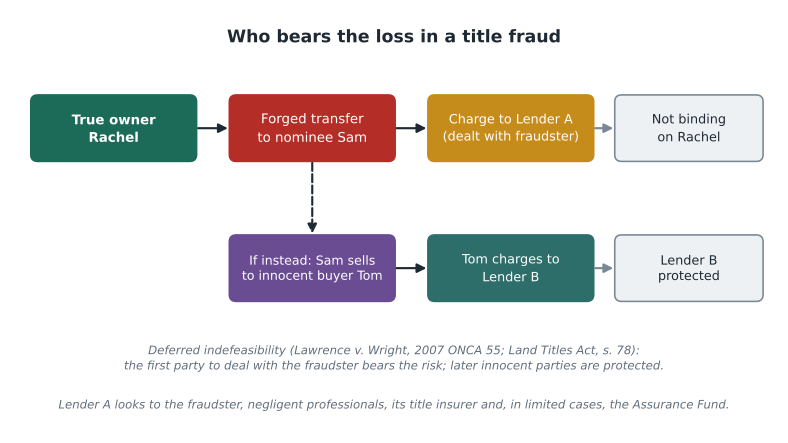
In Household Realty Corp. v. Liu (2005), the Ontario Court of Appeal had appeared to favour immediate indefeasibility for an innocent mortgagee. In Lawrence v. Wright, 2007 ONCA 55, the Court changed course. Susan Lawrence owned a house in Toronto. A fraudster impersonated her, registered a transfer to a person named Wright, and arranged a mortgage from Maple Trust in Wright's name. The Court held that the fraudulent transfer was a nullity as against Lawrence, and that Maple Trust, which had dealt directly with the fraudster's nominee, could not enforce its mortgage against her house. Maple Trust was the party with the opportunity to avoid the fraud, by verifying the identity of the person it was lending to. The Court described this as deferred indefeasibility: the first person to deal with the fraudster bears the risk, while a later innocent party who relies on the register in dealing with someone other than the fraudster takes good title.
The Legislature had already acted. Amendments to the Land Titles Act in force in October 2006, made after highly publicized frauds against homeowners, provide that a fraudulent instrument, and an instrument registered by a person claiming through a fraudulent transfer who is a fraudster or acts with notice, is not effective, while a later instrument in favour of a party without notice of the fraud is effective. The amendments added definitions of fraudulent instrument and fraudulent person and are now found mainly in section 78 of the Act. The result is that a homeowner who loses title to a fraudulent transfer can get her land back free of the mortgage the fraudster arranged, and the innocent lender in Maple Trust's position must look elsewhere.
Asante applies this to the Holloway farm. The forged transfer to Gary Lund is a fraudulent instrument and does not affect the Holloways' title. Brightway Mortgage Corporation dealt directly with Lund, the fraudster's nominee, so its charge cannot be enforced against the farm. Brightway's remedies lie against Lund and the fraudster, against any lawyer or broker who acted negligently in the transaction, against its title insurer if it bought a policy, and in limited circumstances against the Land Titles Assurance Fund.
The Land Titles Assurance Fund
The Land Titles Assurance Fund compensates a person who is wrongfully deprived of an interest in land through the operation of the Act, including through fraud. After the 2006 amendments, an owner who lost title to fraud could apply to the fund more easily, and the director of titles can also correct the register. The fund is not unlimited, and claims by lenders are treated differently from claims by homeowners, because lenders are expected to protect themselves through identity verification and title insurance. In August 2026, the province amended the regulation governing the fund to add a category of claims for certain chargees wrongfully deprived of an interest by the registration of a fraudulent instrument, which Asante describes as a narrow change that the class should read carefully before relying on it.
Other provinces
Western Canada adopted Torrens systems in the nineteenth century. Alberta's Land Titles Act and British Columbia's Land Title Act both guarantee the register, and both have assurance funds. British Columbia amended its statute in 2005 to address fraud, providing that a person who acquires an interest under a void instrument does not acquire title by registration, subject to protection for a later purchaser in good faith and for value. Manitoba and Saskatchewan also have Torrens systems, and Saskatchewan's is administered electronically by a private operator. In Atlantic Canada, Nova Scotia and New Brunswick have been converting registry parcels to land titles as properties are sold or mortgaged, and Prince Edward Island and Newfoundland and Labrador retain registry systems for most land. In Quebec, the land register records rights under the Civil Code, and the notary's role in verifying the parties is a key protection.
What a lawyer must do
Ingleby takes over for the second half of the class with a practical question: what would have stopped the Lund fraud, or the Lawrence fraud? Most frauds succeed because someone in the chain did not verify who they were dealing with. A lawyer acting for a buyer or a lender must identify and verify the client under By-Law 7.1. A lawyer acting for a seller must verify that the seller is the person on title. A lender's lawyer should be especially alert when the borrower has just acquired title, when the property was owned free and clear for many years, when the money is to be paid to a third party, or when the borrower insists on a quick closing.
The parcel register itself can raise flags. A transfer registered a few days before a new mortgage, a change in the owner's address for service, a power of attorney registered for the first time, or a discharge of a long-standing mortgage registered by an unfamiliar lawyer all deserve a second look. Daniel Whitecloud asks whether there is anything an owner can do to protect herself. Asante mentions three things: buy title insurance, which covers fraud for owners who have a policy; register a notice or ask about restrictions the land registrar may place on a title in suspicious circumstances; and watch the mail, since many frauds are discovered when a tax bill or mortgage statement arrives in someone else's name.
Hannah raises the old notices of lodgement of title. These are an obsolete type of instrument that, before electronic registration, allowed someone to hold a deed on deposit. Some remain on title from decades ago, and some have been used in frauds. In May 2026, a private member's bill, the Protecting Homeowners from Title Fraud Act, 2026, was introduced to deem all remaining notices of lodgement expired; it had not passed second reading at the time of this course. Ingleby tells the class to treat any unusual old instrument on a parcel register as a reason to ask questions.
Worked problem
A suspicious mortgage file
The class's hypothetical firm is asked to act for Kessington Capital Inc., a private lender, on a 350,000 dollar second mortgage of a house on Alder Road in Corwin. The parcel register shows that the borrower, Warrick Breck, has owned the house since 1998 with no mortgage. Breck wants the loan to close in three days and the money paid to a numbered company. He provides a driver's licence and a utility bill. His listed address for service on title was changed last week. What should the firm do?
Show solution
- Recognize the red flags: a long-held, mortgage-free property, a recent change to the address for service, urgency and payment to a third party.
- Identify and verify the borrower under By-Law 7.1 with original government-issued photo identification, compared carefully with the photo, signature and details on file, and consider an independent method such as a credit file check.
- Contact the borrower at the address and phone number shown in independent sources, not those he supplied, and ask why the address for service was changed.
- Explain to the lender that under Lawrence v. Wright and section 78 of the Land Titles Act, a charge taken from an impostor will not bind the true owner, so the lender bears the risk of fraud on this transaction.
- Require the lender to obtain a title insurance policy that covers fraud, and refuse to pay the advance to the numbered company without a satisfactory explanation and written authorization.
- If the red flags cannot be resolved, decline to act and record why.
Common mistakes
MistakeTreating an LTCQ parcel register as a perfect statement of title.
InsteadLTCQ title is qualified, for example by possessory claims matured before conversion and the statutory exceptions in section 44 of the Land Titles Act.
MistakeSaying that an innocent lender who takes a mortgage from a fraudster obtains a valid charge because the register is guaranteed.
InsteadUnder Lawrence v. Wright and the 2006 amendments, the first party to deal with the fraudster bears the loss; only later innocent parties are protected.
MistakeAssuming the Land Titles Assurance Fund will cover any lender's loss from fraud.
InsteadThe fund primarily protects owners wrongfully deprived; lenders are expected to verify identity and buy title insurance, and lender claims are limited.
MistakeRelying on photocopied identification sent by email.
InsteadVerify identity under By-Law 7.1 using reliable independent documents or methods, and investigate red flags before closing.
Practice problems
Work each problem on paper first, then reveal the answer to check.
State Ruoff's three principles of a Torrens system.
Show answer
The mirror principle (the register reflects the title), the curtain principle (buyers need not look behind the register) and the insurance principle (the state compensates those who lose through errors in the register).
Why did the Court of Appeal in Lawrence v. Wright place the loss on Maple Trust rather than on Ms. Lawrence?
Show answer
Because Maple Trust dealt directly with the fraudster's nominee and was the party with the opportunity to detect the fraud; under deferred indefeasibility, only a later innocent party dealing with someone other than the fraudster is protected.
What does it mean that a parcel is LTCQ?
Show answer
It was converted from Registry to Land Titles on the basis of a forty-year search and is qualified, for example by possessory claims that matured before conversion, in addition to the statutory exceptions in section 44.
Summary and key terms
- The Registry system records documents without guaranteeing title; the Land Titles system maintains a guaranteed register of title by PIN, and most of Ontario is now LTCQ.
- Electronic registration through Teraview is mandatory; lawyers sign documents with personal security credentials and make statements on their clients' behalf.
- Ontario follows deferred indefeasibility after Lawrence v. Wright and the 2006 amendments: a fraudulent instrument is ineffective, and the first party to deal with the fraudster bears the loss.
- The Land Titles Assurance Fund compensates those wrongfully deprived, primarily owners; a 2026 regulation added a narrow category of chargee claims.
- Identity verification and attention to red flags on the parcel register are the lawyer's main defences against fraud.
- Torrens system
- A land registration system in which the state maintains and guarantees a register of title.
- PIN
- Property identification number, the unique identifier of a parcel in Ontario's Land Titles system.
- LTCQ
- Land Titles Conversion Qualified, the status of most parcels converted from Registry, subject to specified qualifiers.
- Deferred indefeasibility
- The rule that the first party to deal with a fraudster does not obtain good title, but a later innocent party does.
- Land Titles Assurance Fund
- A provincial fund that compensates persons wrongfully deprived of an interest in land through the operation of the Land Titles Act.
- Fraudulent instrument
- Under the Land Titles Act, an instrument registered through fraud, such as a forged transfer, which is not effective against the true owner.
Lesson quiz · 5 questions
Score 60% or more to complete this lesson.
Create a free account to save your progress, take quizzes and earn a certificate.