
LAWC-303 · Lesson 5 of 12 · 19 min
Title searching
▶ Video coming soon A video version of this lesson is on the way.
For the fifth class, Ingleby opens Teraview on the screen and types in a property identification number. 'This,' she says, 'is the most important document you will read on most files, and it fits on one page.' The parcel register for 14 Larkin Crescent appears, and she spends the class teaching the students to read it, to decide which instruments need to be pulled and examined, and to turn what they find into requisitions. She also explains the searches that are not on the parcel register at all.
Reading a parcel register
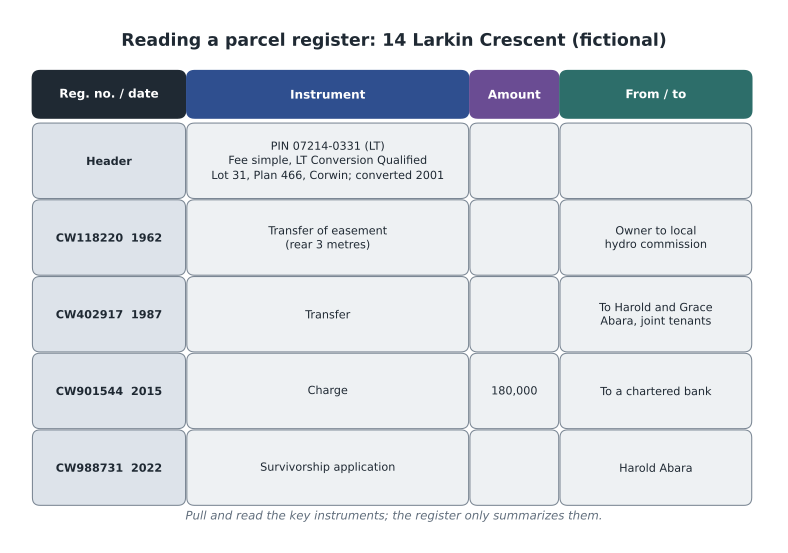
A parcel register has three parts. The header shows the PIN, the land registry office, and the estate and qualifier, which for Larkin Crescent reads 'fee simple, LT conversion qualified.' It also shows the date the parcel was converted from Registry to Land Titles and a thumbnail description of the land, such as 'Lot 31, Plan 466, City of Corwin,' sometimes followed by 'subject to' or 'together with' notes describing easements. The second part lists the current registered owners and how they hold title. The third part lists registered instruments in order of registration, each with a registration number, date, type, amount if any, the parties from and to, and remarks. Instruments that have been deleted, such as a discharged mortgage, can be shown or hidden; a search for the transaction usually focuses on instruments that remain in effect but a careful searcher looks at deleted ones to understand the history.
The Larkin Crescent register shows four instruments that matter. A 1962 transfer of easement gives the local hydro commission, now its successor utility, the right to maintain a line along the rear three metres of the lot. A 1987 transfer conveyed the house to Harold Abara and his wife Grace Abara as joint tenants. A 2015 charge secures 180,000 dollars to a chartered bank. And a 2022 survivorship application, registered after Grace's death, records that Harold is now the sole owner by right of survivorship. Arjun asks why that last document was needed. Ingleby explains that, as LAWC-113 taught, survivorship operates automatically on death, but the register will continue to show both names until someone registers a survivorship application with proof of death. Had Harold not done so, his lawyer would have to register one before closing.
What to pull and why
A parcel register summarizes instruments; it does not reproduce them. The searcher must decide which instruments to obtain and read. For Larkin Crescent, the easement is the obvious one: the class needs to know its exact location, its width, whether it allows the utility to cut trees or prevent buildings, and whether the shed that the seller's listing mentions sits on it. The charge needs to be identified so that the seller's lawyer can be required to discharge it on closing. The transfer and the survivorship application can usually be accepted on their face for an LTCQ parcel, though a careful searcher confirms that the names match.
Other common instruments include restrictive covenants, which may limit building heights or uses; municipal agreements such as site plan or subdivision agreements, which may impose obligations on the owner; notices of lease or option; condominium declarations and by-laws; construction liens; certificates of pending litigation; and notices of a spouse's interest in a matrimonial home under the Family Law Act. A lawyer must read each one that could affect what the buyer is getting. LAWC-113 noted that the Land Titles Act provides that a restrictive covenant registered in Land Titles is deemed to expire forty years after registration unless a shorter period is specified, which is why many old subdivision restrictions no longer bind; but a covenant contained in a municipal agreement or a condominium declaration is governed by its own rules.
Executions
A writ of seizure and sale, usually called an execution or writ, is issued by the court to enforce a money judgment and filed with the sheriff of a county or district. Once filed, it binds the debtor's land in that area. An execution against the seller must therefore be paid out or otherwise dealt with before closing, or the buyer will take title subject to it. Lawyers search the sheriff's records electronically through Teraview's writ search, by the names of the current owner and, in some cases, previous owners. Writs remain in force for six years and can be renewed.
The difficulty is names. The writ search for Larkin Crescent returns one writ against 'Harold James Abarra,' filed in 2020 in favour of a credit card company. The spelling differs by one letter. Is it the same person? Usually the seller swears a statement that he is not the debtor named in the writ, and the seller's lawyer makes a statement in the electronic transfer to that effect. Where there is real doubt, the buyer's lawyer can ask the creditor's lawyer for confirmation, or require the writ to be paid out of the proceeds. The buyer's lawyer also searches executions against the buyers, because the lender will want to know that no judgment creditor will attach the new house as soon as the buyers acquire it.
Searches beyond the register
Some searches relate to the parties. If the seller is a corporation, the lawyer obtains a corporate profile to confirm that the corporation exists and that the people signing have authority. A dissolved corporation cannot convey land, and under Ontario's Forfeited Corporate Property Act, 2015, land owned by a corporation at dissolution generally forfeits to the Crown. If a seller is or may be bankrupt, a search of the Office of the Superintendent of Bankruptcy records shows whether a trustee has an interest in the property. If financed chattels such as a furnace or a hot water tank are being sold with the house, a search under the Personal Property Security Act may reveal a security interest against them.
Surveys are a separate issue. A survey by an Ontario land surveyor, sometimes called a surveyor's real property report, shows the boundaries of the lot and the location of buildings, fences and easements in relation to them. It reveals encroachments that no search of the register will disclose. Many residential buyers in Ontario do not obtain a new survey, relying instead on an older survey and on title insurance, which commonly covers losses from encroachments and other matters that a current survey would have revealed. The lawyer must explain what is lost by not obtaining a survey and what the policy does and does not cover.
Harold's file includes a 1988 survey. It shows the house and garage well within the lot lines, but a chain-link fence along the east side about forty centimetres onto the neighbour's land, and the shed partly within the hydro easement. Hannah asks whether Harold has acquired the forty-centimetre strip by adverse possession. Ingleby reminds the class of the rule from LAWC-113: in Land Titles, no one can acquire title by possession after the parcel's conversion. The parcel was converted in 2001. If the fence had stood in the same place with the necessary open, exclusive and continuous possession for ten years before 2001, a possessory claim may have matured before conversion and been preserved by the LTCQ qualifier. But the fence was put up in 1988 according to Harold, so ten years had passed by 1998. Whether Harold has a claim to the strip is a question of fact; whether the buyers need it is a practical question. The simpler course is often to accept the fence as a fence, not a boundary, and to get title insurance that covers encroachments.
Requisitions
Once the searches are complete, the buyer's lawyer prepares a letter of requisitions to the seller's lawyer by the requisition date in the agreement. Requisitions are demands that the seller remedy defects in title or provide documents that the buyer is entitled to under the agreement. Standard requisitions ask the seller to discharge every registered charge on or before closing, to deal with any executions, to provide statutory declarations confirming possession and the absence of undisclosed tenancies or work orders, and to deliver keys and vacant possession. Specific requisitions ask for things the search has revealed.
It is useful to distinguish title requisitions from conveyancing requisitions. A title requisition raises a defect in the seller's title, such as an undischarged execution or a covenant that the buyer has not agreed to assume, and must be made by the requisition date unless it goes to the root of title, meaning that it shows the seller does not have the title it promised at all. A conveyancing requisition asks for the documents and steps needed to complete the transaction, such as a discharge of mortgage or a statutory declaration about residency, and can usually be made at any time before closing. If the seller is unable or unwilling to satisfy a valid title requisition and the buyer will not waive it, the standard form allows the agreement to be terminated and the deposit returned.
Sophie drafts the Larkin Crescent requisitions on the board. They ask the seller to discharge the 2015 charge on closing; to provide evidence or a statement that Harold James Abarra is not the seller, or to pay out the writ; to provide a copy of the 1962 easement and confirm that no notice of violation has been received from the utility; to confirm that the shed may remain or to remove it from the easement area before closing; to provide a statutory declaration that there are no outstanding work orders or municipal notices; and to confirm that the fence along the east side is not the subject of any dispute with the neighbour. Ingleby approves, but warns about tone: 'Requisitions are a letter to a colleague. Ask for what you need, cite the clause that gives it to you, and be ready to compromise on what does not matter.'
Discharges and undertakings
The seller's existing mortgage is almost never discharged before closing, because the seller needs the buyer's money to pay it off. Instead, the seller's lawyer gives a personal undertaking to pay the amount needed to discharge the mortgage from the proceeds, to obtain the discharge and to register it within a reasonable time. Lawyers in Ontario accept such undertakings routinely for institutional lenders, relying on the discharging lawyer's professional obligation to honour an undertaking. For private lenders, prudent buyers' lawyers insist on a registered discharge, or at least a signed discharge held in escrow, because a private lender who is not paid, or who disputes the payout, may simply refuse to discharge.
Worked problem
The east fence and the hydro easement
Harold's lawyer answers the Larkin Crescent requisitions. She confirms the bank mortgage will be discharged on closing on her undertaking and provides a statement of identity for the writ. On the easement, she says the agreement excepts 'minor easements for the supply of domestic utility or telephone services to the property or adjacent properties' and that the buyers must therefore accept it. On the shed and the fence, she says the buyers agreed to accept the property 'as is.' How should the buyers' lawyer respond?
Show solution
- Read the title clause. The exception for minor utility easements covers easements for supplying domestic services; a broad hydro transmission easement over the rear three metres may or may not fall within it, so obtain the instrument and check its terms.
- Assess materiality. If the easement only allows maintenance of a distribution line, it is likely within the exception and not a valid objection; if it prohibits structures or restricts use of the yard significantly, the buyers may object.
- Address the shed. If the easement forbids structures, ask that the shed be removed or that the seller obtain the utility's written consent, or negotiate a price adjustment.
- Address the fence. An encroachment of a seller's fence onto a neighbour's land is not an encroachment on the seller's title; it may mean the buyers' usable yard is smaller than it looks. Explain this, confirm title insurance coverage, and decide whether it matters to the clients.
- Explain that 'as is' clauses concern the physical condition of the property, not the seller's obligation to deliver the title promised in the title clause.
- Report to the clients in writing and get their instructions before the closing date.
Common mistakes
MistakeRelying on the parcel register summary without reading important instruments.
InsteadThe register summarizes; easements, covenants and municipal agreements must be obtained and read to know what they permit or forbid.
MistakeIgnoring an execution against a similar name.
InsteadObtain a statement of identity, confirmation from the creditor or a payout; an execution against the seller binds the land.
MistakeAssuming a seller's mortgage must be discharged before closing.
InsteadInstitutional mortgages are usually discharged after closing from the proceeds on the seller's lawyer's undertaking; private mortgages call for more caution.
MistakeTreating every requisition as subject to the requisition date.
InsteadTitle requisitions must be made by the requisition date unless they go to the root of title; conveyancing requisitions can be made later.
Practice problems
Work each problem on paper first, then reveal the answer to check.
What are the three parts of a parcel register?
Show answer
The header (PIN, office, estate and qualifier, conversion date and thumbnail description), the current owners and their capacity, and the list of registered instruments in order of registration.
Why must the buyer's lawyer search executions against the seller?
Show answer
Because a writ of seizure and sale filed with the sheriff binds the debtor's land in that area, so the buyer would take title subject to it unless it is paid out or shown not to apply.
What is the difference between a title requisition and a conveyancing requisition?
Show answer
A title requisition raises a defect in the seller's title and must be made by the requisition date unless it goes to the root of title; a conveyancing requisition asks for documents or steps needed to complete and can generally be made until closing.
Summary and key terms
- The parcel register shows the PIN, estate and qualifier, owners and registered instruments; key instruments must be pulled and read.
- Easements, covenants, municipal agreements, liens and certificates of pending litigation all affect what the buyer receives.
- Executions bind the seller's land and must be paid out or shown not to apply; name variations require statements of identity.
- Corporate, bankruptcy and PPSA searches and a survey or title insurance address risks the register does not reveal.
- Requisitions, which distinguish title from conveyancing matters, and undertakings to discharge mortgages turn search results into a closing plan.
- Parcel register
- The Land Titles record for a parcel, listing its description, owners and registered instruments.
- Writ of seizure and sale
- A court document enforcing a money judgment, which once filed with the sheriff binds the debtor's land in that area.
- Survivorship application
- A document registered with proof of death to remove a deceased joint tenant's name from title.
- Requisition
- A written demand by the buyer's lawyer that the seller remedy a defect in title or provide a document required for closing.
- Root of title
- The foundation of the seller's ownership; an objection going to it can be raised even after the requisition date.
- Undertaking
- A personal promise by a lawyer, such as a promise to discharge a mortgage from the sale proceeds, which the lawyer is professionally bound to keep.
Lesson quiz · 5 questions
Score 60% or more to complete this lesson.
Create a free account to save your progress, take quizzes and earn a certificate.