
LAWC-303 · Lesson 8 of 12 · 19 min
Mortgage default and enforcement
▶ Video coming soon A video version of this lesson is on the way.
Ingleby begins the eighth class with a different file. Ambrose Ferrier, a self-employed contractor, owns a semi-detached house in Corwin subject to a first charge to a credit union and a 120,000 dollar second charge to Kessington Capital Inc., a private lender the class met in lesson 4. Work dried up, and Ambrose is four months behind on both mortgages. Kessington's principal wants to know how fast it can sell the house. Ambrose's sister wants to know how to stop it. 'Same statute,' Ingleby says, 'two very different readings.' This lesson covers default, acceleration and reinstatement, the power of sale, foreclosure and judicial sale, the duty to obtain a fair price, and how the proceeds are distributed.
Default and acceleration
A mortgage defines events of default: missing a payment, failing to pay taxes or insure the property, selling without consent, letting another encumbrance be registered, and sometimes the borrower's insolvency. Most mortgages contain an acceleration clause allowing the lender, on default, to demand the entire balance immediately. A lender usually begins with a demand letter, and, for a commercial borrower, may also have to give the ten days' notice required by section 244 of the federal Bankruptcy and Insolvency Act before enforcing security against substantially all of an insolvent business's property.
The Mortgages Act protects borrowers against acceleration. Under section 22, a borrower in default may, at any time before sale or the final order in a proceeding, pay the arrears of principal and interest and the mortgagee's costs, and the mortgage is then reinstated as if there had been no default, despite any acceleration. The borrower is also entitled, on request, to a statement of what is owed; if the mortgagee does not provide it within fifteen days, enforcement is suspended until it does. Section 23 gives the court power in an action to relieve against acceleration on payment of the arrears. These provisions mean that a borrower who can find the arrears, as distinct from the whole debt, can usually stop the enforcement.
The power of sale
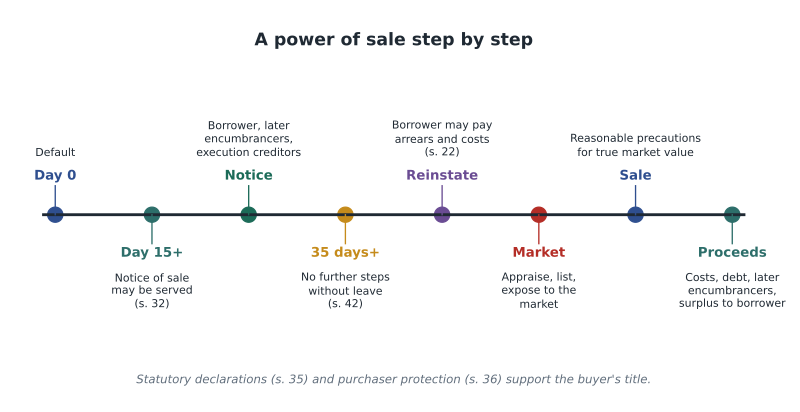
The power of sale is by far the most common enforcement remedy in Ontario. Standard charge terms contain a contractual power of sale, and Part III of the Mortgages Act regulates how it is exercised. Section 32 provides that notice of exercising a power of sale may not be given until the default has continued for at least fifteen days, and that the sale may not take place until at least thirty-five days after the notice is given. Section 31 requires the notice to be given to the borrower, to every person with a registered interest subsequent to the mortgage, to execution creditors, and to others listed in the Act, such as a spouse with an interest in a matrimonial home. Section 33 sets the methods of service, generally personal service or registered mail to the usual or last known address.
Once notice is given, section 42 prevents the mortgagee from taking any further proceeding to enforce the mortgage, such as an action for possession, until the notice period has expired, unless a judge grants leave. During that period, the borrower may reinstate under section 22 or redeem by paying everything owed. After the period, the mortgagee may sell, usually by listing the property on the open market through a real estate brokerage.
Purchasers from a mortgagee need comfort that the sale was properly conducted. Section 35 provides that statutory declarations covering the default, the service of notice and compliance with the Act are sufficient evidence of compliance, and section 36 protects the title of a purchaser where the notice was given in apparent compliance with the Act, leaving any person prejudiced by a defect with a remedy in damages against the mortgagee. In 1173928 Ontario Inc. v. 1463096 Ontario Inc., 2018 ONCA 669, the Court of Appeal held that a notice of sale does not become invalid merely because the amount owing changes over time or partial payments are made, because sections 22 and 31 must be read together; a new notice may be required where the original contained a material error or the default was cured and a new default occurred.
The duty to obtain a fair price
A mortgagee selling under a power of sale is not a trustee for the borrower, and it may choose when to sell. But it must act in good faith and take reasonable precautions to obtain the true market value of the property at the time it chooses to sell. In practice this means obtaining one or more appraisals, listing the property with a brokerage on the multiple listing service for a reasonable time, marketing it to the right audience and considering offers fairly. A mortgagee that sells quickly to a related company at a low price, or fails to expose the property to the market, risks a claim for improvident realization.
The borrower carries a heavy burden in such a claim. In RCML Corp. v. 2524258 Ontario Inc., 2023 ONCA 352, the Court of Appeal upheld summary judgment dismissing a claim that a mortgagee had sold improvidently. It described the question as whether the mortgagee's conduct was plainly on the wrong side of the line, and repeated, citing its earlier decision in Manufacturers Life Insurance Co. v. Granada Investments Ltd. (2001), that even if the mortgagee breached its duty, the borrower must prove that a higher price would have been obtained but for the breach. A mortgagor who alleges an improvident sale must put forward real evidence, such as appraisals or the evidence of agents, about what the property would otherwise have fetched.
Distribution of proceeds and deficiencies
After the sale, the mortgagee applies the proceeds in a fixed order: the costs of the sale, then the mortgage debt with interest and allowable charges, then subsequent encumbrancers in order of priority, and finally any surplus to the borrower. A mortgagee who sells under a first charge must therefore account to the second mortgagee, and if there is doubt about who is entitled to a surplus, it may pay the money into court. If the proceeds do not cover the debt, the mortgagee may sue the borrower and any guarantor on the personal covenant for the deficiency. Ambrose's credit union, as first chargee, could sell and pay Kessington only if there is enough left after its own debt; Kessington, as second chargee, could also sell, but must sell subject to the first charge or pay it out.
Foreclosure, judicial sale and possession
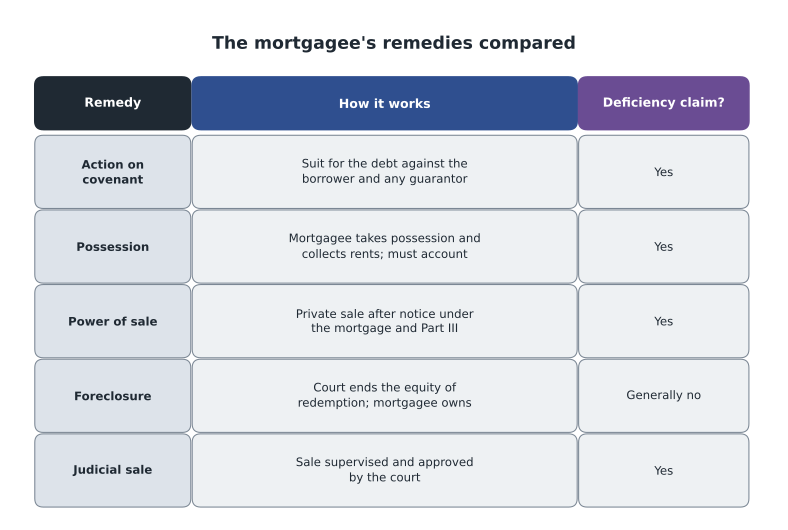
Foreclosure is the older remedy. It is a court action in which the mortgagee asks the court to end the borrower's equity of redemption, so that the mortgagee becomes the owner outright. The borrower is given a period to redeem, and may ask the court to order a sale instead, usually on paying a modest amount into court as security for costs. Foreclosure has two practical consequences. First, because the mortgagee keeps the property, it generally gives up its claim to recover any deficiency from the borrower. Second, because foreclosure wipes out subsequent interests, it can be attractive to a first mortgagee when the property is worth more than its debt and less than all the debts together. For these reasons, Ontario borrowers often request a sale, and foreclosure is less common than in some other provinces.
A judicial sale is a sale under the court's supervision, usually ordered in a foreclosure or mortgage action, with the court approving the listing, the price and the distribution of proceeds. It is slower and more expensive than a private power of sale, but gives the purchaser and the parties the protection of a court order. A mortgagee may also take possession of the property, through an action for possession or by entering peaceably where the mortgage permits, and collect rents. A mortgagee in possession must account strictly for what it receives and must manage the property prudently. Residential tenants have protections under the Residential Tenancies Act, 2006 that a mortgagee generally takes subject to.
Other provinces
Enforcement practice varies across Canada. In Alberta, the Law of Property Act protects many individual borrowers from personal liability for a deficiency, although the protection does not extend to most insured high-ratio mortgages, and enforcement is generally by court-supervised foreclosure or judicial sale. In British Columbia, foreclosure is a court proceeding with a redemption period, commonly six months for residential property, and the court supervises any sale. In Quebec, a hypothecary creditor exercises hypothecary rights under the Civil Code after a prior notice, and may take the property in payment, sell it or have it sold under judicial authority. Lawyers who act for national lenders must know these differences, because the same mortgage default leads to very different timelines in each province.
Advising the borrower
Sophie, who has been taking notes on Ambrose's side, asks what the class would tell his sister. Ingleby lists the options. Ambrose can ask both lenders for a statement of arrears and try to raise the arrears and costs to reinstate. He can negotiate a forbearance agreement, in which the lender agrees not to enforce for a period in return for a payment plan, often with a fee and an acknowledgment of the debt. He can list the house himself before the lenders do, which usually produces a better price than a power of sale. He can refinance with another lender if his credit allows. And if his debts as a whole are unmanageable, he can consult a licensed insolvency trustee about a consumer proposal or bankruptcy, which affects unsecured debts but does not stop secured lenders from enforcing their security. The Financial Consumer Agency of Canada also expects federally regulated lenders to offer relief measures to borrowers in difficulty, which may help with the credit union.
Theo adds a lawyer's point. 'If he lets it go to power of sale and the house sells for less than the debts, he still owes the difference to the credit union and to Kessington.' Ingleby nods. For many borrowers, the worst outcome is not losing the house but losing it and still owing money.
Worked problem
Kessington wants to sell
Kessington Capital Inc. holds a 120,000 dollar second charge on Ambrose Ferrier's house. Ambrose has missed four monthly payments on it, and the credit union's first charge of about 380,000 dollars is also in arrears. Kessington's principal wants a sale within thirty days and asks whether Kessington can sell to a company owned by his brother-in-law to save time. The house is worth roughly 560,000 dollars. Advise Kessington.
Show solution
- Confirm the default and the mortgage terms, including any acceleration clause and any default rate, and check that the default provisions comply with section 8 of the Interest Act.
- Explain the timeline. A notice of sale cannot be given until fifteen days after default, which has passed; the sale cannot occur until at least thirty-five days after notice, so a thirty-day sale is impossible.
- Identify who must be served under section 31: Ambrose, the credit union as prior chargee (as a matter of practice and because its interest will be affected by a sale subject to it), any later encumbrancers, execution creditors and any spouse with an interest in a matrimonial home.
- Warn about the duty to obtain a fair price. A quick sale to a related buyer without market exposure invites a claim for improvident realization; obtain an appraisal, list on the open market and consider all offers.
- Explain that Ambrose can reinstate under section 22 by paying the arrears and costs before sale, and is entitled to a statement within fifteen days of request.
- Explain the distribution. Kessington must sell subject to or pay out the first charge, account for the proceeds in order, and pay any surplus to Ambrose; any shortfall can be pursued on the covenant.
Common mistakes
MistakeSaying a mortgagee may sell as soon as the borrower misses a payment.
InsteadUnder Part III of the Mortgages Act, notice cannot be given until fifteen days after default, and the sale cannot occur until at least thirty-five days after notice.
MistakeTelling a borrower that once the loan is accelerated, only payment of the whole balance can stop the sale.
InsteadSection 22 lets the borrower reinstate by paying the arrears and costs before sale or final order.
MistakeAssuming a mortgagee can sell at any price because it is not a trustee.
InsteadIt must act in good faith and take reasonable precautions to obtain true market value, though the borrower must prove a higher price would have been obtained.
MistakeRecommending foreclosure to a lender that wants to recover a deficiency.
InsteadA mortgagee that forecloses generally gives up its claim for a deficiency; a power of sale preserves it.
Practice problems
Work each problem on paper first, then reveal the answer to check.
What is the minimum period of default before a notice of sale, and the minimum period after notice before sale, under the Mortgages Act?
Show answer
At least fifteen days of default before notice, and at least thirty-five days after notice before the sale.
What did the Court of Appeal decide in 1173928 Ontario Inc. v. 1463096 Ontario Inc.?
Show answer
That a notice of sale is not invalidated merely because the debt changes with time or partial payments, reading sections 22 and 31 together; a fresh notice may be needed where the notice had a material error or a cured default is followed by a new one.
What must a borrower prove in a claim for improvident realization?
Show answer
That the mortgagee failed to take reasonable precautions to obtain true market value, and that but for the breach a higher price would have been obtained (RCML Corp.; Manufacturers Life v. Granada).
Summary and key terms
- Mortgages define default and usually allow acceleration, but section 22 of the Mortgages Act lets the borrower reinstate by paying arrears and costs before sale.
- A power of sale requires fifteen days of default before notice, at least thirty-five days' notice to all interested persons, and no further enforcement steps during the notice period without leave.
- The mortgagee must act in good faith and take reasonable precautions to obtain true market value; the borrower bears the burden of proving loss (RCML Corp.).
- Proceeds pay costs, the debt and subsequent encumbrancers in order, with any surplus to the borrower; the mortgagee may sue on the covenant for a deficiency.
- Foreclosure ends the equity of redemption and generally the claim for a deficiency; judicial sale and possession are alternative remedies, and other provinces follow different procedures.
- Acceleration clause
- A term allowing the lender to demand the whole balance on default.
- Reinstatement
- Putting a mortgage back in good standing by paying arrears and costs, permitted by section 22 of the Mortgages Act.
- Notice of sale
- The notice that a mortgagee must give before exercising a power of sale.
- Improvident realization
- A sale by a mortgagee that fails to take reasonable precautions to obtain true market value.
- Foreclosure
- A court proceeding ending the borrower's equity of redemption so the mortgagee owns the property.
- Deficiency
- The amount by which the debt exceeds the net proceeds of a sale, recoverable on the personal covenant.
Lesson quiz · 5 questions
Score 60% or more to complete this lesson.
Create a free account to save your progress, take quizzes and earn a certificate.