
LAWC-303 · Lesson 11 of 12 · 20 min
Commercial leasing
▶ Video coming soon A video version of this lesson is on the way.
The eleventh class turns to Mei Yuen's file. Yuen's Bakehouse Ltd. has received an offer to lease from Dumont Square Holdings Inc. for Unit 4, a former dry cleaner of about 1,800 square feet in a small plaza on Corwin's west side. The offer proposes a five-year term with two five-year renewal options, basic rent of 24 dollars per square foot per year on a net basis, additional rent for the tenant's share of operating costs and taxes estimated at 11 dollars per square foot, a four-month fixturing period, a personal guarantee from Mei, and a long schedule of the landlord's standard lease terms. 'Residential tenancies are mostly governed by statute,' Ingleby says. 'Commercial tenancies are mostly governed by what the parties sign. That makes the lawyer's job different. You are not checking compliance with a statute; you are negotiating risk.'
The legal framework
A lease grants exclusive possession of premises for a term, in return for rent. As LAWC-113 explained, exclusive possession is what distinguishes a lease from a licence, which gives only permission to use property. In Ontario, the Residential Tenancies Act, 2006 governs residential tenancies in detail, but it does not apply to commercial premises. Commercial tenancies are governed mainly by the common law of contract and property, by the Commercial Tenancies Act, which contains rules on forfeiture, relief, distress and assignment, and by other statutes that touch specific issues, such as the Bankruptcy and Insolvency Act when a tenant fails.
Commercial leasing usually happens in two stages. The parties first sign an offer to lease, which sets out the business terms and is often binding, subject to conditions such as the tenant obtaining permits or the landlord's lender approving. A lease is then negotiated on the landlord's standard form. An offer to lease will be enforceable as an agreement for a lease if it identifies the parties, the premises, the term, the commencement date and the rent with enough certainty. Because a lease of more than three years is an interest in land, the Statute of Frauds requires it to be in writing.
Two other statutes matter at the start. First, under section 50 of the Planning Act, a lease of part of a lot for more than twenty-one years, including renewals, may require consent, but leases of space within a building are exempt, and since January 1, 2022 the exemption also covers related outdoor areas such as parking and patios. Second, a tenant with a long lease should register notice of the lease on title. Under the Land Titles Act, a lease of three years or less with actual occupation is protected without registration, but a longer lease that is not registered may not bind a buyer or a lender who takes without notice.
The key terms
The economic terms come first. Commercial rent is usually quoted per square foot of rentable area, so the lawyer must understand how the area is measured; standards published by the Building Owners and Managers Association are common, and a tenant may pay for a share of common areas as well as its own space. In a net lease, the tenant pays basic rent plus additional rent covering its proportionate share of the landlord's operating costs, realty taxes and insurance. In a gross lease, the landlord pays those costs out of a higher rent. Mei's tenancy is net, so the definition of operating costs matters. A tenant's lawyer will try to exclude capital costs of replacing the roof or structure, the landlord's financing costs, costs of leasing other units and management fees above a reasonable cap, and will ask for annual reconciliation and audit rights. HST applies to commercial rent.
The use clause determines what the tenant may do in the premises, and therefore whether the business can operate. Mei wants a clause permitting a bakery and café with seating, and an exclusive use clause preventing the landlord from leasing another unit in the plaza to a bakery or coffee shop. The landlord wants a radius restriction preventing Mei from opening a second bakery within three kilometres. Each side's lawyer weighs how these clauses affect the business, and whether they might raise competition law concerns, which is rare in a small plaza.
Improvements and timing are next. The offer states what work the landlord will do before delivering the premises, such as removing the dry cleaner's equipment and providing working washrooms and a heating system, and what work the tenant will do at its own cost, such as installing ovens, ventilation and a counter. A fixturing period gives the tenant time to do its work before rent begins, and a tenant improvement allowance may reimburse part of the cost. A dry cleaner's former premises raise an environmental issue: solvents used in dry cleaning can contaminate soil and groundwater, so Mei's lawyer should ask for environmental information and a clause making the landlord responsible for any contamination that existed before the tenancy.
Repairs, insurance and indemnities allocate risk. The landlord usually repairs the structure, the roof and common building systems, with the costs passed through as operating costs, while the tenant repairs its premises and its own equipment. Each party insures its own interests, and the lease contains mutual releases and indemnities so that an insured loss is borne by the insurer of the party who carried the risk. A damage and destruction clause says what happens if the plaza is damaged by fire: whether rent abates, who must rebuild and when either party may terminate.
Several terms protect the landlord's flexibility and the landlord's lender. A relocation clause lets the landlord move the tenant to other premises in the plaza, and a demolition clause lets it terminate the lease for redevelopment, usually on notice. Mei's lawyer will try to remove both, or at least require the landlord to pay moving costs and the unamortized cost of her improvements. A subordination and attornment clause makes the lease rank behind the landlord's mortgages and requires the tenant to recognize a lender or buyer as landlord. In exchange, a tenant can ask for a non-disturbance agreement from the lender, promising that the lender will not end the lease if the landlord defaults on its mortgage as long as the tenant is not in default. Estoppel certificates, in which the tenant confirms the lease terms and the absence of defaults, are required when the landlord sells or refinances.
Assignment and subletting
Most commercial leases prohibit assignment or subletting without the landlord's consent. Section 23 of the Commercial Tenancies Act provides that, unless the lease expressly provides otherwise, a covenant against assigning or subletting without consent is subject to a proviso that consent will not be unreasonably withheld. Many landlord forms therefore state that consent may be withheld in the landlord's sole discretion, or include a recapture right allowing the landlord to terminate the lease instead of consenting. A tenant's lawyer will try to obtain an express standard of reasonableness and permitted transfers without consent, such as an assignment to an affiliate or on a sale of the business. Leases also often treat a change of control of a corporate tenant as an assignment, which matters for Mei if she ever wants to bring in a partner.
Assignment does not usually release the original tenant. Unless the lease or the landlord's consent says otherwise, the original tenant and any guarantor remain liable if the assignee defaults. Theo asks whether that means Mei's personal guarantee could last for fifteen years. It could. Her lawyer will ask that the guarantee be limited in amount or time, for example to the first two years of the term, or that it end if the business meets certain financial tests or is sold with the landlord's consent.
The landlord's remedies
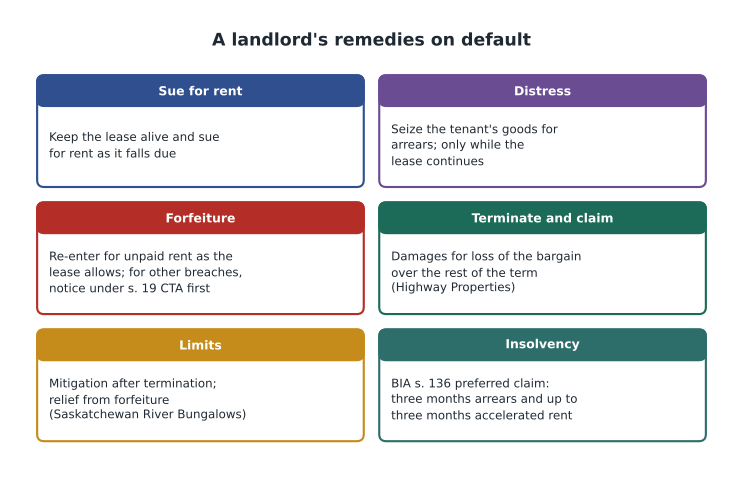
When a tenant defaults, the landlord has several remedies, and must choose among them carefully because some are inconsistent. It may keep the lease in force and sue for rent as it falls due. It may distrain, meaning that it seizes the tenant's goods on the premises and sells them to pay rent arrears; distress is available only while the lease continues and is subject to statutory rules, including exemptions and the rights of third parties who own goods on the premises. It may terminate the lease by re-entering the premises, which the lease usually permits after rent has been unpaid for a stated number of days. For breaches other than non-payment of rent, section 19 of the Commercial Tenancies Act requires the landlord, before forfeiting the lease, to serve a notice specifying the breach and giving the tenant a reasonable time to remedy it.
If the landlord terminates, it may also claim damages for the loss of the bargain. In Highway Properties Ltd. v. Kelly, Douglas and Co., [1971] SCR 562, the anchor tenant of a shopping centre abandoned its premises, and the landlord retook possession. The Supreme Court held that a landlord who terminates on the tenant's repudiation may recover not only rent owed to the date of termination but also damages for the prospective loss of rent over the rest of the term, provided it gives notice that it is claiming such damages, and subject to mitigation. The decision brought commercial leases closer to ordinary contract law.
Tenants may seek relief from forfeiture. The Commercial Tenancies Act gives the court power to relieve against forfeiture, and section 98 of the Courts of Justice Act gives a general power. Courts consider the factors described by the Supreme Court in Saskatchewan River Bungalows Ltd. v. Maritime Life Assurance Co., [1994] 2 SCR 490: the conduct of the applicant, the gravity of the breach, and the disparity between the value of the property forfeited and the damage caused by the breach. Relief is often granted where a tenant pays the arrears promptly and has invested heavily in the premises, and refused where defaults are repeated or deliberate.
Insolvency changes the picture. If a tenant becomes bankrupt, the trustee may disclaim the lease or assign it, and the landlord's claim for rent is limited. Under section 136 of the Bankruptcy and Insolvency Act, the landlord has a preferred claim for arrears of rent for the three months before the bankruptcy and accelerated rent for up to three months after, to the extent the lease provides for acceleration and the value realized from the tenant's property on the premises covers it, and an unsecured claim for the rest. Personal guarantees, such as Mei's, are often the landlord's real security.
Recent history and other provinces
During the COVID-19 pandemic, Ontario temporarily prohibited landlords from evicting or distraining against small business tenants that qualified for federal rent assistance, a measure that ended with the assistance program. The experience led many tenants to ask for force majeure and rent abatement clauses covering government closure orders, which are now common points of negotiation. Elsewhere in Canada, the structure is similar: British Columbia's Commercial Tenancy Act, Alberta's Law of Property Act and Landlord's Rights on Bankruptcy Act, and Quebec's Civil Code rules on leases govern commercial tenancies, but the parties' lease remains the main source of their rights.
Worked problem
Negotiating the Dumont Square offer
Mei Yuen asks the class's firm to review the Dumont Square offer before she signs. The landlord's schedule includes: consent to assignment 'in the landlord's sole and absolute discretion'; a relocation clause; a demolition clause on six months' notice; operating costs including 'all costs of every kind incurred by the landlord in respect of the plaza'; and an unlimited personal guarantee by Mei for the full term and renewals. The premises were a dry cleaner for twenty years. What are the main points to negotiate?
Show solution
- Assignment: Section 23 of the Commercial Tenancies Act implies reasonableness unless the lease says otherwise, which this clause does. Ask for consent not to be unreasonably withheld and for permitted transfers to an affiliate or on a sale of the business.
- Relocation and demolition: Ask to delete them or limit them: no relocation during the first years, comparable premises, all moving costs and the unamortized cost of improvements paid by the landlord, and longer demolition notice with compensation.
- Operating costs: Exclude capital replacements, financing, leasing costs and the landlord's head office overhead, cap management fees and obtain audit rights.
- Environment: Ask for the landlord's environmental reports, a representation about the dry cleaner's use and an indemnity for pre-existing contamination.
- Guarantee: Limit it in time or amount, and have it end on an approved assignment or after a period of no defaults.
- Financing: Ask for a non-disturbance agreement from the landlord's lender, and register notice of the lease on title because the term with renewals exceeds three years.
Common mistakes
MistakeApplying the Residential Tenancies Act, 2006 to a commercial lease.
InsteadCommercial tenancies are governed by the lease, the common law and the Commercial Tenancies Act, not the residential statute.
MistakeAssuming consent to assignment can never be unreasonably withheld.
InsteadSection 23 of the Commercial Tenancies Act implies reasonableness only if the lease does not expressly provide otherwise.
MistakeTelling a landlord that on termination it can recover only the rent owed to that date.
InsteadHighway Properties allows damages for prospective loss over the rest of the term, if the landlord gives notice and mitigates.
MistakeDistraining for rent after terminating the lease.
InsteadDistress is available only while the lease continues; terminating and distraining are inconsistent remedies.
Practice problems
Work each problem on paper first, then reveal the answer to check.
What did the Supreme Court hold in Highway Properties v. Kelly, Douglas?
Show answer
That a landlord who terminates a lease on the tenant's repudiation may recover damages for the loss of rent over the unexpired term, in addition to arrears, if it gives notice of the claim, subject to mitigation.
What must a landlord do under section 19 of the Commercial Tenancies Act before forfeiting a lease for a breach other than non-payment of rent?
Show answer
Serve a notice specifying the breach, requiring it to be remedied if it can be, and allow a reasonable time to remedy it.
What protection does a tenant get from a non-disturbance agreement?
Show answer
A promise from the landlord's lender that it will not terminate the lease or disturb the tenant's possession if it enforces its mortgage, as long as the tenant is not in default.
Summary and key terms
- Commercial leases are governed by contract, property law and the Commercial Tenancies Act, not the Residential Tenancies Act, 2006.
- Offers to lease can be binding; leases over three years must be in writing and should be registered on title; leases of space in a building are exempt from Planning Act consent.
- Key terms include rent and operating costs, use and exclusivity, improvements, repairs and insurance, relocation and demolition, subordination and non-disturbance, and guarantees.
- Section 23 implies that consent to assignment will not be unreasonably withheld unless the lease says otherwise; assignment does not usually release the original tenant.
- Landlords may sue for rent, distrain, forfeit after required notice or terminate and claim prospective damages under Highway Properties; courts may grant relief from forfeiture.
- Net lease
- A lease in which the tenant pays basic rent plus its share of operating costs, taxes and insurance as additional rent.
- Distress
- A landlord's remedy of seizing a tenant's goods on the premises to recover rent arrears while the lease continues.
- Forfeiture
- Termination of a lease by the landlord because of the tenant's breach.
- Non-disturbance agreement
- An agreement by a landlord's lender not to disturb a non-defaulting tenant if it enforces its security.
- Estoppel certificate
- A tenant's written confirmation of the lease terms and status, on which a buyer or lender may rely.
- Relocation clause
- A term allowing the landlord to move the tenant to other premises in the property.
Lesson quiz · 5 questions
Score 60% or more to complete this lesson.
Create a free account to save your progress, take quizzes and earn a certificate.