
LAWC-303 · Lesson 10 of 12 · 19 min
Closing a transaction
▶ Video coming soon A video version of this lesson is on the way.
The tenth class is a rehearsal. Ingleby divides the students into two firms, one acting for Harold Abara and one for Ines Castille, Devon Quigley and their bank, and walks them through the last two weeks of the Larkin Crescent file, ending with closing day itself. 'Everything you have learned so far,' she says, 'arrives on one afternoon. The good lawyers make that afternoon boring.' This lesson covers the steps before closing, the statement of adjustments, the closing documents and undertakings, the Document Registration Agreement and electronic registration, the exchange of funds and keys, tender and time of the essence, and what happens after closing.
The final two weeks
By two weeks before closing, the requisitions should be answered, the searches complete and the mortgage approved. The buyer's lawyer meets the clients to review and sign the documents: the acknowledgment and direction authorizing the lawyer to sign the transfer and charge electronically, the mortgage documents and the lender's disclosure, the title insurance application, and statements for the land transfer tax refund. She explains the standard charge terms, the title insurance policy and the statement of adjustments. She confirms how the clients will hold title, joint tenants in this case, and obtains the balance of the funds. The clients arrange home insurance effective on closing, naming the lender as loss payee, because the lender will not advance without it.
The seller's lawyer, meanwhile, obtains a payout statement for Harold's mortgage, prepares the statement of adjustments, the seller's statutory declarations and undertakings, and a direction about where the sale proceeds should be paid. She confirms with Harold that he will deliver vacant possession and the keys, that he has cancelled or transferred utilities, and that the chattels in the agreement will stay.
The statement of adjustments
The statement of adjustments calculates the amount the buyer must pay on closing. It starts with the price, credits the buyer with the deposit, and then apportions expenses that have been paid or are owed for periods that straddle the closing date. The most common adjustment is for realty taxes. If the seller has paid the full year's taxes, the buyer must reimburse the seller for the part of the year after closing; if the seller has paid only part, the buyer may be credited for the seller's share of the unpaid amount. Ontario practice treats the day of closing as the buyer's day. Other common adjustments include prepaid utilities, the fuel oil in a tank, rent and security deposits on a tenanted property, and condominium common expenses.
Harold paid the full year's taxes of 5,840 dollars. The closing falls with seventy-three days of the tax year remaining, counting the closing day, so the buyers must credit him with 5,840 dollars multiplied by seventy-three over three hundred and sixty-five, or 1,168 dollars. The balance due on closing is the price of 640,000 dollars, minus the 30,000 dollar deposit, plus 1,168 dollars, for a total of 611,168 dollars. The buyers' lawyer checks every line, because an error discovered after closing must be fixed by readjustment, which depends on an undertaking and the other side's goodwill.
The documents and undertakings
The key documents are created in Teraview. The transfer conveys the property from Harold to Ines and Devon and contains statements: the land transfer tax statements about the consideration and the buyers' status, the Planning Act statements, the spousal status statement for Harold, and the residency statement. The charge grants the bank its security, and Harold's lawyer will later register a discharge of his bank's charge. Paper documents complete the file: the seller's statutory declaration about possession, residency, work orders and the absence of other claims; a bill of sale or warranty for the chattels; a direction about funds; and the undertakings.
Undertakings are personal promises by a lawyer or a party to do something after closing. The seller's lawyer undertakes to pay out and discharge the seller's mortgage from the proceeds. The seller undertakes to readjust the statement of adjustments if an error is found, to pay any utility arrears up to closing, and to deliver vacant possession and keys. A lawyer must not give an undertaking she cannot fulfil, must fulfil the undertakings she gives, and must be clear whether she is giving a personal undertaking or merely passing on the client's. The Law Society has long treated a failure to honour an undertaking as serious misconduct, because the whole closing system depends on lawyers being able to rely on each other's word.
The Document Registration Agreement
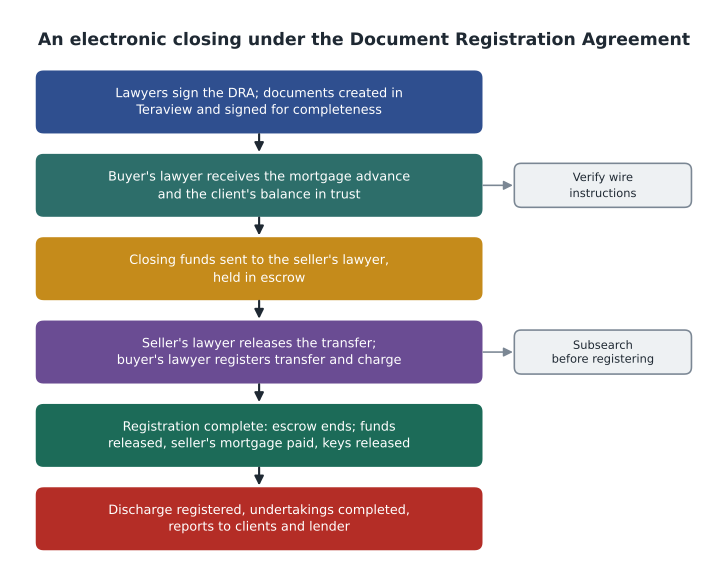
Before electronic registration, lawyers met at the registry office, exchanged paper deeds, cheques and keys across a table, and registered the deed in person. Electronic registration removed the table. The parties now rely on the Law Society's standard Document Registration Agreement, a contract between the two lawyers that governs the closing. Under it, each lawyer holds the documents, funds and keys delivered by the other in escrow until the documents are registered. Neither may release anything received in escrow until registration is complete, and if the deal does not close, everything must be returned. The Law Society publishes versions for two-party and multi-party transactions and has updated them to address matters such as vendor take-back mortgages, documents returned for correction by the land registry, and the wiring of funds and electronic door codes.
In Teraview, each lawyer signs the documents for completeness, confirming that they are in final form, and the seller's lawyer then signs the transfer for release, authorizing the buyer's lawyer to register it once the escrow conditions are met. The buyer's lawyer, having delivered the funds, registers the transfer and the charge. As soon as the registration is complete, the escrow ends: the seller's lawyer may release the funds to pay out the mortgage and pay the balance to the seller, and the keys may be released. Since June 2025, routine transfers and discharges that meet the province's rules have been certified automatically.
Moving the money
On closing day, the bank advances the mortgage money into the buyers' lawyer's trust account, usually by wire or electronic funds transfer through Canada's high-value payment system. The buyers' balance must already be in the account. The buyers' lawyer then sends the closing funds to the seller's lawyer's trust account. Trust accounting rules under By-Law 9 require the lawyer to deal with these funds strictly according to the directions and to record every transaction.
Fraud has moved here too. A common scheme is business email compromise: a fraudster gains access to a lawyer's or client's email and sends new wire instructions, so the money goes to the fraudster's account. LawPRO and the Law Society warn lawyers to confirm wire instructions by telephone using a number from an independent source, never to accept changes to payment instructions by email alone, and to train staff to treat any change of instructions near closing as a red flag. The updated Document Registration Agreement addresses the wiring of funds for the same reason.
Tender and time of the essence
The standard agreement says that time is of the essence. This means that the closing date and the other dates in the agreement must be strictly met, and that a party who is not ready, willing and able to close on the date may be found in default. An extension requires the agreement of both parties, usually in a written amendment signed by the lawyers on the clients' instructions. If both parties are in default, or one party has led the other to believe that the date will not be strictly enforced, time may cease to be of the essence, and a party who wants to restore it must give reasonable notice setting a new date.
When one side is ready to close and the other is not, the ready party protects itself by tendering. Tender means unconditionally offering to perform: the buyer's lawyer offers the funds and the signed documents, or the seller's lawyer offers the transfer released for registration. The standard agreement allows tender on the other party's lawyer, and in an electronic closing a lawyer usually tenders by delivering a letter confirming readiness, with evidence of funds or signed documents in Teraview, and swears an affidavit of tender afterwards. Tender is unnecessary if the other side has clearly repudiated, but a careful lawyer tenders anyway, because the client's later claim for damages or the deposit may depend on proving that the client was ready.
Hannah asks what happens if the land registry system goes down on closing day, which happened in Ontario during outages in the past. The Document Registration Agreement and closing practice expect lawyers to agree on an extension or an escrow closing, and many agreements and lender instructions include language for that situation. The general point is that lawyers must cooperate to close as soon as possible, and must not use a system failure to escape a deal.
After closing
Closing day is not the end. The seller's lawyer pays out the seller's mortgage, obtains the discharge and registers it, and reports to the buyer's lawyer that her undertaking is fulfilled. The buyer's lawyer confirms that the discharge has been registered and that no other instrument was registered against the property between the search and the closing; a subsearch on closing day guards against that risk. She reports to the lender with a final report on title, and to the clients with a reporting letter enclosing the registered documents, the title insurance policy, the statement of adjustments and an account of the funds received and paid. Ingleby tells the class that a good reporting letter does more than list documents: it tells the clients, in plain language, what they own, what it is subject to and what to keep.
Worked problem
The changed wire instructions
On the morning of closing, the buyers' firm receives an email that appears to come from Harold Abara's lawyer, saying that her trust account has changed because of a bank merger and asking that the closing funds of 611,168 dollars be wired to a new account at a different bank. The email address looks right, but the closing letter she sent last week gave different banking details. The bank's mortgage advance has arrived. What should the firm do?
Show solution
- Treat the change as a red flag. A last-minute change to payment instructions by email is the classic sign of business email compromise.
- Do not reply to the email or use any phone number in it. Call Harold's lawyer at a number from an independent source, such as the Law Society directory or her firm's website, and confirm the trust account details.
- If she confirms the instructions are false, send the funds only to the original account confirmed by telephone, report the fraudulent email to her and to the firm's IT and insurer, and consider whether either firm's email has been compromised.
- If there is any doubt, delay sending the funds until it is resolved, and agree with the seller's lawyer on a short extension under the Document Registration Agreement rather than risk sending money to a fraudster.
- Record the steps taken. If funds are lost through failure to verify, the firm may be liable and must report the loss to LawPRO and the Law Society.
- Proceed with the registration only after the funds have been delivered under the escrow terms.
Common mistakes
MistakeTreating the day of closing as the seller's day in the statement of adjustments.
InsteadOntario practice treats the closing day as the buyer's day, so the buyer pays expenses for that day.
MistakeReleasing funds or keys as soon as they are received in an electronic closing.
InsteadUnder the Document Registration Agreement, documents, funds and keys are held in escrow until registration is complete.
MistakeGiving an undertaking that depends on someone else's cooperation without qualification.
InsteadA lawyer must give only undertakings she can personally fulfil, make clear whose undertaking it is, and honour it strictly.
MistakeAssuming that because the other side will not close, there is no need to tender.
InsteadTender is unnecessary after clear repudiation, but tendering and swearing an affidavit of tender protects the client's later claim.
Practice problems
Work each problem on paper first, then reveal the answer to check.
Calculate the realty tax adjustment where annual taxes of 7,300 dollars were paid in full by the seller and 100 days of the year remain, counting the closing day.
Show answer
7,300 dollars multiplied by 100 over 365, or 2,000 dollars, credited to the seller.
What is the purpose of the Document Registration Agreement?
Show answer
It is the standard contract between the lawyers governing an electronic closing, under which documents, funds and keys exchanged before registration are held in escrow until registration is complete, and returned if the deal does not close.
What does it mean that time is of the essence, and how can it be lost?
Show answer
The dates must be strictly met and a party not ready on time may be in default; time can cease to be of the essence if both parties are in default or one leads the other to believe the date will not be enforced, after which it can be restored only by reasonable notice.
Summary and key terms
- In the final weeks the lawyers complete requisitions, review documents with the clients, confirm insurance and gather funds.
- The statement of adjustments credits the deposit and apportions taxes and other expenses, with the closing day treated as the buyer's day.
- The transfer, charge and discharge are created in Teraview with required statements, supported by declarations and undertakings that lawyers must honour strictly.
- Under the Document Registration Agreement, documents, funds and keys are held in escrow until registration; wire instructions must be verified independently to prevent fraud.
- Time is of the essence; a party ready to close should tender; after closing, the discharge is registered, undertakings completed and reports sent to clients and lenders.
- Statement of adjustments
- A statement prepared by the seller's lawyer showing the price, credits and apportioned expenses, and the balance due on closing.
- Document Registration Agreement
- The Law Society's standard agreement between lawyers governing escrow and registration in an electronic closing.
- Escrow
- A condition under which documents, funds or keys are held by one party until specified conditions are met.
- Time of the essence
- A contractual term making dates strictly binding, so that failure to perform on time is a breach going to the root of the contract.
- Reporting letter
- The lawyer's final report to the client after closing, explaining what was done and enclosing the key documents.
- Subsearch
- An updated search of title on or just before closing to confirm nothing new has been registered.
Lesson quiz · 5 questions
Score 60% or more to complete this lesson.
Create a free account to save your progress, take quizzes and earn a certificate.