
LAWC-303 · Lesson 7 of 12 · 19 min
Mortgages
▶ Video coming soon A video version of this lesson is on the way.
For the seventh class, Ingleby hands out the bank's commitment letter and mortgage instructions for Ines and Devon. The couple have 64,000 dollars in savings and 40,000 dollars from Devon's parents, a down payment of 104,000 dollars, a little over sixteen percent of the price. The bank has approved a mortgage loan of 536,000 dollars, insured against default, with a five-year fixed rate and a thirty-year amortization. 'This document,' Ingleby says, 'is a set of instructions to you from a client, and you must follow it. It is also a description of the biggest debt your other clients will ever take on, and you must explain it to them.' This lesson explains what a mortgage is, its key terms and statutory protections, how priorities work, and the lawyer's duties when acting for lender and borrower.
What a mortgage is
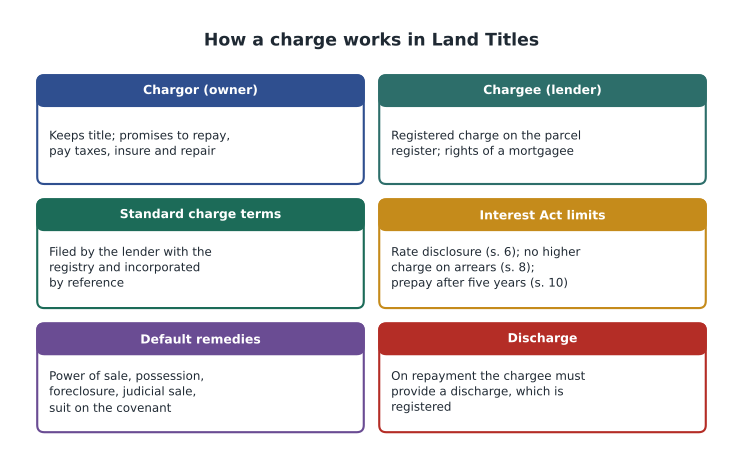
At common law, a mortgage was a transfer of the legal title to the lender, with a proviso that the lender would reconvey the land once the debt was repaid. Equity intervened to protect the borrower: even after the date for repayment passed, the borrower kept an equity of redemption, the right to recover the land by paying what was owed, until the lender went to court to foreclose it. That history still explains much of the vocabulary. Under Ontario's Land Titles system, however, a mortgage is registered as a charge. The owner, called the chargor, keeps title, and the lender, called the chargee, has the rights of a mortgagee, including the remedies we study in lesson 8. In practice Ontario lawyers use 'mortgage' and 'charge' interchangeably.
Most institutional lenders file a set of standard charge terms with the land registry and incorporate them by reference into each charge. The registered charge itself is short: it identifies the land, the parties, the principal, the interest rate, the payment schedule and the standard charge terms that apply. The standard terms contain the borrower's covenants, such as to repay, to pay taxes, to insure the buildings, to keep the property in repair and not to sell without the lender's consent, and the lender's remedies on default. A lawyer must give the borrower a copy and explain them.
Key terms
Several terms define the bargain. The principal is the amount borrowed. The term is the period during which the rate and conditions are fixed, often five years, at the end of which the loan must be renewed or repaid. The amortization is the period over which the payments would repay the loan in full, often twenty-five or thirty years. A fixed rate stays the same for the term; a variable rate moves with the lender's prime rate. An open mortgage may be prepaid at any time without penalty; a closed one may be prepaid only as the contract allows, usually with a prepayment privilege of a set amount each year and a penalty for anything more. Portability allows the borrower to move the mortgage to a new property.
Federal rules shape residential lending. A borrower whose down payment is less than twenty percent of the price needs mortgage default insurance, usually from Canada Mortgage and Housing Corporation or a private insurer, and the premium is typically added to the loan. Since December 15, 2024, insured mortgages have been available for homes priced up to 1.5 million dollars, and first-time buyers and buyers of newly built homes may obtain insured mortgages with thirty-year amortizations. Federally regulated lenders also apply a qualifying rate, known as the stress test, under guidelines issued by the Office of the Superintendent of Financial Institutions, which requires borrowers to show they could afford payments at a rate higher than the contract rate. Ines and Devon, as first-time buyers with less than twenty percent down, fit exactly within these rules.
Statutory protection for borrowers
The federal Interest Act contains several protections that every mortgage lawyer must know. Section 6 requires a mortgage repayable in blended payments of principal and interest to contain a statement of the principal and of the rate of interest calculated yearly or half-yearly, not in advance; if it does not, no interest is recoverable beyond the principal. That is why Canadian fixed-rate mortgages are traditionally compounded semi-annually and why the charge states the rate in that form.
Section 8 prohibits a fine, penalty or rate of interest on arrears of principal or interest secured by a mortgage of real property that has the effect of increasing the charge on the arrears beyond the rate payable on principal not in arrears. In Krayzel Corp. v. Equitable Trust Co., 2016 SCC 18, a commercial mortgage set a high rate but allowed the borrower to pay a lower rate if it was not in default. On default, the lender claimed the higher rate. The Supreme Court held that section 8 looks at substance, not form: the arrangement had the effect of increasing the charge on arrears, so the lender could not recover the difference. A lawyer drafting a private mortgage must make sure the default provisions do not run afoul of section 8.
Section 10 gives a borrower who is a natural person, not a corporation, the right to repay a mortgage at any time after five years from the date of the mortgage, on payment of three months' interest, even if the mortgage is closed for a longer term. This is one reason Canadian residential mortgage terms rarely exceed five years. Finally, the Criminal Code makes it an offence to enter into an agreement to receive interest at a criminal rate, and from January 1, 2025 the criminal rate was lowered to an annual percentage rate above thirty-five percent, with exemptions for some commercial loans. Private lenders charging high fees on short-term loans must calculate carefully, because fees and bonuses count as interest.
Priorities
When a property is charged more than once, priority determines who is paid first. In Land Titles, registered charges generally rank in order of registration. A second mortgage is a charge registered after the first, and its lender takes the risk that the first lender will be paid in full before it receives anything. Lenders may change their priority by a postponement agreement, for example when a first lender agrees to rank behind a new lender on a refinancing.
Some interests do not follow the registration rule. Realty taxes are a special lien with priority over registered charges. Construction liens under the Construction Act have their own priority rules, which can give lien claimants priority over advances made after a lien arises. And collateral charges, which secure a line of credit or all debts of the borrower rather than a fixed loan, raise questions about whether later advances rank ahead of interests registered in between. A buyer's lawyer acting for a lender must therefore check that the lender's charge will rank as the instructions require, usually first, and that every prior charge is discharged on closing.
Other mortgages
Not every mortgage is an institutional loan. A seller may agree to lend part of the price to the buyer, secured by a vendor take-back mortgage registered on closing. Family members may lend money secured by a charge, sometimes to protect a gift in the event of separation. Private lenders and mortgage investment corporations make second mortgages and short-term loans at higher rates, and mortgage brokers and administrators who arrange or administer them are regulated by the Financial Services Regulatory Authority of Ontario under the Mortgage Brokerages, Lenders and Administrators Act, 2006. In Quebec, the equivalent security is a hypothec under the Civil Code, which never transferred title even historically.
Spousal rights apply to mortgages too. Section 21 of the Family Law Act prevents a spouse from encumbering an interest in a matrimonial home without the consent of the other spouse, unless the other has released the right or a court authorizes it. When only one spouse is on title, the other spouse must usually consent to the charge, and lenders' instructions require the lawyer to obtain that consent.
Acting for the lender and the borrower
In most residential purchases, the buyer's lawyer also acts for the lender. The lender's instructions tell the lawyer what to do: confirm the borrower's identity, search title, ensure the charge will rank in first position, obtain title insurance or deliver a title opinion, register the charge, obtain fire insurance naming the lender, and report. The instructions usually also require the lawyer to report material facts that may affect the lender's decision to lend. These can include a different purchase price than the lender was told, a deposit paid directly to the seller rather than through the brokerage, a gift that is really a loan, a second mortgage that the lender did not approve, or a seller who is giving the buyer money back on closing.
This is where the joint retainer can become uncomfortable. Suppose Devon mentions that his parents' 40,000 dollars is really a loan that he and Ines will repay over five years, but that the bank asked for a gift letter. The firm cannot keep that from the bank, because the information is relevant to the loan and the joint retainer was opened on the basis that there would be no confidences between the clients. The firm must tell Devon that it has to disclose the fact or stop acting for the bank, and it must not help the clients mislead the lender. Signing a false gift letter is participating in a misrepresentation to a lender, which the Law Society has repeatedly treated as serious misconduct.
Hannah asks whether this means the lawyer works for the bank more than the buyers. Ingleby says no. The lawyer works for both, on a joint retainer, with full disclosure. If the clients' interests diverge, she must stop acting for at least one. Most of the time they do not diverge, because the buyers and the bank both want a valid first charge on a good title.
Discharge
When a mortgage is repaid, the lender must provide a discharge. The borrower or the borrower's lawyer requests a payout statement, which shows the amount needed to discharge on a given date, including accrued interest and any prepayment penalty. A prepayment penalty on a closed fixed-rate mortgage is often the greater of three months' interest and an interest rate differential calculated under the contract, and in a falling rate environment it can be very large. Harold Abara's 2015 charge has a remaining balance of about 92,000 dollars, and his lawyer will pay it from the sale proceeds and register the discharge after closing under her undertaking.
Worked problem
The gift that was a loan
Two weeks before closing, Devon mentions to the firm's clerk that his parents expect him and Ines to repay the 40,000 dollars at 500 dollars a month, but that the bank's gift letter, which his parents have already signed, says the money is a gift with no repayment expected. Devon asks the firm not to mention it, because the bank might reduce the loan. What should the lawyer do?
Show solution
- Identify the problem. The firm acts for Ines, Devon and the bank on a joint retainer, and the bank's instructions require disclosure of material facts, including any undisclosed debt affecting the down payment.
- Recall the terms of the retainer. The clients were told at the outset that information relevant to the loan would not be kept confidential from the bank.
- Advise the clients. Explain that the firm cannot participate in a misrepresentation to the lender and cannot rely on a gift letter it knows to be false.
- Offer the options. The clients may tell the bank the truth and obtain a corrected letter or revised approval; if they refuse, the firm must stop acting for the bank, and probably for the buyers in the mortgage, giving the bank only as much explanation as the rules permit.
- Consider the effect on closing. If the bank reduces the loan, the buyers may need other money or face a failed closing, which lesson 3 explained can cost them their deposit and more.
- Document every step and every instruction.
Common mistakes
MistakeSaying that under Land Titles a mortgage transfers title to the lender.
InsteadA charge leaves title with the chargor and gives the chargee the rights of a mortgagee.
MistakeDrafting a private mortgage with a reduced rate that is lost on default, assuming that it is not a penalty.
InsteadKrayzel held that section 8 of the Interest Act looks at substance; a loss of a discount on default can increase the charge on arrears and be unenforceable.
MistakeTelling a borrower who is an individual that a ten-year closed mortgage can never be prepaid.
InsteadSection 10 of the Interest Act allows an individual to repay after five years with three months' interest.
MistakeTreating the lender's instructions as a formality when acting on a joint retainer.
InsteadThe lawyer must follow the instructions, report material facts and never participate in misleading the lender.
Practice problems
Work each problem on paper first, then reveal the answer to check.
What did the Supreme Court decide in Krayzel Corp. v. Equitable Trust Co.?
Show answer
That section 8 of the Interest Act applies by substance: a mortgage structure under which the borrower loses a lower rate on default has the effect of increasing the charge on arrears and is prohibited.
What federal mortgage rule changes took effect on December 15, 2024?
Show answer
The price cap for insured mortgages rose to 1.5 million dollars, and thirty-year amortizations became available for insured mortgages for first-time buyers and buyers of new builds.
Why must a non-owner spouse usually consent to a charge of a matrimonial home?
Show answer
Because section 21 of the Family Law Act prohibits encumbering an interest in a matrimonial home without the other spouse's consent, a release or a court order.
Summary and key terms
- A mortgage gives the lender security for a debt; under Land Titles it is registered as a charge, and title stays with the borrower.
- Standard charge terms filed by lenders contain the borrower's covenants and the lender's remedies and must be explained to the borrower.
- The Interest Act requires disclosure of rates (section 6), prohibits higher charges on arrears (section 8, as applied in Krayzel) and allows individuals to prepay after five years (section 10).
- Charges rank by registration, subject to tax liens, construction liens, postponements and special rules for collateral charges.
- When acting for lender and borrower, the lawyer must follow the lender's instructions, report material facts and never assist in misleading the lender.
- Charge
- The Land Titles form of a mortgage, which gives a lender security without transferring title.
- Equity of redemption
- The borrower's right to recover the property by paying the debt, and more broadly the borrower's interest subject to the mortgage.
- Amortization
- The period over which regular payments would repay the loan in full.
- Standard charge terms
- A lender's set of mortgage terms filed with the land registry and incorporated by reference into each charge.
- Postponement
- An agreement by which a lender agrees that its charge will rank behind another interest.
- Vendor take-back mortgage
- A mortgage given by a buyer to the seller to secure part of the price.
Lesson quiz · 5 questions
Score 60% or more to complete this lesson.
Create a free account to save your progress, take quizzes and earn a certificate.