
LAWC-302 · Lesson 9 of 12 · 24 min
Collective agreements, strikes and grievance arbitration
▶ Video coming soon A video version of this lesson is on the way.
Several months later, in the Pellridge file, the union has won a second representation vote ordered by the Ontario Labour Relations Board, and Local 60 is certified for the warehouse. Benedetta Ferrante has been reinstated with compensation. Bargaining for a first collective agreement has been slow. Professor Sabourin puts the next problem on the board: the union is preparing for a strike vote, Pellridge is talking about using managers and agency workers to keep the warehouse running, and a forklift operator who was disciplined last month wants to know whether she can sue. 'Today,' he says, 'we follow a union from certification to the end of a collective agreement, and we see why courts have almost nothing to do with it.'
This lesson covers the content and legal effect of collective agreements, the law of strikes, lockouts and picketing, back-to-work legislation and the federal section 107 power, and grievance arbitration, including the exclusive jurisdiction of arbitrators and the arbitral approach to discipline.
What a collective agreement contains
A collective agreement is a written agreement between an employer and a union containing provisions about terms and conditions of employment and the rights, privileges or duties of the employer, the union and the employees. Under Ontario's Labour Relations Act, 1995, every collective agreement must contain certain terms or will be deemed to contain them. It must recognize the union as the exclusive bargaining agent for the unit. It must provide that there will be no strikes or lockouts during its term (section 46). It must contain a provision for the final and binding settlement by arbitration, without stoppage of work, of all differences between the parties arising from its interpretation, application, administration or alleged violation, including any question of arbitrability (section 48(1)); if it does not, the statutory clause is deemed to be included. Its term must be at least one year (section 58), and on request of the union it must provide for the deduction of union dues from all employees in the unit under the Rand formula (section 47).
Beyond these mandatory terms, collective agreements usually contain a management rights clause, which reserves to the employer the right to manage the enterprise except as limited by the agreement; a just cause clause protecting employees from discipline without just cause; seniority provisions governing layoffs, recalls, promotions and shift selection; a grievance procedure with time limits; and provisions on wages, hours, overtime, benefits, leaves, health and safety and job postings. Arbitrators have held that a management rights clause must be exercised reasonably, consistent with the agreement as a whole, and that an employer's unilateral rules must be consistent with the agreement, clear, brought to employees' attention and reasonable, a test derived from Re Lumber and Sawmill Workers' Union, Local 2537 and KVP Co. Ltd. (1965), an Ontario arbitration award known simply as KVP.
The collective agreement replaces the individual contract
A collective agreement binds the employer, the union and every employee in the unit. Individual bargaining is largely displaced. In McGavin Toastmaster Ltd. v. Ainscough, [1976] 1 S.C.R. 718, the Supreme Court held that the relationship between a unionized employee and the employer is governed by the collective agreement, not by common law notions of individual contract. A unionized employee dismissed without just cause cannot sue for reasonable notice; the remedy is a grievance, and the arbitrator may order reinstatement, a remedy common law courts do not grant.
The road to a strike or lockout
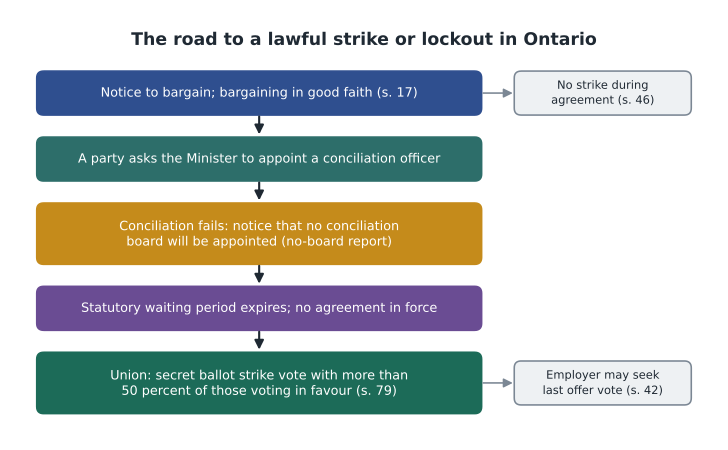
A strike is a cessation of work, a refusal to work or a slowdown by employees acting in combination, designed to restrict output; a lockout is the employer's closing of a place of employment or refusal to employ employees to compel them to agree to terms. Both are lawful only when statutory conditions are met. In Ontario, there can be no strike or lockout during the term of a collective agreement. After a first certification, or when an agreement is about to expire, either party can give notice to bargain. If bargaining fails, a party asks the Minister of Labour to appoint a conciliation officer. If conciliation does not produce an agreement, the Minister issues a notice that a conciliation board will not be appointed, commonly called a no-board report, and a strike or lockout becomes lawful after a short waiting period following that notice. Before a union may strike, it must hold a strike vote by secret ballot, and more than 50 percent of the employees in the unit who vote must be in favour (section 79). The employer may also require, once in each round of bargaining, that its last offer be put to a vote of employees under section 42.
Replacement workers and reinstatement
Ontario does not prohibit an employer from using replacement workers during a lawful strike. A ban introduced in 1993 was repealed in 1995. British Columbia and Quebec have long-standing bans, and since June 20, 2025, the Canada Labour Code has prohibited most federally regulated employers from using replacement workers, including contractors, during a strike or lockout, subject to narrow exceptions for threats to life, health or safety and serious environmental or property damage. In Ontario, the protection for striking employees is different: under section 80, an employee who is on a lawful strike and makes an unconditional application to return to work within six months after the strike begins must be reinstated, subject to there being work available, displacing any replacements.
So when Romilly Ormerod suggests that Pellridge could keep the warehouse running with managers and agency workers during a strike, Arjun Mehta advises that this is lawful in Ontario, subject to the six-month reinstatement right and the prohibition on threatening employees during bargaining. If Pellridge were a federally regulated trucking firm, the answer would be different.
Picketing
Picketing is expressive activity protected in part by the Charter's guarantee of freedom of expression, although the Charter applies directly only to government. In Pepsi-Cola Canada Beverages (West) Ltd. v. R.W.D.S.U., Local 558, 2002 SCC 8, the Supreme Court held that secondary picketing, at locations other than the struck employer's premises, is generally lawful at common law unless it involves wrongful action, such as criminal conduct, trespass, nuisance, intimidation or inducing breach of contract. The court rejected the older rule that secondary picketing was illegal per se. Picketing that blocks access, intimidates or causes property damage can be restrained by an injunction. In Ontario, section 102 of the Courts of Justice Act limits injunctions in labour disputes, requiring, among other things, that reasonable efforts to obtain police assistance have been unsuccessful before an injunction is granted without notice.
Essential services and back-to-work legislation
Some public sector workers in Ontario cannot strike at all. Hospital workers, police and firefighters, for example, are covered by statutes that replace the right to strike with binding interest arbitration, in which an arbitrator sets the terms of a new collective agreement. Other public sector strikes may be limited by essential services agreements. Governments can also end a particular strike by special back-to-work legislation, which orders employees to return and usually imposes arbitration or a settlement. After the Supreme Court's 2015 decision in Saskatchewan Federation of Labour, discussed in lesson 10, such legislation must respect the constitutional right to strike, which means it must be justified under section 1 of the Charter.
The federal section 107 power
At the federal level, governments have recently used a different tool. Section 107 of the Canada Labour Code allows the Minister of Labour, in order to maintain or secure industrial peace, to refer questions to the Canada Industrial Relations Board and direct it to take action. In 2024 and 2025 the Minister used section 107 nine times, according to the federal government's own figures, including for the national rail stoppage at CN and CPKC in August 2024, the West Coast and Montreal port disputes in November 2024, Canada Post in December 2024 and Air Canada flight attendants in August 2025. In most of these cases the Board was directed to order an end to an actual or threatened stoppage and to impose binding arbitration or extend the existing agreement; in the Canada Post referral, the government instead appointed an industrial inquiry commission to examine the dispute. In August 2025, the Board held, in a decision on the Canada Post referral that became public that autumn, that section 107 was not unconstitutional on its face and that it had no authority to review the Minister's direction; unions' challenges to the referrals were before the Federal Courts in early 2026.
The government responded to criticism with Bill C-39, the Building Canada Strong Act, introduced in September 2026. Among many other changes, it would require the appointment of a special mediator, lengthen the conciliation period from 60 to 90 days, allow the Minister to act only after a stoppage begins, and require a finding of significant adverse national impact before the Minister could direct the Board to end a strike or lockout or impose arbitration. In October 2026 the bill had passed second reading and was being studied in committee. Students should check its status before relying on it.
Grievance arbitration and exclusive jurisdiction
Grievance arbitration is the heart of the collective bargaining system. Under a typical grievance procedure, an employee or the union files a written grievance, there are one or more meetings with management, and if the matter is not resolved the union may refer it to arbitration. The union controls the grievance; an individual employee usually cannot take a grievance to arbitration without the union, which is why the duty of fair representation matters. Arbitrators are usually experienced labour lawyers or academics chosen by the parties. Under section 48(12)(j) of the Ontario Act, an arbitrator may interpret and apply human rights and other employment-related statutes, even if they conflict with the collective agreement, and under section 48(17) may substitute a lesser penalty for discharge or discipline unless the agreement contains a specific penalty for the infraction.
The Supreme Court has held that arbitration is the exclusive forum for disputes arising under the collective agreement. In Weber v. Ontario Hydro, [1995] 2 S.C.R. 929, an employee's employer hired private investigators who, by pretending to be someone else, gained entry to his home to check whether he was genuinely disabled while he was on sick leave. He sued in tort and for breach of his Charter rights. The court held that the action was barred. The question is whether the dispute, in its essential character, arises from the interpretation, application, administration or violation of the collective agreement; if so, the arbitrator has exclusive jurisdiction, and the arbitrator can apply the Charter and grant tort-type remedies. The essential character of Weber's claim concerned the employer's handling of his sick leave benefits, which the collective agreement governed.
Weber does not oust the courts completely. Courts retain residual jurisdiction to grant remedies an arbitrator cannot, such as certain injunctions, and claims that do not in their essential character arise from the agreement may still proceed in court. As lesson 7 explained, Northern Regional Health Authority v. Horrocks, 2021 SCC 42 applied the same exclusivity principle to human rights tribunals, subject to the wording of each province's legislation.
Discipline at arbitration
Most collective agreements protect employees from discipline or discharge without just cause. Arbitrators have developed a structured approach, set out in Wm. Scott and Company Ltd. and Canadian Food and Allied Workers Union, Local P-162, [1977] 1 Canadian LRBR 1, a 1976 decision of the British Columbia Labour Relations Board chaired by Paul Weiler. The arbitrator asks three questions. First, has the employee given just and reasonable cause for some form of discipline? Second, if so, was the employer's decision to dismiss, or the penalty imposed, an excessive response in all the circumstances? Third, if it was excessive, what alternative measure should be substituted as just and equitable?
This approach differs from the common law in two important ways. Arbitrators apply progressive discipline more consistently, so that a long-service employee with a clean record will rarely be discharged for a first offence that is not grave. And arbitrators can reinstate the employee and substitute a lesser penalty, such as a suspension, which no common law court can do. Arbitrators also enforce 'last chance agreements', in which an employee who has been reinstated agrees that a further specified breach will lead to discharge, although such agreements remain subject to human rights law where the employee has a disability.
The grieving forklift operator
Sabourin returns to the forklift operator. After the first collective agreement was signed, Zainab Rennick was given a three-day suspension for leaving her shift forty minutes early without permission when the school called to say her daughter was ill. She wants to sue Pellridge in Small Claims Court for the lost pay and for 'stress'. Sophie Tremblay-Hart explains that under Weber she cannot: the essential character of her dispute is discipline under the collective agreement, which belongs to the arbitrator. Her remedy is to ask Local 60 to grieve the suspension. Under Wm. Scott, the arbitrator would ask whether leaving early without permission justified some discipline, whether three days was excessive given her record and the family emergency, and what penalty would be appropriate. Because family status is engaged, the arbitrator can also apply the Human Rights Code under section 48(12)(j).
| Issue | Non-union employee | Unionized employee |
|---|---|---|
| Forum for dismissal disputes | Superior Court or Small Claims Court | Grievance arbitration (Weber) |
| Standard | Just cause or reasonable notice | Just cause under the collective agreement |
| Reinstatement available? | No | Yes; substitution of penalty under section 48(17) |
| Who controls the case? | The employee | The union, subject to the duty of fair representation |
| Human rights claims | Tribunal or civil action under section 46.1 | Arbitrator can apply the Code; tribunal may defer |
Judicial review of arbitration awards
Arbitration awards are final and binding, but they are subject to judicial review. In Ontario, applications for review go to the Divisional Court. Under Canada (Minister of Citizenship and Immigration) v. Vavilov, 2019 SCC 65, the standard of review is presumptively reasonableness, and courts have long shown considerable deference to labour arbitrators because of their expertise and the legislature's choice to send these disputes to them. A party challenging an award must show that it is unreasonable, not merely that the court would have decided differently.
Worked problem
Advising Local 60 before a strike
Local 60's bargaining committee asks: (a) Can members refuse overtime as a pressure tactic before conciliation ends? (b) Can they picket the warehouse of Pellridge's largest customer? (c) If they strike and Pellridge hires replacements, can members get their jobs back?
Show solution
- (a) A concerted refusal of overtime designed to restrict output is a strike under the Act. It is unlawful before the statutory conditions are met and the strike vote is held, and the Board can issue a declaration and direction to stop it.
- (b) Secondary picketing is lawful at common law under Pepsi-Cola unless it involves wrongful action such as intimidation, trespass, nuisance or inducing breach of contract. Peaceful, informational picketing at the customer's site is likely lawful; blocking its entrances is not.
- (c) Ontario permits replacement workers, but under section 80 striking employees who apply unconditionally to return within six months of the start of a lawful strike must be reinstated, subject to available work, displacing replacements.
- Overall advice: follow the statutory sequence, hold a proper secret strike vote, keep picketing peaceful and document any employer threats as possible unfair labour practices.
Common mistakes
MistakeAdvising a unionized employee to sue in court for wrongful dismissal or unpaid wages under the collective agreement.
InsteadUnder Weber and McGavin Toastmaster, disputes arising from the collective agreement belong exclusively to arbitration.
MistakeAssuming replacement workers are banned throughout Canada.
InsteadBans exist in British Columbia, Quebec and, since June 20, 2025, the federal sphere; Ontario permits replacements but protects strikers' reinstatement under section 80.
MistakeTreating secondary picketing as illegal per se.
InsteadPepsi-Cola adopted a wrongful action model: secondary picketing is lawful unless it involves criminal or tortious conduct.
MistakeDescribing section 107 as requiring a finding of national harm.
InsteadThe current section 107 contains no such test; Bill C-39 would add a significant adverse national impact requirement if enacted.
MistakeAssuming an arbitrator must uphold a discharge if some misconduct is proven.
InsteadUnder Wm. Scott and section 48(17), the arbitrator asks whether discharge was excessive and may substitute a lesser penalty.
Practice problems
Work each problem on paper first, then reveal the answer to check.
Name four terms that every Ontario collective agreement must contain or is deemed to contain.
Show answer
Recognition of the union as exclusive bargaining agent, a no-strike and no-lockout provision for its term, a final and binding arbitration clause, and a term of at least one year; on the union's request, dues deduction for all unit employees.
What test did Weber v. Ontario Hydro set for whether a dispute belongs to an arbitrator?
Show answer
Whether the dispute, in its essential character, arises from the interpretation, application, administration or violation of the collective agreement. If so, the arbitrator has exclusive jurisdiction.
What are the three questions in Wm. Scott?
Show answer
Did the employee give just and reasonable cause for some discipline? Was the penalty imposed excessive in all the circumstances? If so, what alternative measure should be substituted?
What would Bill C-39 change about the federal section 107 power?
Show answer
It would require a special mediator, lengthen conciliation from 60 to 90 days, allow the Minister to act only after a stoppage begins, and require a finding of significant adverse national impact before directing the Board to end a stoppage or impose arbitration. In October 2026 it was in committee.
Summary and key terms
- Ontario collective agreements must recognize the union, prohibit strikes and lockouts during their term, provide for final and binding arbitration and last at least one year; they displace individual employment contracts.
- A strike or lockout is lawful only after bargaining, conciliation, a no-board notice and the waiting period, and for a strike a majority secret ballot vote; Ontario permits replacement workers but guarantees reinstatement within six months.
- Secondary picketing is lawful unless it involves wrongful action (Pepsi-Cola); back-to-work legislation must respect the Charter right to strike.
- The federal Minister used section 107 of the Canada Labour Code repeatedly in 2024 and 2025; Bill C-39 (2026) would narrow the power.
- Arbitrators have exclusive jurisdiction over disputes arising from the agreement (Weber; Horrocks), review discipline under Wm. Scott, can reinstate and substitute penalties, and receive deference on judicial review.
- Strike
- A concerted cessation of work, refusal to work or slowdown by employees designed to restrict output.
- Lockout
- An employer's closing of a workplace or refusal to employ employees to compel them to agree to terms.
- No-board report
- The Minister's notice that a conciliation board will not be appointed, which starts the countdown to a lawful strike or lockout.
- Interest arbitration
- Arbitration that sets the terms of a new collective agreement, replacing the right to strike for some public sector workers.
- Grievance arbitration
- Binding arbitration of disputes about the interpretation, application or violation of a collective agreement.
- Last chance agreement
- An agreement reinstating an employee on condition that a further specified breach will lead to discharge.
Lesson quiz · 5 questions
Score 60% or more to complete this lesson.
Create a free account to save your progress, take quizzes and earn a certificate.