
LAWC-302 · Lesson 10 of 12 · 22 min
The Charter and labour relations
▶ Video coming soon A video version of this lesson is on the way.
Professor Sabourin opens the tenth class with a question for Hannah Kowalczyk, who has already told the class that she distrusts what she calls 'judicial labour policy'. 'Suppose the provincial legislature passes a statute ending a strike and imposing a wage settlement. Is that a matter for the courts?' Kowalczyk says it should not be: the legislature is accountable to voters, and the courts lack expertise in labour economics. Daniel Whitecloud disagrees: if the Charter protects anything about workers acting together, a statute that wipes out their bargaining surely engages it. 'You have just restated forty years of Supreme Court history,' Sabourin says. 'The court took Hannah's view in 1987 and Daniel's view in 2007. Today we trace how it got from one to the other, and where it stands now.'
This lesson covers the scope of the Charter in labour relations, the development of freedom of association under section 2(d) from the 1987 labour trilogy through Health Services, Fraser, the 2015 trilogy and the 2024 decision in Société des casinos, its application to wage restraint and back-to-work legislation, and the role of freedom of expression and the notwithstanding clause.
When the Charter applies
Section 32 of the Charter limits its application to Parliament, the provincial legislatures and government. In Retail, Wholesale and Department Store Union, Local 580 v. Dolphin Delivery Ltd., [1986] 2 S.C.R. 573, the Supreme Court held that the Charter does not apply to private litigation between a union and a private employer governed by the common law, although the common law should be developed consistently with Charter values. The Charter therefore applies to labour statutes and regulations, to government employers, and to bodies exercising statutory powers, but not directly to a private employer like Pellridge or to a private collective agreement. In McKinney v. University of Guelph, [1990] 3 S.C.R. 229, the court held that universities were not part of government for Charter purposes, even though they are publicly funded. Lawyers must therefore start any Charter argument by identifying the government action being challenged.
The 1987 labour trilogy
In Reference re Public Service Employee Relations Act (Alta.), [1987] 1 S.C.R. 313, and two companion cases, the majority of the Supreme Court held that freedom of association under section 2(d) protects the freedom to form and maintain associations and to engage collectively in activities that individuals may lawfully pursue alone, but does not protect collective bargaining or the right to strike. Justice McIntyre reasoned that the right to strike was a modern statutory creation, not a fundamental freedom, and that judges should defer to legislatures on labour relations. Chief Justice Dickson, dissenting with Justice Wilson, would have recognized both collective bargaining and the right to strike, and his dissent contains the often-quoted statement that work is one of the most fundamental aspects of a person's life, providing a means of financial support and a contributory role in society.
Dunmore and Health Services
The first crack came in Dunmore v. Ontario (Attorney General), 2001 SCC 94. Ontario had repealed legislation that extended collective bargaining to agricultural workers, leaving them entirely outside the labour relations regime. The court held that the total exclusion of agricultural workers from the protections that allowed other workers to organize infringed section 2(d), because without some statutory protection those vulnerable workers could not meaningfully exercise their freedom to associate. The court did not require Ontario to give farm workers full Wagner Act rights, but it required a minimum framework protecting their ability to organize.
The decisive change came in Health Services and Support - Facilities Subsector Bargaining Assn. v. British Columbia, 2007 SCC 27. British Columbia passed legislation that unilaterally invalidated provisions of health sector collective agreements on contracting out, layoffs and bumping rights, and prohibited future bargaining on those subjects. The court overruled the trilogy so far as it held that collective bargaining was not protected. Chief Justice McLachlin and Justice LeBel held that section 2(d) protects the capacity of members of labour unions to engage in collective bargaining on workplace issues, meaning a process of good faith bargaining; it does not guarantee any particular outcome or a particular model of labour relations. A law infringes the right if it substantially interferes with that process, considering the importance of the matter to the process and the manner in which the measure affects the right to consult and negotiate in good faith. Parts of the British Columbia statute failed that test and were not justified under section 1.
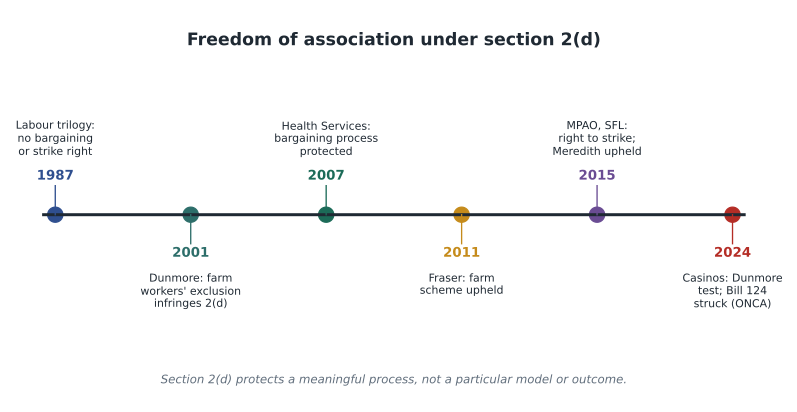
Fraser and the limits of Health Services
Ontario responded to Dunmore with the Agricultural Employees Protection Act, 2002, which allowed farm workers to form associations and make representations to employers, who had to listen and respond in good faith, but did not provide for certification, exclusive representation or a statutory duty to bargain. In Ontario (Attorney General) v. Fraser, 2011 SCC 20, the court upheld the statute. The majority read it as implicitly requiring employers to consider employees' representations in good faith, and held that section 2(d) does not require a Wagner Act model. Fraser showed that Health Services protected a process, not a particular statutory scheme.
The 2015 trilogy
Three decisions in early 2015 consolidated the modern law. In Mounted Police Association of Ontario v. Canada (Attorney General), 2015 SCC 1, the court struck down the exclusion of RCMP members from collective bargaining and the imposition of a management-controlled staff relations program. The majority held that section 2(d) protects a meaningful process of collective bargaining that provides employees with a degree of choice and independence sufficient to enable them to determine and pursue their collective interests. An employer-dominated association does not satisfy that guarantee.
In Saskatchewan Federation of Labour v. Saskatchewan, 2015 SCC 4, the court recognized the right to strike. Saskatchewan's Public Service Essential Services Act allowed public employers to designate essential employees unilaterally, with no independent review of the designations and no meaningful alternative dispute resolution, and the designated employees could not strike. Justice Abella, for the majority, held that the right to strike is an indispensable component of the right to a meaningful process of collective bargaining, and that a prohibition on strikes substantially interferes with that process. The statute was not minimally impairing because it went beyond what was reasonably required to ensure the continued delivery of essential services, and in particular because it provided no impartial mechanism for resolving disputes. The court explicitly overruled the 1987 trilogy on the right to strike.
In Meredith v. Canada (Attorney General), 2015 SCC 2, decided the same day, the court upheld federal legislation that rolled back scheduled wage increases for RCMP members as part of broader public sector restraint. The majority found no substantial interference, because the restraints were consistent with the outcome of bargaining elsewhere in the public sector, were limited in time, and did not prevent consultation on other matters. Meredith shows that wage restraint is not automatically unconstitutional.
Société des casinos (2024): the test confirmed
The most recent Supreme Court decision is Société des casinos du Québec inc. v. Association des cadres de la Société des casinos du Québec, 2024 SCC 13, released on April 19, 2024. Quebec's Labour Code excludes managers from its definition of employee, so first-level managers at Quebec's state casino corporation could not obtain certification. Their association argued that the exclusion infringed section 2(d) of the Canadian Charter and section 3 of the Quebec Charter. Justice Jamal, for the majority, held that the only framework for determining whether legislation infringes section 2(d) is the two-step test derived from Dunmore. At the first step, the court asks whether the activities the claimants seek to pursue fall within the scope of freedom of association; at the second, whether the legislation, in purpose or effect, substantially interferes with those activities. The managers' activities, including forming an independent association and making collective representations, were within the scope of the freedom. But the exclusion did not substantially interfere with them in purpose or effect, so there was no infringement. Justice Côté, with Chief Justice Wagner, and Justice Rowe agreed in the result but interpreted the framework differently.
Wage restraint in Ontario: Bill 124
The leading recent appellate decision in Ontario concerns the Protecting a Sustainable Public Service for Future Generations Act, 2019, known as Bill 124, which capped compensation increases for most broader public sector employees, including nurses, teachers and university staff, at 1 percent a year for three years. In Ontario English Catholic Teachers Association v. Ontario (Attorney General), 2024 ONCA 101, decided on February 12, 2024, the majority of the Court of Appeal held that the statute substantially interfered with collective bargaining for unionized employees and was not justified under section 1. The majority pointed to the lack of meaningful consultation, the broad definition of compensation and an exemption process it regarded as illusory, and found that the government had not shown the restraint was minimally impairing or proportionate. Justice Hourigan dissented. The majority also held that the trial judge erred in striking down the statute entirely: it was invalid only as it applied to unionized employees, since non-union employees have no collective bargaining process to interfere with. Ontario did not appeal and repealed the statute, and arbitrators subsequently awarded retroactive increases to many affected groups.
The Bill 124 litigation shows how the post-2007 framework operates in practice. Courts do not ask whether a wage settlement is fair. They ask whether the government substantially interfered with the process of bargaining and, if so, whether it can justify that interference with evidence.
Back-to-work legislation and the notwithstanding clause
After Saskatchewan Federation of Labour, back-to-work legislation that ends a lawful strike must be justified under section 1. Courts have considered factors such as whether the government allowed bargaining a fair chance, whether the legislation imposes a neutral arbitration process or dictates the outcome, and whether the stoppage posed a genuine threat to essential services or the economy. In 2016, for example, the Ontario Superior Court held that the 2012 legislation that imposed contracts on teachers and education workers infringed section 2(d), and the province later agreed to pay compensation to the affected unions.
Governments can also use section 33, the notwithstanding clause, to shield legislation from sections 2 and 7 to 15 for renewable five-year periods. In November 2022, Ontario invoked section 33 in the Keeping Students in Class Act, 2022, which prohibited a strike by education workers and imposed a contract. After the workers walked out anyway, amid widespread protest, Ontario agreed to repeal the statute in exchange for the union ending the walkout, and the repeal followed within about two weeks of enactment. The episode illustrated both the legal power of section 33 and its political cost.
Freedom of expression and picketing
Section 2(b) of the Charter protects picketing and leafleting as expressive activity, although picketing that is coercive or blocks access can be limited. In U.F.C.W., Local 1518 v. KMart Canada Ltd., [1999] 2 S.C.R. 1083, the Supreme Court struck down a British Columbia provision that prohibited leafleting at secondary sites, because peaceful leafleting is a less coercive form of expression than picketing. In Alberta (Information and Privacy Commissioner) v. United Food and Commercial Workers, Local 401, 2013 SCC 62, the court held that a privacy statute that prevented a union from recording and using images of people crossing a picket line infringed section 2(b). Pepsi-Cola, discussed in lesson 9, developed the common law of picketing in light of Charter values.
Applying the framework
Sabourin ends with a hypothetical. Suppose Ontario, after a long strike at a private home care agency, passes legislation that ends the strike, imposes the employer's last offer for three years and prohibits bargaining on staffing levels for that period. Theo Marchetti works through it. There is government action: a statute. Striking and bargaining on staffing levels are within the scope of freedom of association. Ending the strike and imposing the employer's offer while prohibiting bargaining on a central issue would almost certainly substantially interfere with the bargaining process, under Health Services and Saskatchewan Federation of Labour. The province would have to justify the law under section 1. Imposing one party's offer, rather than a neutral arbitration process, would make minimal impairment very difficult to show. Unless the province used section 33, the legislation would likely be struck down.
| Case | Year | Holding on section 2(d) |
|---|---|---|
| Alberta Reference (labour trilogy) | 1987 | No protection for collective bargaining or striking; later overruled |
| Dunmore v. Ontario | 2001 | Total exclusion of farm workers from organizing protections infringes 2(d) |
| Health Services v. British Columbia | 2007 | Protects a process of good faith collective bargaining |
| Ontario v. Fraser | 2011 | Ontario's farm worker scheme upheld; no Wagner model required |
| Mounted Police Association v. Canada | 2015 | Protects a meaningful process with choice and independence |
| Saskatchewan Federation of Labour | 2015 | Protects the right to strike |
| Meredith v. Canada | 2015 | RCMP wage restraint upheld; no substantial interference |
| Société des casinos du Québec | 2024 | Two-step Dunmore test confirmed; exclusion of managers upheld |
Worked problem
A Charter challenge to an essential services law
A province passes a law allowing the government, by regulation, to designate any public sector job as essential, with no review, and prohibiting designated employees from striking. Disputes are to be settled by the minister. A union representing paramedics and clerical staff challenges the law. Analyze the claim.
Show solution
- Government action: a provincial statute and regulations, so the Charter applies (section 32).
- Scope (step one): striking is within the scope of freedom of association as part of a meaningful bargaining process (Saskatchewan Federation of Labour; Société des casinos).
- Substantial interference (step two): prohibiting strikes for designated employees substantially interferes with bargaining. A designation power covering clerical staff with no review goes well beyond genuinely essential services.
- Section 1: the objective of maintaining essential services is pressing and substantial, but the law is unlikely to be minimally impairing because it allows unilateral designations without independent review and replaces the strike with resolution by the minister rather than an impartial process. The law is likely unconstitutional, at least as applied to non-essential workers.
Common mistakes
MistakeArguing that a private employer's refusal to bargain violates section 2(d) of the Charter.
InsteadThe Charter applies only to government action (Dolphin Delivery). Private sector bargaining duties come from the Labour Relations Act.
MistakeSaying section 2(d) guarantees a Wagner Act model or a particular outcome.
InsteadHealth Services and Fraser protect a meaningful process of good faith bargaining, not a specific statutory model or result.
MistakeTreating all wage restraint legislation as unconstitutional.
InsteadMeredith upheld wage restraint; Bill 124 failed because of how it interfered with bargaining and the lack of justification.
MistakeRelying on the 1987 trilogy to deny a right to strike.
InsteadSaskatchewan Federation of Labour (2015) overruled the trilogy and recognized the right to strike under section 2(d).
MistakeUsing a different test for "positive" and "negative" freedom of association claims.
InsteadSociété des casinos (2024) confirmed that the two-step Dunmore framework is the only test for whether legislation infringes section 2(d).
Practice problems
Work each problem on paper first, then reveal the answer to check.
What did Health Services overrule, and what did it hold?
Show answer
It overruled the 1987 trilogy so far as it denied protection to collective bargaining, holding that section 2(d) protects a process of good faith collective bargaining and is infringed by substantial interference with that process.
Why was the Saskatchewan essential services statute struck down?
Show answer
Because prohibiting strikes substantially interfered with collective bargaining, and the statute was not minimally impairing: employers designated essential employees unilaterally, without independent review, and there was no meaningful impartial dispute resolution mechanism.
What did the Court of Appeal decide about Bill 124, and why was the remedy limited?
Show answer
It held that Bill 124 unjustifiably infringed section 2(d) for unionized employees, and declared it invalid only as applied to them, because non-union employees had no bargaining process with which the statute interfered.
What is the two-step test confirmed in Société des casinos?
Show answer
First, whether the activities the claimants seek to pursue fall within the scope of freedom of association; second, whether the legislation, in purpose or effect, substantially interferes with those activities.
Summary and key terms
- The Charter applies only to government action; private labour relations are governed by statute and common law developed consistently with Charter values (Dolphin Delivery).
- The 1987 trilogy denied protection to bargaining and striking; Dunmore (2001) and Health Services (2007) recognized protection for organizing and a process of good faith bargaining.
- Fraser (2011) upheld Ontario's farm worker scheme; the 2015 trilogy protected a meaningful, independent bargaining process (MPAO), recognized the right to strike (SFL) and upheld wage restraint (Meredith).
- Société des casinos (2024) confirmed the two-step Dunmore test and upheld the exclusion of managers; the Court of Appeal struck down Bill 124 for unionized workers in 2024.
- Back-to-work laws must be justified under section 1 unless section 33 is used, as Ontario briefly did in 2022; section 2(b) protects peaceful picketing and leafleting.
- Freedom of association
- The Charter section 2(d) freedom to form associations and pursue collective goals, including a meaningful process of collective bargaining and the right to strike.
- Substantial interference
- The threshold for a section 2(d) infringement: a law that in purpose or effect significantly disrupts protected associational activity.
- Labour trilogy
- The 1987 Supreme Court decisions holding that section 2(d) did not protect bargaining or striking, later overruled.
- Section 1
- The Charter provision allowing reasonable limits on rights that can be demonstrably justified in a free and democratic society.
- Notwithstanding clause
- Section 33 of the Charter, allowing legislatures to override certain rights for renewable five-year periods.
- Essential services
- Services whose interruption would endanger life, health or safety, which may justify limits on the right to strike.
Lesson quiz · 5 questions
Score 60% or more to complete this lesson.
Create a free account to save your progress, take quizzes and earn a certificate.