
LAWC-302 · Lesson 11 of 12 · 25 min
Occupational health and safety
▶ Video coming soon A video version of this lesson is on the way.
Professor Sabourin opens the eleventh class with a photograph of a warehouse aisle, the kind found in any distribution centre in Ontario: tall steel racks loaded with pallets, a forklift parked at the end and a yellow line painted on the concrete floor. 'Most of you will never prosecute or defend a health and safety case,' he says. 'But every one of you will advise employers and employees who work in places like this, and when someone is hurt, every other issue in the file, from the termination to the human rights claim to the grievance, will be shaped by what happened here.'
The Pellridge file takes a serious turn. On a Tuesday afternoon, a forklift operated by a trainee struck an upright on a pallet rack in aisle 7. A section of the rack partly collapsed, and a box of steel fittings fell, striking a picker, Sanjay Iqbal, on the shoulder and fracturing his collarbone. Two weeks earlier, a joint health and safety committee member had reported that the upright was bent and recommended that the aisle be closed until it was replaced. The warehouse supervisor had put a cone in front of the damaged upright and told staff to 'be careful'. The day after the incident, Benedetta Ferrante refused to work in aisle 9, where she said another upright looked bent.
This lesson explains Ontario's Occupational Health and Safety Act and the internal responsibility system, the duties of employers, supervisors, directors and workers, workers' rights to know, participate and refuse, workplace violence and harassment, regulatory enforcement and the defence of due diligence, criminal liability after the Westray disaster, and the workers' compensation system.
The internal responsibility system
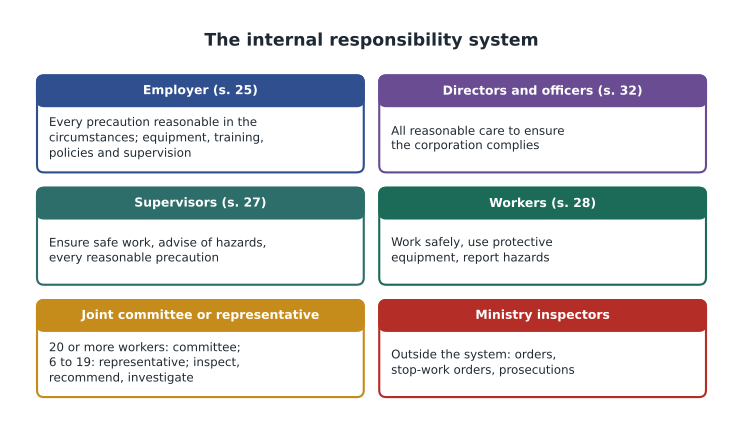
Ontario's Occupational Health and Safety Act was enacted in 1978 and came into force in 1979, following the 1976 report of the Royal Commission on the Health and Safety of Workers in Mines, chaired by James Ham. The Ham Commission found that the safety of workers depended mainly on the people in the workplace, not on outside inspectors, and recommended what it called the internal responsibility system. Under that system, everyone in the workplace, from the board of directors to the newest worker, has a share of responsibility for health and safety, in proportion to their authority and ability. Government inspectors act as a backstop rather than the primary mechanism.
The Act's structure reflects this philosophy. It imposes duties on employers, supervisors, workers, owners, constructors, suppliers and corporate directors and officers. It creates joint health and safety committees, with at least half their members representing workers, at workplaces regularly employing 20 or more workers, and requires a health and safety representative selected by workers at workplaces with six to nineteen. Committees inspect the workplace at least monthly, identify hazards, make written recommendations to which the employer must respond in writing within 21 days, and investigate serious incidents.
The duties
Section 25 sets out the employer's duties. Under section 25(1), the employer must ensure that equipment, materials and protective devices are provided and maintained in good condition and that prescribed measures and procedures are carried out. Under section 25(2), the employer must provide information, instruction and supervision to protect workers, appoint competent supervisors, acquaint workers with hazards, prepare and review a written health and safety policy, and, in the general duty clause in section 25(2)(h), take every precaution reasonable in the circumstances for the protection of a worker. The general duty clause is broad. It allows the prosecution of employers for hazards that no specific regulation addresses.
Supervisors, defined as persons who have charge of a workplace or authority over a worker, must ensure that workers work in the manner and with the protective devices required, advise workers of hazards of which the supervisor is aware, and take every precaution reasonable in the circumstances for the protection of workers (section 27). Workers must work in compliance with the Act, use required equipment, and report known hazards and contraventions to the employer or supervisor (section 28). Directors and officers of a corporation must take all reasonable care to ensure that the corporation complies with the Act, the regulations and orders (section 32). In the Pellridge incident, each of these duties is engaged: the employer's duty to maintain equipment and take every reasonable precaution, the supervisor's duty to act on a known hazard, and the trainee's duty to operate the forklift safely within his training.
Ontario's Regulation 851 for industrial establishments contains detailed requirements for racking, storage and material handling equipment. Among other things, it requires that material be stored in a manner that prevents tipping, collapsing or falling and that powered lift trucks be operated only by competent workers. Pellridge's failure to remove the damaged upright from service after the committee's recommendation is likely to be the focus of any prosecution.
Workers' rights: to know, to participate and to refuse
The Act gives workers three core rights. The right to know includes the right to be informed about hazards, including through the Workplace Hazardous Materials Information System (WHMIS), which requires labels, safety data sheets and worker education for hazardous products. The right to participate is exercised through the joint committee or the health and safety representative. And the right to refuse unsafe work is set out in section 43.
Under section 43(3), a worker may refuse to work or to do particular work if the worker has reason to believe that any equipment, machine, device or thing the worker is to use or operate is likely to endanger the worker or another worker, that the physical condition of the workplace is likely to endanger the worker, that workplace violence is likely to endanger the worker, or that the equipment or work contravenes the Act or regulations and is likely to endanger the worker or another worker. The worker must promptly report the refusal and the reasons to the employer or supervisor. The employer must investigate in the presence of the worker and a worker member of the joint committee or the health and safety representative. If the refusal continues, an inspector is called, investigates and gives a written decision. While waiting, the worker must remain in a safe place near the work station, and the employer may assign reasonable alternative work.
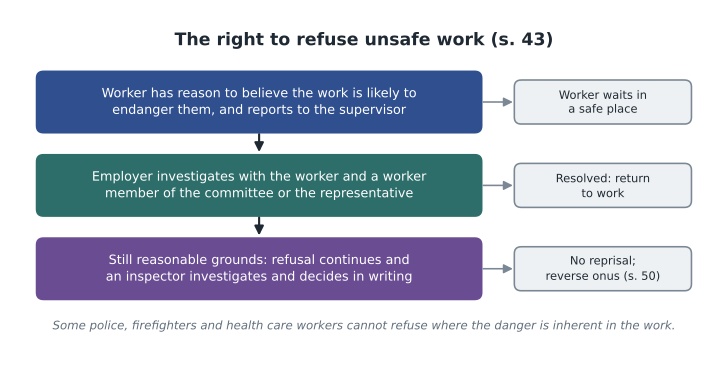
The right to refuse is limited for some workers. Police officers, firefighters, workers in correctional institutions and certain workers in hospitals and other health care facilities cannot refuse where a circumstance is inherent in their work or is a normal condition of their employment, or where the refusal would directly endanger the life, health or safety of another person. Section 50 prohibits reprisals against a worker for acting in compliance with the Act, including refusing work in good faith, and in a reprisal complaint to the Ontario Labour Relations Board, the burden is on the employer to prove that it did not act in reprisal. Unionized workers may instead pursue a reprisal through grievance arbitration.
Ferrante's refusal in aisle 9, the day after Iqbal's injury, is a textbook example of a legitimate refusal. She has reason to believe that the physical condition of the workplace, a possibly bent upright, is likely to endanger her, and the events of the previous day make her belief entirely reasonable. Pellridge must investigate with a worker committee member present. If it tries to discipline her, particularly given her history as a union supporter, it will face both an OHSA reprisal complaint and an unfair labour practice complaint, and the burden of proof in each will be on Pellridge.
Workplace violence and harassment
Since 2010, the Act has required employers to address workplace violence and harassment. Employers must prepare policies on workplace violence and workplace harassment, review them at least annually, and develop programs to implement them, including measures for workers to report incidents and procedures for investigating and dealing with them. In 2016, the definition was expanded to include workplace sexual harassment, and employers became obliged to ensure that an investigation appropriate in the circumstances is conducted into incidents and complaints, and to inform the worker who complained and the alleged harasser of the results. An inspector may order an employer to have an investigation conducted by an impartial person at the employer's expense.
Workplace harassment means engaging in a course of vexatious comment or conduct against a worker in a workplace that is known or ought reasonably to be known to be unwelcome, or workplace sexual harassment. A reasonable action taken by an employer or supervisor relating to the management and direction of workers or the workplace is not workplace harassment. In Metrolinx v. Amalgamated Transit Union, Local 1587, decided by the Court of Appeal in 2025, the court affirmed that the employer's statutory obligation to investigate harassment can extend to off-duty conduct that affects the workplace, and that the employer may discipline for such conduct. The case reinforces the link between health and safety law and the just cause analysis in lesson 6, as Render v. ThyssenKrupp also showed.
Enforcement, offences and due diligence
Ministry inspectors may enter workplaces without a warrant, inspect, take samples, interview workers and issue orders requiring compliance, including stop-work orders. Orders may be appealed to the Ontario Labour Relations Board. Employers must report critical injuries and deaths to the Ministry immediately, and the scene must not be disturbed, except to protect life or prevent further injury, without an inspector's permission. A fractured collarbone may or may not meet the regulatory definition of critical injury, which includes fractures of major bones such as the leg or arm, so Pellridge should report and consult counsel promptly.
Contraventions of the Act are provincial offences prosecuted in the Ontario Court of Justice. Under section 66, a corporation is liable to a fine of up to 2 million dollars, an increase that took effect on October 26, 2023; a director or officer of a corporation is liable to a fine of up to 1.5 million dollars, imprisonment for up to twelve months, or both; and any other individual, such as a supervisor, is liable to a fine of up to 500,000 dollars, imprisonment for up to twelve months, or both. A corporation convicted of a second or subsequent offence resulting in death or serious injury within a two-year period faces a minimum fine of 500,000 dollars. Courts also impose a victim fine surcharge.
Offences under the Act are strict liability offences under the framework in R. v. Sault Ste. Marie (City), [1978] 2 S.C.R. 1299. The Crown must prove the prohibited act beyond a reasonable doubt but need not prove intent. The accused can escape liability by proving, on a balance of probabilities, that it exercised due diligence: that it took all reasonable care to prevent the event, or that it reasonably believed in a mistaken set of facts which, if true, would have made the act innocent. Due diligence is assessed in light of the foreseeability of the hazard, the employer's knowledge, industry standards and the steps actually taken. An employer that has written policies but fails to enforce them, or that knows of a specific hazard and does not fix it, will rarely establish due diligence. Pellridge's knowledge of the bent upright for two weeks, and its decision to rely on a cone and a warning, will make due diligence very difficult to prove.
| Person | Statutory duty | Maximum penalty |
|---|---|---|
| Employer (corporation) | Section 25, including every precaution reasonable in the circumstances | Fine of 2,000,000 dollars (since October 26, 2023) |
| Director or officer | Section 32: all reasonable care to ensure corporate compliance | Fine of 1,500,000 dollars and/or 12 months |
| Supervisor | Section 27: ensure safe work, advise of hazards, every reasonable precaution | Fine of 500,000 dollars and/or 12 months |
| Worker | Section 28: work safely, use equipment, report hazards | Fine of 500,000 dollars and/or 12 months |
Criminal liability after Westray
On May 9, 1992, an underground methane and coal dust explosion at the Westray mine in Plymouth, Nova Scotia killed 26 miners. The public inquiry led by Justice Peter Richard found that the disaster resulted from a complex mix of management failures, regulatory neglect and a culture that ignored safety. Prosecutions of the company and two managers failed. The inquiry's report, titled The Westray Story: A Predictable Path to Disaster, recommended changes to the criminal law, and Parliament responded with Bill C-45, which came into force on March 31, 2004.
Bill C-45 made two key changes to the Criminal Code. Section 217.1 imposes a legal duty on everyone who undertakes, or has the authority, to direct how another person does work or performs a task to take reasonable steps to prevent bodily harm to that person, or any other person, arising from that work or task. Breach of that duty, showing wanton or reckless disregard for the lives or safety of others, can support a conviction for criminal negligence. And sections 22.1 and 22.2 made it easier to convict organizations by attributing to them the conduct and state of mind of their representatives and senior officers. Section 718.21 lists factors for sentencing organizations.
The leading Ontario cases arose from a construction disaster on Christmas Eve 2009, when a swing stage collapsed at a Toronto apartment building and four workers fell to their deaths; a fifth was seriously injured. The workers had not been tied off to lifelines, the swing stage was defective, and several workers had consumed drugs. In R. v. Metron Construction Corp., 2013 ONCA 541, the company pleaded guilty to criminal negligence causing death, and the Court of Appeal increased its fine from 200,000 dollars to 750,000 dollars, emphasizing the need for general deterrence. In R. v. Kazenelson, 2018 ONCA 77, the court upheld the conviction of the project manager for criminal negligence causing death and his sentence of three and a half years' imprisonment. More recently, in R. v. Urgiles, 2025 ONSC 845, a supervisor was sentenced to five years' imprisonment for criminal negligence causing death.
Criminal charges remain rare compared with regulatory prosecutions, but they are no longer exceptional. For the Pellridge incident, no criminal charge is likely: Iqbal was injured, not killed, and the conduct, though negligent, may not reach the standard of wanton or reckless disregard. But the supervisor's decision to rely on a cone after a written warning about a damaged rack is exactly the kind of conduct section 217.1 was designed to address if the outcome had been worse.
Workers' compensation
Iqbal cannot sue Pellridge for his injury. Ontario's workers' compensation system, now governed by the Workplace Safety and Insurance Act, 1997, rests on a historic compromise recommended by Sir William Meredith in 1913 and enacted in 1914: workers receive no-fault compensation for workplace injuries, funded by employer premiums, and in exchange give up the right to sue their employer and co-workers. Section 28 of the Act bars actions by workers against Schedule 1 employers and their workers, and the Workplace Safety and Insurance Appeals Tribunal decides whether an action is barred.
Iqbal's remedy is a claim to the Workplace Safety and Insurance Board for loss of earnings benefits, health care costs and, if he has a permanent impairment, a non-economic loss award. Since January 1, 2018, the system has covered chronic mental stress caused by substantial work-related stressors, such as workplace harassment, in addition to traumatic mental stress. The employer has obligations to report the injury, to cooperate in Iqbal's early and safe return to work, and, for employers regularly employing 20 or more workers, to re-employ a worker with at least one year's continuous employment who has been unable to work because of the injury, subject to the duty to accommodate under the Human Rights Code.
Worked problem
Advising Pellridge after the aisle 7 incident
Pellridge's president asks what Pellridge must do now, what liability it faces, and whether it can discipline Ferrante for refusing to work in aisle 9 'when the inspector had already been called about aisle 7'. Advise.
Show solution
- Immediate duties: report the injury to the Ministry if it is a critical injury and in any event to the Workplace Safety and Insurance Board; preserve the scene; notify the joint committee; investigate; and inspect and remove from service all damaged racking.
- Regulatory liability: Pellridge faces a likely prosecution under section 25(2)(h) and Regulation 851. Its due diligence defence is weak because it knew of the hazard for two weeks. The supervisor may also be charged under section 27. Maximum fines are 2 million dollars for the corporation and 500,000 dollars for the supervisor.
- Ferrante: her refusal is a protected right under section 43, and the earlier call to the inspector about aisle 7 does not remove it. Pellridge must follow the refusal procedure and may assign alternative work. Discipline would be a reprisal under section 50 and, given her union activity, likely an unfair labour practice.
- Iqbal: his claim is to the Board, not the courts. Pellridge must support his return to work and, as an employer of more than 20 workers, has re-employment obligations if he has a year of continuous employment.
Common mistakes
MistakeTreating health and safety as the inspector's job.
InsteadUnder the internal responsibility system, employers, supervisors, directors and workers all have statutory duties; inspectors are a backstop.
MistakeTelling a worker they cannot refuse because the hazard has already been reported.
InsteadSection 43 gives a worker who has reason to believe work is likely to endanger them the right to refuse, regardless of earlier reports. Reprisals are prohibited by section 50.
MistakeAssuming a written safety policy establishes due diligence.
InsteadDue diligence requires proof that all reasonable care was actually taken, including enforcement and response to known hazards (Sault Ste. Marie).
MistakeAdvising an injured worker to sue the employer for negligence.
InsteadSection 28 of the Workplace Safety and Insurance Act bars actions against Schedule 1 employers; the remedy is a claim to the Board.
MistakeSaying the Westray amendments created a new offence of corporate killing.
InsteadBill C-45 added a duty in section 217.1 and new rules for organizational liability; charges are laid as criminal negligence causing death or bodily harm.
Practice problems
Work each problem on paper first, then reveal the answer to check.
What is the general duty clause in Ontario's Occupational Health and Safety Act?
Show answer
Section 25(2)(h), which requires the employer to take every precaution reasonable in the circumstances for the protection of a worker.
Describe the steps in a work refusal under section 43.
Show answer
The worker reports the refusal to the supervisor or employer; the employer investigates with the worker and a worker member of the joint committee or the representative present; if the worker still has reasonable grounds, the refusal continues and an inspector investigates and decides in writing. The worker stays in a safe place nearby meanwhile.
What are the maximum fines under section 66 for a corporation, a director or officer, and a supervisor?
Show answer
2 million dollars for a corporation (since October 26, 2023), 1.5 million dollars for a director or officer, and 500,000 dollars for other individuals such as supervisors, with up to twelve months' imprisonment for individuals.
What duty does section 217.1 of the Criminal Code impose?
Show answer
A duty on everyone who undertakes, or has the authority, to direct how another person does work to take reasonable steps to prevent bodily harm to that person or others arising from the work.
Summary and key terms
- The Occupational Health and Safety Act is built on the internal responsibility system recommended by the Ham Commission: duties for employers, supervisors, directors, officers and workers, with joint committees and representatives.
- Employers must take every precaution reasonable in the circumstances (section 25(2)(h)); supervisors, workers and directors have their own duties.
- Workers have the rights to know, to participate and to refuse unsafe work under section 43; reprisals are prohibited and the employer bears the burden of disproof.
- Offences are strict liability; due diligence is the defence. Maximum fines are 2 million dollars for corporations, 1.5 million for directors and officers, and 500,000 for other individuals.
- After Westray, section 217.1 of the Criminal Code and organizational liability rules support criminal negligence prosecutions (Metron; Kazenelson); injured workers receive no-fault compensation instead of suing.
- Internal responsibility system
- The principle that everyone in the workplace shares responsibility for health and safety according to their authority and ability.
- Joint health and safety committee
- A committee of worker and management representatives required at workplaces with 20 or more workers.
- Work refusal
- A worker's statutory right to refuse work they have reason to believe is likely to endanger them.
- Due diligence
- The defence to a strict liability offence that the accused took all reasonable care to prevent the event.
- Critical injury
- A serious injury defined by regulation that must be reported immediately and triggers scene preservation.
- Historic compromise
- The workers' compensation bargain under which workers receive no-fault benefits in exchange for giving up the right to sue.
Lesson quiz · 5 questions
Score 60% or more to complete this lesson.
Create a free account to save your progress, take quizzes and earn a certificate.