
LAWC-302 · Lesson 8 of 12 · 24 min
Unions and bargaining: certification and the Wagner Act model
▶ Video coming soon A video version of this lesson is on the way.
The eighth class meets on the day the Pellridge file takes a new turn. Professor Sabourin hands out an email that Pellridge's operations director, Romilly Ormerod, sent to all warehouse staff that morning. It says that 'outsiders' from the Federated Warehouse and Logistics Workers Union, Local 60, a fictional union for this course, have been seen handing out cards at the warehouse gate. It says that Pellridge 'respects every employee's right to choose' but that 'a union would destroy the family atmosphere we have built and could make the Corwin warehouse uncompetitive compared to our London location.' It invites everyone to a paid meeting in the lunchroom on Friday 'to hear the facts.'
'Read that email three times,' Sabourin says. 'Then tell me which sentences are lawful, which are not, and what the union's lawyer is going to do with it.' This lesson provides the tools: the history and principles of the Wagner Act model, who can unionize, how a union becomes certified in Ontario, what employers and unions may and may not do during an organizing campaign, and the duty to bargain in good faith once a union is certified.
The Wagner Act model
Canadian collective bargaining law is built on a model borrowed from the United States National Labor Relations Act of 1935, known as the Wagner Act. The model has several defining features. Workers choose whether to be represented by a union through a process supervised by a labour relations board. A certified union becomes the exclusive bargaining agent for all employees in a defined bargaining unit, whether or not they are members. The employer must recognize the union and bargain with it in good faith. Strikes and lockouts are permitted only after the collective agreement expires and statutory conditions are met, and are prohibited during the term of an agreement. Disputes about the meaning of the agreement are resolved by binding grievance arbitration. And specialized tribunals, rather than courts, administer the system.
The model came to Canada through the federal wartime order P.C. 1003 of 1944, which applied to most industries during the war, and was then adopted in federal and provincial statutes after the war. A distinctively Canadian addition came from Justice Ivan Rand's 1946 arbitration award ending the Ford strike in Windsor. Rand held that because the union bargains for and benefits every employee in the unit, every employee should pay union dues, but no employee should be compelled to become a member. The Rand formula, requiring dues deduction from all bargaining unit employees, is now required by statute in Ontario on the union's request. The Supreme Court upheld compulsory dues against a Charter challenge in Lavigne v. Ontario Public Service Employees Union, [1991] 2 S.C.R. 211.
Sabourin asks why the system uses exclusive representation rather than allowing several unions or individual bargaining. Sophie Tremblay-Hart answers that exclusivity gives the union bargaining power and gives the employer a single counterpart. 'And it is why the union owes a duty of fair representation to every member of the unit,' Sabourin adds. 'If you are the only voice, you have to speak for everyone.'
Who can unionize
The Labour Relations Act, 1995 applies to most private sector employers in Ontario and to many public sector employers such as municipalities, hospitals and universities. Some public sector workers, including teachers, police, firefighters, Crown employees and community college staff, have separate statutes. The Act excludes certain people from its definition of employee. Under section 1(3), a person who exercises managerial functions or is employed in a confidential capacity in matters relating to labour relations is not an employee. Members of some professions, such as architects, dentists, land surveyors, lawyers and physicians, employed in their professional capacity, are excluded by section 3. Agricultural workers are excluded and are covered instead by the Agricultural Employees Protection Act, 2002, a narrower statute upheld by the Supreme Court in Ontario (Attorney General) v. Fraser, 2011 SCC 20, which lesson 10 discusses.
As lesson 1 explained, the Act includes dependent contractors in its definition of employee. That is how Pellridge's owner-operator drivers, if they are economically dependent on Pellridge, could join a bargaining unit, although the Board may place dependent contractors in a separate unit.
The bargaining unit
A union applies to represent a bargaining unit described in its application, such as 'all employees of Pellridge Supply Ltd. at its warehouse in Corwin, save and except supervisors, persons above the rank of supervisor, office and clerical staff and sales staff.' The Ontario Labour Relations Board decides whether the unit is appropriate for collective bargaining under section 9. The Board considers whether employees share a community of interest, whether the unit would allow viable bargaining, and whether it would cause serious labour relations harm to the employer, for example by fragmenting the workforce into too many small units. The union does not need to propose the most appropriate unit, only an appropriate one.
Certification in Ontario
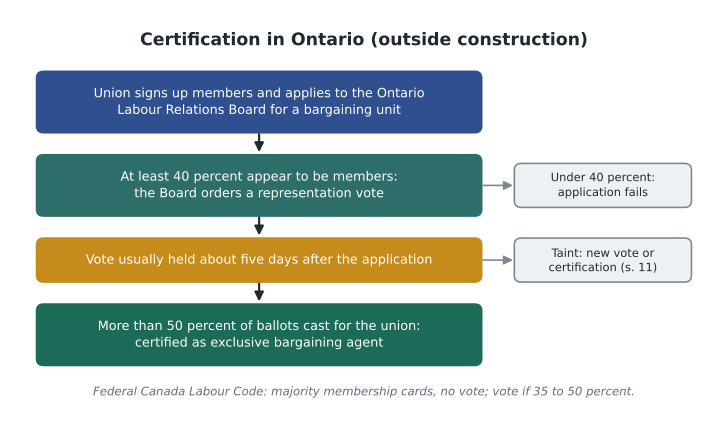
Outside the construction industry, Ontario uses a mandatory vote system. The union files an application for certification with the Board, together with evidence of membership, usually signed membership cards. If the Board is satisfied that 40 percent or more of the employees in the proposed bargaining unit appear to be members, it directs a representation vote under section 8. The vote is normally held five days after the application is filed, a short period designed to limit the opportunity for pressure. The union is certified if more than 50 percent of the ballots cast are in its favour. The employer files a response and a list of employees, and disputes about who is in the unit can be dealt with after the vote by segregating disputed ballots.
The construction industry has its own rules in Ontario, and some other sectors have been subject to card-based certification at various times. Other jurisdictions take different approaches. Under the federal Canada Labour Code, the Canada Industrial Relations Board certifies a union without a vote if more than 50 percent of employees in the unit are members, and orders a vote if membership is between 35 and 50 percent. Card-based certification for federally regulated employers was restored in 2017. Several provinces use card check for some or all certifications, and the policy debate between cards and votes is one of the most persistent in Canadian labour law. Card check is faster and gives employers less opportunity to campaign against the union; votes are secret and may better reflect employees' considered choices.
Unfair labour practices during organizing
The Act protects the organizing process. Section 70 prohibits an employer from participating in or interfering with the formation, selection or administration of a trade union or the representation of employees by a union, and from contributing financial or other support to a union. Section 72 prohibits an employer from refusing to employ or continue to employ a person, or discriminating against a person in regard to employment or any term or condition of employment, because the person is or proposes to become a union member or is exercising rights under the Act. Section 76 prohibits any person from seeking by intimidation or coercion to compel a person to become or cease to be a union member. Section 86, the statutory freeze, prohibits an employer from changing wages or other terms of employment without the union's consent once it has been notified of an application for certification, except in accordance with the way the business was carried on before.
Two procedural features make these protections effective. First, under section 96(5), when a complaint alleges that an employer acted contrary to the Act, the burden of proof that it did not do so lies on the employer. An employer that disciplines or dismisses a union supporter during a campaign must prove that anti-union sentiment played no part in the decision. Second, the Board can order interim relief, including the interim reinstatement of an employee dismissed during an organizing campaign, under section 98, pending a full hearing.
Employer speech
Employers are not required to stay silent. Section 70 provides that nothing in it deprives an employer of its freedom to express its views so long as it does not use coercion, intimidation, threats, promises or undue influence. The Board has developed a substantial body of case law on where the line falls. An employer may state facts, express its preference for a direct relationship with employees and correct what it believes are inaccuracies in the union's campaign. It may not threaten job losses, plant closures, loss of benefits or other reprisals if employees unionize, or promise improvements if they reject the union. Statements that are framed as predictions can be threats if the employer controls the outcome. Captive audience meetings, where employees are required to attend a meeting on paid time to hear the employer's views, are not automatically unlawful in Ontario, but the Board will consider them as part of the overall context of whether the employer used undue influence.
Sabourin returns to Ormerod's email. Arjun Mehta works through it. Saying that Pellridge respects employees' right to choose is lawful. Saying that the employer prefers a 'family atmosphere' is an opinion and likely lawful on its own. But saying that a union 'could make the Corwin warehouse uncompetitive compared to our London location' is a veiled threat of relocation or job loss within the employer's control, which is a classic form of coercion or intimidation. The Friday meeting on paid time is not unlawful in itself, but combined with the threat, it adds to the pressure. 'And the union's lawyer,' Sabourin says, 'will file an unfair labour practice complaint, ask the Board to keep the email in mind when it assesses the vote, and watch very carefully what happens to the union's inside organizer.'
The campaign unfolds
The facts develop over the following weeks. Benedetta Ferrante, a picker with eight years' service who has been the union's main supporter inside the warehouse, is moved to a night shift two days after the email and is dismissed the following week for being late three times. The union applies for certification with membership cards from 52 percent of the 58 employees in the proposed unit. The vote is held five days later; 55 employees vote, and the union loses 26 to 29. The union files an unfair labour practice complaint alleging that Ferrante's dismissal and the email interfered with the vote, and asks the Board to certify it under section 11.
Theo Marchetti summarizes the union's case. The reverse onus under section 96(5) requires Pellridge to prove that Ferrante's transfer and dismissal were not motivated even in part by her union activity. The timing is suspicious, her record was clean, and lateness after an abrupt move to nights hardly seems serious enough to justify dismissal of an eight-year employee. If the Board finds that Pellridge contravened the Act and that, as a result, the vote is not likely to reflect the employees' true wishes, section 11 allows the Board to order a new representation vote or, where a new vote would not reflect the employees' wishes, to certify the union. The Board can also order Ferrante's reinstatement with compensation.
| Employer conduct during a campaign | Likely status in Ontario |
|---|---|
| Stating facts about wages and benefits accurately | Lawful employer speech |
| Expressing a preference for dealing with employees directly | Usually lawful, if free of threats or promises |
| Suggesting the workplace may close or move if the union wins | Threat; unfair labour practice under sections 70 and 76 |
| Granting a new benefit after notice of the application | Breach of the statutory freeze (section 86) unless business as usual |
| Dismissing a union supporter for minor misconduct | Presumed unlawful unless the employer proves anti-union motive played no part (section 96(5)) |
| Interrogating employees about how they will vote | Interference; unfair labour practice |
After certification: the duty to bargain
Once a union is certified, the employer must recognize it as the exclusive bargaining agent and may not bargain directly with employees about terms of employment. Section 17 requires the parties to meet and bargain in good faith and make every reasonable effort to make a collective agreement. In Royal Oak Mines Inc. v. Canada (Labour Relations Board), [1996] 1 S.C.R. 369, the Supreme Court explained that the duty has a subjective element, a genuine intention to reach an agreement, and an objective element, judged by reasonable industry standards. Hard bargaining is lawful: a party may take a strong position and refuse to move. Surface bargaining, going through the motions without any intention of reaching an agreement, is not. In Royal Oak Mines, which arose from a long and bitter strike at a mine in the Northwest Territories, the employer's refusal to negotiate about the employees it had dismissed during the strike, an issue central to any settlement, was held to breach the duty.
Where a first collective agreement cannot be reached, section 43 of the Act allows either party to apply to the Board for first contract arbitration in specified circumstances, such as where the employer refuses to recognize the union's bargaining authority or adopts uncompromising positions without reasonable justification. First contracts are notoriously difficult, and the availability of arbitration is intended to prevent employers from defeating certification by refusing to agree. The federal Canada Labour Code also provides for first contract arbitration, and the federal Bill C-39, introduced in September 2026 and in committee in October 2026, would make it available as of right after nine months of bargaining.
The union's duties
Exclusive representation brings obligations. Section 74 imposes a duty of fair representation on a certified union: it must not act in a manner that is arbitrary, discriminatory or in bad faith in representing employees in the unit, whether or not they are members. The duty applies most often to decisions about whether to take a grievance to arbitration. A union may decline to pursue a grievance it reasonably believes lacks merit, but it must investigate and consider the employee's interests honestly. Complaints go to the Board. Employees can also apply to terminate a union's bargaining rights, known as decertification, during defined open periods under section 63, and the Act includes successor rights under section 69 that preserve bargaining rights when a business is sold.
Worked problem
Advising Pellridge during the campaign
Before the vote, Romilly Ormerod asks the clinic's supervising lawyer what he can lawfully do. He wants to hold another meeting, give all warehouse staff a 1 dollar an hour raise 'to show we care' and ask shift leads to find out who signed cards. Advise him.
Show solution
- Meetings and speech: he may hold an information meeting and state Pellridge's views and accurate facts, but must avoid threats about the London location, job losses or closure and avoid promises of improvements if the union loses (section 70).
- Raise: once Pellridge has notice of the application, the statutory freeze in section 86 prohibits changes to wages unless consistent with the way the business was carried on before. A new raise in the middle of the campaign would likely be an unfair labour practice and a promise or inducement.
- Finding out who signed: asking shift leads to identify card signers is interference with employees' rights and may be intimidation. It must not be done.
- Ferrante: because of the reverse onus in section 96(5), any discipline of union supporters during the campaign must be carefully justified and documented, and should be reviewed by counsel before it occurs.
Common mistakes
MistakeAssuming that an Ontario union with majority cards is certified without a vote.
InsteadOutside construction, Ontario requires a representation vote once 40 percent membership is shown; certification follows if more than 50 percent of ballots cast support the union. The federal Code uses card check.
MistakePlacing the burden on the union to prove anti-union motive in a dismissal complaint.
InsteadSection 96(5) puts the burden on the employer to prove it did not act contrary to the Act.
MistakeTreating any employer statement during a campaign as unlawful.
InsteadEmployers may express views and facts so long as they do not use coercion, intimidation, threats, promises or undue influence (section 70).
MistakeEquating hard bargaining with bad faith bargaining.
InsteadHard bargaining is lawful. Surface bargaining, with no genuine intention of reaching agreement, breaches section 17 (Royal Oak Mines).
MistakeAssuming a union must take every grievance to arbitration.
InsteadThe duty of fair representation prohibits arbitrary, discriminatory or bad faith conduct; a union may decline a grievance after honest and reasonable consideration.
Practice problems
Work each problem on paper first, then reveal the answer to check.
What is the Rand formula, and where does it come from?
Show answer
A requirement that all bargaining unit employees pay union dues, whether or not they become members, from Justice Rand's 1946 arbitration award in the Ford Windsor strike. It was upheld against a Charter challenge in Lavigne.
What membership level triggers a certification vote in Ontario, and what result is needed?
Show answer
At least 40 percent of the proposed unit must appear to be members; the union is certified if more than 50 percent of ballots cast favour it.
What is the statutory freeze?
Show answer
Under section 86, once the employer has notice of an application for certification, it may not change wages or other terms of employment without the union's consent, except in accordance with its normal way of carrying on business.
What remedies may the Board grant if employer unfair labour practices tainted a vote?
Show answer
Under section 11, it may order a new representation vote or certify the union if a new vote would not reflect the employees' true wishes, and it may order reinstatement and compensation for affected employees.
Summary and key terms
- Canada adopted the Wagner Act model through P.C. 1003 (1944): board-supervised certification, exclusive representation, a duty to bargain, controlled strikes and grievance arbitration; the Rand formula requires dues from all unit employees.
- In Ontario, a union showing 40 percent membership obtains a vote about five days after applying and is certified with more than 50 percent of ballots cast; federally, majority cards suffice.
- Employers may express views but not threaten, coerce, promise or exert undue influence; the statutory freeze and the reverse onus in section 96(5) protect the campaign.
- Tainted votes can lead to a new vote or remedial certification under section 11, and dismissed supporters can be reinstated, including on an interim basis.
- After certification, the parties must bargain in good faith (Royal Oak Mines); first contract arbitration is available in defined cases; the union owes a duty of fair representation.
- Certification
- An order of a labour relations board making a union the exclusive bargaining agent for a bargaining unit.
- Bargaining unit
- The group of employees a union represents, which must be appropriate for collective bargaining.
- Unfair labour practice
- Conduct prohibited by labour relations legislation, such as interference with organizing or dismissal for union activity.
- Statutory freeze
- The prohibition on changing terms of employment after notice of a certification application or during bargaining.
- Rand formula
- A requirement that all bargaining unit employees pay union dues without being required to join the union.
- Duty of fair representation
- A union's obligation not to act arbitrarily, discriminatorily or in bad faith toward employees it represents.
Lesson quiz · 5 questions
Score 60% or more to complete this lesson.
Create a free account to save your progress, take quizzes and earn a certificate.