
LAWC-302 · Lesson 3 of 12 · 24 min
Employment standards: the statutory floor
▶ Video coming soon A video version of this lesson is on the way.
Professor Sabourin opens the third class by placing a thick office consolidation of the Employment Standards Act, 2000 on the table. 'Many lawyers never read this statute until a client is in trouble,' he says. 'That is a mistake. It is the floor under every non-union and unionized employee in the province, it changes almost every year, and the first question in every termination file is what it guarantees. Find the floor first. Then argue about everything above it.'
This lesson explains how the Act works as a floor of rights, its coverage and exemptions, the main standards on wages, hours, vacations and leaves, recent amendments, the termination and severance provisions, and the enforcement system, including the important rule that an employee must choose between a statutory complaint and a lawsuit. The Pellridge file returns at the end, when Pellridge restructures its sales force.
The floor and the prohibition on contracting out
The Employment Standards Act sets minimum terms and conditions of employment. Section 5(1) provides that, subject to section 5(2), no employer or agent of an employer and no employee or agent of an employee shall contract out of or waive an employment standard, and any contracting out or waiver is void. Section 5(2) allows a contract to provide a greater right or benefit than the standard, in which case the contract term prevails. The effect is that every employment contract, written or oral, has the statutory minimums built into it. An employee cannot agree to work for less than minimum wage, to give up vacation pay, or to accept less than the statutory termination entitlements, even if the employee signs a document saying so.
The Supreme Court in Machtinger v. HOJ Industries Ltd., [1992] 1 S.C.R. 986 drew a crucial consequence from this structure. A termination clause that provides less than the statutory minimum is void. The employer cannot argue that the clause should simply be read up to the statutory minimum. Instead, the clause disappears and the employee is entitled to reasonable notice at common law, which is usually far more generous. Justice Iacobucci reasoned that if a clause offering less than the minimum were merely read up, employers would have no incentive to comply with the Act when drafting contracts, because the worst outcome would be paying the minimum they owed anyway. That reasoning drives the termination clause cases in the next lesson.
Coverage and exemptions
The Act applies to employees and employers where the employee's work is performed in Ontario, or in and outside Ontario where the work outside is a continuation of work in Ontario. It does not apply to federally regulated workplaces, to independent contractors, to secondary school students in work experience programs, to people in some training programs, or to inmates. Many standards have special rules or exemptions for particular occupations. Regulation 285/01, for example, exempts or modifies hours of work and overtime rules for categories such as information technology professionals, managers and supervisors whose work is supervisory or managerial with only irregular non-managerial duties, and certain professionals such as lawyers, accountants, engineers and doctors. Farm workers and some seasonal workers have their own exemptions. Students must always check the regulations, because an exemption for one standard does not mean an exemption from the others.
Wages, hours and overtime
The general minimum wage is set by regulation and indexed to inflation, with adjustments taking effect each October 1. Employers must pay wages on a regular pay day, provide a written wage statement, and may deduct from wages only where a statute or court order requires it or the employee has authorized the deduction in writing for a specific amount. Deductions for faulty work, cash shortages or lost property are prohibited even with authorization. Section 11 requires all wages owing to be paid within seven days after employment ends or on the next regular pay day, whichever is later.
The maximum hours of work are eight hours a day, or the employer's established regular work day if longer, and 48 hours a week. An employee can agree in writing to work more than these limits, subject to conditions. Overtime is payable at one and one half times the regular rate for each hour worked over 44 in a work week. Employers and employees can agree in writing to average hours over a period of up to four weeks for overtime purposes. Employees are entitled to eleven consecutive hours off each day, a 30-minute eating period after five hours of work, and either 24 consecutive hours off each week or 48 consecutive hours off every two weeks.
Public holidays, vacation and equal pay
Ontario has nine public holidays under the Act: New Year's Day, Family Day, Good Friday, Victoria Day, Canada Day, Labour Day, Thanksgiving Day, Christmas Day and Boxing Day. Civic Holiday in August and Remembrance Day are not statutory public holidays in Ontario, although many employers give them. Employees are entitled to the day off with public holiday pay, or to premium pay or a substitute day if they work. Vacation entitlement is two weeks after each twelve-month vacation entitlement year, increasing to three weeks after five years of employment, and vacation pay is at least 4 percent of wages, or 6 percent once the employee has five or more years of employment.
Section 42 prohibits paying an employee of one sex less than an employee of the other sex for substantially the same kind of work performed in the same establishment, requiring substantially the same skill, effort and responsibility, under similar working conditions. Differences based on a seniority system, a merit system, a system that measures earnings by quantity or quality of production, or any other factor other than sex are permitted. The broader goal of equal pay for work of equal value is pursued through the Pay Equity Act.
Leaves of absence
The Act creates a long list of job-protected leaves. During a leave, the employer must continue participation in benefit plans, and at the end the employee must be reinstated to the same position if it still exists, or to a comparable position if it does not. Seniority and length of service continue to accrue. Section 74 prohibits reprisal against an employee for taking or asking about a leave or for exercising any right under the Act, and in a reprisal complaint the employer bears the burden of proving it did not contravene the section.
| Leave | Length | Key condition |
|---|---|---|
| Pregnancy | Up to 17 weeks | 13 weeks of employment before the expected birth date |
| Parental | Up to 61 weeks if pregnancy leave taken, otherwise 63 weeks | 13 weeks of employment |
| Sick | 3 days per calendar year, unpaid | 2 consecutive weeks of employment; no medical note may be required since October 28, 2024 |
| Family responsibility | 3 days per calendar year, unpaid | Illness, injury or urgent matter of specified relatives |
| Bereavement | 2 days per calendar year, unpaid | Death of specified relatives |
| Family caregiver | Up to 8 weeks per calendar year per relative | Certificate of serious medical condition |
| Domestic or sexual violence | Up to 10 days and up to 15 weeks; first 5 days paid | 13 consecutive weeks of employment |
| Long-term illness | Up to 27 weeks in a 52-week period | Since June 19, 2025; 13 consecutive weeks of employment and a health practitioner's certificate |
Several other leaves exist, including family medical leave of up to 28 weeks, critical illness leave, organ donor leave, reservist leave, child death leave and crime-related child disappearance leave. A leave for employees affected by a group termination, giving three unpaid days to look for work, was added effective November 27, 2025. A child placement leave for adoptive parents and parents through surrogacy was enacted with an effective date to be set by the government. The pattern is clear: the Legislature regularly adds leaves in response to particular needs, and students should check the current consolidation before advising.
Recent amendments
Since 2021, a series of statutes called the Working for Workers Acts has amended the Employment Standards Act almost every year. Several of the amendments matter for this course and for practice. Larger employers must have written policies on disconnecting from work and on electronic monitoring of employees. New hires at employers with 25 or more employees must receive written information about the employer, pay, hours and work location before their first day or as soon as possible afterwards. Since January 1, 2026, employers with 25 or more employees that publish job postings must include the expected compensation or a range of no more than 50,000 dollars a year (with an exemption for positions paying more than 200,000 dollars), must say whether the posting is for an existing vacancy, must disclose whether artificial intelligence is used to screen, assess or select applicants, must not require Canadian experience, and must tell interviewed applicants whether a hiring decision has been made within 45 days of the last interview.
Termination and severance
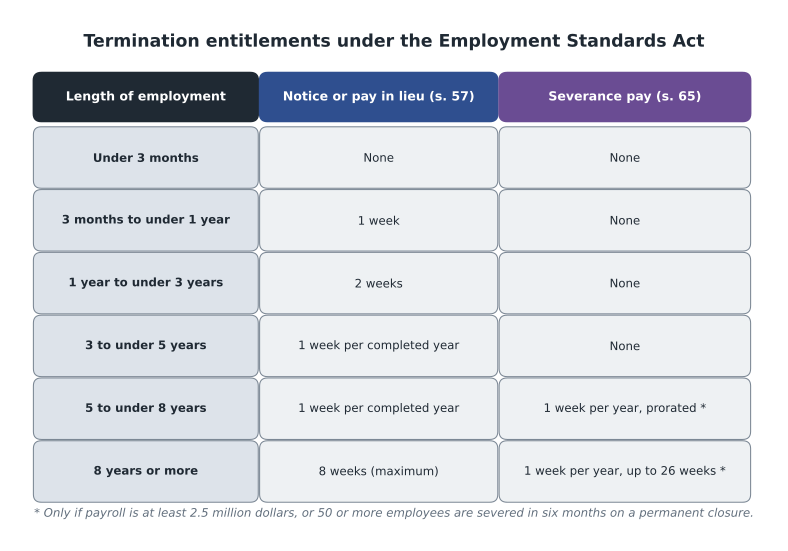
The Act's termination provisions are the most litigated part of the statute. Section 54 prohibits an employer from terminating an employee who has been employed for three months or more unless the employer gives written notice of termination or pay in lieu of notice, or a combination. Section 57 sets the length of notice: one week for employment of less than one year, two weeks for one to three years, and then one week for each completed year of employment, to a maximum of eight weeks for eight or more years. During the notice period the employer must continue the employee's benefits and pay at least the regular wages. Pay in lieu of notice must be accompanied by continued benefit plan contributions for the statutory notice period.
Section 58 sets longer notice for mass terminations of 50 or more employees at an establishment within a four-week period: eight weeks for 50 to 199 employees, twelve weeks for 200 to 499, and sixteen weeks for 500 or more, with notice to the Director of Employment Standards. Severance pay under sections 63 to 65 is a separate entitlement. It is payable to an employee with five or more years of employment whose employer has a payroll of at least 2.5 million dollars, or who is severed as part of a group of 50 or more employees within six months because all or part of the business permanently closes. Severance is one week's regular wages for each year of employment, including a proportion for a partial year, up to 26 weeks.
Both termination pay and severance pay are subject to exceptions set out in Regulation 288/01. The most important is for an employee who has been guilty of wilful misconduct, disobedience or wilful neglect of duty that is not trivial and has not been condoned by the employer. That standard is higher than common law just cause, because it requires deliberate wrongdoing rather than conduct that is merely careless or incompetent. An employee may be dismissed for cause at common law and still be entitled to statutory notice and severance if the misconduct was not wilful. Other exceptions cover employees on temporary layoff who refuse reasonable recall, construction employees, employees who refuse reasonable alternative work, and frustrated contracts, although frustration caused by the employee's illness or injury does not remove the entitlement.
Temporary layoffs are regulated too. A layoff becomes a termination if it lasts more than 13 weeks in any period of 20 consecutive weeks, or up to 35 weeks in 52 if certain conditions are met, such as continued benefits. Since November 27, 2025, an employer and employee may agree in writing, with the approval of the Director, to a longer layoff of up to 52 weeks within a 78-week period. The statutory right to lay off does not override the common law: unless the contract permits temporary layoff, a layoff may still be a constructive dismissal at common law, a point discussed in lesson 6.
Enforcement and the election rule
An employee can enforce the Act by filing a claim with the Ministry of Labour, Immigration, Training and Skills Development. An employment standards officer investigates and may order the employer to pay wages owing, issue compliance orders, or order reinstatement and compensation for reprisal. Either party can apply to the Ontario Labour Relations Board for review of an officer's order or refusal to issue an order. The general limitation period for recovering wages is two years from the date the wages became due.
Section 97 contains a trap for the unwary. An employee who files a complaint for failure to pay wages or termination entitlements, or for reprisal, may not commence a civil action for wrongful dismissal on the same termination or severance. An employee who files a complaint and then wishes to sue must withdraw the complaint within two weeks after filing it. An employee who sues cannot file a complaint on the same matter. Because common law reasonable notice is usually much greater than the statutory entitlement, a lawyer advising a long-service employee will usually recommend a civil action, while an employee with a small claim, or one who cannot afford litigation, may prefer the free statutory process. Unionized employees enforce the Act through the grievance procedure rather than a complaint, under section 99.
Pellridge restructures
Sabourin turns to the file. In spring 2026, Pellridge announced the closure of its Windsor sales office and terminated eleven employees, including three warehouse staff and eight sales representatives. Its total Ontario payroll is about 11 million dollars a year. 'What does each terminated employee get from the floor alone?' he asks. Arjun Mehta works through it on the board. Because fewer than 50 employees were terminated, the mass termination rules do not apply. Each employee with at least three months of service receives notice or pay in lieu under section 57, up to eight weeks. Because Pellridge's payroll exceeds 2.5 million dollars, every employee with five or more years of service is also entitled to severance pay of one week per year, prorated, up to 26 weeks, regardless of how many were terminated.
'And Vivienne Ashdown?' Sabourin asks. Ashdown was not part of the Windsor closure, but if she were dismissed today after sixteen years, the floor alone would give her eight weeks' termination pay and about sixteen weeks' severance pay, roughly 24 weeks in total, with continued benefits for the eight-week notice period. 'Hold onto that number,' he says. 'In lesson 5 we will see what the common law would give her. The difference between the two is why the termination clause in her contract is worth fighting about.'
Worked problem
Calculating statutory entitlements
Pellridge terminates three employees without cause and without notice. Its payroll is over 2.5 million dollars. (a) Gurdeep, a warehouse worker, has 2 years and 4 months of service. (b) Imelda, an accounts clerk, has 6 years and 6 months. (c) Wesley, a driver, has 2 months. What are their minimum entitlements?
Show solution
- (a) Gurdeep: two weeks' notice or pay in lieu under section 57, because he has more than one but less than three years. No severance, because he has less than five years.
- (b) Imelda: six weeks' notice or pay in lieu, one week for each of her six completed years. Severance of 6.5 weeks, because the payroll test is met and severance includes the partial year. Benefits continue for the six-week notice period.
- (c) Wesley: nothing under section 54, because he has been employed for less than three months. He may still have a common law claim for reasonable notice unless a valid contract term excludes it.
Common mistakes
MistakeReading a termination clause that gives less than the statutory minimum up to the minimum.
InsteadUnder Machtinger, the clause is void and the employee is entitled to common law reasonable notice.
MistakeApplying the payroll test for severance to termination notice.
InsteadNotice under section 57 applies to any employee with three months of service; only severance under section 64 depends on five years of service plus the payroll or group termination test.
MistakeTreating common law just cause as automatically removing statutory termination pay.
InsteadThe statutory exception requires wilful misconduct, disobedience or wilful neglect of duty that is not trivial and has not been condoned, which is a higher standard.
MistakeFiling an Employment Standards Act claim for a long-service employee and later suing for wrongful dismissal.
InsteadSection 97 bars the lawsuit unless the complaint is withdrawn within two weeks of filing. Choose the forum deliberately.
MistakeListing Civic Holiday as a statutory public holiday in Ontario.
InsteadOntario has nine public holidays under the Act; Civic Holiday and Remembrance Day are not among them.
Practice problems
Work each problem on paper first, then reveal the answer to check.
An employee with eleven years of service at an employer with a 4 million dollar payroll is terminated without cause. What are the statutory minimums?
Show answer
Eight weeks' notice or pay in lieu under section 57 (the maximum), and eleven weeks' severance under section 65, with benefits continued for the eight-week notice period.
What is the overtime threshold in Ontario, and at what rate is overtime paid?
Show answer
Overtime is payable after 44 hours in a work week at one and one half times the regular rate, subject to averaging agreements and exemptions.
Since January 1, 2026, what must a publicly advertised job posting by an Ontario employer with 25 or more employees include?
Show answer
Expected compensation or a pay range of no more than 50,000 dollars (subject to the 200,000 dollar exemption), a statement whether the job is an existing vacancy, disclosure of any artificial intelligence screening, and no Canadian experience requirement. The employer must also reply to interviewed applicants within 45 days.
May an Ontario employer require a doctor's note when an employee takes one of the three statutory sick days?
Show answer
No. Since October 28, 2024, employers may not require a certificate from a qualified health practitioner for statutory sick leave, though they may require other reasonable evidence.
Summary and key terms
- The Employment Standards Act is a floor: section 5 voids any waiver or contracting out unless the employee receives a greater benefit.
- Under Machtinger, a termination clause below the statutory minimum is void, and the employee gets common law reasonable notice.
- Key standards include minimum wage, the 44-hour overtime threshold, nine public holidays, two or three weeks of vacation with 4 or 6 percent vacation pay, and a growing list of job-protected leaves.
- Statutory termination notice is up to eight weeks; severance of up to 26 weeks is owed to employees with five years' service where the payroll or group termination test is met.
- Claims are enforced through the Ministry and the Ontario Labour Relations Board; section 97 forces a choice between a statutory complaint and a civil action.
- Contracting out
- An attempt to agree to less than a statutory employment standard, which is void under section 5 of the Act.
- Pay in lieu of notice
- A lump sum equal to the wages the employee would have earned during the notice period, paid instead of working notice.
- Severance pay
- A separate statutory payment for long-service employees of larger employers, of one week per year of service up to 26 weeks.
- Wilful misconduct
- Deliberate, non-trivial misconduct that has not been condoned, which removes statutory termination and severance pay.
- Reprisal
- Penalizing an employee for exercising or asking about rights under the Act, prohibited by section 74.
- Election
- The section 97 rule that an employee must choose between a statutory complaint and a civil action for the same termination.
Lesson quiz · 5 questions
Score 60% or more to complete this lesson.
Create a free account to save your progress, take quizzes and earn a certificate.