
LAWC-302 · Lesson 1 of 12 · 25 min
Employment and labour law in Canada: who is an employee and which law applies
▶ Video coming soon A video version of this lesson is on the way.
The first class of Employment and Labour Law meets in the Lister Room at Brannock University Faculty of Law on a grey autumn morning. Professor Everett Sabourin has taught the course for nine years. Before that he spent thirteen years at a union-side labour firm in Hamilton and then six years at a management-side boutique in Toronto, which he describes as 'the only way to learn that every collective agreement has two authors and both of them think they lost.' He begins by writing three words across the whiteboard: Floor. Contract. Collective. 'Every workplace problem you will ever see as a lawyer,' he says, 'sits somewhere in those three words. Before you ask what the answer is, ask which of them governs.'
He then hands out a short file that the class will use for most of the term. Pellridge Supply Ltd. is a fictional industrial and safety supply distributor based in Corwin, Ontario, with about 160 employees, a warehouse on the edge of the city and a sales force that covers southwestern Ontario. Its regional sales manager, Vivienne Ashdown, has worked there for sixteen years. Its warehouse staff are not yet unionized, although an organizing campaign is about to begin. Its delivery work is done partly by employees and partly by drivers who own their own trucks. 'Pellridge,' Sabourin says, 'is a perfectly ordinary Ontario business. That is exactly why it will keep you busy.'
This lesson builds the map for the rest of the course. It explains the three layers of workplace law, the constitutional question of whether a workplace is governed by federal or provincial law, and the threshold question of who counts as an employee. Every later lesson assumes you can answer those three questions quickly.
Three layers of workplace law
Canadian workplace law is best understood as three layers stacked on top of each other. The bottom layer is a set of statutes that apply to almost every worker in the province: in Ontario, the Employment Standards Act, 2000, the Human Rights Code, the Occupational Health and Safety Act and the Workplace Safety and Insurance Act, 1997. These statutes set minimum standards that the parties cannot bargain below. Section 5 of the Employment Standards Act, for example, says that no employer or employee may contract out of or waive an employment standard, and that any such attempt is void, unless the contract gives the employee a greater benefit.
The middle layer is the individual contract of employment. For a non-union employee like Vivienne Ashdown, the contract governs pay, duties, bonuses, restrictive covenants and, above all, what happens when the employment ends. The contract may be written or oral, and much of it consists of terms the courts imply, such as the employer's obligation to give reasonable notice of termination without cause. Disputes about the contract are decided by the ordinary courts, usually in an action for wrongful dismissal.
The top layer applies only where a union has been certified or voluntarily recognized as the bargaining agent for a group of employees. In that case the collective agreement negotiated by the union largely replaces individual bargaining. The Supreme Court of Canada recognized in McGavin Toastmaster Ltd. v. Ainscough, [1976] 1 S.C.R. 718, that the individual contract of employment has little room to operate once collective bargaining takes over. Disputes about the collective agreement go to a grievance arbitrator under a mandatory arbitration clause, not to the courts, a principle confirmed in Weber v. Ontario Hydro, [1995] 2 S.C.R. 929, which you will study in lesson 9.
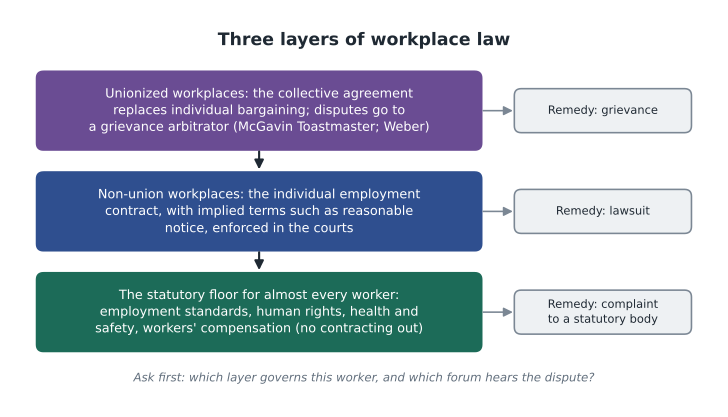
Sabourin asks Arjun Mehta, who spent several years as a civil engineer before law school, to sum up the structure. 'The statutes are the foundation,' Mehta says. 'The contract or the collective agreement is the building. You can build anything you like on the foundation, but you cannot dig below it.' Sabourin nods. 'And the remedy depends on which floor of the building you are standing on. A non-union employee sues. A unionized employee grieves. Both of them can usually complain to a statutory body about the foundation.'
The main statutes
The following table lists the statutes you will meet most often in this course. Ontario is the reference province, but every province has equivalent legislation, and the federal Canada Labour Code covers federally regulated workplaces.
| Subject | Ontario statute | Federal counterpart | Main forum |
|---|---|---|---|
| Minimum standards (wages, hours, leaves, termination) | Employment Standards Act, 2000 | Canada Labour Code, Part III | Ministry of Labour, Immigration, Training and Skills Development; Ontario Labour Relations Board on review |
| Discrimination and harassment | Human Rights Code | Canadian Human Rights Act | Human Rights Tribunal of Ontario |
| Health and safety | Occupational Health and Safety Act | Canada Labour Code, Part II | Ministry inspectors; provincial offences court |
| Workplace injury compensation | Workplace Safety and Insurance Act, 1997 | Government Employees Compensation Act (federal public servants) | Workplace Safety and Insurance Board and Appeals Tribunal |
| Unionization and collective bargaining | Labour Relations Act, 1995 | Canada Labour Code, Part I | Ontario Labour Relations Board; Canada Industrial Relations Board |
| Gig and platform work | Digital Platform Workers' Rights Act, 2022 (in force July 1, 2025) | None specific | Ministry and Ontario Labour Relations Board |
Several other statutes matter in particular cases. The Pay Equity Act requires many employers to compare jobs held mainly by women with jobs held mainly by men. The Accessibility for Ontarians with Disabilities Act, 2005 adds standards for employment practices. Public sector employees may be covered by special statutes, such as the School Boards Collective Bargaining Act, 2014 or the Crown Employees Collective Bargaining Act, 1993. Privacy law in Ontario's private sector is thinner than in some provinces, because Ontario has no general private sector privacy statute covering employee information, although the Employment Standards Act now requires larger employers to have a written policy on electronic monitoring.
Which government regulates the workplace?
The Constitution Act, 1867 does not mention labour relations. The question of which level of government regulates employment was settled by the Privy Council in Toronto Electric Commissioners v. Snider, [1925] A.C. 396, which held that a federal statute on industrial disputes could not apply to a municipal electricity commission. Labour relations are primarily a matter of property and civil rights in the province under section 92(13). Provincial jurisdiction is therefore the rule and federal jurisdiction is the exception.
The exception covers employees of federal works, undertakings and businesses. These include banks, airlines and airports, interprovincial and international railways, trucking and bus lines that cross provincial borders, shipping and ports, telecommunications and broadcasting, pipelines that cross borders, uranium mining, grain elevators declared to be for the general advantage of Canada, federal Crown corporations and the federal public service. For these workplaces the Canada Labour Code applies instead of the provincial statutes. Federal human rights law is in the Canadian Human Rights Act.
The Supreme Court restated the test in NIL/TU,O Child and Family Services Society v. B.C. Government and Service Employees' Union, 2010 SCC 45. The court first asks whether the entity's normal and habitual activities, viewed as a going concern, make it a federal undertaking. Only if that functional test is inconclusive does the court ask whether provincial regulation would impair the core of a federal head of power. In NIL/TU,O itself, a child welfare agency serving First Nations families in British Columbia was held to be provincially regulated. The agency's activity was child welfare, a provincial matter, and the fact that it served Indigenous families and received federal funding did not change the nature of that activity.
Daniel Whitecloud, who worked in band administration in northern Saskatchewan before law school, raises his hand. 'So the employees of a band council aren't automatically federal?' Sabourin explains that the cases turn on what the particular employees do. Work that is part of the band council's governance under the Indian Act has often been treated as federal, while services such as child welfare or education delivered under provincial frameworks may be provincial. 'Never assume,' he says. 'Ask what the operation actually does day to day, and then look for the closest decided case.'
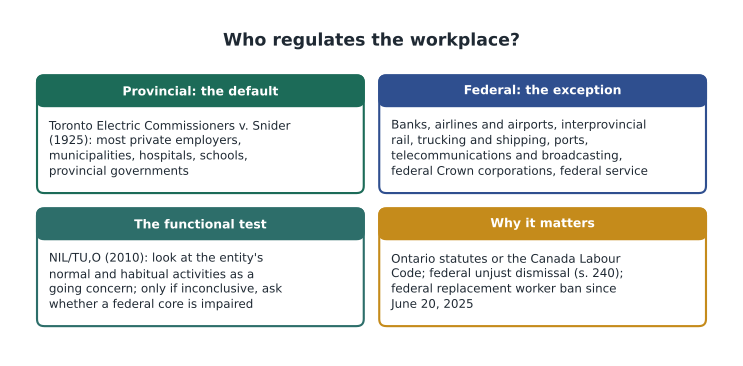
The answer matters because the statutes differ. Federal employees have a statutory unjust dismissal remedy under sections 240 to 246 of the Canada Labour Code, which Ontario does not offer, and since June 20, 2025 federally regulated employers have been largely prohibited from using replacement workers during a strike or lockout. Pellridge is a provincial business: it sells and delivers goods within Ontario, and nothing about its normal operations is federal. If its drivers regularly hauled goods into Michigan as an integral part of the business, the analysis could change, because extraprovincial trucking is a federal undertaking.
Who is an employee?
Most employment statutes and most common law rights apply only to employees. An independent contractor is a person in business on their own account, and the relationship is governed by the commercial contract. The distinction matters enormously. An employee is entitled to minimum wage, overtime, vacation pay, statutory leaves and, at common law, reasonable notice of termination. An independent contractor receives none of these unless the contract provides them.
The leading case is 671122 Ontario Ltd. v. Sagaz Industries Canada Inc., 2001 SCC 59. Justice Major, for the court, explained that there is no single conclusive test. The central question is whether the person who has been engaged to perform the services is performing them as a person in business on their own account. In answering that question, the court considers the level of control the employer has over the worker's activities, whether the worker provides their own equipment, whether the worker hires their own helpers, the degree of financial risk taken by the worker, the degree of responsibility for investment and management, and the worker's opportunity for profit in the performance of the tasks. The list is not exhaustive, and the weight of each factor depends on the facts.
Courts look at the substance of the relationship, not the label. A contract that calls a worker an independent contractor will not prevent a court from finding employment if the worker is in fact controlled, integrated into the business and dependent on it. Ontario's Employment Standards Act makes the point explicitly. Section 5.1 prohibits an employer from treating an employee as if the employee were not an employee, and in any proceeding under the Act the employer bears the burden of proving that the worker is not an employee.
The dependent contractor
Between the employee and the truly independent contractor lies an intermediate category. In McKee v. Reid's Heritage Homes Ltd., 2009 ONCA 916, the Court of Appeal for Ontario held that a contractor who is economically dependent on one client is a dependent contractor and is entitled to reasonable notice of termination at common law, even though they are not an employee. The court explained that exclusivity, or a high level of dependence on a single client, is a key indicator. The worker in McKee had sold new homes exclusively for one builder for many years. In Keenan v. Canac Kitchens Ltd., 2016 ONCA 79, the court applied the same reasoning to a married couple who had installed kitchens for one company for decades, almost exclusively, after being moved from employee status to contractor status.
The Labour Relations Act, 1995 also includes dependent contractors in its definition of employee, so that economically dependent workers can unionize. That definition became famous in 2020, when the Ontario Labour Relations Board held that couriers who delivered food for the app-based company Foodora were dependent contractors who could be represented by a union. Foodora left the Canadian market shortly afterwards.
Platform workers and the Uber litigation
App-based work has tested these categories. In Uber Technologies Inc. v. Heller, 2020 SCC 16, an Uber driver brought a proposed class action claiming that drivers were employees under the Employment Standards Act. Uber's standard contract required disputes to go to mediation and arbitration in the Netherlands, with up-front fees of about 14,500 US dollars, which was close to the driver's annual income. The Supreme Court held the arbitration clause unconscionable and therefore unenforceable, so the class action could proceed. The court did not decide whether the drivers were employees. The case is important in employment law for a different reason: it shows that standard-form terms imposed on vulnerable workers will be scrutinized closely.
Ontario responded to platform work with the Digital Platform Workers' Rights Act, 2022, which came into force on July 1, 2025. It covers ride share, delivery and courier workers whether or not they are employees. It guarantees at least the general minimum wage for active work time, measured per assignment or per pay period and excluding tips, a regular pay period, written information about how pay and ratings work, written reasons for removal from the platform, two weeks' notice of removals lasting 24 hours or more (subject to exceptions such as wilful misconduct), and protection of tips. The statute deliberately avoids deciding whether these workers are employees, which remains a question for the Employment Standards Act and the courts.
Applying the tests to Pellridge
Sabourin returns to the file. Pellridge uses two kinds of delivery drivers. Six drivers are employees who drive company vans on fixed routes. Four others, including a driver named Emeric Lindholm, own their own trucks, are paid per delivery, carry their own insurance and can in theory decline routes. In practice Lindholm has driven only for Pellridge for nine years, wears a Pellridge jacket, follows a schedule set by the dispatcher and has never declined a route. Hannah Kowalczyk, who worked in an oil and gas regulatory office before law school, argues that Lindholm is clearly a contractor because he owns a truck worth tens of thousands of dollars. Theo Marchetti, who spent ten years as a litigation law clerk, disagrees. 'The truck is the only factor pointing his way. Pellridge controls when he works, where he goes and what he wears, and he has no other customers.'
Sabourin's answer is that Lindholm is at least a dependent contractor, and arguably an employee. The ownership of the truck and the per-delivery pay suggest a business on his own account, but control, integration, exclusivity and the absence of any real opportunity for profit point the other way. If Pellridge ended the relationship without notice, Lindholm could sue for reasonable notice either as an employee or as a dependent contractor. If he were an employee, he would also have Employment Standards Act entitlements, and Pellridge would bear the burden of proving otherwise in any proceeding under that Act.
Worked problem
Classifying three workers
Classify each worker and explain the consequence. (a) Perpetua, a graphic designer, does logo work for twelve clients a year, sets her own hours and uses her own software. One of those clients is Pellridge. (b) Emeric Lindholm, described above, has driven only for Pellridge for nine years in his own truck. (c) Jae, a warehouse picker placed at Pellridge by a temporary help agency, is paid by the agency but supervised by Pellridge's shift lead.
Show solution
- (a) Perpetua is an independent contractor. She is in business on her own account: she has many clients, controls her work, owns her tools and bears her own financial risk. Her rights against Pellridge depend on the commercial contract.
- (b) Lindholm is at least a dependent contractor under McKee because of his near-total economic dependence on Pellridge, and the control and integration factors support employee status under Sagaz. Either way he is owed reasonable notice at common law. The label in his contract does not decide the question.
- (c) Jae is an employee of the temporary help agency, which is the employer under the Employment Standards Act's rules for assignment employees. Ontario's statute also makes the client business jointly liable in some circumstances for unpaid wages and imposes duties on it, so Pellridge cannot ignore Jae's statutory rights simply because the agency issues the pay cheques.
Why the first questions matter
Sabourin closes the class by returning to the board. 'When a client walks in, ask three questions before anything else,' he says. 'First, which government regulates this workplace? Second, is this person an employee, a dependent contractor or an independent contractor? Third, is there a union? Those answers tell you which statute applies, which forum hears the case and what remedies are possible. Students who skip them write beautiful answers to the wrong question.' He assigns the next reading, on the employment contract, and asks the class to bring a copy of any employment contract they have signed. Several students look slightly alarmed.
Common mistakes
MistakeAssuming the Canada Labour Code applies because the employer is a large national company.
InsteadSize and national reach do not matter. Ask whether the operation is a federal work or undertaking under the functional test in NIL/TU,O. A national retailer is provincially regulated in each province.
MistakeTreating the "independent contractor" label in a contract as decisive.
InsteadCourts look at the substance of the relationship under Sagaz, and section 5.1 of the Employment Standards Act puts the burden on the employer to prove a worker is not an employee.
MistakeConcluding that a contractor has no right to notice.
InsteadAn economically dependent contractor is entitled to reasonable notice at common law under McKee v. Reid's Heritage Homes.
MistakeAdvising a unionized employee to sue for wrongful dismissal.
InsteadDisputes arising under a collective agreement belong to the grievance arbitrator under Weber. The employee's route is a grievance filed by the union.
MistakeSaying that Uber v. Heller decided that Uber drivers are employees.
InsteadThe court held only that the arbitration clause was unconscionable, so the class action on employment status could proceed in Ontario.
Practice problems
Work each problem on paper first, then reveal the answer to check.
A bank employee in Corwin is dismissed without notice. Which statute governs her minimum termination entitlements?
Show answer
Banking is a federal undertaking, so the Canada Labour Code, Part III applies rather than the Ontario Employment Standards Act. If she has twelve months of continuous service and is not a manager, she may also file an unjust dismissal complaint under section 240.
What is the central question in Sagaz, and name four factors used to answer it.
Show answer
Whether the worker is performing the services as a person in business on their own account. Factors include control, ownership of tools, hiring of helpers, financial risk, responsibility for investment and management, and opportunity for profit.
Why does the Labour Relations Act include dependent contractors in its definition of employee?
Show answer
So that workers who are economically dependent on one business, but formally contractors, can unionize and bargain collectively, as the Foodora couriers did in 2020.
What does the Digital Platform Workers' Rights Act, 2022 guarantee, and what does it not decide?
Show answer
It guarantees minimum wage for active work time, pay periods, information about pay and ratings, written reasons and notice for removal, and protection of tips. It does not decide whether platform workers are employees.
Summary and key terms
- Workplace law has three layers: statutory minimums that cannot be waived, the individual employment contract enforced in court, and, in unionized workplaces, the collective agreement enforced by arbitration.
- Labour relations are provincial by default under Toronto Electric Commissioners v. Snider; federal jurisdiction covers federal works and undertakings, identified by the functional test in NIL/TU,O.
- Under Sagaz, the question is whether the worker is in business on their own account, assessed through control, tools, helpers, risk, investment and opportunity for profit.
- Dependent contractors who are economically dependent on one client are entitled to reasonable notice (McKee; Keenan) and can unionize under the Labour Relations Act.
- Uber v. Heller struck down an arbitration clause as unconscionable; the Digital Platform Workers' Rights Act, 2022 has protected platform workers since July 1, 2025.
- Employment standards
- Statutory minimum terms of employment, such as minimum wage, overtime, leaves and termination pay, which cannot be waived.
- Federal undertaking
- A work or business within federal jurisdiction, such as a bank, airline or interprovincial railway, whose labour relations are governed by the Canada Labour Code.
- Functional test
- The NIL/TU,O test that classifies an entity for labour jurisdiction by its normal and habitual activities as a going concern.
- Dependent contractor
- A worker who is not an employee but is economically dependent on one client, and who is owed reasonable notice at common law.
- Independent contractor
- A person in business on their own account, whose rights depend on the commercial contract.
- Collective agreement
- A written agreement between an employer and a union setting terms and conditions of employment for a bargaining unit.
Lesson quiz · 5 questions
Score 60% or more to complete this lesson.
Create a free account to save your progress, take quizzes and earn a certificate.