
LAWC-302 · Lesson 4 of 12 · 23 min
Termination clauses and the Employment Standards Act
▶ Video coming soon A video version of this lesson is on the way.
The fourth class begins with a single sheet projected on the screen. It is clause 9 of Vivienne Ashdown's 2019 agreement with Pellridge Supply. Professor Sabourin reads it aloud, slowly. Clause 9(a) says that Pellridge may terminate her employment at any time without cause by providing the minimum notice or pay in lieu, benefits continuation and severance pay required by the Employment Standards Act, 2000, and that this satisfies any notice obligation at common law. Clause 9(b) says that Pellridge may terminate her employment for cause at any time without notice or pay in lieu, and that cause includes, without limitation, dishonesty, insubordination, a serious breach of company policy and poor performance after a written warning. Clause 9(c) says that if any part of clause 9 is found unenforceable, the rest shall remain in force.
'Sixteen years of service,' Sabourin says. 'If clause 9 is enforceable, Ms. Ashdown gets about 24 weeks. If it is not, she gets common law reasonable notice, which for a 54-year-old regional sales manager could be close to two years. Nothing else in this course is worth more money per word than that clause. So: is it enforceable?'
This lesson works through the answer. It explains the presumption of reasonable notice, the rule in Machtinger, the Court of Appeal's line of cases from Wood v. Fred Deeley to Waksdale, the Dufault controversy, and the Court of Appeal's 2025 and 2026 decisions that have brought some balance back to the law.
The presumption of reasonable notice
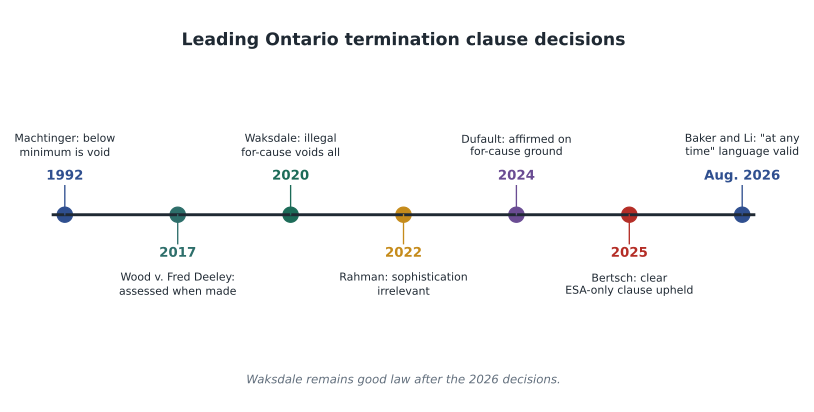
An indefinite-term employment contract contains an implied term that the employer will give reasonable notice of termination without cause. The presumption can be rebutted by a contractual term that clearly specifies some other period of notice, whether expressly or impliedly. In Machtinger v. HOJ Industries Ltd., [1992] 1 S.C.R. 986, the employment contracts of two car dealership managers provided for less notice than the statute then required. The Supreme Court held that the clauses were null and void under the Employment Standards Act's prohibition on contracting out, so the presumption of reasonable notice was not rebutted. The employees received seven and seven and one half months' common law notice instead of the few weeks the statute required.
Machtinger set the basic structure. A clause can limit the employee to the statutory minimum, or to any other amount at or above the minimum, if it does so clearly and lawfully. If the clause offers less than the statute requires, it is void and common law notice applies. The modern cases are about how strictly courts examine the clause for possible non-compliance.
Wood v. Fred Deeley: benefits, severance and timing
In Wood v. Fred Deeley Imports Ltd., 2017 ONCA 158, the employee's clause allowed termination by giving two weeks' notice or pay in lieu for each year of service, which was more than the statutory notice, but it did not mention the continuation of benefits during the notice period and arguably excluded severance pay. The Court of Appeal held the clause void. Its reasons established several principles that remain central. Because the Act is remedial legislation, courts should favour the interpretation of a termination clause that gives the employee the greater benefit. Where a clause is ambiguous, the interpretation more favourable to the employee prevails. A clause that fails to comply with the statute is void even if the employer actually paid the statutory amounts when it dismissed the employee, because the clause is assessed at the time the contract was made. And an employee is not required to show that the clause misled them.
The timing point is significant. An employer cannot cure a defective clause by being generous at the end. The question is always whether the words, as written, could result in the employee receiving less than the statute guarantees.
Waksdale: the for-cause clause and the whole scheme
The most important modern case is Waksdale v. Swegon North America Inc., 2020 ONCA 391. The employee's contract contained a without-cause provision that, the parties agreed, complied with the statute. A separate for-cause provision allowed termination without notice or pay for conduct that fell short of the statutory standard of wilful misconduct. The employer had dismissed the employee without cause, so it argued that the for-cause clause was irrelevant, and in any event the contract contained a severability clause.
The Court of Appeal rejected both arguments. The court held that termination provisions must be read as a whole, not in isolation, and that an employment agreement must be interpreted as a whole and not on a piecemeal basis. If any of the termination provisions breach the statute, all of them are unenforceable, whether or not the employer relied on the offending provision when it ended the employment. A severability clause cannot save provisions that contravene the Act. The Supreme Court of Canada denied leave to appeal in January 2021.
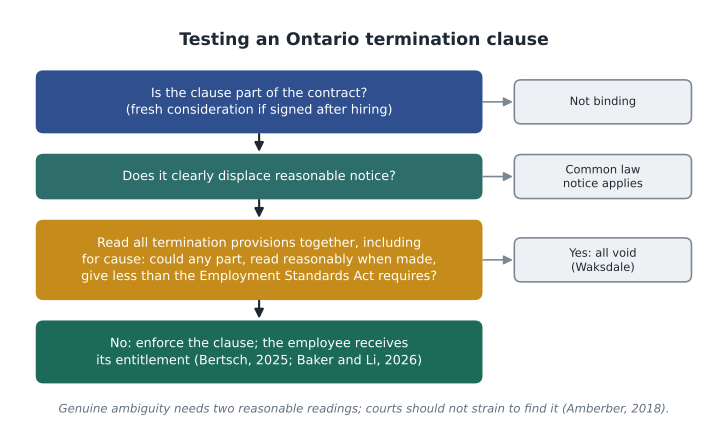
Waksdale transformed practice. Employment lawyers began scrutinizing the for-cause portion of every termination clause. Many for-cause clauses copied the common law language of just cause, allowing termination without notice for conduct such as 'poor performance', 'insubordination' or 'any breach of company policy'. Because the statutory exception requires wilful misconduct, disobedience or wilful neglect of duty that is not trivial and has not been condoned, a clause that removes statutory entitlements for any lesser conduct can deprive the employee of the statutory minimum. After Waksdale, such a clause takes the without-cause clause down with it.
Rahman and the irrelevance of sophistication
In Rahman v. Cannon Design Architecture Inc., 2022 ONCA 451, the employer argued that the employee was a sophisticated professional who had obtained legal advice and negotiated her contract, so she must have understood that the employer intended to comply with the statute. The Court of Appeal held that the employee's sophistication and the availability of legal advice do not change the analysis. The question is whether the clause, on its words, complies with the Act. The for-cause clause in Rahman allowed termination without notice for conduct short of wilful misconduct, and the whole termination scheme fell.
The Dufault controversy
Waksdale left open a further question: what about clauses that comply on their face but give the employer broad discretion? In Dufault v. The Corporation of the Township of Ignace, 2024 ONSC 1029, a motion judge held a fixed-term contract's termination provisions unenforceable for several reasons. One was the familiar Waksdale problem: the for-cause clause defined cause more broadly than wilful misconduct. But the judge also held that language allowing the employer to terminate 'at any time' and in its 'sole discretion' contravened the statute, because the Act limits when an employer may terminate, for example by prohibiting termination during a protected leave or as a reprisal. The employee recovered the wages for the remainder of her fixed term, more than 150,000 dollars.
The decision alarmed employers, because 'at any time' language appeared in thousands of Ontario contracts. On appeal, in a decision released in December 2024, the Court of Appeal dismissed the township's appeal, but only on the for-cause ground. It applied Waksdale, declined the township's invitation to reconsider that decision, and expressly left open whether the 'at any time' and 'sole discretion' language was itself a breach of the statute. For more than eighteen months, trial courts divided on the point.
Bertsch: clear clauses are enforced
The Court of Appeal signalled a change of tone in Bertsch v. Datastealth Inc., 2025 ONCA 379. The employee, a vice-president with an annual base salary of 300,000 dollars, was dismissed after about eight and a half months and paid four weeks. His contract limited him, on termination 'with or without cause', to the minimum payments and entitlements under the Act, which the contract said would satisfy any common law notice obligation, and it included a provision stating that if any entitlement fell below the statutory minimum, the minimum would apply instead. He argued that an ordinary reader might take the clause to permit dismissal for cause without notice for conduct short of wilful misconduct. A unanimous panel upheld the motion judge's decision enforcing the clause. The court explained that the question is how the agreement can reasonably be read, not whether a person could misread it, and that ambiguity requires more than competing interpretations, citing Amberber v. IBM Canada Ltd., 2018 ONCA 571.
Baker and Li: the 2026 decisions
The 'at any time' question finally reached the Court of Appeal in two appeals heard together in March 2026: Baker v. Van Dolder's Home Team Inc. and Li v. Wayfair Canada ULC. In Baker, the motion judge had held the termination clause unenforceable because of its 'at any time' language and its for-cause wording. In Li, a different motion judge had enforced a clause containing 'at any time and for any reason' language. In decisions released in August 2026, reported as 2026 ONCA 568, the Court of Appeal allowed the appeal in Baker and dismissed the appeal in Li, finding the clauses in both cases enforceable.
The court held that general contract interpretation principles apply to employment agreements, read as a whole and in light of the parties' objective intentions, and that courts typically favour readings that encourage compliance with the statute. Genuine ambiguity arises only where there are two or more reasonable but differing interpretations, and courts should not strive to find an ambiguity where none reasonably exists. Words such as 'at any time' and 'for any reason' simply confirm that a without-cause termination may take effect whenever it occurs, provided the employer meets its contractual and statutory obligations. The court drew on Wallace v. United Grain Growers Ltd., [1997] 3 S.C.R. 701 for the long-standing principle that an employer may terminate without cause, at any time, provided it gives the required notice. It also found the for-cause clause in Baker enforceable because it expressly preserved the employee's statutory minimums.
Waksdale itself remains good law. The 2026 decisions did not overrule it, and a for-cause clause that removes statutory entitlements for conduct short of wilful misconduct will still invalidate the whole termination scheme. What has changed is the interpretive attitude: courts are now directed to read clauses reasonably and as a whole, not to search for strained readings that might produce a breach. Defence lawyers describe the decisions as 'common sense'; employee-side lawyers note that the core Waksdale rule still catches most poorly drafted clauses.
Applying the law to clause 9
Sabourin asks the class to test Ashdown's clause. Theo Marchetti starts with clause 9(a). 'It gives her the statutory minimum notice, benefits continuation and severance. It says that satisfies common law notice. After Baker and Li, the words 'at any time' are not a problem. On its own, 9(a) looks enforceable.' Sabourin agrees. 'Now read it with 9(b).'
Sophie Tremblay-Hart takes clause 9(b). It allows termination for cause without notice or pay in lieu for conduct including 'a serious breach of company policy' and 'poor performance after a written warning'. Neither of those necessarily amounts to wilful misconduct, disobedience or wilful neglect of duty. Poor performance, in particular, is usually not wilful at all. If Pellridge relied on clause 9(b) to dismiss an employee for poor performance, the employee would lose statutory termination and severance pay to which the Act entitles them. Unlike the clause in Baker, clause 9(b) does not preserve statutory minimums. Under Waksdale, read as a whole, the termination provisions breach the statute, and clause 9(c), the severability clause, cannot save them.
'So Ms. Ashdown is entitled to common law reasonable notice,' Sabourin concludes. 'Even though Pellridge is dismissing her without cause, and even though clause 9(a) would have been fine on its own. That is Waksdale. Pellridge's lawyers will argue that 9(b) should be read as limited by the statute, and after Baker and Li that argument is better than it was. But the clause does not say so, and the court cannot add words the parties did not write.'
Worked problem
Redrafting a termination clause
Pellridge asks you to redraft clause 9 for future hires so that it will survive the current case law while limiting employees to statutory minimums. What must the new clause do?
Show solution
- State clearly that on termination without cause the employee will receive only the notice or pay in lieu, benefits continuation and severance pay (if applicable) required by the Employment Standards Act, and that these satisfy all notice and severance obligations at common law (Bertsch; Amberber).
- Make the for-cause provision lawful. Either limit termination without any notice or pay to conduct that amounts to wilful misconduct, disobedience or wilful neglect of duty that is not trivial and has not been condoned, or state expressly that even where the employer has cause the employee will receive any statutory entitlements that the Act requires (Baker).
- Avoid any language that could reduce statutory entitlements, such as limits on benefits continuation, a cap on base salary only where the Act requires regular wages including other components, or a requirement to sign a release before receiving statutory amounts.
- Do not rely on a severability clause or on a general 'savings' statement to cure a non-compliant provision (Waksdale). A failsafe statement that the employee will always receive at least the statutory minimum helps confirm the clear meaning, but it cannot rescue language that is plainly illegal.
- Present the agreement before the employee starts work, so that the job offer provides the consideration (Francis; Hobbs).
Other provinces and the federal sphere
Ontario has produced most of the termination clause litigation, but the same principles apply elsewhere. Courts in other provinces follow Machtinger, and several have accepted that clauses must comply with their provincial employment standards statutes. Not every province has adopted Waksdale's whole-scheme approach, so lawyers outside Ontario must check local appellate authority. For federally regulated non-managerial employees with twelve months of service, a contractual termination clause does not prevent an unjust dismissal complaint under section 240 of the Canada Labour Code, because the Supreme Court held in Wilson v. Atomic Energy of Canada Ltd., 2016 SCC 29 that the Code does not permit dismissal without cause simply on payment of notice or severance.
Common mistakes
MistakeTesting only the without-cause clause because the employee was dismissed without cause.
InsteadWaksdale requires the termination provisions to be read as a whole. An illegal for-cause clause invalidates the without-cause clause too.
MistakeRelying on the employer's actual payment of statutory amounts to save a defective clause.
InsteadUnder Wood v. Fred Deeley, the clause is assessed when the contract was made, not by what the employer later paid.
MistakeRelying on a severability clause.
InsteadWaksdale holds that a severability clause cannot save termination provisions that contravene the Employment Standards Act.
MistakeTreating "at any time" language as automatically fatal after Dufault.
InsteadThe Court of Appeal in Dufault did not decide that point, and in Baker and Li (2026 ONCA 568) it held that "at any time and for any reason" language does not breach the statute when read in context.
MistakeArguing that a sophisticated employee who had legal advice cannot challenge the clause.
InsteadRahman v. Cannon Design holds that the employee's sophistication does not change whether the clause complies with the statute.
Practice problems
Work each problem on paper first, then reveal the answer to check.
A clause allows dismissal without notice for "any breach of the employer's code of conduct". The employee was dismissed without cause and paid more than the statutory minimum. Is the without-cause clause enforceable?
Show answer
Probably not. A breach of the code of conduct may fall short of wilful misconduct, so the for-cause clause can deprive the employee of statutory entitlements. Under Waksdale the whole termination scheme is void, and the employee is entitled to common law reasonable notice.
What did the Court of Appeal decide, and leave undecided, in Dufault?
Show answer
It upheld the finding that the termination provisions were unenforceable because the for-cause clause breached the statute, applying Waksdale. It expressly left undecided whether "at any time" and "sole discretion" language was itself a breach, a question later resolved in favour of employers in Baker and Li.
Why did the Court of Appeal enforce the clause in Bertsch?
Show answer
Read reasonably and as a whole, the clause clearly limited the employee to the statutory minimums on termination with or without cause and did not breach the statute. The employee's alternative reading required ignoring words in the clause, and mere competing interpretations do not create ambiguity.
Does a valid termination clause prevent a federally regulated, non-managerial employee with two years' service from complaining of unjust dismissal?
Show answer
No. Under Wilson v. Atomic Energy of Canada, the Canada Labour Code's unjust dismissal scheme does not allow dismissal without cause merely on payment of notice or severance, so the employee may still complain under section 240.
Summary and key terms
- Reasonable notice is presumed; a clause can rebut the presumption only if it is clear and complies with the Employment Standards Act (Machtinger).
- Wood v. Fred Deeley: clauses are read in the employee's favour, assessed when made, and void if they omit statutory benefits or severance.
- Waksdale: termination provisions are read as a whole; an illegal for-cause clause voids the without-cause clause, and a severability clause cannot save them.
- Dufault was affirmed only on the for-cause ground; in August 2026, Baker and Li (2026 ONCA 568) held that "at any time and for any reason" language does not breach the statute when read in context.
- Bertsch and Baker show that clear clauses limiting employees to statutory minimums, with for-cause wording that preserves statutory entitlements, are enforceable.
- Termination clause
- A contractual term setting what an employee receives when the employment is ended, usually displacing common law reasonable notice.
- Presumption of reasonable notice
- The rule that an indefinite contract requires reasonable notice of termination without cause unless a clear and lawful term provides otherwise.
- For-cause clause
- The part of a termination provision that allows dismissal without notice or pay for misconduct.
- Severability clause
- A term stating that invalid provisions are to be removed and the rest enforced, which cannot save illegal termination provisions in Ontario.
- Failsafe clause
- A statement that the employee will always receive at least the statutory minimum, which may confirm but cannot cure a clause.
- ESA-only clause
- A termination clause limiting the employee to the minimum entitlements under the Employment Standards Act.
Lesson quiz · 5 questions
Score 60% or more to complete this lesson.
Create a free account to save your progress, take quizzes and earn a certificate.