
LAWC-302 · Lesson 7 of 12 · 23 min
Human rights at work
▶ Video coming soon A video version of this lesson is on the way.
Professor Sabourin begins the class on human rights by asking every student to name, silently, one personal characteristic that an employer has no business considering. Then he puts the list from section 5(1) of Ontario's Human Rights Code on the screen and asks how many of them appear. Most hands go up. 'Human rights law is the part of employment law that most people already believe in,' he says. 'The difficulty is not the principle. The difficulty is applying it to a forklift schedule, a drug policy and a doctor's note that says almost nothing. That is what we will do today.'
This lesson explains the Ontario Human Rights Code as it applies to employment, the test for prima facie discrimination, adverse effect discrimination, the bona fide occupational requirement and the duty to accommodate to the point of undue hardship, harassment and reprisal, and the forums and remedies for human rights claims. Two Pellridge warehouse employees provide the examples.
The Code and its grounds
Section 5(1) of the Human Rights Code gives every person a right to equal treatment with respect to employment without discrimination because of race, ancestry, place of origin, colour, ethnic origin, citizenship, creed, sex, sexual orientation, gender identity, gender expression, age, record of offences, marital status, family status or disability. 'Employment' is interpreted broadly to include recruitment, hiring, terms and conditions, promotion, discipline and termination. Sex includes pregnancy. Age means eighteen years or more, and since 2006 mandatory retirement has generally been prohibited. Record of offences covers provincial offences and federal offences for which a pardon or record suspension has been granted. Disability is defined broadly to include physical, mental and learning disabilities, mental disorders and injuries for which benefits were claimed under workers' compensation legislation, and it includes a past disability or a perceived disability.
The Code is quasi-constitutional legislation. Courts interpret it broadly and purposively, and its provisions prevail over other provincial statutes unless they expressly provide otherwise, under section 47(2). The parties cannot contract out of it. Human rights legislation in other provinces and the Canadian Human Rights Act for federally regulated employers follow a similar structure, with some differences in the protected grounds.
The test for discrimination
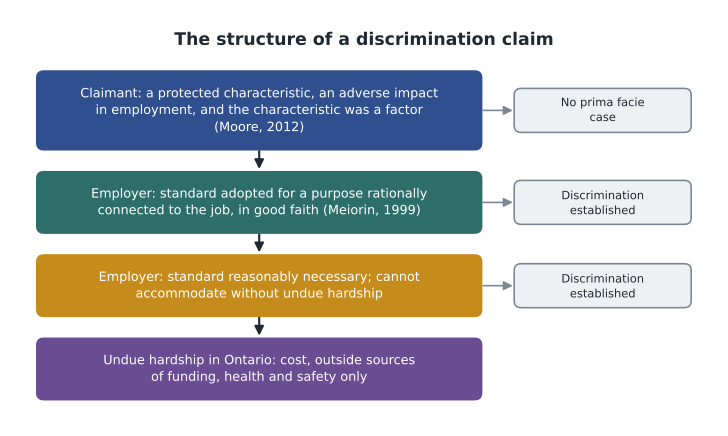
In Moore v. British Columbia (Education), 2012 SCC 61, the Supreme Court set out the test that claimants must meet to establish prima facie discrimination. The claimant must show that they have a characteristic protected from discrimination under the Code, that they experienced an adverse impact with respect to employment (or another protected area), and that the protected characteristic was a factor in the adverse impact. The claimant does not have to prove that the employer intended to discriminate, and the protected characteristic need only be a factor, not the only or main cause. Once the claimant establishes prima facie discrimination, the burden shifts to the employer to justify its conduct.
Discrimination can be direct, as when an employer refuses to hire a pregnant applicant, or adverse in effect, where a neutral rule has a disproportionate impact on people with a protected characteristic. Section 11 of the Ontario Code addresses adverse effect discrimination directly: a requirement, qualification or factor that is not discriminatory on its face but results in the exclusion, restriction or preference of a group identified by a prohibited ground is discrimination unless it is reasonable and bona fide in the circumstances, and it cannot be found reasonable and bona fide unless the needs of the group cannot be accommodated without undue hardship.
Meiorin and the bona fide occupational requirement
Before 1999, Canadian law treated direct and adverse effect discrimination differently, with different defences. In British Columbia (Public Service Employee Relations Commission) v. BCGSEU, [1999] 3 S.C.R. 3, known as Meiorin, the Supreme Court replaced that framework with a unified test. Tawney Meiorin, a forest firefighter with three years of satisfactory service, was dismissed after she failed one part of a new fitness test, a running test designed to measure aerobic capacity. Most women could not meet the standard, which had been developed from the performance of mainly male test subjects. Justice McLachlin, for the court, held that an employer can justify a standard that is prima facie discriminatory as a bona fide occupational requirement only if it shows three things: that it adopted the standard for a purpose rationally connected to the performance of the job; that it adopted the standard in an honest and good faith belief that it was necessary to fulfil that purpose; and that the standard is reasonably necessary to accomplish that purpose, in the sense that it is impossible to accommodate individual employees sharing the claimant's characteristics without imposing undue hardship on the employer.
The government had not shown that the aerobic standard was reasonably necessary to perform the job safely and efficiently, or that it could not accommodate women without undue hardship, so Meiorin's dismissal was discriminatory. The third step, reasonable necessity, is where most cases are decided. It requires the employer to consider individual assessment and alternative standards, not just to defend the rule it chose.
The duty to accommodate
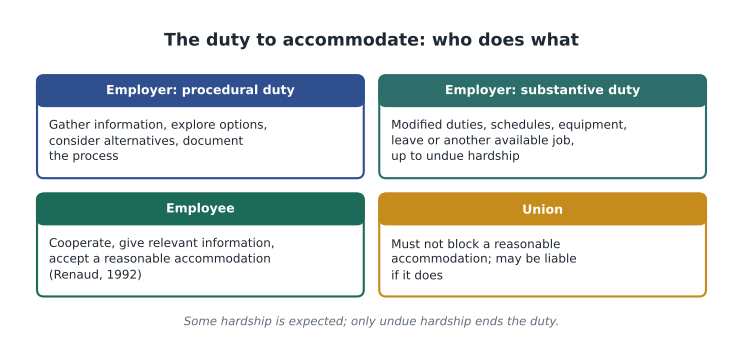
The duty to accommodate has a procedural and a substantive component. Procedurally, the employer must take reasonable steps to understand the employee's needs, obtain relevant information, explore options and consider alternatives. Substantively, it must provide an accommodation that meets the employee's needs, up to the point of undue hardship. Section 11(2) and section 17(2) of the Ontario Code limit the factors that can establish undue hardship to three: cost, outside sources of funding, if any, and health and safety requirements, if any. Inconvenience, customer preference, employee morale and collective agreement provisions are not listed, although they may sometimes be relevant to how accommodation is provided.
Undue hardship is a high standard. Some hardship is acceptable; only undue hardship relieves the employer. In Hydro-Québec v. Syndicat des employé-e-s de techniques professionnelles et de bureau d'Hydro-Québec, section locale 2000, 2008 SCC 43, the Supreme Court clarified that the test is not whether it was impossible to accommodate the employee in the literal sense. The employer must show that it could not accommodate the employee's characteristics without undue hardship. Where an employee with a disability has been unable to work regularly for a long time despite accommodation, and is unable to work for the reasonably foreseeable future, the employer may be able to end the employment without breaching the Code.
The duty is shared. In Central Okanagan School District No. 23 v. Renaud, [1992] 2 S.C.R. 970, the court held that the employee must cooperate in the search for accommodation and must accept a reasonable accommodation even if it is not the one they would have preferred. Unions also have a duty: a union that blocks a reasonable accommodation, for example by insisting on a seniority provision, may itself be liable.
Family status
Family status means the status of being in a parent and child relationship, and accommodation requests often involve childcare or eldercare. The legal test has been contested. In Canada (Attorney General) v. Johnstone, 2014 FCA 110, the Federal Court of Appeal, applying the Canadian Human Rights Act, held that a claimant must show that the childcare obligation engages a legal responsibility for the child, rather than a personal choice, and that the claimant has made reasonable efforts to meet the obligation through reasonable alternative solutions. In Misetich v. Value Village Stores Inc., 2016 HRTO 1229, the Human Rights Tribunal of Ontario declined to adopt a separate test for family status and applied the ordinary Moore test, while stressing that the claimant must show a real disadvantage to the parent and child relationship and not merely a negative impact on a family need. Lawyers in Ontario therefore apply the ordinary test, but should expect the tribunal to look closely at whether the employer's rule genuinely interferes with substantial family obligations.
Two Pellridge employees
Sabourin introduces two warehouse employees. Zainab Rennick, a forklift operator with five years' service, has been moved from day shift to a rotating schedule that includes two weeks of night shifts each month. She is a single parent of a seven-year-old, and her mother, who had provided overnight care, has moved to a long-term care home. She asks to stay on days. Her supervisor says that everyone has to rotate, that the collective agreement being negotiated will set shift rules, and that her childcare is 'her business'.
Daniel Whitecloud applies the test. Rennick has a protected characteristic, family status. The new schedule has an adverse impact: she cannot provide overnight care for her child and has made efforts to find alternatives. Her family status is a factor in the impact. Under Misetich, she must show a real disadvantage to the parent and child relationship, which the loss of overnight care for a seven-year-old would likely establish. The burden then shifts to Pellridge to show that the rotation is reasonably necessary and that keeping her on days would cause undue hardship based on cost or health and safety. Telling her that childcare is 'her business' is a failure of the procedural duty. Pellridge should explore options, such as a permanent day shift, a swap with a volunteer or a modified rotation.
The second employee, Piotr Wasik, is also a forklift operator. He has been prescribed medical cannabis for chronic pain after a back injury and has told his supervisor that he uses it in the evenings. Pellridge's policy prohibits employees in safety-sensitive positions from being impaired at work and requires them to disclose any medication that could impair them. Hannah Kowalczyk points out that he has disclosed the prescription, as the policy requires, and that Pellridge cannot simply remove him from forklift work because of a disability without an individualized assessment.
The relevant Supreme Court authority is Stewart v. Elk Valley Coal Corp., 2017 SCC 30. Stewart, a loader driver at a mine, was dismissed after an accident when he tested positive for cocaine. The employer's policy offered treatment to employees who disclosed a drug problem before an incident but provided for dismissal after an incident if no disclosure had been made. Stewart said he had not realized he was addicted until after the accident. A majority of the Supreme Court upheld the tribunal's finding that he was dismissed for breaching the policy, not because of his addiction, so there was no prima facie discrimination, and that in any event the employer had accommodated addicted employees through the disclosure and treatment provisions. The decision is sometimes misread as approving any drug policy. It turned on the tribunal's factual findings and the standard of review, and it confirmed that addiction is a disability.
For Wasik, Pellridge can require that he not be impaired at work, because safety is a legitimate requirement and health and safety is an undue hardship factor. But it must assess him individually: what the medical evidence says about timing and impairment, whether his evening use affects his capacity on shift, and whether a temporary non-driving role is available while the assessment is done. A blanket removal from forklift work because he has a cannabis prescription would likely fail the third Meiorin step.
Harassment and reprisal
Section 5(2) of the Code protects employees from harassment in the workplace by the employer, the employer's agent or another employee because of a prohibited ground. Section 7 deals specifically with sexual harassment, including a sexual solicitation or advance by a person in a position to confer or deny a benefit, and reprisal for rejecting it. Harassment is defined as engaging in a course of vexatious comment or conduct that is known or ought reasonably to be known to be unwelcome. An employer is liable for the conduct of its employees in the course of employment, and a corporation is liable for the acts of its directing minds. Section 8 prohibits reprisal against a person for claiming or enforcing a Code right or participating in a proceeding.
Harassment also has a separate legal home in the Occupational Health and Safety Act, which requires employers to have workplace harassment policies and programs and to investigate incidents and complaints, as lesson 11 explains. The Court of Appeal for Ontario held in Merrifield v. Canada (Attorney General), 2019 ONCA 205 that there is no freestanding common law tort of harassment, so harassment claims are pursued through human rights law, health and safety law, constructive dismissal or other established torts such as intentional infliction of mental suffering.
Forums and remedies
An Ontario employee can file an application with the Human Rights Tribunal of Ontario within one year of the last incident under section 34 of the Code, unless the tribunal is satisfied that a delay was incurred in good faith and no substantial prejudice will result. Since 2008, applications go directly to the tribunal rather than through the Human Rights Commission. The tribunal can order monetary compensation, including compensation for injury to dignity, feelings and self-respect, restitution such as lost wages, reinstatement, and public interest remedies such as policy changes and training, under section 45.2. Awards for injury to dignity are not capped.
A person who brings a civil action for wrongful dismissal or another cause of action may also claim Code damages in that action under section 46.1, but cannot sue for breach of the Code alone. In unionized workplaces, the question of forum is more complex. In Northern Regional Health Authority v. Horrocks, 2021 SCC 42, the Supreme Court held that where a labour statute gives a grievance arbitrator exclusive jurisdiction over disputes arising from the collective agreement, a human rights tribunal has no jurisdiction over a discrimination claim that falls within that scope, unless the legislature has clearly provided for concurrent jurisdiction. The Ontario Code gives the tribunal power to defer or dismiss applications where another proceeding has appropriately dealt with the substance, so Ontario unionized employees often have both routes, but the tribunal frequently defers to arbitration.
Worked problem
Responding to an accommodation request
Pellridge's human resources director, Soraya Haddadi, asks how to respond to Zainab Rennick's request to stay on day shift. Pellridge says that letting one employee opt out of nights would be unfair to others and might lead to more requests. Advise Pellridge.
Show solution
- Recognize the request as a Code issue. Rennick's family status is engaged, and under Misetich she will likely establish prima facie discrimination if the rotation genuinely interferes with her care for her child.
- Meet the procedural duty. Meet with Rennick, ask what she needs and why, ask for reasonable information about the childcare situation, and record the options considered.
- Consider the options and undue hardship. Possible accommodations include a permanent day assignment, voluntary swaps or a modified rotation. 'Unfairness' to others and fear of more requests are not undue hardship factors under section 11(2); only cost, outside funding and health and safety count.
- Decide and document. If a day assignment is possible without undue hardship, provide it. If it is not, explain why with evidence and offer the next best accommodation. Rennick must cooperate and accept a reasonable alternative (Renaud).
Common mistakes
MistakeRequiring the claimant to prove that the employer intended to discriminate.
InsteadIntent is not required. The claimant must show a protected characteristic, an adverse impact and that the characteristic was a factor (Moore).
MistakeJustifying a standard because it is applied to everyone equally.
InsteadA neutral rule can be adverse effect discrimination. The employer must show the standard is a bona fide occupational requirement under Meiorin, including that accommodation would cause undue hardship.
MistakeCiting employee morale or customer preference as undue hardship in Ontario.
InsteadThe Ontario Code limits undue hardship to cost, outside sources of funding and health and safety requirements.
MistakeReading Stewart v. Elk Valley as approving zero-tolerance drug policies generally.
InsteadStewart turned on the tribunal's findings that the dismissal was for breach of a policy that included treatment for those who disclosed; addiction remains a disability requiring accommodation.
MistakeSuing an employer for the tort of harassment.
InsteadMerrifield held there is no freestanding tort of harassment in Ontario; use human rights, health and safety, constructive dismissal or established torts.
Practice problems
Work each problem on paper first, then reveal the answer to check.
State the three steps of the Meiorin test for a bona fide occupational requirement.
Show answer
The employer must show that it adopted the standard for a purpose rationally connected to the job, in an honest and good faith belief that it was necessary, and that the standard is reasonably necessary because the employer cannot accommodate individuals sharing the claimant's characteristics without undue hardship.
What factors can establish undue hardship under the Ontario Human Rights Code?
Show answer
Cost, outside sources of funding, if any, and health and safety requirements, if any.
What duty does an employee have in the accommodation process?
Show answer
Under Renaud, to cooperate, provide relevant information and accept a reasonable accommodation even if it is not the one they prefer.
What is the limitation period for an application to the Human Rights Tribunal of Ontario, and what remedies can it award?
Show answer
One year from the last incident, subject to extension for good faith delay without substantial prejudice. The tribunal can award compensation, including for injury to dignity, feelings and self-respect, restitution, reinstatement and public interest remedies.
Summary and key terms
- The Ontario Human Rights Code prohibits discrimination in employment on fifteen grounds, including disability, family status, creed, sex and age; it is quasi-constitutional and cannot be waived.
- A claimant establishes prima facie discrimination by showing a protected characteristic, an adverse impact and that the characteristic was a factor (Moore); intent is not required.
- An employer justifies a discriminatory standard only under the three-step Meiorin test, which requires accommodation to the point of undue hardship, limited in Ontario to cost, outside funding and health and safety.
- Accommodation is shared: employers must explore options, employees must cooperate (Renaud), and unions must not block reasonable accommodation.
- Claims go to the Human Rights Tribunal of Ontario within one year, may be added to a civil action under section 46.1, or, in unionized workplaces, may belong to arbitration (Horrocks).
- Prima facie discrimination
- Discrimination established by the claimant's evidence, which the employer must then justify.
- Adverse effect discrimination
- Discrimination resulting from a neutral rule that has a disproportionate impact on a protected group.
- Bona fide occupational requirement
- A standard that is rationally connected to the job, adopted in good faith and reasonably necessary, which justifies prima facie discrimination.
- Duty to accommodate
- The obligation to adjust rules, practices or conditions to meet the needs of a person protected by the Code, short of undue hardship.
- Undue hardship
- The limit of the duty to accommodate, assessed in Ontario by cost, outside sources of funding and health and safety.
- Family status
- The status of being in a parent and child relationship.
Lesson quiz · 5 questions
Score 60% or more to complete this lesson.
Create a free account to save your progress, take quizzes and earn a certificate.