
LAWC-302 · Lesson 6 of 12 · 24 min
Just cause and constructive dismissal
▶ Video coming soon A video version of this lesson is on the way.
Professor Sabourin begins the sixth class with two short stories. In the first, an employee with twenty years of service is caught taking home an unopened box of printer paper worth about forty dollars. The employer fires him on the spot for theft. In the second, an employee's employer cuts her salary by a quarter, moves her to a smaller office and gives her best clients to a newer colleague, while insisting that she has not been dismissed. 'In the first story, the employer says there was a dismissal for cause. In the second, the employer says there was no dismissal at all,' Sabourin says. 'In both, the employer may be wrong. Today we study the two doctrines that decide whether the employer gets away with it.'
This lesson covers the law of just cause, including the contextual approach from McKinley, progressive discipline, condonation and the difference between cause and statutory wilful misconduct; and the law of constructive dismissal under Potter, including pay cuts, demotions, layoffs and toxic workplaces. The Pellridge file returns twice: once for a warehouse supervisor accused of dishonesty and once for Vivienne Ashdown's reorganization.
Just cause: an exceptional remedy
An employer may dismiss an employee without notice if it has just cause. Because the consequence is so severe, the employee losing all notice and often struggling to find new work with a dismissal for cause on the record, courts treat just cause as an exceptional remedy. The employer bears the burden of proving it on a balance of probabilities. Just cause is assessed on the facts as they actually existed at the time of dismissal, and an employer may rely on misconduct it discovered after the dismissal if the misconduct occurred before it. But an employer that alleges cause and cannot prove it may face damages for bad faith in the manner of dismissal, as Wallace and Keays showed.
McKinley and the contextual approach
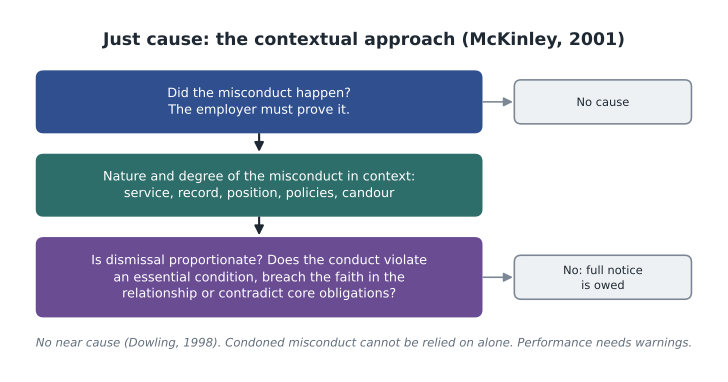
The leading case is McKinley v. BC Tel, 2001 SCC 38. McKinley, a chartered accountant with seventeen years' service, took medical leave for high blood pressure. His employer dismissed him and later alleged that he had been dishonest about his condition and treatment options. The question was whether any dishonesty, however minor, automatically justified dismissal. Justice Iacobucci, for a unanimous court, rejected that approach. Whether dishonesty justifies dismissal depends on its nature and degree, assessed in context. The test is whether the employee's dishonesty gave rise to a breakdown in the employment relationship: whether the conduct violates an essential condition of the employment contract, breaches the faith inherent to the work relationship, or is fundamentally or directly inconsistent with the employee's obligations to the employer.
McKinley built in a principle of proportionality. Justice Iacobucci emphasized that the sanction imposed for misconduct must be proportional to the misconduct, and he linked that principle to the importance of work to a person's identity and dignity. The contextual approach applies to all forms of alleged misconduct, not just dishonesty. Relevant context includes the employee's length of service and disciplinary record, the employee's position and the trust it requires, the nature of the business, whether the conduct was a single incident or part of a pattern, whether the employee admitted it and showed remorse, and whether the employer's policies were known and consistently enforced.
No near cause
Employers sometimes argue that even if misconduct does not amount to cause, it should reduce the notice period. The Supreme Court rejected that argument in Dowling v. Halifax (City), [1998] 1 S.C.R. 22, affirming the Nova Scotia Court of Appeal's rejection of a 'near cause' doctrine. Either the employer has cause and owes no notice, or it does not and owes full reasonable notice. The employee's misconduct short of cause does not reduce the notice period.
Categories of misconduct
Some kinds of conduct commonly support a finding of cause, always subject to the contextual analysis. Serious dishonesty, such as theft, fraud or falsifying records, is the most common. Serious insubordination, such as a deliberate refusal to follow a reasonable and lawful instruction, may justify dismissal, especially if repeated after warnings. Workplace harassment and violence are taken very seriously. In Render v. ThyssenKrupp Elevator (Canada) Limited, 2022 ONCA 310, the Court of Appeal held that a single incident of sexual harassment by a long-service manager, who slapped a subordinate's buttocks in front of co-workers after making an inappropriate gesture, could justify dismissal, emphasizing the employer's statutory obligations under the Occupational Health and Safety Act to protect workers from harassment. Serious breaches of safety rules, conflicts of interest and competing with the employer can also justify dismissal. Off-duty conduct can amount to cause where it harms the employer's reputation or business, or makes it impossible for the employee to perform their duties.
Poor performance is different. An employer that wishes to dismiss for performance must usually show that it set clear and reasonable standards, told the employee they were not meeting them, gave the employee a reasonable opportunity and assistance to improve, and warned the employee that dismissal would follow if they did not improve. Only a failure to improve after such warnings, or gross incompetence, will normally amount to cause. Most employers who dismiss for poor performance are better advised to give reasonable notice.
Progressive discipline and condonation
Many employers use progressive discipline: a verbal warning, then a written warning, then a suspension, then dismissal. At common law, there is no general duty to impose progressive discipline before dismissal, but in practice warnings are often decisive. A warning shows that the employee knew the standard and that the employer took the conduct seriously, and repeated misconduct after warnings is more likely to show a breakdown of the relationship. A non-union employer has no inherent right to suspend without pay unless the contract allows it; an unauthorized disciplinary suspension may itself be a constructive dismissal, as discussed below.
Condonation is a related doctrine. If an employer knows of misconduct and does not act on it within a reasonable time, or continues the employment as if nothing had happened, it may be taken to have forgiven the misconduct and cannot later rely on it alone as cause. Condoned misconduct can be revived, however, if the employee commits further misconduct.
Cause and statutory wilful misconduct
As lesson 3 explained, the Employment Standards Act removes termination and severance pay only where the employee has been guilty of wilful misconduct, disobedience or wilful neglect of duty that is not trivial and has not been condoned. That standard looks at the employee's state of mind: the conduct must be deliberate, not merely careless or a lapse in judgment. An employer may therefore have just cause at common law, so that no common law notice is owed, and still owe statutory termination and severance pay because the misconduct was not wilful. Employers who dismiss for cause should usually consider paying the statutory amounts to avoid a claim and a possible finding that they have breached the Act.
The Pellridge warehouse supervisor
Sabourin turns to a new part of the file. Lorcan Quarrie, a warehouse shift supervisor with eleven years at Pellridge and no prior discipline, was found to have taken home two pallets of damaged safety boots that were scheduled for disposal. Pellridge's policy prohibits removing company property without written authorization, but supervisors had for years allowed staff to take damaged goods that were going to be thrown out, and Quarrie said he thought this was permitted. When asked, he admitted taking the boots and offered to return them. Pellridge dismissed him for theft.
Arjun Mehta argues for the employer: Quarrie was a supervisor responsible for enforcing the policy, and taking two pallets is not trivial. Sophie Tremblay-Hart argues that under McKinley the dishonesty is minor or nonexistent: the goods were waste, the practice was tolerated, he admitted it immediately and he had eleven years of clean service. Sabourin's view is that a court applying McKinley would probably not find cause. Even if it did, the conduct would almost certainly not be wilful misconduct under the Act, because he honestly believed he was allowed to take the goods. At minimum, Pellridge owes him statutory termination and severance pay, and probably full common law notice.
Constructive dismissal
Constructive dismissal occurs when the employer, without dismissing the employee in so many words, breaches the contract in a way that entitles the employee to treat the employment as ended. The employee resigns and sues for damages as if they had been dismissed without notice. In Farber v. Royal Trust Co., [1997] 1 S.C.R. 846, a regional manager was offered a branch manager position that would have cut his income roughly in half; the Supreme Court held that he had been constructively dismissed. The court explained that the question is whether, at the time the offer was made, a reasonable person in the same situation as the employee would have felt that the essential terms of the employment contract were being substantially changed.
Potter: the two branches
The Supreme Court restated the law in Potter v. New Brunswick Legal Aid Services Commission, 2015 SCC 10. Potter, the executive director of the commission, was suspended indefinitely with pay while the board secretly asked the government to dismiss him for cause. He resigned and sued for constructive dismissal. Justice Wagner, for the majority, identified two branches of the test.
Under the first branch, the court identifies a single unilateral act by the employer that breaches an express or implied term of the contract. It must first determine objectively whether a breach has occurred, and then whether, at the time of the breach, a reasonable person in the employee's situation would have felt that the essential terms of the contract were being substantially changed. An act that the employer is authorized to take under the contract is not a breach. Under the second branch, a course of conduct by the employer can amount to constructive dismissal if, viewed objectively, it shows that the employer no longer intends to be bound by the contract. The second branch does not require the court to identify a specific substantial change to an essential term.
In Potter, the majority held that the administrative suspension was a breach under the first branch. An employer has no general right to suspend an employee with pay; such a suspension must be reasonable and justified, which depends on factors such as its duration, whether it was made in good faith, and whether there was a legitimate business reason. The commission's suspension was indefinite, unexplained and made while it was secretly seeking his dismissal, so it was unauthorized and a substantial change. Potter had been constructively dismissed.
Common situations
A significant reduction in pay is the classic example. There is no fixed threshold, but reductions of 10 to 15 percent or more are often found to be substantial, and smaller cuts may be enough in combination with other changes. A demotion, a significant change in duties or reporting relationships, a relocation that the contract does not allow, or the removal of key responsibilities can each support a claim. At common law, a temporary layoff is a constructive dismissal unless the contract expressly or impliedly permits it. In Elsegood v. Cambridge Spring Service (2001) Ltd., 2011 ONCA 831, the Court of Appeal confirmed that an employer has no implied right to lay off an employee temporarily, so a layoff without such a right may entitle the employee to claim constructive dismissal, even though the Employment Standards Act regulates the length of layoffs.
The second branch covers toxic workplaces. Persistent harassment, humiliation or abuse by a supervisor, which the employer knows about and fails to stop, can show that the employer no longer intends to honour its obligation to treat the employee with civility and decency. Courts have accepted such claims where the conduct was serious and sustained; a single unpleasant incident or ordinary workplace friction is not enough.
Acceptance, timing and the duty to mitigate
An employee who continues working for a significant time without objecting may be taken to have accepted the change, losing the right to claim constructive dismissal. Under Wronko v. Western Inventory Service Ltd., 2008 ONCA 327, an employee who objects clearly may keep working on the old terms, but an employee who wants to claim constructive dismissal must resign within a reasonable time after the breach. Constructively dismissed employees must still mitigate. Under Evans v. Teamsters, that can include accepting the employer's offer of the changed position during the notice period if a reasonable person would do so, which can sharply reduce damages where the change was modest and the relationship is not poisoned.
Ashdown's reorganization
Return to Vivienne Ashdown. Suppose that instead of eliminating her position outright, Pellridge had moved her from regional sales manager to an 'inside sales lead' role, with no direct reports, a base salary cut from 118,000 to 96,000 dollars, and the loss of her car allowance. Theo Marchetti calculates that her total compensation would fall by about 23 percent, and her status would fall further. Under Farber and the first branch of Potter, a reasonable person in her position would feel that the essential terms of her employment were being substantially changed. Nothing in her contract permits Pellridge to demote her. She could resign within a reasonable time and claim constructive dismissal, with the same damages as for an outright dismissal, subject to mitigation. Whether Evans would require her to accept the inside sales role during the notice period is debatable: the role is a demotion, involves a significant pay cut and would place her under a former subordinate, which points against requiring her to accept it.
Worked problem
Advising on a pay cut
A Pellridge sales representative, Yusra, earns a base salary of 70,000 dollars plus commission averaging 40,000 dollars. Pellridge announces a new commission plan that will reduce her expected total pay by about 18 percent and asks all representatives to sign it. Her contract says commission rates are 'subject to change at the company's discretion'. Advise her.
Show solution
- Is there a breach? The contract allows Pellridge to change commission rates at its discretion. Under the first branch of Potter, an act authorized by the contract is not a breach. But under Wastech, the discretion must be exercised reasonably and for purposes connected to why it was granted, and a change that guts her compensation may exceed the scope of the discretion.
- Is it substantial? An 18 percent reduction in total compensation would usually be substantial under Farber.
- Options under Wronko: she may accept the change, resign within a reasonable time and claim constructive dismissal, or object clearly in writing and continue working, forcing Pellridge to give reasonable notice of the change.
- Mitigation: if she resigns, Evans may require her to keep working under the new plan during the notice period if a reasonable person would do so, which could reduce her damages to the difference in pay. Advise her not to resign without considering that risk.
Common mistakes
MistakeTreating any dishonesty as automatic cause.
InsteadMcKinley requires a contextual assessment of the nature and degree of the misconduct and a proportionate response.
MistakeReducing the notice period for misconduct that falls short of cause.
InsteadThere is no "near cause" in Canadian law (Dowling v. Halifax). Either cause exists or full notice is owed.
MistakeAssuming that cause at common law removes statutory termination and severance pay.
InsteadThe statutory exception requires wilful misconduct that is not trivial and has not been condoned, which is a higher standard.
MistakeTelling a client to keep working under a demotion for six months while thinking about it.
InsteadProlonged acceptance without objection may defeat a constructive dismissal claim. The employee should object clearly and decide within a reasonable time.
MistakeAssuming an employer may lay off a non-union employee because the Employment Standards Act permits temporary layoffs.
InsteadAt common law there is no implied right to lay off; without a contractual right, a layoff may be a constructive dismissal (Elsegood).
Practice problems
Work each problem on paper first, then reveal the answer to check.
What is the test for whether dishonesty justifies dismissal under McKinley?
Show answer
Whether, in context, the dishonesty gave rise to a breakdown in the employment relationship: whether it violated an essential condition of the employment contract, breached the faith inherent to the relationship, or was fundamentally inconsistent with the employee's obligations. The sanction must be proportional.
Describe the two branches of constructive dismissal in Potter.
Show answer
First, a single unilateral act breaching an express or implied term that a reasonable person would see as substantially changing an essential term. Second, a course of conduct showing, objectively, that the employer no longer intends to be bound by the contract.
An employer suspends an employee indefinitely with pay and gives no reason. Can this be constructive dismissal?
Show answer
Yes. Under Potter, an administrative suspension must be reasonable and justified, considering its duration, good faith and the business reason. An indefinite, unexplained suspension may be an unauthorized and substantial change.
An employee is dismissed for cause for falsifying expense claims over two years. Is the employer automatically relieved of statutory termination pay?
Show answer
Only if the conduct amounts to wilful misconduct, disobedience or wilful neglect of duty that is not trivial and was not condoned. Deliberate, repeated falsification would very likely meet that standard.
Summary and key terms
- Just cause is an exceptional remedy that the employer must prove; McKinley requires a contextual, proportionate assessment of the misconduct.
- There is no near cause (Dowling). Condoned misconduct cannot alone be relied on later, and performance problems usually require clear warnings and a chance to improve.
- A single serious incident, such as sexual harassment by a manager, can justify dismissal (Render v. ThyssenKrupp).
- Common law cause and statutory wilful misconduct are different standards; an employee dismissed for cause may still be owed statutory entitlements.
- Constructive dismissal arises from a substantial unilateral change to an essential term or a course of conduct showing the employer no longer intends to be bound (Farber; Potter); unauthorized layoffs and toxic workplaces are common examples.
- Just cause
- Serious misconduct that justifies dismissal without notice, assessed contextually under McKinley.
- Proportionality
- The principle that dismissal must be a proportionate response to the misconduct in its full context.
- Condonation
- An employer's forgiveness of misconduct, express or implied by inaction, which prevents reliance on it alone as cause.
- Progressive discipline
- A sequence of increasingly serious sanctions, such as warnings and suspensions, before dismissal.
- Constructive dismissal
- An employer's breach that entitles the employee to treat the employment as ended and claim damages as if dismissed.
- Administrative suspension
- A non-disciplinary suspension, with or without pay, which must be reasonable and justified to avoid constructive dismissal.
Lesson quiz · 5 questions
Score 60% or more to complete this lesson.
Create a free account to save your progress, take quizzes and earn a certificate.