
LAWC-302 · Lesson 12 of 12 · 23 min
Capstone: solving an employment and labour law problem
▶ Video coming soon A video version of this lesson is on the way.
Professor Sabourin's last class is a problem day. He hands out a four-page fact pattern and gives the students forty minutes to outline an answer before discussing it. 'I have written this problem the way real files arrive,' he says. 'Five people walk into your office in the same week from the same employer, and every one of them thinks their problem is the only one that matters. Your job is to classify, choose the forum, state the law and give advice the client can act on. Floor, contract, collective. Then the forum. Then the clock.'
This lesson sets out the fact pattern, a method for answering multi-issue problems, and a model answer for each issue. The facts are entirely fictional. All events are assumed to have taken place in autumn 2026, and the law is as it stood on November 22, 2026.
The fact pattern
Grist and Gable Brewing Co. Ltd. is a craft brewery in Corwin, Ontario, owned and run by its president, Ottoline Mabry. It employs about 85 people in its brewhouse, cellar, packaging line, taproom and sales office, and its annual payroll is about 5.5 million dollars. Its beer is sold in Ontario and, since 2023, to a distributor in Gatineau, Quebec.
Rosamund Kilbride, 58, has been Grist and Gable's sales director for 22 years. She earns a base salary of 135,000 dollars and a discretionary annual bonus that has averaged 25,000 dollars over the last five years; the bonus plan says that bonuses are payable only to employees who are 'actively employed and not under notice of termination on the payment date of March 31'. In 2021 she signed a new employment agreement when she was given an equity-linked retention payment of 15,000 dollars. Its termination clause gives her, on termination without cause, 'the minimum notice, termination pay, benefits continuation and severance pay required by the Employment Standards Act, 2000, and nothing further', and allows termination for cause without notice or pay for 'any breach of company policy, including the code of conduct'. On October 5, 2026, Mabry told Kilbride that her role was being eliminated, effective immediately, and offered her the statutory amounts. Kilbride says that in July Mabry assured her, in front of two other managers, that her job was 'safe through retirement' and that she should turn down a recruiter's offer from a competing brewery, which she did.
Selwyn Asibey is a cellar worker with four years' service. In September 2026 he began talking to co-workers about joining a union, the fictional Ontario Food and Beverage Workers Union, Local 9. On October 14, an alarm sounded in the cellar, and Asibey and two co-workers left the room, saying they smelled 'something wrong' and that the carbon dioxide monitor had been beeping intermittently for a week. The cellar manager told them the monitor was faulty and ordered them back in. Asibey refused and asked for the joint health and safety committee's worker co-chair. The manager sent him home. On October 16, after the union filed an application for certification, Asibey was dismissed for 'insubordination and leaving his work station without permission'. A Ministry inspector who attended on October 15 found a leaking carbon dioxide fitting and issued an order.
Elodie Gauthier is a part-time taproom server who has worked at Grist and Gable for two years, usually 28 hours a week. On September 20 she told her shift manager she was pregnant. Over the following four weeks her scheduled hours fell to between eight and twelve a week. When she asked why, the shift manager said customers 'prefer a high-energy floor staff on weekends' and that the change was 'for her own good'.
Hamish Dorrington has delivered for Grist and Gable for six years in his own refrigerated truck. He has no other customers. He drives the routes the brewery sets, wears a Grist and Gable jacket and is paid a per-load rate. Three times a week he drives a load to the Gatineau distributor. On October 20, Mabry told him by text that the brewery was 'switching to a logistics company' and would not need him after the end of the week.
A method for the answer
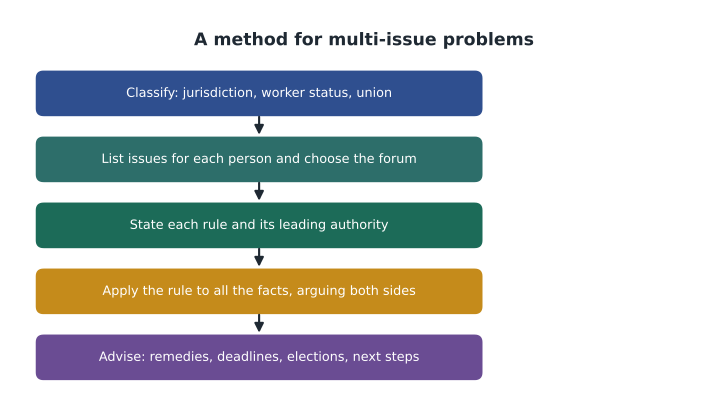
Before discussing the issues, Sabourin reviews the method he has asked students to use all term. First, classify: which government regulates the workplace, whether each person is an employee, a dependent contractor or an independent contractor, and whether a union represents them. Second, list the issues for each person and choose the forum. Third, state each rule with its leading authority. Fourth, apply the rule to the facts, arguing both sides where the facts are mixed. Fifth, conclude with practical advice, including deadlines, remedies and the election rules. He adds five rules for examination answers: answer the question asked; organize by person and issue; name the test before applying it; use the facts, all of them; and finish every issue with a conclusion and a next step.
Issue 1: Jurisdiction
Grist and Gable is a brewery. Brewing and selling beer is a provincial undertaking, and the fact that some of its products are sold in Quebec does not make the brewery a federal work or undertaking under the functional test in NIL/TU,O Child and Family Services Society v. B.C. Government and Service Employees' Union, 2010 SCC 45. Its normal and habitual activity, viewed as a going concern, is manufacturing and selling beer. The Ontario statutes apply to its employees: the Employment Standards Act, 2000, the Human Rights Code, the Occupational Health and Safety Act and the Labour Relations Act, 1995.
Dorrington's deliveries to Gatineau raise a narrower question. Interprovincial trucking is a federal undertaking under section 92(10)(a) of the Constitution Act, 1867, but the cases distinguish a trucking business that regularly crosses provincial borders from a manufacturer that occasionally ships across them as an incident of its own business. Dorrington does not operate a trucking business serving the public; he hauls one customer's goods, mostly within Ontario. The better view is that his relationship with Grist and Gable is provincially regulated. The point matters mainly for whether the Ontario Employment Standards Act or the Canada Labour Code would apply to him if he is an employee.
Issue 2: Kilbride's termination clause and damages
Rule. A termination clause can limit an employee to statutory minimums if it is clear and complies with the Employment Standards Act (Machtinger v. HOJ Industries Ltd., [1992] 1 S.C.R. 986; Bertsch v. Datastealth Inc., 2025 ONCA 379). Termination provisions are read as a whole, and if any part, including the for-cause provision, could deprive the employee of statutory entitlements, all are void (Waksdale v. Swegon North America Inc., 2020 ONCA 391). The 2026 decisions in Baker v. Van Dolder's Home Team Inc. and Li v. Wayfair Canada ULC, 2026 ONCA 568 direct courts not to strain to find ambiguity, but did not overrule Waksdale.
Application. The without-cause portion is clear and compliant, and it was supported by fresh consideration, the 15,000 dollar retention payment (Hobbs v. TDI Hospitality Management Consultants Inc., 2009 ONCA 787). But the for-cause portion allows termination without notice or pay for 'any breach of company policy, including the code of conduct'. A breach of policy may be inadvertent or trivial and need not amount to wilful misconduct, disobedience or wilful neglect of duty that is not trivial and has not been condoned, the standard in Regulation 288/01. Unlike the clause in Baker, it does not preserve statutory entitlements. Under Waksdale, the whole termination scheme is void, and Kilbride is entitled to common law reasonable notice.
Reasonable notice. Applying the factors in Bardal v. Globe and Mail Ltd. (1960), 24 D.L.R. (2d) 140, Kilbride is 58, has 22 years' service, held a senior position, and faces a small market for craft brewery sales directors. A court would likely award between 20 and 24 months. The July assurance and her decision to turn down the recruiter's offer may support the upper end, by analogy to inducement, and could also support a claim that Mabry breached the duty of honest performance (Bhasin v. Hrynew, 2014 SCC 71; C.M. Callow Inc. v. Zollinger, 2020 SCC 45) if Mabry knew at the time that the role would be eliminated. Under Dawe v. Equitable Life Insurance Company of Canada, 2019 ONCA 512, more than 24 months would require exceptional circumstances.
Bonus. The bonus plan requires active employment and that the employee not be 'under notice of termination' on March 31. Under Matthews v. Ocean Nutrition Canada Ltd., 2020 SCC 26, the court asks whether she would have received the bonus during the notice period and whether the plan unambiguously removes that right. The 'not under notice' wording is closer to addressing termination than the bare 'active employment' language in Paquette v. TeraGo Networks Inc., 2016 ONCA 618, but it does not clearly address damages for a failure to give reasonable notice, and courts apply Matthews strictly. Kilbride has a strong argument that her damages include the bonus for each year of the notice period. The 'discretionary' label does not defeat the claim where the bonus was paid consistently and formed an integral part of her compensation.
Mitigation and advice. She must make reasonable efforts to find comparable work, and the burden of proving a failure is on Grist and Gable (Michaels v. Red Deer College, [1976] 2 S.C.R. 324). She should keep a careful record of her search. She should not file an Employment Standards Act complaint, because section 97 would bar a civil action unless she withdrew it within two weeks. Her claim should be brought in the Superior Court of Justice. Damages for the manner of dismissal under Honda Canada Inc. v. Keays, 2008 SCC 39 require evidence of bad faith conduct and actual mental distress; the abrupt termination alone is not enough, but the misleading July assurance could support such a claim if she suffered distress beyond the ordinary.
Issue 3: Asibey's dismissal
Rule. Section 72 of the Labour Relations Act, 1995 prohibits dismissal because a person is exercising rights under the Act, and section 96(5) places the burden on the employer to prove it did not act contrary to the Act. Section 50 of the Occupational Health and Safety Act prohibits reprisal against a worker who acts in compliance with the Act, including refusing unsafe work, with the burden on the employer. Section 43 gives a worker the right to refuse work they have reason to believe is likely to endanger them.
Application. Asibey's refusal on October 14 was a protected work refusal. An intermittently beeping carbon dioxide monitor and a smell he could not identify gave him reason to believe the cellar was likely to endanger him, and the inspector's finding of a leak the next day confirms it. The manager's response, sending him home without the investigation required by section 43, was itself a breach of the refusal procedure. Two days later, immediately after the union's certification application, he was dismissed for 'insubordination' and 'leaving his work station', which describe the protected refusal. Grist and Gable bears the burden under both statutes and will find it very hard to discharge.
Forum and remedies. The union can file an unfair labour practice complaint with the Ontario Labour Relations Board and seek interim reinstatement under section 98, which is designed for dismissals during organizing campaigns. Asibey can also file an OHSA reprisal complaint, which the Board also hears. The Board can order reinstatement with full compensation and, if the employer's conduct means a representation vote would not reflect employees' true wishes, may order a new vote or certify the union under section 11. Practical advice: file promptly, gather statements from the two co-workers and preserve the inspector's order.
Issue 4: The carbon dioxide incident
Grist and Gable's duties under section 25 of the Occupational Health and Safety Act include maintaining equipment in good condition and taking every precaution reasonable in the circumstances (section 25(2)(h)). The cellar manager, as a supervisor, had to advise workers of known hazards and take every reasonable precaution (section 27). A week of intermittent monitor alarms, dismissed as a fault without investigation, is the kind of known hazard that defeats a due diligence defence under R. v. Sault Ste. Marie (City), [1978] 2 S.C.R. 1299. The company risks prosecution with a maximum fine of 2 million dollars, and the manager risks a fine of up to 500,000 dollars. The company should comply with the inspector's order, review its gas detection and maintenance procedures with the joint committee, and retrain supervisors on the work refusal procedure.
Issue 5: Gauthier's reduced hours
Rule. Section 5(1) of the Human Rights Code protects equal treatment in employment without discrimination because of sex, which includes pregnancy. Under Moore v. British Columbia (Education), 2012 SCC 61, a claimant must show a protected characteristic, an adverse impact and that the characteristic was a factor. Section 74 of the Employment Standards Act also protects against reprisal for asking about or exercising rights under the Act, including pregnancy leave.
Application. Gauthier's pregnancy is a protected characteristic. A cut from 28 hours to between eight and twelve hours is a serious adverse impact. The timing, immediately after her disclosure, and the manager's explanations, that customers 'prefer a high-energy floor staff' and that the change was 'for her own good', make it very likely that her pregnancy was a factor. Customer preference is never a defence, and in any event the Code limits undue hardship to cost, outside sources of funding and health and safety. If the employer had a genuine safety concern, it would have had to assess her individually and consult her, not cut her hours unilaterally.
Forum and remedies. Gauthier can apply to the Human Rights Tribunal of Ontario within one year under section 34, seeking lost wages, compensation for injury to dignity, feelings and self-respect, and an order restoring her hours. The substantial reduction in hours may also be a constructive dismissal under Potter v. New Brunswick Legal Aid Services Commission, 2015 SCC 10, but she wants to keep her job. The tribunal route, which can order restoration of hours and does not require her to resign, is the better choice. If she later sues for constructive dismissal, she can claim Code damages in that action under section 46.1, but she should not pursue both routes on the same facts.
Issue 6: Dorrington's status and notice
Rule. Under 671122 Ontario Ltd. v. Sagaz Industries Canada Inc., 2001 SCC 59, the question is whether the worker is in business on their own account, considering control, ownership of tools, helpers, financial risk, investment and opportunity for profit. A contractor who is economically dependent on one client is a dependent contractor entitled to reasonable notice (McKee v. Reid's Heritage Homes Ltd., 2009 ONCA 916; Keenan v. Canac Kitchens Ltd., 2016 ONCA 79).
Application. Dorrington owns a refrigerated truck and is paid per load, which point toward a business of his own. But he has had no other customer for six years, drives routes the brewery sets, wears its jacket and has no real opportunity to grow a business. He is at least a dependent contractor under McKee and arguably an employee. Either way, he is entitled to reasonable notice. Given six years of exclusive service and the specialized truck, a court might award several months. If he is an employee, he is also entitled to statutory notice of six weeks, and Grist and Gable, with a payroll over 2.5 million dollars, would owe severance pay because he has more than five years' service. Section 5.1 of the Employment Standards Act would place the burden on the brewery to prove he is not an employee in any proceeding under that Act.
Advice. Dorrington should send a demand letter claiming reasonable notice and, in the alternative, his statutory entitlements as an employee. If the amounts involved are under 50,000 dollars, the Small Claims Court is available. He must decide whether to file an Employment Standards Act claim, which would trigger the section 97 election.
| Client | Main claims | Forum | Key authorities |
|---|---|---|---|
| Rosamund Kilbride | Common law notice; bonus; possible manner-of-dismissal damages | Superior Court of Justice | Waksdale; Bardal; Matthews; Bhasin; Keays |
| Selwyn Asibey | Unfair labour practice; OHSA reprisal; interim reinstatement | Ontario Labour Relations Board | Labour Relations Act ss. 72, 96(5), 98, 11; OHSA ss. 43, 50 |
| Elodie Gauthier | Pregnancy discrimination; restoration of hours | Human Rights Tribunal of Ontario | Human Rights Code s. 5(1); Moore |
| Hamish Dorrington | Reasonable notice as dependent contractor or employee | Small Claims or Superior Court; possibly ESA claim | Sagaz; McKee; Keenan |
| Grist and Gable | OHSA compliance and prosecution risk | Ministry inspector; Ontario Court of Justice | OHSA ss. 25, 27, 66; Sault Ste. Marie |
Debrief
When the class compares outlines, Sabourin points out the most common mistakes. Several students assumed that because Kilbride's without-cause clause was clear, it was enforceable, and forgot to read the for-cause clause. Some advised Asibey to sue in court, overlooking the Board's jurisdiction and the reverse onus. A few treated Gauthier's case as an Employment Standards Act issue only. And almost everyone forgot to mention deadlines: one year for the Human Rights Tribunal, two years for Employment Standards Act wage recovery, the two-year limitation period for civil claims under Ontario's Limitations Act, 2002, and the urgency of an interim reinstatement application.
Arjun Mehta asks whether there is a single principle that ties the course together. Sabourin thinks for a moment. 'The law gives workers a floor they cannot sign away, a contract that courts read with an eye to the inequality of the parties, and, if they act together, a collective voice the constitution now protects. Your job is to know which of those a client has, and to use it before the clock runs out.' He erases the three words on the board, Floor. Contract. Collective., and writes one more: Advice.
Common mistakes
MistakeAnalyzing only the issue the client raises.
InsteadClassify each person and list every issue, including those the client has not mentioned, such as a health and safety reprisal hidden in a dismissal for insubordination.
MistakeStating a conclusion without the test.
InsteadName the rule and its authority before applying it, for example Waksdale for termination clauses or Moore for discrimination.
MistakeIgnoring forum and election rules.
InsteadChoose the forum deliberately and explain consequences such as section 97 of the Employment Standards Act and Weber exclusivity.
MistakeTreating a dependent contractor as having no rights.
InsteadApply Sagaz and McKee; economically dependent contractors are owed reasonable notice.
MistakeLeaving out deadlines and next steps.
InsteadEvery issue should end with the limitation period or urgency and a concrete next step for the client.
Practice problems
Work each problem on paper first, then reveal the answer to check.
Why is Kilbride's termination clause unenforceable even though the without-cause part complies with the statute?
Show answer
Because the for-cause part allows termination without notice or pay for any breach of policy, which may fall short of wilful misconduct. Under Waksdale, the provisions are read as a whole and all are void.
What is the most important procedural advantage Asibey has before the Ontario Labour Relations Board?
Show answer
The reverse onus: under section 96(5) of the Labour Relations Act and section 50 of the Occupational Health and Safety Act, the employer must prove that it did not dismiss him for union activity or for the work refusal.
Why is the Human Rights Tribunal a better forum than a constructive dismissal action for Gauthier?
Show answer
Because she wants to keep her job. The tribunal can order her hours restored and compensate her without requiring her to resign, while a constructive dismissal claim requires treating the employment as ended.
Does the Gatineau delivery route make Grist and Gable a federally regulated employer?
Show answer
No. Its normal and habitual activity is brewing and selling beer, a provincial undertaking. Occasional interprovincial shipments incidental to that business do not make it federal under the functional test.
Summary and key terms
- Begin every problem by classifying the workplace (federal or provincial), each worker (employee, dependent or independent contractor) and the presence of a union.
- Organize by person and issue, choose the forum for each, state the rule and authority, apply it to all the facts and conclude with practical advice and deadlines.
- Termination clauses must be read as a whole under Waksdale; bonuses survive unless plans unambiguously exclude them under Matthews.
- Dismissals during organizing campaigns and after work refusals face a reverse onus before the Ontario Labour Relations Board.
- Pregnancy discrimination is sex discrimination under the Code; economically dependent contractors are owed reasonable notice.
- Classification
- The first step in any workplace problem: identifying the jurisdiction, the worker's status and whether a union is present.
- Forum
- The body that decides a dispute, such as a court, tribunal, labour board or arbitrator.
- IRAC
- Issue, rule, application and conclusion: a structure for legal analysis.
- Interim reinstatement
- A Labour Relations Board order returning a dismissed employee to work pending a hearing.
- Limitation period
- The deadline for starting a proceeding, such as one year for a human rights application.
- Practical advice
- The concrete steps a lawyer recommends to the client, including forum, timing and evidence.
Lesson quiz · 5 questions
Score 60% or more to complete this lesson.
Create a free account to save your progress, take quizzes and earn a certificate.