
LAWC-302 · Lesson 5 of 12 · 23 min
Wrongful dismissal: reasonable notice, mitigation and damages
▶ Video coming soon A video version of this lesson is on the way.
Lesson 4 ended with a conclusion that changed the value of Vivienne Ashdown's file: her termination clause is unenforceable, so she is entitled to common law reasonable notice. The facts have now moved on. In September 2026 Pellridge told Ashdown that her regional manager role was being eliminated in a reorganization, gave her a letter offering eight weeks' termination pay and sixteen weeks' severance under the Employment Standards Act, and asked her to sign a release in exchange for a further four weeks' pay. She refused and has come to the Brannock legal clinic, where Theo Marchetti and Hannah Kowalczyk are assigned to her file under Professor Sabourin's supervision.
'A wrongful dismissal action,' Sabourin tells them, 'is a claim for breach of contract. The breach is not the dismissal itself. An employer is entitled to end an indefinite employment relationship at any time. The breach is failing to give enough notice. So the damages are the wages and benefits the employee would have earned during the notice period she should have received, less what she earns elsewhere in that period. Everything else in this lesson is detail. But the details are where clients win and lose.'
This lesson explains how reasonable notice is assessed, the duty to mitigate, what counts as damages including bonuses and incentive plans, and the separate damages that may be awarded for the manner of dismissal.
The nature of the claim
At common law, either party may end an indefinite employment contract by giving reasonable notice. An employer that dismisses an employee without cause and without reasonable notice, or with insufficient pay in lieu of notice, breaches the contract. The employee's damages are measured by the amount that would put them in the position they would have been in had proper notice been given. Courts do not order reinstatement in a common law action; that remedy is available only under statutes such as the Canada Labour Code's unjust dismissal scheme, human rights legislation or collective agreements.
The claim is usually brought in the Superior Court of Justice, or in the Small Claims Court for claims up to its monetary limit of 50,000 dollars. Many wrongful dismissal actions in Ontario proceed under the simplified procedure of Rule 76 of the Rules of Civil Procedure, and courts have encouraged summary judgment in straightforward cases where the main issue is the length of notice.
Reasonable notice: the Bardal factors
The classic statement of the factors comes from Chief Justice McRuer in Bardal v. Globe and Mail Ltd. (1960), 24 D.L.R. (2d) 140 (Ont. H.C.). Reasonable notice is decided with reference to each particular case, having regard to the character of the employment, the length of service of the employee, the age of the employee and the availability of similar employment, having regard to the experience, training and qualifications of the employee. The Supreme Court endorsed this approach in Machtinger and in later cases.
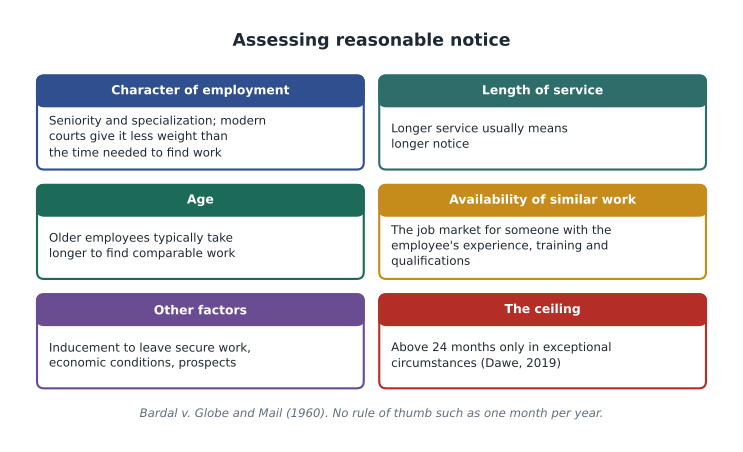
Character of employment was traditionally used to give senior managers longer notice than clerical or manual workers, on the theory that senior jobs are harder to find. Modern courts are more cautious. In several decisions the Court of Appeal for Ontario has said that the character of employment should not be overemphasized and that the central question is how long it will reasonably take the employee to find comparable work. Length of service and age remain powerful factors: a long-service employee in their fifties or sixties will usually receive far more notice than a younger employee with a few years' service. Availability of similar employment looks at the job market for someone with the employee's skills at the time of dismissal.
There is no rule of thumb such as one month per year of service, and the Court of Appeal has repeatedly rejected such formulas. Notice periods for long-service, older employees typically cluster between 18 and 24 months. In Dawe v. Equitable Life Insurance Company of Canada, 2019 ONCA 512, the trial judge had awarded 30 months to a 62-year-old senior vice-president with 37 years' service, reasoning that the 24-month figure often cited was not a cap. The Court of Appeal reduced the award to 24 months, holding that while there is no absolute cap, awards above 24 months are reserved for exceptional circumstances, and that the employee's statements that he intended to retire in about two years were relevant to the period he would reasonably have worked.
Inducement and short-service employees
An employee who was induced to leave secure employment by the new employer may receive a longer notice period, because the employer assumed responsibility for the risk the employee took. Inducement is a factor that can be significant for short-service employees, who would otherwise receive modest notice. In Wallace v. United Grain Growers Ltd., [1997] 3 S.C.R. 701, the employee had been recruited from a long-term position with another printing company with assurances of job security until retirement; the trial judge treated that inducement as one reason for a long notice period.
Short service does not mean short notice. Courts have awarded several months' notice to employees with less than a year's service where their age, seniority and the difficulty of finding comparable work justified it. Students should resist the instinct to treat notice as proportional to service.
The duty to mitigate
A dismissed employee must make reasonable efforts to find comparable employment, and earnings from new employment during the notice period are deducted from damages. The duty is not an obligation to accept any job; the employee need only seek reasonably comparable work, considering the nature of the previous position, salary and location. The burden of proving a failure to mitigate is on the employer. In Michaels v. Red Deer College, [1976] 2 S.C.R. 324, the Supreme Court held that the employer must show both that the employee failed to take reasonable steps and that, had they done so, they would likely have found comparable employment.
In Evans v. Teamsters Local Union No. 31, 2008 SCC 20, the court held that in some circumstances mitigation may require the dismissed employee to return to work for the same employer during the notice period. Justice Bastarache explained that an employee should accept such an offer where the salary, working conditions and relationships are not changed, the work is not demeaning, and there is no atmosphere of hostility, embarrassment or humiliation. The test is objective: whether a reasonable person in the employee's position would accept the offer. Evans had been offered a return to his job for the balance of the notice period after a dispute with the union, and his refusal was held unreasonable.
The duty to mitigate has limits. It does not apply to statutory entitlements under the Employment Standards Act, which are owed regardless of new employment. As discussed in lesson 2, it does not apply to the unexpired term of a fixed-term contract unless the contract imposes one (Howard v. Benson Group Inc., 2016 ONCA 256). And it does not apply where a valid contract specifies a fixed payment on termination, because the parties have agreed on the amount.
What counts as damages
Damages include everything the employee would have received during the notice period: base salary, regular commissions, car allowances, pension contributions, group benefits (or their value), stock options or units that would have vested, and bonuses. Where the employee would have received benefits such as health and dental coverage, the court may award the cost of replacement coverage or the amount of expenses the employee actually incurred. Where the employee would have received disability benefits had they remained covered, the employer may be liable for the lost insurance.
Bonuses and incentive plans have produced the most litigation. In Matthews v. Ocean Nutrition Canada Ltd., 2020 SCC 26, a senior chemist was constructively dismissed in 2011. The trial judge set his reasonable notice period at 15 months. During that period, the company was sold, triggering payments under a long-term incentive plan that said employees had to be full-time employees at the time of the sale, and that the plan would not otherwise be payable. The plan also said it did not provide for reasonable notice or damages. The Court of Appeal for Nova Scotia held that the plan's language excluded Matthews.
The Supreme Court reversed. Justice Kasirer, for a unanimous court, set out a two-step approach. First, would the employee have been entitled to the bonus or payment as part of their compensation during the reasonable notice period? Second, if so, do the terms of the plan unambiguously take away or limit that common law right? Clauses requiring the employee to be 'full-time' or 'active' on the date of payment are not sufficient, because the employee's claim is that, had proper notice been given, they would have been employed on that date. The plan must clearly address entitlement on termination without notice. Matthews recovered about one million dollars under the plan. The court also confirmed that the duty of honest performance from Bhasin applies to termination, although it did not decide the case on that ground.
Ontario courts had taken the same approach before Matthews. In Paquette v. TeraGo Networks Inc., 2016 ONCA 618, the Court of Appeal held that a bonus plan requiring active employment on the payment date did not exclude a dismissed employee's claim, because the plan did not unambiguously alter his common law right to damages for the notice period.
Damages for the manner of dismissal
An employee can also recover damages for mental distress caused by the way they were dismissed, but only if the employer breached its obligation of good faith and fair dealing in the manner of dismissal. In Wallace v. United Grain Growers, the court held that employers must be candid, reasonable, honest and forthright when dismissing, and must not be untruthful, misleading or unduly insensitive. Wallace's employer had alleged cause, which it maintained until trial before abandoning it. The court addressed this bad faith by extending the notice period, a remedy that became known as the 'Wallace bump'.
In Honda Canada Inc. v. Keays, 2008 SCC 39, the court changed the method. Keays, an assembly line worker with chronic fatigue syndrome, was dismissed after refusing to meet a company doctor, following a period in which Honda had required him to document his absences in a way that other employees were not required to. The trial judge awarded 15 months' notice, extended it by nine months for bad faith, and awarded 500,000 dollars in punitive damages, later reduced to 100,000 dollars by the Court of Appeal. The Supreme Court set aside both the extension and the punitive damages. Justice Bastarache held that damages for the manner of dismissal should be awarded as compensation for actual mental distress caused by bad faith conduct in the manner of dismissal, on the principles in Fidler v. Sun Life Assurance Co. of Canada, 2006 SCC 30, not by an arbitrary extension of the notice period. The ordinary distress and hurt feelings that accompany any dismissal are not compensable.
Keays also confirmed that punitive damages are exceptional. They require an independent actionable wrong, such as a breach of the duty of good faith in the manner of dismissal, that is harsh, vindictive, reprehensible and malicious, and they should be awarded only where compensatory damages are insufficient to achieve the goals of denunciation and deterrence. The court also held that a breach of the Human Rights Code is not an independent actionable wrong at common law, following Seneca College v. Bhadauria, [1981] 2 S.C.R. 181, although Ontario now permits a court in a civil action to award human rights damages under section 46.1 of the Code where another cause of action is properly before it.
| Head of damages | Requirement | Leading authority |
|---|---|---|
| Pay in lieu of reasonable notice | Dismissal without cause and without a valid termination clause | Bardal; Machtinger |
| Bonuses and incentive payments during notice | Would have been earned; not unambiguously excluded | Matthews v. Ocean Nutrition |
| Mental distress for manner of dismissal | Bad faith conduct causing actual distress beyond normal hurt feelings | Honda v. Keays; Wallace |
| Punitive damages | Independent actionable wrong that is harsh, vindictive and malicious | Honda v. Keays |
| Human rights damages in a civil action | Code breach plus another cause of action | Human Rights Code, s. 46.1 |
Calculating Ashdown's claim
Marchetti and Kowalczyk prepare a draft calculation for Sabourin. Ashdown is 54, has sixteen years' service, was a regional sales manager supervising seven representatives, earned a base salary of 118,000 dollars, a car allowance of 9,600 dollars a year and an annual bonus that averaged 20,000 dollars over the last three years, and received group health, dental and life insurance. The market for regional sales managers in industrial supply in southwestern Ontario is small. Kowalczyk argues for 22 months; Marchetti thinks 18 to 20 months is more likely. Sabourin suggests they plead 24 months and advise Ashdown that a court would probably award between 18 and 22.
The bonus plan says bonuses are paid only to employees 'actively employed on the payment date'. Under Matthews and Paquette, that language does not exclude her claim, because it does not clearly address what happens when an employee is dismissed without proper notice. Her damages therefore include the bonus she would have earned during the notice period. Her ESA entitlements of eight weeks' termination pay and about sixteen weeks' severance, roughly 24 weeks in total, will be credited against the common law award but cannot be reduced by mitigation.
Pellridge's demand that she sign a release before receiving any amount beyond the statutory minimum is a common practice, but Sabourin warns that withholding statutory entitlements pending a release would itself breach the Act. The September letter offered the statutory amounts unconditionally, which was correct. The clinic will advise Ashdown to keep detailed records of her job search, including applications, networking and interviews, because Pellridge will scrutinize her mitigation efforts if the case goes to trial.
Worked problem
Calculating damages with mitigation
Assume a court awards Ashdown 20 months' notice. Her annual compensation is 118,000 dollars in salary, 9,600 in car allowance, 20,000 in average bonus, and benefits valued at 6,000 a year. Pellridge paid 24 weeks of statutory amounts at the time of dismissal. Ashdown starts a new job at 96,000 dollars a year (with comparable benefits) after nine months. What are her damages, before interest and costs?
Show solution
- Annual compensation: 118,000 plus 9,600 plus 20,000 plus 6,000 equals 153,600 dollars. Twenty months is 20 twelfths of that, or 256,000 dollars.
- Mitigation: for the remaining eleven months of the notice period, she earns 96,000 dollars a year plus benefits. Her new earnings over eleven months are about 88,000 dollars in salary, plus benefits worth about 5,500 dollars, for a total of about 93,500 dollars.
- Deduct mitigation and amounts paid. Pellridge paid about 24 weeks of base wages and continued benefits for eight weeks, roughly 54,000 dollars plus benefits. Damages are about 256,000 minus 93,500 minus 54,000, which is about 108,500 dollars, subject to the rule that the statutory amounts are not themselves reduced by mitigation.
- Advice: the result is sensitive to the notice period, the bonus and the timing of new employment. Settlement discussions should use a range, not a single number, and should account for prejudgment interest and costs.
Common mistakes
MistakeCalculating notice at one month per year of service.
InsteadCourts reject rules of thumb. Notice depends on the Bardal factors applied to the particular employee, and awards above 24 months require exceptional circumstances (Dawe).
MistakeTreating an "active employment" requirement in a bonus plan as excluding a dismissed employee.
InsteadUnder Matthews, the plan must unambiguously remove the right to bonuses during the reasonable notice period; "active" or "full-time" language is not enough.
MistakePlacing the burden of proving mitigation on the employee.
InsteadThe employer must prove both a failure to take reasonable steps and that comparable work would likely have been found (Michaels v. Red Deer College).
MistakeExtending the notice period because the employer behaved badly.
InsteadSince Honda v. Keays, bad faith in the manner of dismissal is compensated by damages for actual mental distress, not a "Wallace bump".
MistakeDeducting mitigation earnings from statutory termination and severance pay.
InsteadEmployment Standards Act entitlements are owed in full regardless of new employment.
Practice problems
Work each problem on paper first, then reveal the answer to check.
List the four Bardal factors.
Show answer
The character of the employment, the length of service, the age of the employee, and the availability of similar employment having regard to the employee's experience, training and qualifications.
When must a dismissed employee accept an offer to return to work for the same employer during the notice period?
Show answer
Under Evans v. Teamsters, where a reasonable person in the employee's position would accept: salary, working conditions and relationships are unchanged, the work is not demeaning, and there is no atmosphere of hostility, embarrassment or humiliation.
What two questions does Matthews v. Ocean Nutrition ask about a bonus or incentive plan?
Show answer
First, would the employee have been entitled to the payment as part of their compensation during the reasonable notice period? Second, if so, do the terms of the plan unambiguously take away or limit that right?
What changed in Honda v. Keays about damages for the manner of dismissal?
Show answer
The court replaced the practice of extending the notice period with compensatory damages for actual mental distress caused by bad faith in the manner of dismissal, and confirmed that punitive damages require an independent actionable wrong and are exceptional.
Summary and key terms
- A wrongful dismissal claim is for breach of the implied term to give reasonable notice; damages are what the employee would have earned during that notice period.
- Reasonable notice is assessed under the Bardal factors: character of employment, length of service, age and availability of similar employment; awards above 24 months require exceptional circumstances.
- Employees must mitigate, but the employer bears the burden of proof (Michaels), and in some cases an offer to return to the same employer must be accepted (Evans).
- Damages include salary, benefits, allowances and bonuses; Matthews requires unambiguous language to exclude incentive payments during the notice period.
- Bad faith in the manner of dismissal is compensated by damages for actual mental distress (Honda v. Keays); punitive damages require an independent actionable wrong.
- Wrongful dismissal
- Dismissal without cause and without reasonable notice or pay in lieu, which breaches the employment contract.
- Reasonable notice
- The period of advance notice an employer must give to end an indefinite employment contract without cause, assessed case by case.
- Mitigation
- The dismissed employee's obligation to make reasonable efforts to find comparable work, with earnings deducted from damages.
- Inducement
- Persuading an employee to leave secure employment, which can lengthen the notice period.
- Wallace bump
- The former practice of extending the notice period for bad faith in the manner of dismissal, replaced by Honda v. Keays.
- Punitive damages
- Damages to punish and deter harsh, vindictive and malicious conduct that amounts to an independent actionable wrong.
Lesson quiz · 5 questions
Score 60% or more to complete this lesson.
Create a free account to save your progress, take quizzes and earn a certificate.