
LAWC-302 · Lesson 2 of 12 · 23 min
The employment contract
▶ Video coming soon A video version of this lesson is on the way.
Professor Sabourin asked the class to bring an employment contract they had signed, and the results are spread across the seminar table: an offer letter from a summer firm, a two-page agreement from a hospital pharmacy, a franchise restaurant's handbook with a signature page, and, from Theo Marchetti, a single sheet from a Hamilton law firm that reads, in its entirety, 'Welcome aboard. Start Monday. Salary as discussed.' Sabourin picks up Marchetti's page and holds it in the air. 'This,' he says, 'is a perfectly enforceable employment contract. It is also, from the employer's point of view, a disaster. Everything it does not say is filled in by the law, and almost everything the law fills in favours the employee.'
This lesson covers how an employment contract is formed, where its terms come from, the special rule on terms imposed after hiring, the implied duties of good faith and fidelity, restrictive covenants and Ontario's ban on non-competition agreements, fixed-term contracts, and what happens when an employer tries to change the contract unilaterally. Vivienne Ashdown's file at Pellridge Supply provides the running example.
Formation: an ordinary contract with special features
An employment contract is formed like any other contract, by offer, acceptance and consideration. It need not be in writing. The parties exchange work for wages, and that exchange is enough. But employment contracts differ from most commercial contracts in three ways that shape the whole law. First, the parties usually have very unequal bargaining power. In Machtinger v. HOJ Industries Ltd., [1992] 1 S.C.R. 986, Justice Iacobucci emphasized that individual employees on the whole lack both the bargaining power and the information needed to achieve more favourable contract provisions than those offered by the employer. Second, the contract is relational and long-term, so the parties' expectations develop over years. Third, employment is central to a person's identity and sense of self-worth, a point the Supreme Court made in Reference re Public Service Employee Relations Act (Alta.), [1987] 1 S.C.R. 313, in Chief Justice Dickson's dissent, and adopted in later cases including Wallace v. United Grain Growers Ltd., [1997] 3 S.C.R. 701.
Those features explain why courts read employment contracts with a protective eye. Ambiguous terms are construed against the employer who drafted them, a principle known as contra proferentem. Terms that try to limit statutory rights are read strictly. And courts imply terms that reflect the reasonable expectations of the parties, the most important being that the employer must give reasonable notice before ending an indefinite employment relationship without cause.
Where the terms come from
An employment contract has four main sources of terms. Express terms are those the parties wrote or said: salary, title, duties, hours, benefits, bonus plans and any termination clause. Policies and handbooks can become part of the contract if they are brought to the employee's attention and accepted, but an employer generally cannot rely on a policy that was never shown to the employee or that was introduced later without fresh consideration. Implied terms are those the law adds. Statutory terms are those the Employment Standards Act and other statutes read in, overriding any express term that gives the employee less.
The implied terms deserve attention. Every indefinite-term employment contract contains an implied term that the employer will give reasonable notice of termination without cause, unless the contract clearly and validly provides otherwise. Every contract also carries the general duty of honest performance recognized in Bhasin v. Hrynew, 2014 SCC 71, under which parties must not lie to or knowingly mislead each other about matters directly linked to the performance of the contract. In C.M. Callow Inc. v. Zollinger, 2020 SCC 45, the court held that this duty can be breached by active deception, including half-truths and misleading silence in some circumstances. In Wastech Services Ltd. v. Greater Vancouver Sewerage and Drainage District, 2021 SCC 7, the court held that contractual discretion must be exercised reasonably, in a manner connected to the purposes for which it was granted. Both duties have been applied to employment: an employer that lies to an employee about her job security, or exercises a discretion over bonuses for a purpose unconnected to the plan, may be liable.
Employees owe implied duties too. Every employee owes a duty of fidelity, which requires honesty, loyalty and good faith during the employment, and a duty not to misuse the employer's confidential information during or after employment. Senior employees who are key to the business may owe fiduciary duties as well. In Canadian Aero Service Ltd. v. O'Malley, [1974] S.C.R. 592, senior officers who resigned to pursue a contract they had been developing for their employer were held liable for taking a maturing business opportunity. Ordinary employees, by contrast, may compete fairly with a former employer once they leave, provided they do not use confidential information and are not bound by a valid restrictive covenant.
Terms imposed after hiring: the need for fresh consideration
Employers often present a written contract after the employee has already accepted the job or started work. The courts have held that such a contract is not binding unless the employee receives fresh consideration. In Francis v. Canadian Imperial Bank of Commerce (1994), 21 O.R. (3d) 75 (C.A.), an employee who had accepted a job was asked to sign a contract with a termination clause on his first day. The Court of Appeal held that the clause was unenforceable because he received nothing new in exchange. In Hobbs v. TDI Hospitality Management Consultants Inc., 2009 ONCA 787, the court applied the same principle and rejected the argument that continued employment alone was sufficient consideration. The consideration must be something the employee was not already entitled to, such as a raise, a promotion, a signing bonus or a new benefit.
Sabourin turns to Vivienne Ashdown's file. She joined Pellridge in 2010 as a sales representative on an oral agreement and a one-page offer letter that said nothing about termination. In 2019 she was promoted to regional sales manager with a salary increase of 12,000 dollars a year and a car allowance, and she signed a new written agreement containing a termination clause. 'Is the 2019 clause supported by consideration?' Sabourin asks. Sophie Tremblay-Hart answers that the promotion and the raise are fresh consideration, so the clause is part of the contract, at least so far as consideration goes. 'Right,' says Sabourin. 'Whether it is enforceable is another question, which we will spend all of lesson 4 answering.'
Interpreting employment contracts
Courts interpret employment contracts using the ordinary principles of contractual interpretation from Sattva Capital Corp. v. Creston Moly Corp., 2014 SCC 53, reading the words in light of the surrounding circumstances known to both parties when the contract was made. Two employment-specific principles are added. First, the Court of Appeal for Ontario held in Wood v. Fred Deeley Imports Ltd., 2017 ONCA 158 that because the Employment Standards Act is remedial legislation intended to protect employees, courts should favour an interpretation of a termination clause that gives employees the greater benefit. Second, contra proferentem is applied with force against the employer who drafted the document. The court in Wood also held that a termination clause is assessed as of the time it was written, not by asking whether the employer actually complied with the statute when it ended the employment.
The Court of Appeal has also warned against straining to find ambiguity. In Amberber v. IBM Canada Ltd., 2018 ONCA 571, the court enforced a termination clause and said that a provision is not ambiguous merely because the parties suggest different readings; ambiguity requires that the language reasonably admit of more than one meaning. That warning became central in the 2025 and 2026 decisions discussed in lesson 4.
Restrictive covenants
Many employers want to stop departing employees from competing with them or soliciting their customers. At common law, a covenant in restraint of trade is presumptively unenforceable. The employer must show that it protects a legitimate proprietary interest, such as customer connections or confidential information, and that it is reasonable in geographic scope, duration and activities restricted. In Elsley v. J.G. Collins Insurance Agencies Ltd., [1978] 2 S.C.R. 916, the court upheld a covenant against a manager who had built close relationships with the employer's customers, while stressing that courts approach such clauses with caution.
In Shafron v. KRG Insurance Brokers (Western) Inc., 2009 SCC 5, the court refused to enforce a non-competition clause that restricted an insurance broker from working within the 'Metropolitan City of Vancouver' for three years, because no such place existed and the term was ambiguous. Justice Rothstein held that courts should not rewrite an unreasonable or ambiguous covenant to make it enforceable. Notional severance, which reads down a term to a reasonable scope, is not available for restrictive covenants in employment contracts, and blue-pencil severance, which strikes out words, is to be used only rarely, where the part removed is trivial and not part of the main purpose of the covenant. The court contrasted employment with the sale of a business, where the parties bargain on more equal terms. In Payette v. Guay inc., 2013 SCC 45, decided under Quebec law, the court applied a more flexible standard to covenants given by vendors of a business.
Ontario added a statutory layer in 2021. Section 67.2 of the Employment Standards Act, in force since October 25, 2021, prohibits employers from entering into an employment contract or other agreement with an employee that is, or includes, a non-compete agreement. Two exceptions apply: where a business is sold and the seller becomes an employee of the purchaser immediately after the sale, and for executives, defined to include positions such as chief executive officer, president, chief financial officer and other chief positions. The ban does not cover non-solicitation clauses or confidentiality obligations, which remain subject to the common law test.
| Clause | What it restricts | Ontario position for ordinary employees |
|---|---|---|
| Non-competition | Working for a competitor or starting a competing business | Prohibited by section 67.2 since October 25, 2021, except sale of business and executives |
| Non-solicitation of customers | Soliciting the employer's customers | Enforceable if reasonable in scope and duration and protecting a legitimate interest |
| Non-solicitation of employees | Recruiting former colleagues | Enforceable if reasonable |
| Confidentiality | Using or disclosing confidential information | Enforceable; also an implied duty |
Ashdown's 2019 agreement contains a twelve-month non-competition clause covering all of Ontario and a twelve-month non-solicitation clause covering Pellridge customers she dealt with in her last two years. Hannah Kowalczyk notes that the non-compete was signed before October 25, 2021, so the statutory ban does not apply to it directly. Sabourin agrees that the ban governs agreements entered into on or after that date, but points out that the common law test would probably defeat the clause anyway. A province-wide ban on working for any competitor for a regional sales manager in southwestern Ontario is broader than needed to protect Pellridge's customer connections, which the non-solicitation clause already does. Under Shafron, the court will not rewrite it to something narrower.
Fixed-term contracts
Most employment is for an indefinite term, but parties can agree on a fixed term. A fixed-term contract ends automatically at the end of the term without any notice, but if the employer ends it early without cause and without a valid early termination clause, the employee is entitled to the wages for the balance of the term. In Howard v. Benson Group Inc., 2016 ONCA 256, the Court of Appeal held that such an employee has no duty to mitigate unless the contract imposes one, because the damages are a liquidated amount fixed by the contract. The case involved an employee whose five-year contract was ended after about two years, and he recovered the wages for the remaining term.
Courts look closely at successive fixed-term contracts. If an employee works under a series of renewed contracts for years, a court may find that the relationship has become indefinite, so that reasonable notice is owed at the end. Employers who want the benefit of a fixed term must draft it clearly and must not treat the term as a formality.
Unilateral changes and the employee's options
Employers sometimes change an employee's pay, duties or location without agreement. A change to a fundamental term without consent is a breach of contract. In Wronko v. Western Inventory Service Ltd., 2008 ONCA 327, the Court of Appeal described the employee's three options. The employee may accept the change, expressly or by continuing to work without objection for a significant period, in which case it becomes part of the contract. The employee may treat the change as a repudiation of the contract, resign and sue for constructive dismissal. Or the employee may reject the change, make the objection clear and continue working on the old terms. In the third case, the employer must either accept the employee's position or give reasonable notice that the old terms will end and offer new terms; if the employer simply carries on, it is bound by the old terms.
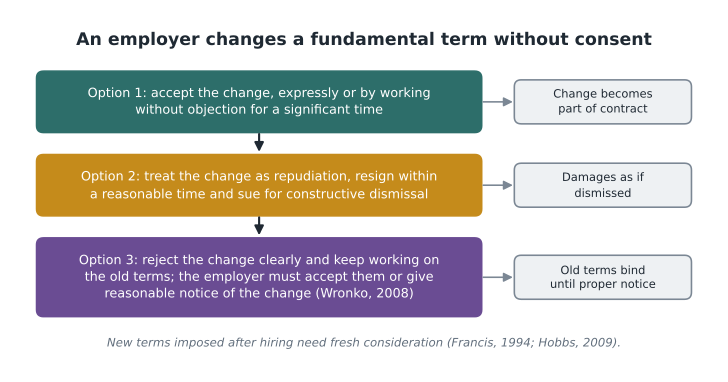
Wronko involved a termination clause the employer announced it would change in two years. The employee objected repeatedly, continued working, and when the two years ended the employer told him that if he did not accept the new terms he had no job. The court held that he had been dismissed and was entitled to the benefit of the original clause. The practical lesson for employers is that changes to fundamental terms should be made with consent and fresh consideration, or with reasonable working notice of the change.
Worked problem
Advising Pellridge on a new contract
Pellridge's new human resources director, Soraya Haddadi, wants all current sales staff to sign a revised agreement that adds a termination clause limiting them to Employment Standards Act minimums, a twelve-month non-solicitation clause and an eighteen-month non-competition clause covering Ontario. She plans to email the agreement and tell staff to sign within a week. Advise her.
Show solution
- Consideration: existing employees must receive fresh consideration, such as a signing bonus or a raise, for the new terms to bind them (Francis; Hobbs). Continued employment alone is not enough.
- Non-competition: the eighteen-month non-compete is void under section 67.2 of the Employment Standards Act for any employee who is not an executive, because the agreement would be entered into after October 25, 2021. It should be removed.
- Non-solicitation: a reasonable non-solicitation clause limited to customers the employee dealt with, for a shorter period such as twelve months, is more likely to be enforceable under Elsley and Shafron. It must be clear, because courts will not rewrite it.
- Termination clause: the clause must comply with the Employment Standards Act in every respect, including the for-cause portion, or the whole clause may fall under Waksdale (lesson 4).
- Process: give employees a real opportunity to review and seek advice. An employee who objects should not be dismissed for refusing; under Wronko, the employer's lawful route is reasonable notice of the change.
Common mistakes
MistakeTreating continued employment as consideration for a new contract signed after hiring.
InsteadOntario courts require fresh consideration for terms imposed after the employment has begun (Francis; Hobbs).
MistakeAsking a court to read down an overbroad non-competition clause to a reasonable scope.
InsteadShafron rejects notional severance for employment restrictive covenants; an unreasonable or ambiguous covenant is simply unenforceable.
MistakeApplying the Ontario non-compete ban to non-solicitation clauses.
InsteadSection 67.2 covers non-compete agreements only. Non-solicitation and confidentiality clauses remain subject to the common law test.
MistakeReducing damages for the early termination of a fixed-term contract by the employee's new earnings.
InsteadWithout an express mitigation term, the employee recovers the balance of the term without deduction (Howard v. Benson Group).
MistakeAssuming an employee who keeps working after objecting to a change has accepted it.
InsteadUnder Wronko, an employee may reject the change and continue on the old terms; the employer must then give reasonable notice of the change or accept the old terms.
Practice problems
Work each problem on paper first, then reveal the answer to check.
An employee accepts a job by phone and on her first day is told to sign a contract with a termination clause. She signs. Is the clause binding?
Show answer
Probably not. The contract was formed when she accepted the offer, and the new term needs fresh consideration under Francis and Hobbs. Without it, the termination clause does not bind her.
What is the difference between the duty of honest performance and the duty to exercise discretion in good faith?
Show answer
Honest performance (Bhasin, Callow) prohibits lying or knowingly misleading about matters directly linked to the contract. The good faith exercise of discretion (Wastech) requires that a discretionary power be exercised reasonably and for purposes connected to why it was granted.
Who may still be bound by a non-compete clause in Ontario after October 25, 2021?
Show answer
Executives, as defined in section 67.2, and a seller of a business who becomes an employee of the purchaser immediately after the sale.
An employee on a three-year fixed-term contract is dismissed without cause after one year and finds a new job a month later. The contract has no early termination clause. What does she recover?
Show answer
The wages and benefits for the remaining two years, without deduction for her new earnings, because there is no duty to mitigate in the absence of an express term (Howard v. Benson Group).
Summary and key terms
- Employment contracts are formed by offer, acceptance and consideration, but courts read them protectively because of the inequality of bargaining power recognized in Machtinger.
- Terms come from express agreement, incorporated policies, implied terms such as reasonable notice and honest performance, and statutory minimums that override lesser terms.
- A term imposed after hiring needs fresh consideration (Francis; Hobbs); courts favour interpretations that give employees the greater benefit (Wood v. Fred Deeley).
- Restrictive covenants must protect a legitimate interest and be reasonable; Shafron forbids rewriting them, and section 67.2 of the Employment Standards Act has banned most non-competes since October 25, 2021.
- Under Wronko, an employee faced with a unilateral change may accept it, resign and claim constructive dismissal, or reject it and keep working on the old terms.
- Fresh consideration
- Something new of value given to an employee in exchange for agreeing to new contractual terms after employment has begun.
- Contra proferentem
- The principle that ambiguous contract language is interpreted against the party who drafted it.
- Duty of fidelity
- An employee's implied obligation of honesty, loyalty and good faith toward the employer during employment.
- Restrictive covenant
- A contractual term limiting an employee's freedom to compete, solicit customers or employees, or use information after employment ends.
- Notional severance
- Reading down an unreasonable term to make it reasonable, which Shafron rejects for employment restrictive covenants.
- Fixed-term contract
- An employment contract that ends automatically on a stated date or event.
Lesson quiz · 5 questions
Score 60% or more to complete this lesson.
Create a free account to save your progress, take quizzes and earn a certificate.