
LAWC-301 · Lesson 9 of 12 · 24 min
Corporations, shareholders and integration
▶ Video coming soon A video version of this lesson is on the way.
Margot Bellamy's accountant has asked the clinic a question that Petrakis says every owner-manager asks at least once a year. Lakeshore Furniture Co. Ltd. has earned about 900,000 dollars of profit before paying Margot anything beyond her base salary. Should Lakeshore pay her a large bonus, pay her dividends, or keep the money in the company? The board approved a 300,000 dollar bonus for her in November, over the objections of other shareholders, and students in business associations debated whether it was oppressive. 'Professor Okwuosa asked whether the bonus was fair to Simon and Raj,' Petrakis says. 'I am asking what it costs, and who pays the tax.'
This lesson covers the taxation of corporations, the small business deduction, the integration of corporate and personal tax through the dividend gross-up and credit, the salary and dividend decision, shareholder benefits and loans, distributions of paid-up capital and deemed dividends, rollovers into a corporation under section 85, and the tax differences between selling shares and selling assets.
The corporation as a taxpayer
A corporation is a person for the purposes of the Act and computes its income under the same rules as individuals, with some differences: it has no personal credits, its taxation year is its fiscal period, and it may deduct dividends received from other taxable Canadian corporations under section 112, so that intercorporate dividends generally pass tax-free within a corporate group. The basic federal rate is 38 percent, reduced by a 10 point abatement for income earned in a province and by a 13 point general rate reduction, leaving a net federal rate of 15 percent. Ontario adds 11.5 percent on general income, for a combined rate of 26.5 percent.
A Canadian-controlled private corporation, defined in section 125(7) as a private corporation that is a Canadian corporation not controlled directly or indirectly by non-residents or public corporations, can claim the small business deduction on active business income up to the business limit of 500,000 dollars a year. The federal small business rate is 9 percent. Ontario's small business rate was 3.2 percent and fell to 2.2 percent from July 1, 2026, so the combined rate on qualifying income is now 11.2 percent. The business limit is shared among associated corporations under section 125(3), which prevents an owner from multiplying the limit by creating several companies, and it is ground down for corporations with large taxable capital and for corporations whose adjusted aggregate investment income exceeds 50,000 dollars, being eliminated at 150,000 dollars.
Income from property earned by a Canadian-controlled private corporation, such as interest, rent and taxable capital gains, is not eligible for the small business deduction. It is taxed at a high rate, about 50 percent in Ontario, but a portion of that tax is refundable to the corporation when it pays taxable dividends, through the refundable dividend tax on hand accounts. The design aims to remove any advantage from earning passive income inside a corporation while ensuring that the total tax, once the income is paid out, approximates the tax an individual would have paid directly.
Integration
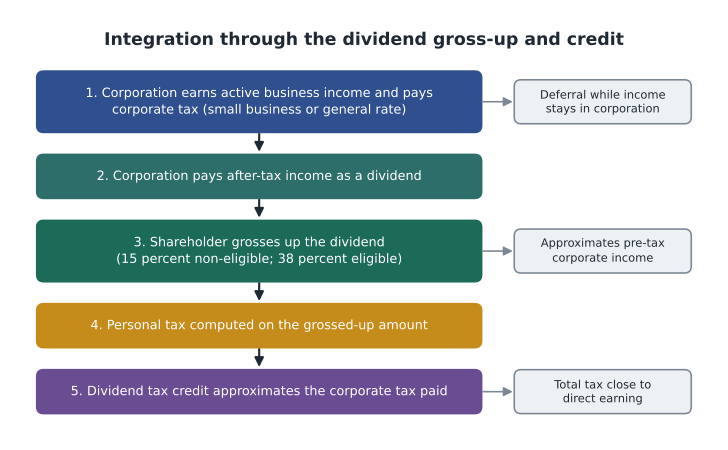
Integration, as lesson 2 explained, aims to make the total tax on income earned through a corporation roughly equal to the tax on the same income earned directly. Canada achieves this through the dividend gross-up and credit. When an individual receives a taxable dividend from a Canadian corporation, section 82 requires the shareholder to include the dividend plus a gross-up, intended to approximate the corporation's pre-tax income. Section 121 then gives a dividend tax credit, intended to approximate the corporate tax already paid.
There are two kinds of dividends. Eligible dividends, paid out of income taxed at the general corporate rate, are grossed up by 38 percent and carry a larger credit. Non-eligible dividends, paid out of income that benefited from the small business deduction or out of investment income, are grossed up by 15 percent and carry a smaller credit. A Canadian-controlled private corporation tracks its general rate income pool to know how much it can designate as eligible dividends. Provinces provide their own dividend tax credits, which determine whether integration in a particular province is close to perfect.
Integration is approximate, and the differences matter. Where the combined corporate and personal tax on a dividend is lower than the tax on salary, there is an advantage to earning through a corporation; where it is higher, there is a cost. The largest advantage, however, comes from deferral: active business income taxed at 11.2 percent can be kept in the corporation and reinvested, and personal tax is paid only when dividends are paid, which may be years later, at a time when the shareholder's income is lower.
Salary, bonus or dividend?
Margot's choice illustrates the trade-offs. A salary or bonus is deductible by Lakeshore and taxable to Margot as employment income. It creates registered retirement savings plan contribution room, requires Canada Pension Plan contributions from both Margot and Lakeshore, and must be paid within 180 days after the end of the corporation's year to be deductible in that year under section 78(4). A dividend is not deductible by Lakeshore, is paid out of after-tax income, is taxed to Margot with the gross-up and credit, creates no retirement plan room and requires no pension contributions.
Arjun Mehta lays out a simple comparison. If Lakeshore pays the 300,000 dollar bonus, Lakeshore saves corporate tax on 300,000 dollars, and Margot pays personal tax at her marginal rate, most of it above 50 percent. If Lakeshore keeps the 300,000 dollars, it pays corporate tax at 11.2 percent on the portion within the business limit and 26.5 percent on the rest, and has the after-tax amount to reinvest or to pay later as dividends. If it pays dividends, total tax is close to the tax on salary, depending on the mix of eligible and non-eligible dividends. 'The bonus is not the tax-efficient answer unless Margot needs the cash now,' Arjun concludes, 'or unless the bonus is used to bring Lakeshore's income down to the business limit, which is a common strategy called bonusing down.' Petrakis agrees and adds that reasonableness under section 67 is not usually an issue for a bonus to a controlling shareholder-manager like Margot, under the CRA's longstanding practice, but the corporate law question of whether the board acted properly remains, and a bonus approved over the objection of minority shareholders invites an oppression application.
Shareholder benefits and loans
Owner-managers often treat a corporation's money as their own. The Act does not. Section 15(1) includes in a shareholder's income the value of any benefit conferred on the shareholder by the corporation, other than through specified transactions such as dividends and the reduction of paid-up capital. If Lakeshore pays for renovations to Margot's cottage, lets Simon use a company truck for personal purposes or sells a showroom sofa to Claire at a fraction of its value, the benefit is included in the shareholder's income and, unlike salary, is not deductible by the corporation. Double taxation results, which is why shareholder benefits are expensive mistakes.
Section 15(2) includes in a shareholder's income a loan or other indebtedness from the corporation, unless an exception applies. The main exceptions are loans repaid within one year after the end of the corporation's taxation year in which the loan was made, provided the repayment is not part of a series of loans and repayments; loans made in the ordinary course of the corporation's business of lending money; and loans made to a shareholder because of their employment, for specified purposes such as buying a home or buying shares of the employer, with bona fide repayment arrangements. If a loan is included, repayment later gives a deduction under section 20(1)(j). A loan that is not included may still produce an imputed interest benefit under section 80.4.
Paid-up capital, redemptions and deemed dividends
A corporation can return capital to its shareholders tax-free to the extent of the paid-up capital of their shares, which is generally the amount contributed for the shares, computed under corporate law and adjusted for tax purposes. Section 84 deems distributions above paid-up capital to be dividends. Under section 84(3), when a corporation redeems, acquires or cancels its shares, the amount paid above their paid-up capital is a deemed dividend, and the shareholder's proceeds of disposition, for capital gains purposes, are reduced by the amount of the deemed dividend under the definition of proceeds in section 54.
Students who followed Margot's proposal to make Raj Gill's Class B shares redeemable will recognize the consequence. If Lakeshore redeems Raj's shares for 900,000 dollars and their paid-up capital is 100 dollars, Raj receives a deemed dividend of about 900,000 dollars, taxed as a dividend with the gross-up and credit, and his capital gain or loss is computed with proceeds of only 100 dollars. If instead Raj sold his shares to Margot, he would realize a capital gain, potentially sheltered by his own lifetime capital gains exemption. The choice between a redemption and a sale therefore affects Raj's tax as much as the price does, which is one reason minority shareholders resist forced redemptions.
Section 84.1 prevents an individual from converting a dividend into a tax-free return of capital or a capital gain by selling shares of one corporation to another corporation with which they do not deal at arm's length after the sale. Where it applies, consideration above the greater of paid-up capital and modified adjusted cost base is a deemed dividend, and paid-up capital of the new shares is ground down. Amendments in 2021 and revisions in 2024 created a limited exception for genuine intergenerational transfers of family businesses to children or grandchildren, subject to conditions about control, management and timing. Section 55(2) recharacterizes certain intercorporate dividends as capital gains where they are used to reduce a gain on a later sale. These provisions are the core of the anti-surplus-stripping rules, and they are frequently at issue in general anti-avoidance rule cases such as Copthorne, discussed in lesson 10.
Rollovers into a corporation: section 85
When Henry and Margot Bellamy incorporated Lakeshore in 2004, they transferred the partnership's business to the new corporation. Without a rollover, the transfer would have been a disposition at fair market value, triggering recapture on equipment and capital gains on goodwill. Section 85 allows a taxpayer who transfers eligible property to a taxable Canadian corporation in exchange for consideration that includes at least one share to elect, jointly with the corporation, an amount between the property's tax cost and its fair market value. The elected amount becomes the transferor's proceeds of disposition and the corporation's cost.
Non-share consideration, called boot, is limited in practice: if boot exceeds the elected amount, the elected amount is deemed to equal the boot, and a gain results. The transferor's cost of the new shares is the elected amount minus the boot, allocated first to preferred and then to common shares. Section 85(2) provides a similar rollover for a partnership's transfer of property to a corporation, and section 85(3) allows the partnership to wind up. Section 85(2.1) grinds the paid-up capital of the new shares so that it cannot exceed the tax cost of the property transferred minus boot, preventing a tax-free extraction of surplus. A benefit conferred on a related person through an undervalued transfer is caught by section 85(1)(e.2), which deems the transferor to receive the excess.
Section 85 is the workhorse of corporate tax planning. It is used to incorporate businesses, to carry out estate freezes, in which a parent exchanges common shares for fixed-value preferred shares so that future growth accrues to new common shares held by children or a family trust, and to move assets within corporate groups. An estate freeze also fixes the parent's tax on death to the frozen value, and the tax on split income rules must be considered for any dividends later paid to family members.
Selling the business: shares or assets
Norland Home's proposal to buy Lakeshore brings the share and asset choice into focus. In a share sale, the shareholders sell their Lakeshore shares to Norland. Each shareholder realizes a capital gain, only half of which is taxable, and each may shelter up to 1.25 million dollars with the lifetime capital gains exemption if the shares are qualified small business corporation shares. Lakeshore itself is unchanged: its assets keep their tax values, its tax attributes remain subject to the loss restriction rules on acquisition of control, and Norland inherits its tax history, including any exposure to reassessment.
In an asset sale, Lakeshore sells its assets to Norland. Lakeshore realizes recapture on depreciable property, income on inventory and capital gains on goodwill and land, all taxed at corporate rates, and the shareholders then receive the after-tax proceeds as dividends or on a winding-up, with a second layer of tax. Norland obtains a cost equal to the price allocated to each asset, which gives it fresh capital cost allowance and avoids inheriting Lakeshore's tax history. Sellers therefore usually prefer share sales, and buyers often prefer asset purchases; the price negotiation reflects the difference, and hybrid structures are common. Norland is a listed public company, so after a share sale Lakeshore would no longer be a Canadian-controlled private corporation and would lose the small business deduction.
Section 116 does not apply because the sellers are Canadian residents, but purchasers routinely ask for representations about residence, about tax filings and about the absence of unpaid source deductions, which leads to the subject of lesson 11. Tamarack Millwork's unremitted source deductions, discovered after Lakeshore bought Tamarack's shares, are exactly the kind of inherited tax history that an asset purchaser would have avoided.
Worked problem
Raj Gill's Class B shares
Lakeshore proposes to redeem Raj Gill's Class B non-voting shares for 900,000 dollars. Assume the shares have a paid-up capital and adjusted cost base of 100 dollars because Raj subscribed for them at a nominal price. Alternatively, Margot offers to buy the shares from Raj personally for the same price. Assume Lakeshore is a Canadian-controlled private corporation and the shares are qualified small business corporation shares. Compare the tax consequences for Raj.
Show solution
- Redemption. Section 84(3) deems a dividend of 899,900 dollars (900,000 minus paid-up capital of 100). Raj includes the dividend with the gross-up (15 percent if non-eligible, 38 percent if designated eligible) and claims the dividend tax credit. His proceeds of disposition for capital gains purposes are reduced to 100 dollars, so he has no capital gain.
- Sale to Margot. Raj disposes of the shares for 900,000 dollars and realizes a capital gain of 899,900 dollars. If the shares are qualified small business corporation shares and he has not used his exemption, he can deduct up to 1.25 million dollars of gains under section 110.6, so the entire gain may be sheltered, subject to the alternative minimum tax and his cumulative net investment loss.
- Section 84.1 does not apply to the sale to Margot, because she is an individual, not a corporation. If Margot used a holding company to buy the shares, section 84.1 would be considered; it applies where the seller does not deal at arm's length with the purchaser corporation, and Raj, as an unrelated employee, would generally deal at arm's length unless the facts show otherwise.
- Advice. On these facts a sale is far better for Raj than a redemption. The corporate law issue of whether the Class B shares can be made redeemable over his objection, discussed in business associations, therefore has a large tax dimension.
Common mistakes
MistakeAssuming the small business deduction applies to all income of a private company.
InsteadIt applies only to active business income of a Canadian-controlled private corporation, up to a business limit shared by associated corporations and ground down for passive income.
MistakePaying a shareholder's personal expenses through the company and deducting them.
InsteadSection 15(1) taxes the shareholder on the benefit, and the corporation gets no deduction.
MistakeLeaving a shareholder loan outstanding for two year ends.
InsteadSection 15(2) includes the loan in income unless repaid within one year after the end of the year it was made, and not as part of a series.
MistakeTreating a share redemption as a capital gain.
InsteadSection 84(3) deems the excess over paid-up capital to be a dividend, and proceeds are reduced accordingly.
MistakeTaking boot above the elected amount on a section 85 rollover.
InsteadThe elected amount is deemed to be at least the boot, producing an immediate gain.
Practice problems
Work each problem on paper first, then reveal the answer to check.
What is the combined federal and Ontario small business rate on active business income for most of the second half of 2026?
Show answer
11.2 percent: 9 percent federal and 2.2 percent Ontario (Ontario's rate fell from 3.2 percent on July 1, 2026).
How do the gross-up and dividend tax credit achieve integration?
Show answer
The gross-up adds back an amount approximating corporate pre-tax income, and the credit approximates the corporate tax already paid, so the shareholder's total tax is roughly what it would have been on income earned directly.
When is a salary or bonus to a shareholder-manager deductible in the corporation's year?
Show answer
When it is reasonable and paid within 180 days after the end of the corporation's taxation year (section 78(4)).
What does section 84(3) do?
Show answer
It deems an amount paid on a redemption, acquisition or cancellation of shares in excess of their paid-up capital to be a dividend.
Why do sellers of private businesses usually prefer share sales?
Show answer
A share sale produces capital gains taxed at half and potentially sheltered by the lifetime exemption, with one level of tax; an asset sale produces corporate-level recapture, income and gains and a second layer of tax on distribution.
Summary and key terms
- Corporations pay a net federal rate of 15 percent and Ontario 11.5 percent on general income; Canadian-controlled private corporations pay 9 percent federal and 2.2 percent Ontario (from July 1, 2026) on the first 500,000 dollars of active business income.
- Integration operates through the dividend gross-up (38 or 15 percent) and the dividend tax credit, with refundable taxes on private corporations' investment income.
- Salary is deductible and creates retirement room; dividends are not deductible but may be efficient; deferral is the main advantage of retaining income.
- Section 15 taxes shareholder benefits and unrepaid shareholder loans; section 84 deems distributions above paid-up capital to be dividends; section 84.1 and section 55(2) police surplus stripping.
- Section 85 allows tax-deferred transfers to corporations; share sales and asset sales produce very different tax results.
- Canadian-controlled private corporation
- A private Canadian corporation not controlled by non-residents or public corporations, eligible for the small business deduction.
- Small business deduction
- The reduced rate on the first 500,000 dollars of active business income of a Canadian-controlled private corporation.
- Eligible dividend
- A dividend designated out of income taxed at the general rate, grossed up by 38 percent.
- Paid-up capital
- The tax measure of capital contributed for shares, returnable without dividend treatment.
- Deemed dividend
- An amount treated as a dividend under section 84, such as a redemption above paid-up capital.
- Boot
- Non-share consideration received on a section 85 transfer.
- Estate freeze
- A reorganization fixing a parent's interest in fixed-value shares so future growth accrues to others.
Lesson quiz · 5 questions
Score 60% or more to complete this lesson.
Create a free account to save your progress, take quizzes and earn a certificate.