
LAWC-301 · Lesson 5 of 12 · 26 min
Computing business and property income: profit, deductions and interest
▶ Video coming soon A video version of this lesson is on the way.
The class begins with three short files. Arjun Mehta's cousin breeds show dogs and has lost money for six straight years. Hannah Kowalczyk's former colleague bought two condominium units in a pre-construction project with almost no money down and reports rental losses every year because the interest exceeds the rent. And Claire Bellamy's online venture, Lakeshore Direct Inc., wants to know whether it can deduct a trip to a furniture fair in Milan, a client dinner, a parking ticket and the cost of redesigning its website. Petrakis tells the class that all three files raise the same two questions: is there a source of income, and if there is, which expenses can be deducted in computing the profit from it?
This lesson covers the source test in Stewart, the computation of profit under section 9 and Canderel, the general limits on deductions in section 18, the reasonableness and specific limits in sections 67 and 67.1, the deduction of interest under section 20(1)(c), and the main timing rules. Capital outlays and capital cost allowance are the subject of lesson 6.
Is there a source? The test in Stewart
For decades, the CRA and the courts denied losses from activities that had no reasonable expectation of profit, a test associated with Moldowan v. The Queen, [1978] 1 S.C.R. 480, a case about a man who raced horses as a sideline while working as an oil and gas executive. The test was applied broadly, including to rental properties that produced losses because of high financing costs. Stewart v. Canada, 2002 SCC 46, changed the law.
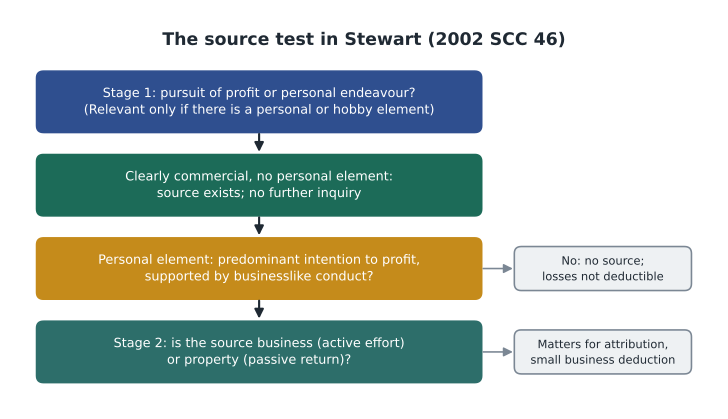
Brian Stewart, an experienced real estate investor, bought four condominium units in a syndicated development, financing almost the entire price, and claimed rental losses, mainly from interest, for several years. The Minister disallowed the losses on the ground that he had no reasonable expectation of profit, and the Tax Court and the Federal Court of Appeal agreed. The Supreme Court, in joint reasons by Justices Iacobucci and Bastarache, allowed the appeal. It held that the reasonable expectation of profit test is not a free-standing test for the existence of a source. Instead, courts apply a two-stage approach. First, is the activity undertaken in pursuit of profit, or is it a personal endeavour? Second, if it is not a personal endeavour, is the source of income a business or property?
The first stage matters only where there is a personal or hobby element. Where an activity is clearly commercial, such as renting property to arm's length tenants with no personal use, there is a source, and the inquiry ends. The Court said that it is not for the courts to second-guess the business judgment of taxpayers, and that the fact that a taxpayer also expects a capital gain or is motivated by tax savings does not make an activity personal. Where there is a personal element, the taxpayer must establish a predominant intention to make a profit, and that the activity was carried out in accordance with objective standards of businesslike behaviour. The factors that formerly made up the reasonable expectation of profit test, such as the history of profits and losses, the taxpayer's training, the intended course of action and the capability of the venture to show a profit, remain relevant at this stage.
Stewart also drew an important line: whether a source exists is a different question from whether a particular expense is deductible. If an expense is unreasonable or personal, the remedy is to deny that expense under sections 18 and 67, not to deny the existence of the source. Applying the test to the class's files, the condominium investor is in the same position as Stewart: renting units to arm's length tenants is commercial, so there is a source, and the losses are deductible unless specific expenses are denied. The dog breeder's activity has an obvious personal element, so the question is whether she has a predominant intention to profit and runs the activity in a businesslike way, with a business plan, separate accounts, advertising, a breeding program designed for sale and a realistic path to profit. Six years of losses do not decide the question, but they are evidence.
Losses from farming are subject to a further rule. Under section 31, a taxpayer whose chief source of income is neither farming nor a combination of farming and some other source can deduct farm losses against other income only up to an annual limit. In Canada v. Craig, 2012 SCC 43, the Supreme Court held that a taxpayer whose farming was a significant, though subordinate, source of income could combine farming with another source as a chief source, overruling Moldowan on that point. Parliament promptly amended section 31 to require that the other source be subordinate to farming, reversing Craig for taxation years after 2012.
Business or property?
If there is a source, the second stage asks whether it is a business or property. The distinction matters for several rules: the attribution rules in lesson 8 apply to income from property but not to business income; the small business deduction in lesson 9 is available only for active business income; and certain deductions and inclusions differ. Business implies activity, organization and effort, while property income is a passive return on an investment, such as interest, dividends, rent and royalties. Renting an apartment to a long-term tenant generally produces property income; operating a hotel that provides services generally produces business income. The line is drawn by looking at the level of services and activity involved.
Computing profit: section 9 and Canderel
Section 9(1) provides that income from a business or property is the taxpayer's profit from it. The Act does not define profit. In Canderel Ltd. v. Canada, [1998] 1 S.C.R. 147, a developer paid inducements to tenants to lease space in a new office tower and deducted them in the year paid. The Minister argued that they had to be amortized over the terms of the leases, matching them against the rent. Justice Iacobucci, for the Court, held that the determination of profit is a question of law. The taxpayer may compute profit using any method that is consistent with the provisions of the Act, established case law principles and well-accepted business principles, and that gives an accurate picture of income for the year. Accounting principles such as generally accepted accounting principles are interpretive aids, not rules of law, and the matching principle is not a rule of law that overrides an accurate picture. Once the taxpayer shows that its method gives an accurate picture, the Minister must show that another method gives a more accurate one. Canderel was allowed to deduct the inducements in the year paid.
Profit computation starts from revenue. Section 12 adds specific inclusions, such as amounts receivable for goods sold or services rendered in the year (paragraph 12(1)(b)), which puts most businesses on an accrual basis, and interest under paragraph 12(1)(c) with annual accrual rules in section 12(3) and (4). Inventory is valued under section 10 at the lower of cost and fair market value, or for some businesses at fair market value. Professionals other than certain specified professions must include work in progress in income since 2017.
The general limits on deductions
Section 18(1) begins: 'In computing the income of a taxpayer from a business or property no deduction shall be made in respect of'. It then lists prohibitions. Three are fundamental.
Paragraph 18(1)(a) prohibits an outlay or expense except to the extent that it was made or incurred by the taxpayer for the purpose of gaining or producing income from the business or property. The test is purpose, not result: an advertising campaign that fails is still deductible. The expense need not produce income directly or in the same year, but it must be incurred for an income-earning purpose. In 65302 British Columbia Ltd. v. Canada, [1999] 3 S.C.R. 804, an egg producer exceeded its quota and paid an over-quota levy. The Supreme Court held that the levy was incurred for the purpose of earning income and was deductible, and that there was no general public policy rule barring deduction of fines and penalties. Parliament responded in 2004 by enacting section 67.6, which now prohibits deducting any fine or penalty imposed under a law of Canada, a province or a foreign country, with limited exceptions. Lakeshore Direct's parking ticket is not deductible.
Paragraph 18(1)(b) prohibits an outlay on account of capital, except as expressly permitted, for example through capital cost allowance. The capital and current distinction is examined in lesson 6.
Paragraph 18(1)(h) prohibits personal or living expenses, except travel expenses incurred while away from home in the course of carrying on the business. The boundary between business and personal expenses has produced some of the most important cases in Canadian tax law. In Symes v. Canada, [1993] 4 S.C.R. 695, Beth Symes, a Toronto lawyer in partnership, deducted the salary of a nanny who cared for her children while she practised law. The majority, in reasons by Justice Iacobucci, held that the expense was not deductible as a business expense because section 63, which provides a limited deduction for child care expenses, was a complete code for that kind of expense. The majority also rejected her argument that denying the deduction discriminated against women under section 15 of the Charter, because she had not shown that women disproportionately bear the cost of child care in the sense of paying it, as distinct from bearing the social burden of it. Justices L'Heureux-Dubé and McLachlin dissented, arguing that the traditional view of business expenses reflected the experience of male professionals whose child care was provided by spouses at home.
Petrakis asks the class whether Symes was rightly decided. Sophie Tremblay-Hart says the majority's reasoning on section 63 is persuasive as a matter of statutory interpretation, even if the policy is debatable. Daniel Whitecloud says the case shows how the definition of a business expense reflects assumptions about who does business. Petrakis says both points are correct and that the case is a good illustration of the limits of litigation as a vehicle for tax reform.
Reasonableness and specific limits
Section 67 provides that no deduction shall be made in respect of an outlay or expense otherwise deductible except to the extent that it was reasonable in the circumstances. The provision is applied most often to payments to related persons, such as salaries paid to family members that exceed the value of their work. The CRA has a longstanding administrative practice of not challenging the reasonableness of salaries and bonuses paid to the principal shareholder-managers of Canadian-controlled private corporations, on the theory that the income is taxed in the shareholder's hands either way, but it does challenge payments to family members who do little or no work.
Section 67.1 limits the deduction for food, beverages and entertainment to 50 percent of the lesser of the amount paid and a reasonable amount, with exceptions, such as for meals at a general event for all employees. Lakeshore Direct can deduct half of a reasonable client dinner. Section 18(12) restricts the deduction of home office expenses to cases where the workspace is the principal place of business, or is used exclusively to earn business income and on a regular and continuous basis for meeting clients, and prevents home office expenses from creating a loss. Section 67.2 and section 67.3 and the capital cost allowance rules limit deductions for passenger vehicles, and section 18(1)(l) prohibits deducting the cost of recreational facilities and club dues.
Travel to a trade fair is generally deductible under the travel exception in section 18(1)(h) if it is incurred for the business. If Claire takes a week of vacation in Italy after the Milan fair, only the business portion is deductible, and if her spouse accompanies her, his travel costs are deductible only if he has a genuine business role. Conventions are limited by section 20(10) to two a year, held in a location consistent with the territorial scope of the organization holding them.
Interest: section 20(1)(c)
Interest is a cost of capital, and because section 18(1)(b) prohibits capital outlays, it would not be deductible without a specific provision. Section 20(1)(c) allows a deduction for interest paid or payable in the year under a legal obligation to pay interest on borrowed money used for the purpose of earning income from a business or property, or on an amount payable for property acquired for that purpose, to the extent the amount is reasonable. Interest on money borrowed to buy a home, a car for personal use or a vacation is not deductible.
The leading cases focus on use. In Bronfman Trust v. The Queen, [1987] 1 S.C.R. 32, a trust borrowed money to make a capital distribution to a beneficiary instead of selling its investments, which it wanted to keep. The Supreme Court held that the interest was not deductible, because the borrowed money was used to make a distribution, not to earn income; the court looks at the direct use of the borrowed funds, not at the indirect effect of preserving income-producing assets. In Singleton v. Canada, 2001 SCC 61, a lawyer withdrew 300,000 dollars of his capital from his law firm partnership and used it to buy a house, and on the same day borrowed 300,000 dollars and put it back into the partnership. The Supreme Court held the interest deductible: the borrowed money was in fact used to refinance his partnership capital, an income-earning use, and the courts must respect the legal form of the transactions, even though the overall effect was to finance a house. In Ludco Enterprises Ltd. v. Canada, 2001 SCC 62, the Court held that the purpose requirement is met if the taxpayer had a bona fide purpose of earning income, which means gross income rather than net profit, at the time the money was borrowed or used, even if earning income was not the primary purpose.
Singleton has made the debt swap a common planning technique. A taxpayer who has investments and wants to buy a house can sell the investments, use the proceeds to buy the house, and then borrow to repurchase investments, so that the interest becomes deductible. The general anti-avoidance rule has generally not been applied to such straightforward swaps, but more complex arrangements have been challenged, notably in Lipson v. Canada, 2009 SCC 1, discussed in lesson 10. Federal statutes also deal with specific cases: section 20.1 preserves the deductibility of interest when the source of income disappears, and the excessive interest and financing expenses limitation rules introduced in 2023 cap net interest deductions for many large corporate groups.
Losses and their use
A loss from a business or property is computed in the same way as income, with expenses exceeding revenue. Under section 3(d), it reduces income from other sources in the year. A non-capital loss that cannot be used in the year may be carried back three years or forward twenty years under section 111(1)(a). Net capital losses can be carried back three years or forward indefinitely but only against taxable capital gains. Section 111(5) restricts the use of a corporation's losses after an acquisition of control by an unrelated person, which is the provision at the centre of the Deans Knight case in lesson 10.
Worked problem
Lakeshore Direct's expense list
Lakeshore Direct Inc. sells Lakeshore furniture online and through a licensing arrangement with Norland Home. In its year it pays: 6,000 dollars for Claire's flights and hotel to attend the Milan furniture fair, plus 2,500 dollars for a vacation week afterward; 900 dollars for a dinner with Norland's buyers; 140 dollars for a parking ticket outside a client's office; 28,000 dollars to a designer to build a new e-commerce website expected to be used for several years; 40,000 dollars in salary to Rohan Iyer's nineteen-year-old cousin, who answered email for two hours a week; and interest on a line of credit used half for inventory and half to pay for a car Claire drives only personally. Which amounts are deductible?
Show solution
- Milan fair: the 6,000 dollars of business travel is deductible under the travel exception in section 18(1)(h); the 2,500 dollar vacation week is personal and not deductible.
- Dinner: deductible to the extent of 50 percent under section 67.1, so 450 dollars, assuming the amount is reasonable.
- Parking ticket: a penalty imposed under a provincial or municipal law, denied by section 67.6.
- Website: a website development cost producing an enduring asset is generally a capital outlay under section 18(1)(b), recoverable through capital cost allowance (computer software and systems software are in Class 50 or 12 depending on the component), not deductible in full in the year.
- Cousin's salary: deductible only to the extent reasonable under section 67; two hours a week of email justifies perhaps a few thousand dollars, not 40,000. The excess is denied, and the CRA may also consider whether the arrangement is a shareholder benefit if the payment is really for a shareholder's family.
- Interest: deductible under section 20(1)(c) only on the half of the borrowing used for inventory, because the borrowed money's direct use determines deductibility (Bronfman Trust, Singleton).
Common mistakes
MistakeDenying rental losses because the property has no reasonable expectation of profit.
InsteadAfter Stewart, a clearly commercial activity with no personal element is a source; unreasonable expenses are denied individually, not the source itself.
MistakeTreating generally accepted accounting principles as binding law in computing profit.
InsteadCanderel holds that profit is a question of law; accounting principles are interpretive aids, and the goal is an accurate picture of income.
MistakeDeducting fines and penalties because they were incurred in the course of business.
InsteadSection 67.6, enacted after 65302 British Columbia Ltd., denies deductions for fines and penalties imposed under law.
MistakeTracing interest deductibility to the indirect benefit of keeping income-earning assets.
InsteadBronfman Trust looks at the direct use of borrowed money; Singleton respects the legal form of a properly structured refinancing.
MistakeDeducting the full cost of meals and entertainment.
InsteadSection 67.1 limits most meal and entertainment expenses to 50 percent.
Practice problems
Work each problem on paper first, then reveal the answer to check.
State the two stages of the Stewart test.
Show answer
First, is the activity undertaken in pursuit of profit or is it a personal endeavour (relevant only where there is a personal element)? Second, if it is in pursuit of profit, is the source business or property?
What did Canderel decide about the computation of profit?
Show answer
Profit is a question of law; a taxpayer may use any method consistent with the Act, case law and well-accepted business principles that gives an accurate picture of income, and the Minister must show that another method is more accurate.
Why could Beth Symes not deduct her nanny's wages as a business expense?
Show answer
The majority held that section 63 was a complete code for child care expenses, and rejected her section 15 Charter argument.
What does Ludco require for the purpose test in section 20(1)(c)?
Show answer
A bona fide purpose of earning income (gross income, not necessarily net profit) at the time the money is borrowed or used; it need not be the primary purpose.
How long can a non-capital loss be carried back and forward?
Show answer
Back three years and forward twenty years under section 111(1)(a).
Summary and key terms
- Stewart replaced the free-standing reasonable expectation of profit test with a two-stage source test that matters mainly where there is a personal element.
- Profit under section 9 is a legal concept computed by any method giving an accurate picture consistent with the Act and well-accepted business principles (Canderel).
- Sections 18(1)(a), (b) and (h) bar expenses without an income-earning purpose, capital outlays and personal expenses; Symes treated section 63 as a complete code for child care.
- Section 67 requires reasonableness, section 67.1 halves meals and entertainment, and section 67.6 bars fines and penalties.
- Interest is deductible under section 20(1)(c) if borrowed money is directly used to earn income from business or property (Bronfman Trust, Singleton, Ludco).
- Source
- A business or property (or other recognized source) from which income or loss arises.
- Profit
- Revenue minus deductible expenses, computed under section 9 as a question of law.
- Current expense
- An expense whose benefit is consumed in the year, deductible when incurred.
- Personal or living expense
- An expense of the taxpayer's personal life, prohibited by section 18(1)(h).
- Debt swap
- Selling investments to fund a personal purchase and borrowing to reinvest, so that interest becomes deductible.
- Non-capital loss
- A loss from business, property or employment that may be carried back three and forward twenty years.
- Property income
- A passive return on an investment, such as interest, dividends, rent and royalties.
Lesson quiz · 5 questions
Score 60% or more to complete this lesson.
Create a free account to save your progress, take quizzes and earn a certificate.