
LAWC-301 · Lesson 12 of 12 · 28 min
Capstone: solving an income tax problem
▶ Video coming soon A video version of this lesson is on the way.
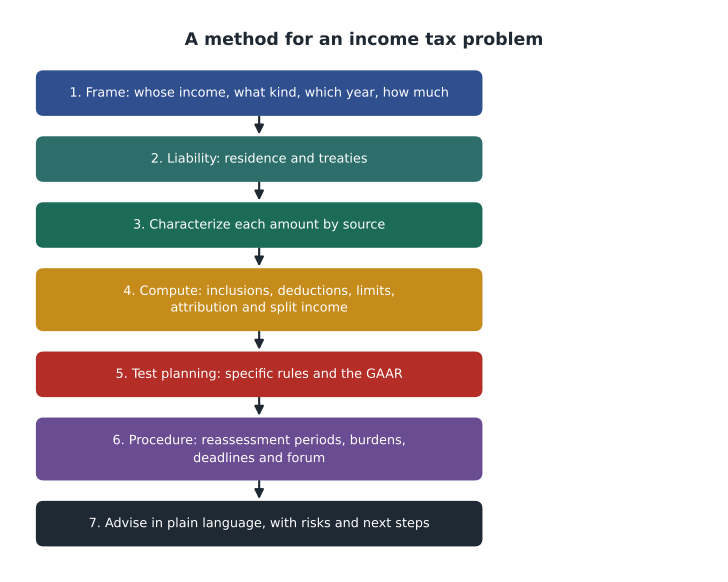
For the final class, Professor Petrakis hands out a fact pattern and gives the class ninety minutes to prepare a memorandum. Before they start, he writes the method on the board and walks through it. 'Frame the problem with the four questions. Check liability. Characterize every amount by source. Apply the computation rules and the limits. Test the planning against the anti-avoidance rules. Then check procedure, because a correct analysis filed a day late is worth nothing. Finish with advice a client can understand.' He adds his final catchphrase of the course: 'Find the taxpayer, the source and the year. The amount will follow.'
The facts
Anouk Delacroix, fifty-one, is a data scientist who lives in Corwin with her husband, Felix Okonjo, fifty-three, a high school teacher who earns 92,000 dollars a year. Their daughter Mireille, twenty-three, finished university last year and works part-time in a bookshop. Their son Bastien is sixteen. The family owns their house on Ferris Street, bought in 2008 for 350,000 dollars and now worth about one million dollars. Until June 2025 they also owned a cottage on Gull Lake, bought in 2012 for 180,000 dollars and used every summer.
Anouk carries on her consulting work through Delacroix Analytics Inc., an Ontario corporation incorporated in 2014 and wholly owned by her until 2022. In 2022, on the advice of a friend, she had the corporation issue non-voting shares to Felix and to Mireille for ten dollars each. In 2025 the corporation paid dividends of 80,000 dollars to Anouk, 60,000 dollars to Felix and 40,000 dollars to Mireille. Felix has never worked in the business. Mireille helped with data entry for about ten hours a week for two summers.
In 2025, about 95 percent of the corporation's revenue came from a single client, Halcyon Grid Systems, a utility software company based in Denver, Colorado. From early February to late September 2025, Anouk lived in a rented apartment in Denver and worked at Halcyon's offices, about two hundred and twenty days in all. Halcyon set her working hours, assigned her tasks through its project manager, gave her a Halcyon laptop and email address and listed her on its internal team directory. The corporation invoiced Halcyon monthly at an hourly rate. Anouk flew home to Corwin most months for a long weekend. Felix and the children stayed in the Ferris Street house throughout.
In June 2025, Anouk and Felix sold the Gull Lake cottage for 610,000 dollars. In 2021, Anouk personally bought shares of Pinecrest Robotics Inc., a Canadian-controlled private corporation carrying on an active robotics business in Ontario, for 60,000 dollars. Pinecrest made an assignment in bankruptcy in November 2025, and its shares are worthless.
In September 2026, a tax planner sent Anouk a proposal: she would sell her common shares of Delacroix Analytics to a new holding company owned by her in exchange for a note and new shares with high paid-up capital, after a series of steps involving an amalgamation with an unrelated shell company, so that she could withdraw about 700,000 dollars of the corporation's retained earnings without paying dividend tax. The planner's fee is 10 percent of the tax saved.
Finally, on October 14, 2026, the CRA sent Anouk a notice of reassessment for her 2021 taxation year, which was originally assessed on May 20, 2022. The reassessment adds a 40,000 dollar dividend from Delacroix Analytics that she did not report, and imposes a gross negligence penalty. Anouk says the corporation's bookkeeper issued the slip late and she forgot about the dividend. She consults the Brannock legal clinic on November 18, 2026, and asks for advice on every issue.
Step one: framing
Hannah Kowalczyk frames the problem. There are four taxpayers whose positions matter: Anouk, Delacroix Analytics, Felix and Mireille. The years in play are 2021, 2025 and future years. The kinds of income include business income of the corporation, dividends, a capital gain on the cottage, a capital loss on the Pinecrest shares, and the proposed extraction of surplus. 'The facts are mostly about Anouk,' Hannah says, 'but the tax is spread across four taxpayers, and we have to keep them separate.'
Step two: residence in 2025
Theo Marchetti takes residence. Anouk spent about two hundred and twenty days in Denver. Under Thomson and the CRA's approach, her significant residential ties all remained in Canada: her husband and dependent son lived in the Ferris Street house, which remained available to her, and her stay in Denver was tied to a contract of limited length. She returned home most months. She remained factually resident in Canada throughout 2025 and is taxable on worldwide income. The 183-day sojourning rule is irrelevant to Canadian residence, because she was factually resident anyway.
Theo then considers the United States. Anouk may have met the American substantial presence test and be resident there under its domestic law. If so, the treaty tie-breaker in Article IV of the Canada-United States convention applies. She had a permanent home available in Canada and probably not in the United States, since the Denver apartment was a short-term rental tied to the contract; even if both were permanent homes, her centre of vital interests, her family and economic life, was in Canada. She is resident in Canada for treaty purposes. Her dividends from the Canadian corporation are taxable only in Canada under the treaty, subject to American withholding rules that do not apply here. The corporation's income is a separate question.
Step three: the corporation and the personal services business
Arjun Mehta takes the corporation. Delacroix Analytics is a Canadian-controlled private corporation, deemed resident in Canada under section 250(4). Its income from consulting is business income. The question is whether it is a personal services business under section 125(7). The test asks whether Anouk, as an incorporated employee, would reasonably be regarded as an officer or employee of Halcyon but for the existence of the corporation, and whether the corporation employed more than five full-time employees, which it did not.
Arjun applies Wiebe Door and Sagaz. Control points strongly to employment: Halcyon set her hours, assigned tasks through its manager and integrated her into its team. Tools point to employment: Halcyon supplied the laptop and email account. Chance of profit and risk of loss point to employment: she billed hourly, had no investment at risk and could not hire helpers to do the work. The parties' intention, shown by the consulting agreement and invoices, points to an independent relationship, but under Connor Homes that intention must be consistent with the objective reality, and here it is not. On these facts, the corporation probably carried on a personal services business in 2025.
The consequences are serious. The corporation loses the small business deduction on that income, does not get the general rate reduction and pays an additional 5 percent tax, for a federal rate of 33 percent and a combined Ontario rate of about 44.5 percent, and section 18(1)(p) limits its deductions to salary and benefits paid to Anouk and a few other items. Arjun also flags a cross-border question: if the corporation's activities in Denver created a permanent establishment in the United States, its business profits attributable to that establishment could be taxed there, with a foreign tax credit in Canada. That question needs facts about where the corporation's work was done and who had authority to contract, and he recommends getting American advice.
Practical advice: for future years, Anouk should either restructure the relationship so that the corporation genuinely operates as a business, with multiple clients, its own equipment and control over how work is done, or accept that it is a personal services business and pay herself salary, which is deductible to the corporation and avoids the extra corporate tax.
Step four: dividends to Felix and Mireille
Sophie Tremblay-Hart takes the dividends. Dividends from a private corporation are generally split income under section 120.4 when received by a family member of the business's principal owner, unless an exclusion applies. Felix is fifty-three and has never worked in the business. He owns non-voting shares, so he cannot meet the excluded shares test, which requires at least 10 percent of the votes and value, and the corporation earns more than 90 percent of its business income from services in any event. Anouk is fifty-one, so the exclusion for spouses of owners aged sixty-five or more is unavailable. Felix's 60,000 dollars of dividends are split income taxed at the top marginal rate.
Mireille is twenty-three. Ten hours a week for two summers falls well short of the twenty-hour bright line, and whether her work was regular, continuous and substantial in any of the relevant years is doubtful. For a person aged eighteen to twenty-four, the safe harbour capital return and reasonable return exclusions are narrow and depend on capital contributed, which was ten dollars. Her 40,000 dollars of dividends are very likely split income too. Sophie notes that the attribution rules do not apply, because the shares were issued by the corporation rather than transferred by Anouk, but that is cold comfort once the tax on split income applies. Anouk's own dividends of 80,000 dollars are taxed normally, because she is actively engaged in the business.
Advice: report the 2025 dividends to Felix and Mireille as split income; stop paying dividends on their shares unless an exclusion will apply, for example if Mireille works in the business for at least twenty hours a week; and consider whether reasonable salaries for real work would be better. In 2028, when Mireille turns twenty-five, the excluded shares exclusion still will not help, because the corporation is a services business and her shares are non-voting.
Step five: the cottage
Daniel Whitecloud takes the cottage. The capital gain on the cottage is 430,000 dollars (610,000 minus 180,000), ignoring selling costs and improvements, which should be added to the adjusted cost base if documented. Because Anouk and Felix owned it jointly, each has a gain of 215,000 dollars. The cottage was ordinarily inhabited by the family each summer, so it can qualify as a principal residence. But the family unit can designate only one property for each year after 1981, and the Ferris Street house, which they still own, has been their main home.
Daniel compares gain per year. The cottage gained 430,000 dollars over fourteen years of ownership (2012 to 2025), roughly 30,700 dollars a year. The house has gained about 650,000 dollars over eighteen years, roughly 36,000 dollars a year. If the house's growth continues, it has the higher gain per year, so designating the cottage for the years of overlap would use up years that would shelter more gain on the house later. A partial designation is possible: designating the cottage for some years and the house for others. The answer depends on forecasts of the house's value and on when the house is likely to be sold. If they designate no years for the cottage, each spouse has a taxable capital gain of 107,500 dollars for 2025. Daniel also notes that the sale must be reported on Schedule 3 whether or not a designation is made, and that the 2025 return was due April 30, 2026; if they did not report it, they should file an adjustment request now, because failure to report keeps the year open indefinitely.
Step six: Pinecrest Robotics
Hannah returns to take Pinecrest. Anouk's shares are worthless, and under section 50(1), a taxpayer who owns shares of a corporation that has become bankrupt in the year may elect to be deemed to have disposed of the shares for nil proceeds at the end of the year and reacquired them at nil. She therefore has a capital loss of 60,000 dollars in 2025. Because Pinecrest is a Canadian-controlled private corporation carrying on an active business in Canada, it is likely a small business corporation, and the loss is a business investment loss under section 39(1)(c). Half, 30,000 dollars, is an allowable business investment loss, deductible against any income under paragraph 3(d), not only against capital gains. Hannah notes two limits: the loss is reduced to the extent Anouk has previously claimed the lifetime capital gains exemption, and the corporation must have been a small business corporation at the time of the deemed disposition or within the preceding twelve months. She recommends confirming Pinecrest's status at the relevant time.
Step seven: the planner's proposal
Arjun returns to the planner's proposal. Selling her shares to her own holding company in exchange for high paid-up capital shares and a note is the classic surplus strip that section 84.1 is designed to prevent. Anouk does not deal at arm's length with a corporation she controls, so section 84.1 deems any non-share consideration in excess of the greater of the paid-up capital and the modified adjusted cost base of her shares to be a dividend, and grinds the paid-up capital of the new shares. The intergenerational transfer exception does not apply; she is not transferring the business to her children.
The amalgamation with an unrelated shell is designed to get around the grind, which is the pattern in Copthorne. Even if each step complies with the text, the general anti-avoidance rule would apply: there is a tax benefit compared with paying a dividend; under the post-2024 test, one of the main purposes of the series is obviously to obtain that benefit; and the series frustrates the rationale of sections 84.1 and 87(3), which is to prevent the extraction of corporate surplus as a tax-free return of capital. The economic substance rule points the same way: Anouk's economic position is unchanged apart from the cash, and the tax benefit is the whole purpose. For a transaction in 2026 or 2027, the 25 percent penalty would apply to the tax benefit unless the transaction were disclosed, and the reassessment period would be extended by three years. The contingent fee also makes the transaction reportable under section 237.3, which carries its own penalties for failure to disclose. Arjun's advice is short: decline.
Step eight: the 2021 reassessment
Theo takes procedure. Anouk's 2021 return was originally assessed on May 20, 2022, so the normal reassessment period for an individual expired on May 20, 2025. The October 14, 2026 reassessment is valid only if the Minister proves a misrepresentation attributable to neglect, carelessness or wilful default under section 152(4)(a)(i). Failing to report a 40,000 dollar dividend from her own wholly owned corporation is a misrepresentation, and forgetting about it is probably careless, even if the slip was late. A court is likely to find that the year could be reopened.
The gross negligence penalty is a different question. Under section 163(2), the Minister must prove that Anouk knowingly, or in circumstances amounting to gross negligence, failed to report the dividend. Gross negligence requires a high degree of negligence tantamount to intentional acting or indifference. A single forgotten dividend reported on a late slip, by a taxpayer who otherwise filed carefully, may well be ordinary carelessness rather than gross negligence. The penalty is worth contesting. Interest has been accruing since April 30, 2022, and a request for interest relief under section 220(3.1) is unlikely to succeed on these facts, since the cause was her own oversight.
Deadlines: as an individual, Anouk must file a notice of objection by the later of ninety days after October 14, 2026, which is January 12, 2027, and one year after her 2021 filing due date, which passed in 2023. Her deadline is therefore January 12, 2027. Collection of the reassessed amount is suspended while the objection is pending, but interest continues, so she may choose to pay the tax and dispute the penalty to stop interest from running on the tax. If the Appeals Division confirms the penalty, she may appeal to the Tax Court; the amount of federal tax and penalties for the year is likely to be under 25,000 dollars, so the informal procedure is available.
Step nine: advice to Anouk
Petrakis asks the class to write the last part of the memorandum as a letter Anouk can understand. Their draft reads: 'You remained a resident of Canada in 2025 even though you worked in Denver for most of the year, so Canada taxes all your income, with credit for any American tax. Your company probably operated as what the tax law calls a personal services business, because Halcyon treated you like an employee; that means a higher tax rate for the company on that income, and we recommend changing either the arrangement or the way you pay yourself. The dividends paid to Felix and Mireille are taxed at the highest rate under the split income rules; we recommend stopping them unless Mireille works substantially in the business. You and Felix each have a gain on the cottage, and you need to decide whether to use the principal residence exemption for it or save it for your house; we can model both options. Your Pinecrest loss can reduce your other income. Do not proceed with the planner's proposal: it is very likely to be challenged, with a penalty, and it carries professional and reporting risks. For 2021, the CRA can probably reopen the year, but we think the gross negligence penalty can be fought. We must file your objection by January 12, 2027.'
Petrakis's closing
Petrakis ends the course where he began, with his four questions on the board. 'Every problem you will ever see in practice can be organized under those questions. Whose income? What kind? Which year? How much? The law changes every budget. The questions do not. Read the section, then read the definition section. Tax follows the legal relationship. Planning is lawful; pretending is not.' He picks up the consolidation of the Act, now dog-eared from the term, and tells the class that next year's edition will be thicker.
Worked problem
A quick computation for Felix
Felix's 2025 income includes his teaching salary of 92,000 dollars, non-eligible dividends of 60,000 dollars from Delacroix Analytics that are split income, and a capital gain of 215,000 dollars on his half of the cottage, assuming no principal residence designation. Describe how each amount enters his return.
Show solution
- Salary: employment income of 92,000 dollars under section 5, with tax withheld by his school board.
- Dividends: grossed up by 15 percent to 69,000 dollars and included in income; because they are split income, section 120.4 imposes tax on the grossed-up amount at the top federal rate (33 percent), with only the dividend tax credit and limited other credits allowed against that tax; Ontario applies a parallel rule.
- Capital gain: 215,000 dollars minus any share of selling costs; taxable capital gain of one half, about 107,500 dollars, under section 38, unless some years are designated for the cottage.
- Interaction: the large taxable capital gain pushes Felix's ordinary income into high brackets for the year, and the alternative minimum tax should be checked because of the gain.
- Planning note: if the family decides to designate some cottage years, the designation must be made by both spouses consistently, since the family unit can designate only one property per year.
Common mistakes
MistakeTreating the corporation's income as Anouk's, or her dividends as the corporation's.
InsteadKeep the taxpayers separate: the corporation computes business income; shareholders are taxed on dividends.
MistakeConcluding that a contract calling Anouk a consultant ends the personal services business inquiry.
InsteadThe parties' intention must be consistent with the objective reality of control, tools, profit and risk (Connor Homes).
MistakeAssuming that dividends to adult family members are taxed at their own rates.
InsteadSince 2018, the tax on split income applies unless an exclusion applies.
MistakeDesignating the cottage automatically because it was sold first.
InsteadCompare gain per year on each property and consider the future sale of the house; the family unit can designate only one property per year.
MistakeMissing the objection deadline while negotiating with the auditor.
InsteadCalendar the later of ninety days after the notice and one year after the filing due date, and file a protective objection.
Practice problems
Work each problem on paper first, then reveal the answer to check.
Why does the 183-day sojourning rule not decide Anouk's residence?
Show answer
She was factually resident in Canada throughout 2025 because her significant ties remained here; the sojourning rule applies only to persons who are not factually resident.
What are the consequences if Delacroix Analytics carried on a personal services business?
Show answer
It loses the small business deduction and the general rate reduction and pays an additional 5 percent tax, for a federal rate of 33 percent on that income, and its deductions are limited by section 18(1)(p).
How is the Pinecrest loss treated?
Show answer
Under section 50(1), Anouk may elect a deemed disposition for nil on bankruptcy; the 60,000 dollar capital loss is a business investment loss, and half (30,000 dollars) is an allowable business investment loss deductible against any income, subject to the small business corporation conditions and any prior use of the lifetime exemption.
Why would the general anti-avoidance rule apply to the planner's proposal?
Show answer
There is a tax benefit compared with a dividend; one of the main purposes is to obtain it; and the series frustrates the rationale of sections 84.1 and 87(3), as in Copthorne, with an economic substance rule pointing the same way.
When is Anouk's objection deadline for the 2021 reassessment?
Show answer
January 12, 2027, which is ninety days after October 14, 2026, because that is later than one year after her 2021 filing due date.
Summary and key terms
- A tax memorandum should frame the problem by taxpayer, source, year and amount, then address liability, characterization, computation, anti-avoidance and procedure.
- Residence turns on significant ties; a long working stay abroad with family and home kept in Canada usually leaves a taxpayer resident, with treaty relief for foreign tax.
- An incorporated worker integrated into a client's operations may cause the corporation to carry on a personal services business, with higher tax and limited deductions.
- Dividends to family members who are not actively engaged in a services business are generally split income taxed at the top rate.
- Principal residence designations require comparing gains per year across properties; business investment losses can offset all income; surplus strips attract section 84.1 and the general anti-avoidance rule.
- Reassessments after the normal period require proof of misrepresentation attributable to carelessness; gross negligence penalties require more, and objection deadlines must be calendared immediately.
- Memorandum of advice
- A structured written analysis applying the law to a client's facts and recommending action.
- Incorporated employee
- An individual who provides services through a corporation in a relationship that would otherwise be employment.
- Business investment loss
- A capital loss on shares or debt of a small business corporation, half of which is deductible against any income.
- Surplus strip
- An arrangement that extracts corporate retained earnings without dividend tax.
- Protective objection
- A notice of objection filed to preserve rights while facts are gathered or discussions continue.
- Permanent establishment
- A fixed place of business through which an enterprise carries on business in another treaty country.
- Section 50(1) election
- An election to recognize a loss on shares of a bankrupt or insolvent corporation.
Lesson quiz · 5 questions
Score 60% or more to complete this lesson.
Create a free account to save your progress, take quizzes and earn a certificate.