
LAWC-301 · Lesson 6 of 12 · 23 min
Capital cost allowance, recapture and terminal losses
▶ Video coming soon A video version of this lesson is on the way.
Lakeshore Furniture Co. Ltd. owns a factory on the edge of Corwin, a fleet of delivery trucks through its subsidiary Lakeshore Logistics Inc., woodworking machines, computers and a showroom full of furniture that it sells. Petrakis puts a list of Lakeshore's spending for the year on the screen: wages and wood, which no one doubts are deductible; a new roof for the factory; repairs to a band saw; a new computer-controlled router; a replacement for a truck that was written off in an accident; and the purchase of a small company, Tamarack Millwork Ltd., whose customer relationships Lakeshore valued highly. 'Which of these,' he asks, 'can Lakeshore deduct this year?'
The answer depends on the distinction between current expenses and capital outlays. Section 18(1)(b) prohibits deducting an outlay on account of capital except as the Act expressly permits. The main express permission is capital cost allowance under section 20(1)(a) and Part XI of the Income Tax Regulations. This lesson covers the capital and current distinction, the capital cost allowance system, the half-year rule and accelerated allowances, recapture and terminal losses, and the treatment of goodwill and other intangibles.
Capital or current?
The Act does not define a capital outlay. The courts have developed several tests, none conclusive. The best known comes from British Insulated and Helsby Cables Ltd. v. Atherton, [1926] A.C. 205, where Viscount Cave said that when an expenditure is made, not only once and for all, but with a view to bringing into existence an asset or an advantage for the enduring benefit of a trade, there is very good reason for treating it as attributable to capital. Canadian courts use the enduring benefit test together with other indicators: whether the expenditure is recurring, whether it relates to the business structure or to its operations, whether it restores an asset or improves it, and how the expenditure is treated for accounting purposes.
The repair cases illustrate the approach. Replacing worn shingles on Lakeshore's factory roof restores the roof to its original condition and is a current repair, deductible in the year. Replacing a tar-and-gravel roof with a new roof of a better material and a longer life may be an improvement and therefore capital, although courts have often held that replacing a component with a modern equivalent is still a repair. Fixing the band saw is current. The new router is a new machine with a long life: capital. The replacement truck is a new asset: capital, although the old truck's disposition has consequences of its own.
Johns-Manville Canada Inc. v. The Queen, [1985] 2 S.C.R. 46, shows the residual presumption in action. Johns-Manville operated an open-pit asbestos mine. To keep the pit walls at a safe slope as the pit deepened, it had to buy adjoining land every year, which was then consumed by the widening pit. The Minister treated the land purchases as capital. The Supreme Court, in reasons by Justice Estey, held that the purchases were deductible current expenses: they recurred annually, the land was used up in the mining process, and the expenditures were part of the daily operation of extracting ore. The Court added that where the taxing statute is not explicit, reasonable uncertainty arising from the language should be resolved in favour of the taxpayer. Petrakis cautions that the residual presumption was applied in Johns-Manville only after the ordinary tests had produced a genuinely balanced result.
Some outlays fall between categories. Legal fees to defend the existing business, such as fees to defend a lawsuit by a customer, are generally current. Legal fees to acquire a capital asset, such as fees on a purchase of real estate, are added to the asset's cost. Fees to incorporate a company or reorganize capital are capital. Financing costs, such as fees to arrange a loan, are deductible over five years under section 20(1)(e). The cost of landscaping business grounds is deductible in the year paid under section 20(1)(aa). These specific provisions reflect Parliament's preference for certainty over case-by-case analysis.
Capital cost allowance: the system
If an outlay is capital and the property is depreciable, the taxpayer recovers its cost over time through capital cost allowance. Unlike accounting depreciation, which aims to match cost to the asset's useful life, capital cost allowance follows the Regulations, which group property into classes and assign each class a rate. The taxpayer chooses each year how much allowance to claim, up to the maximum, which allows businesses with losses to save their allowance for later years.
Most classes use the declining balance method. Common classes include Class 1 for most buildings acquired after 1987, at 4 percent, with higher rates for new non-residential buildings used in manufacturing or other non-residential purposes if they are placed in a separate class; Class 8 for furniture, fixtures and most machinery not in another class, at 20 percent; Class 10 for automobiles and trucks, at 30 percent; Class 10.1 for each passenger vehicle whose cost exceeds a prescribed ceiling, at 30 percent, with the cost capped at the ceiling; Class 12 for small tools, applications software and some other items, at 100 percent; Class 50 for computer hardware and systems software, at 55 percent; Class 53 and successor rules for manufacturing and processing machinery, which have carried accelerated rates; and Class 14.1 for goodwill and other intangibles of indefinite life, at 5 percent. Land is not depreciable, so the cost of a building and the land under it must be allocated between them. A few classes, such as leasehold improvements in Class 13 and patents or licences of limited life in Class 14, are deducted on a straight-line basis over the term.
The basic computation is done by class, not asset by asset. Each class has an undepreciated capital cost, often called the pool. The pool begins with the closing balance from the previous year. The capital cost of property acquired in the year is added. For each property disposed of in the year, the lesser of the proceeds of disposition and the property's original capital cost is subtracted. The taxpayer may then claim allowance up to the class rate times the resulting balance, subject to the rules for property acquired in the year, and the closing balance carries forward.
The half-year rule and accelerated allowances
Without special rules, a business that bought an asset on the last day of its year could claim a full year's allowance on it. Regulation 1100(2), the half-year rule, generally allows only half the normal allowance on net additions to a class in the year they are acquired. The available-for-use rules in section 13(26) to (32) prevent claims before property is actually ready to be used to earn income, with a fallback that allows claims after a period of time.
Parliament has repeatedly used capital cost allowance as an economic policy tool. In 2018 it introduced the Accelerated Investment Incentive, which suspended the half-year rule for most property acquired after November 20, 2018 and allowed one and a half times the normal first-year claim, together with immediate expensing for manufacturing and processing machinery and certain clean energy equipment. The incentive was scheduled to be phased down after 2023 and to end for property available for use after 2027. Federal Budget 2025 proposed to restore enhanced first-year allowances for a range of property, and that measure was enacted in the budget implementation legislation that received Royal Assent in March 2026. Petrakis warns that the first-year rules change often and that any computation must check the rules in force for the year and the date the property became available for use. 'The architecture of the pool is stable,' he says. 'The first-year percentage is politics.'
Recapture, terminal losses and capital gains
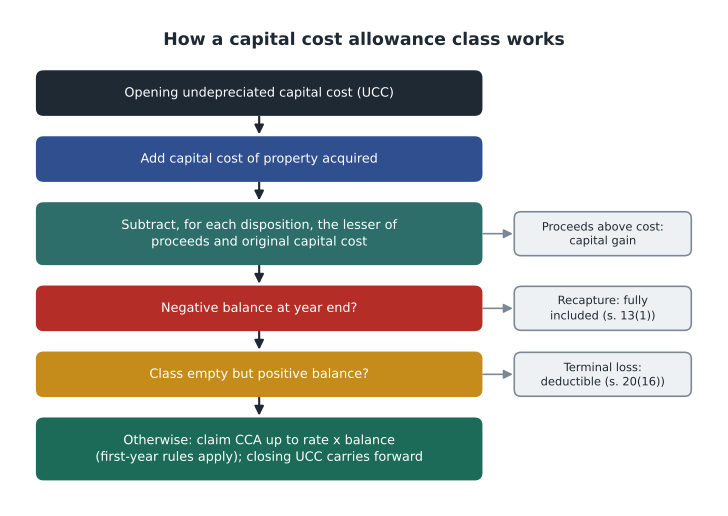
The pool system means that the gain or loss on a single depreciable property is usually not recognized when the property is sold. Instead, subtracting the proceeds from the pool reduces future allowance claims. Two exceptions bring the gain or loss into income.
Recapture. If the undepreciated capital cost of a class is negative at the end of the year, section 13(1) includes the negative amount in income, and the pool is reset to zero. A negative balance means the taxpayer has claimed more allowance than the property's actual decline in value, and recapture reverses the excess. Recapture is fully included in income, not half-included like a capital gain.
Terminal loss. If at the end of the year the class contains no property but still has a positive balance, section 20(16) allows the balance to be deducted as a terminal loss. A positive balance with no remaining property means the taxpayer has claimed less allowance than the property's actual decline in value, and the terminal loss allows the shortfall to be deducted in full. Terminal losses are not available for Class 10.1 passenger vehicles, which are subject to special rules.
Capital gain. Because only the lesser of proceeds and capital cost is subtracted from the pool, any excess of proceeds over the property's original capital cost is not recapture. It is a capital gain under the rules in lesson 7, only half of which is taxable. Selling a building for more than it cost therefore produces two different amounts: recapture of all the allowance previously claimed, up to the original cost, and a capital gain on the amount above original cost.
A depreciable property can never produce a capital loss. Section 39(1)(b)(i) excludes depreciable property from the definition of capital loss, because the decline in value is recognized through allowance and terminal losses instead.
Several separate-class rules preserve these results. Each rental building costing 50,000 dollars or more must be placed in a separate Class 1 by regulation 1101(1ac), so that recapture on a sale of one building cannot be sheltered by the pool of others. Rental properties are also subject to regulation 1100(11), which prevents capital cost allowance on rental buildings from creating or increasing a rental loss. Certain computers and other equipment may be placed in a separate class by election, so that a terminal loss can be claimed when they are discarded.
Change of use and transfers between related parties
When a taxpayer changes the use of property from personal to income-earning, or the reverse, section 13(7) deems a disposition and reacquisition at fair market value, subject to rules that prevent the capital cost of property acquired in a non-arm's length transaction from being stepped up without tax being paid. Section 13(7)(e) limits the capital cost of depreciable property acquired from a non-arm's length person to the transferor's cost plus the taxable portion of any gain recognized, and deems the excess to have been claimed as allowance, so that a family member or related corporation cannot obtain new allowance on gains that were only half taxed. Transfers to a corporation under section 85, discussed in lesson 9, allow depreciable property to be rolled into a corporation at undepreciated capital cost, deferring recapture.
Goodwill and Class 14.1
Until 2017, goodwill, customer lists and other intangibles of indefinite life were eligible capital property, with three quarters of the cost added to a separate pool deductible at 7 percent a year and three quarters of the proceeds subtracted, producing a mixture of income and quasi-capital gain treatment. Since January 1, 2017, such property belongs to Class 14.1, deductible at 5 percent on a declining balance basis, with the cost added at 100 percent and dispositions treated like other depreciable property, including recapture and capital gains. Balances in the old pools were transferred to the new class. Gifford, the client list case in lesson 4, would today involve a Class 14.1 asset if the buyer had been carrying on a business.
Lakeshore's purchase of Tamarack Millwork raises a structural point. If Lakeshore bought Tamarack's assets, it would allocate the purchase price among inventory, equipment, buildings, land and goodwill, and each allocation would have tax consequences: inventory deductible as sold, equipment and buildings in their classes, land not depreciable, and goodwill in Class 14.1. Section 68 allows the CRA to reallocate any part of a price that cannot reasonably be regarded as consideration for the particular property, and it also reaches amounts reasonably attributable to restrictive covenants given by the seller. If Lakeshore bought Tamarack's shares, as students learned it did in business associations, the purchase price is the cost of the shares, which is not depreciable, and Tamarack's own assets keep their existing tax values. Petrakis draws the moral for transactional lawyers: whether a purchase is a share deal or an asset deal changes the buyer's future deductions and the seller's tax, so the parties negotiate over price and structure together.
Worked problem
Lakeshore's Class 10 trucks
Lakeshore Logistics Inc. has a Class 10 pool with an opening undepreciated capital cost of 120,000 dollars for its delivery trucks. During the year it buys a new truck for 90,000 dollars and receives 30,000 dollars in insurance proceeds for a truck that originally cost 70,000 dollars and was written off. Assume the ordinary half-year rule applies to net additions and the rate is 30 percent. Compute the maximum capital cost allowance and the closing balance. Then assume instead that the company sold all its trucks at the end of the year for 260,000 dollars, and that their total original cost was 240,000 dollars.
Show solution
- Opening balance 120,000 dollars; add 90,000 dollars; subtract the lesser of proceeds (30,000) and original cost (70,000), which is 30,000 dollars. Balance before allowance: 180,000 dollars.
- Net additions in the year are 60,000 dollars (90,000 minus 30,000). Under the half-year rule, half of the net additions, 30,000 dollars, is excluded from the base for the year's claim, giving a base of 150,000 dollars.
- Maximum allowance: 30 percent of 150,000 dollars is 45,000 dollars. Closing balance: 180,000 minus 45,000 is 135,000 dollars, carried forward.
- Alternative: on a sale of all trucks for 260,000 dollars, subtract the lesser of total proceeds and total original cost, which is 240,000 dollars, from the 180,000 dollar balance (before allowance). The balance becomes negative 60,000 dollars, which is recapture included in income under section 13(1). No allowance is claimed.
- The 20,000 dollar excess of proceeds over original cost is a capital gain, half of which (10,000 dollars) is a taxable capital gain. Total inclusion: 70,000 dollars.
Common mistakes
MistakeDeducting the full cost of a new machine because it is necessary for the business.
InsteadA long-lived asset is a capital outlay under section 18(1)(b); its cost is recovered through capital cost allowance.
MistakeTreating every gain on selling a depreciable asset as recapture.
InsteadRecapture is limited to allowance previously claimed; proceeds above original cost are a capital gain, only half taxable.
MistakeClaiming a capital loss on selling a building at a loss.
InsteadDepreciable property cannot produce a capital loss; the decline is recognized through allowance or a terminal loss.
MistakeUsing the rental building pool to shelter recapture on a sale of one building.
InsteadRental buildings costing 50,000 dollars or more are in separate classes, and allowance cannot create a rental loss.
MistakeAssuming last year's first-year allowance rules still apply.
InsteadEnhanced first-year rules have changed repeatedly since 2018; check the rules for the year and the available-for-use date.
Practice problems
Work each problem on paper first, then reveal the answer to check.
State the enduring benefit test.
Show answer
An expenditure made once and for all with a view to bringing into existence an asset or advantage for the enduring benefit of a trade is generally capital (British Insulated and Helsby Cables).
Why were the land purchases in Johns-Manville deductible?
Show answer
They recurred annually, the land was consumed in the mining operation and the expenditures were part of daily operations; any remaining doubt was resolved in the taxpayer's favour.
When does recapture arise, and how is it taxed?
Show answer
When a class has a negative undepreciated capital cost at year end; the negative amount is fully included in income under section 13(1).
When can a terminal loss be claimed?
Show answer
When a class has a positive balance at year end but no property remains in it; the balance is deductible under section 20(16) (not available for Class 10.1).
What class does goodwill fall into today, and at what rate?
Show answer
Class 14.1, at 5 percent declining balance, since January 1, 2017.
Summary and key terms
- Capital outlays are not deductible (section 18(1)(b)); courts use the enduring benefit test, recurrence, repair versus improvement and the residual presumption (Johns-Manville).
- Capital cost allowance groups property into classes with prescribed rates, mostly declining balance, and the claim is discretionary up to the maximum.
- The half-year rule limits first-year claims, but accelerated first-year allowances have been introduced, phased and restored repeatedly since 2018.
- A negative pool at year end is recapture (fully taxable); a positive pool with no property is a terminal loss; proceeds above original cost are a capital gain.
- Goodwill and other indefinite-life intangibles have been in Class 14.1 at 5 percent since 2017; share purchases and asset purchases have different tax consequences.
- Capital cost allowance
- The deduction for the cost of depreciable property, computed by class under the Regulations.
- Undepreciated capital cost
- The balance of a class after additions, dispositions and previous allowance claims.
- Half-year rule
- The rule allowing only half the normal allowance on net additions in the year of acquisition.
- Recapture
- The inclusion in income of a negative undepreciated capital cost balance.
- Terminal loss
- The deduction of a positive balance in a class that contains no property.
- Class 14.1
- The class for goodwill and other intangibles of indefinite life, at 5 percent.
- Available-for-use rules
- Rules that delay allowance until property is ready to earn income.
Lesson quiz · 5 questions
Score 60% or more to complete this lesson.
Create a free account to save your progress, take quizzes and earn a certificate.