
LAWC-301 · Lesson 10 of 12 · 27 min
Tax avoidance and GAAR
▶ Video coming soon A video version of this lesson is on the way.
Petrakis puts a slide on the screen titled 'The planner's memo'. It describes a fictional proposal sent to the owner of a successful private company. In seven steps over three weeks, the owner would transfer shares to a new holding company, cause the operating company to amalgamate with a shell corporation that had been created years earlier for another purpose, increase the paid-up capital of a class of shares, and redeem those shares for cash. The memo predicts that the owner will receive two million dollars without paying any personal tax, and it concludes: 'Each step complies with the Act.' Petrakis asks the class what is wrong with the memo. Hannah Kowalczyk says that it reads as though compliance with each step answers the question, when it does not. 'Exactly,' he says. 'That sentence is the most expensive sentence in Canadian tax practice.'
This lesson covers the distinction between tax planning, avoidance and evasion, the history and text of the general anti-avoidance rule in section 245, the three-step test from Canada Trustco and its application in the major Supreme Court cases, the 2024 amendments, specific anti-avoidance rules, sham, the mandatory disclosure rules, penalties for planners, and the limits on fixing mistakes through rectification and rescission.
Planning, avoidance and evasion
Tax evasion is a crime: knowingly failing to report income, claiming deductions that were never incurred or hiding assets abroad. Section 239 makes it an offence punishable by fines and imprisonment, and the Criminal Code's fraud provisions may also apply. Tax planning is the lawful arrangement of affairs to take advantage of choices the Act offers, such as contributing to a registered retirement savings plan, choosing between salary and dividends, or claiming the principal residence exemption. Between them lies tax avoidance: transactions that comply with the letter of the Act but produce results Parliament did not intend. Avoidance is not illegal, but its results can be reversed under the general anti-avoidance rule.
Petrakis reminds the class of his catchphrase from lesson 1: planning is lawful; pretending is not. Evasion involves pretending, because the taxpayer conceals the truth. Avoidance involves real transactions that do what they say. The question is whether the Act, properly read, permits the result.
The road to section 245
Duke of Westminster confirmed the taxpayer's right to arrange affairs to minimize tax. Stubart, in 1984, rejected a judge-made business purpose test and left the policing of avoidance to Parliament. The government responded with a general anti-avoidance rule, enacted in 1988 as section 245, and the rule has been at the centre of Canadian tax litigation ever since. Before the rule was enacted, Parliament relied on specific anti-avoidance rules, which address particular schemes, such as the attribution rules, section 84.1 on surplus stripping, section 55(2) on capital gains strips and section 111(5) on loss trading. Specific rules remain important, but they are reactive: by the time a rule is drafted, planners have often found a new path.
The text of section 245
Section 245(2) provides that where a transaction is an avoidance transaction, the tax consequences to a person shall be determined as is reasonable in the circumstances in order to deny a tax benefit that, but for the section, would result from that transaction or from a series of transactions that includes that transaction. Section 245(1) defines a tax benefit broadly as a reduction, avoidance or deferral of tax or other amount payable under the Act, or an increase in a refund. Section 245(3) defines an avoidance transaction. Section 245(4) limits the rule to transactions that would result in a misuse of the provisions of the Act, the Regulations, a tax treaty or another relevant enactment, or an abuse having regard to those provisions read as a whole. Section 245(5) lists the ways in which tax consequences may be redetermined, such as denying deductions or recharacterizing payments.
The three questions: Canada Trustco
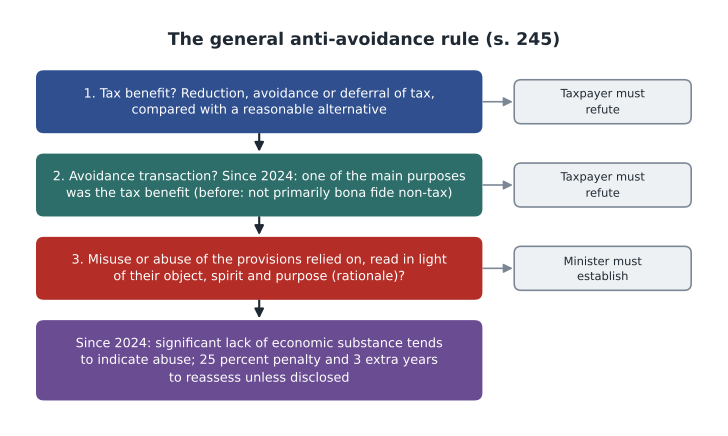
In Canada Trustco Mortgage Co. v. Canada, 2005 SCC 54, the Supreme Court, in unanimous reasons by Chief Justice McLachlin and Justice Major, set out the framework that still governs. Three questions must be answered. First, is there a tax benefit arising from a transaction? Second, is the transaction an avoidance transaction, in the sense that it cannot reasonably be considered to have been undertaken or arranged primarily for bona fide purposes other than to obtain the tax benefit? Third, is the avoidance transaction abusive, in the sense that it results in a misuse or abuse of the provisions relied on? The taxpayer bears the burden of refuting the first two; the Minister bears the burden of establishing the third.
The abuse analysis has two parts. The court first interprets the provisions relied on, using a textual, contextual and purposive analysis to identify their object, spirit and purpose, which the later cases call their rationale. The court then asks whether the transaction falls within or frustrates that rationale. Abuse may be found where the transaction achieves an outcome the provision was intended to prevent, defeats the underlying rationale of the provision, or circumvents it in a manner that frustrates its object. The Court emphasized that the rule is a provision of last resort, that where the existence of abuse is unclear the benefit of the doubt goes to the taxpayer, and that the Act's specificity means that the text often carries significant weight even in the abuse analysis.
On the facts, Canada Trustco bought a large fleet of truck trailers for 120 million dollars, financed almost entirely by a loan, and leased them back through a series of arrangements under which the risks were largely eliminated through prepaid financing. It claimed capital cost allowance on the trailers. The Minister argued that the arrangement was circular and that Canada Trustco had not really incurred a cost. The Court held that the capital cost allowance provisions refer to the cost of property, a legal concept, and that Parliament intended capital cost allowance to be available on the cost of property acquired in sale-leaseback transactions, a common commercial arrangement. There was no abuse. In the companion case, Mathew v. Canada, 2005 SCC 55, the Court applied the rule to deny the use of losses of a failed trust company's real estate partnership, transferred to arm's length investors through partnership interests, because the partnership provisions were not intended to permit the transfer of losses to arm's length parties.
The major cases
Lipson v. Canada, 2009 SCC 1, discussed in lesson 8, applied the rule to a use of the attribution rules that shifted an interest deduction to the higher-income spouse. The case also shows that the rule can apply to a series of transactions each of which is ordinary on its own, such as a home mortgage, a loan between spouses and a share purchase.
Copthorne Holdings Ltd. v. Canada, 2011 SCC 63, involved paid-up capital. The taxpayer's group had shares with high paid-up capital in one corporation. Rather than amalgamate vertically, which would have cancelled the paid-up capital of the parent's shares in the subsidiary under section 87(3), the group first sold the subsidiary to a sister corporation, so that the two corporations could amalgamate horizontally and preserve the paid-up capital. The new corporation then redeemed shares, returning the preserved paid-up capital without dividend tax. Justice Rothstein, for a unanimous Court, held that the paid-up capital provisions were designed to prevent the return of more than the amount actually invested with after-tax funds by the shareholders, and that the horizontal amalgamation circumvented section 87(3) in a manner that frustrated its purpose. The rule applied. Copthorne also clarified that a transaction is part of a series if it was undertaken in contemplation of the series, looking back or forward, with more than a mere possibility of connection.
Canada v. Alta Energy Luxembourg S.A.R.L., 2021 SCC 49, went the other way. A Luxembourg company owned shares of a Canadian company that held oil and gas rights in Alberta. On selling the shares at a large gain, it claimed an exemption under the Canada-Luxembourg treaty for gains on shares deriving their value from immovable property in which the business was carried on. The Minister argued that the arrangement was treaty shopping by investors with no real connection to Luxembourg. Justice Côté, for a majority of six, held that the treaty's text, its context and the evidence of the parties' intentions showed that Canada and Luxembourg had deliberately agreed to the exemption, and that the residence requirement in the treaty did not require economic substance in Luxembourg. There was no abuse. Three judges dissented. The decision added pressure for legislative change. Separately, since 2019 the OECD multilateral instrument has added a principal purpose test to many of Canada's treaties, which would be central to similar arrangements in later years.
Deans Knight Income Corp. v. Canada, 2023 SCC 16, applied the rule to loss trading. A biotechnology company with about 90 million dollars of unused tax losses and credits entered into an arrangement with an investor that gave the investor effective control over the company's future without acquiring a majority of its voting shares, which would have triggered the loss restriction in section 111(5). The company was then used as the vehicle for an unrelated investment business, which used the losses to shelter its income. Justice Rowe, for the majority, with only Justice Côté dissenting, held that the rationale of section 111(5) is to prevent corporations from being acquired by unrelated parties to deduct unused losses against the income of another business for the new owners' benefit. Although the transactions complied with the literal text, which focuses on voting control, they achieved the functional equivalent of an acquisition of control and frustrated the provision's purpose. The rule applied. The Court also offered guidance on the abuse analysis, emphasizing that a provision's rationale may be broader or narrower than its text and that courts must look at the provision's text, context and purpose to identify it.
The 2024 amendments
In 2023 the government proposed substantial amendments to the rule, which were enacted in Bill C-59, which received Royal Assent on June 20, 2024. They apply generally to transactions occurring on or after January 1, 2024.
First, a preamble in section 245(0.1) states that the rule applies to deny the tax benefit of avoidance transactions that result in a misuse or abuse, while allowing the tax benefits Parliament intended, and that it seeks to balance taxpayers' need for certainty in planning their affairs with the government's responsibility to protect the tax base and the fairness of the tax system. The preamble took effect on June 20, 2024, and courts are expected to treat it as guidance in interpreting the rule.
Second, the avoidance transaction test was lowered. A transaction is now an avoidance transaction if it may reasonably be considered that one of the main purposes of the transaction, or of a series that includes it, was to obtain the tax benefit. The earlier test asked whether the transaction was undertaken primarily for bona fide non-tax purposes, so a transaction with mainly commercial purposes and an important tax purpose can now meet the test.
Third, an economic substance rule in section 245(4.1) provides that where a transaction or series is significantly lacking in economic substance, that tends to indicate misuse or abuse. Indicators include that the taxpayer's opportunity for gain and risk of loss remain all or substantially unchanged, that the expected value of the tax benefit exceeds the expected non-tax economic return, and that the entire or almost entire purpose of the transaction was to obtain the tax benefit. The rule is a factor in the abuse analysis, not an independent test, but it responds directly to cases like Alta Energy in which the Court declined to require substance.
Fourth, a penalty applies to transactions occurring on or after June 20, 2024: 25 percent of the amount of the tax benefit determined under the rule, reduced by any gross negligence penalty for the same transaction. The penalty does not apply if the transaction was disclosed to the CRA under the reportable or notifiable transaction rules or by voluntary disclosure on the prescribed form by the filing due date, or if it was reasonable to conclude, on the basis of case law or published CRA guidance on identical or almost identical transactions, that the rule would not apply. Fifth, the normal reassessment period for an assessment under the rule is extended by three years unless the transaction was disclosed.
Daniel Whitecloud asks whether the amendments change the cases studied earlier. Petrakis answers carefully. 'Canada Trustco's framework still governs, but the second question is easier for the Crown to answer, and the economic substance rule gives the Crown a new argument at the third question. A case like Alta Energy would be argued very differently today, especially under treaties amended by the multilateral instrument. Lower courts are only beginning to apply the new rules, and the Supreme Court has not yet interpreted them.'
Sham and other doctrines
Sham remains distinct from the rule. A sham exists where the parties create a false impression of their legal relationships, intending to deceive the tax authority, as the courts have defined it since Stubart. Where a transaction is a sham, its tax consequences are determined according to the real arrangement, and penalties may follow. Window dressing, in which documents are drafted to give an appearance that does not reflect reality, is closely related. The courts have also recognized the ineffective transaction, which fails because it does not create the legal rights it purports to create, for example where a share issuance was never authorized under corporate law.
Disclosure and penalties for planners
The mandatory disclosure rules require taxpayers, and in many cases promoters and advisers, to report certain transactions to the CRA. Reportable transactions under section 237.3 are avoidance transactions with certain hallmarks, such as contingent fees, confidentiality protection or contractual protection against the transaction failing. Notifiable transactions under section 237.4, introduced in 2023, are transactions the Minister has designated as the same as or substantially similar to transactions of concern. Penalties apply for failure to report. Lawyers benefit from a limited exception for information subject to solicitor-client privilege.
Section 163.2 imposes civil penalties on third parties, including planners and preparers, who make or participate in false statements, knowing or in circumstances amounting to culpable conduct. In Guindon v. Canada, 2015 SCC 41, a lawyer who provided a legal opinion for a charitable donation program that she knew was not as described was assessed penalties under section 163.2. The Supreme Court held that the penalty proceedings are administrative and not criminal, so the protections of section 11 of the Charter do not apply. The Law Society of Ontario's Rules of Professional Conduct independently prohibit lawyers from knowingly assisting in dishonesty, fraud or illegal conduct.
Fixing mistakes: rectification and rescission
Sometimes planning fails not because it is abusive but because the documents did not do what the parties intended, and taxpayers ask courts to correct them. In Canada (Attorney General) v. Fairmont Hotels Inc., 2016 SCC 56, the Supreme Court restricted rectification to cases in which the parties had reached a prior agreement whose terms were definite and ascertainable and the written instrument failed to record those terms correctly. Rectification cannot be used to change an agreement because it produced unexpected tax consequences, even if the parties had a general intention to avoid tax. In Canada (Attorney General) v. Collins Family Trust, 2022 SCC 26, the Court extended the same reasoning to rescission: taxpayers cannot unwind a transaction because they misunderstood its tax consequences. The CRA's ability to assess depends on what the taxpayer actually did, not on what the taxpayer would have done with better advice.
Petrakis draws the practical lesson. 'After Fairmont and Collins, the remedy for a planning mistake is usually a claim against the adviser, not a court order that makes the mistake disappear. Draft the documents to match the agreement, and read them before closing.'
Worked problem
The planner's memo
Return to the planner's memo at the start of the lesson. The owner of a private company proposes to extract two million dollars of retained earnings tax-free by moving shares to a new holding company, amalgamating with an unrelated shell to preserve paid-up capital, and redeeming shares. The steps would occur in 2027. How would the general anti-avoidance rule apply?
Show solution
- Tax benefit: the reduction of tax compared with a reasonable alternative, such as paying a taxable dividend of two million dollars. The taxpayer would struggle to refute it.
- Avoidance transaction: under the post-2024 test, it is enough that one of the main purposes of a transaction or the series was to obtain the tax benefit. The memo itself states the purpose. The test is easily met.
- Misuse or abuse: the provisions relied on, including section 84 and the paid-up capital rules, are designed to allow tax-free return of capital actually contributed with after-tax funds, not of retained earnings. As in Copthorne, preserving paid-up capital through an amalgamation to strip surplus frustrates the rationale of section 87(3) and section 84.1. The series also appears to lack economic substance under section 245(4.1): the owner's economic position is unchanged apart from the cash, and the tax benefit is the whole purpose.
- Consequences: the Minister may treat the two million dollars as a dividend, add a 25 percent penalty on the tax benefit unless the transaction was disclosed, and reassess within an extended period. Section 84.1 itself may also apply directly.
- Advice: decline to implement; if the client insists, the transaction must be disclosed, and a lawyer cannot assist in misrepresenting it. Consider lawful alternatives, such as paying dividends over several years at lower brackets, using any capital dividend account, or a genuine intergenerational transfer if the conditions are met.
Common mistakes
MistakeConcluding that a transaction is safe because each step complies with the text of the Act.
InsteadThe general anti-avoidance rule applies precisely where the text is complied with but the result frustrates the rationale of the provisions relied on.
MistakeApplying the pre-2024 primary purpose test to transactions after 2023.
InsteadFor transactions on or after January 1, 2024, a transaction is an avoidance transaction if one of the main purposes was to obtain the tax benefit.
MistakeTreating avoidance as evasion.
InsteadEvasion involves deception and is a crime; avoidance involves real transactions whose benefits may be denied under section 245.
MistakePromising a client that rectification can fix a planning error.
InsteadFairmont limits rectification to errors in recording a definite prior agreement, and Collins bars rescission for unexpected tax consequences.
MistakeIgnoring disclosure.
InsteadDisclosure of the transaction avoids the 25 percent penalty and the three-year extension and may be mandatory under sections 237.3 and 237.4.
Practice problems
Work each problem on paper first, then reveal the answer to check.
State the three questions from Canada Trustco and who bears the burden on each.
Show answer
Is there a tax benefit (taxpayer must refute)? Is the transaction an avoidance transaction (taxpayer must refute)? Is it abusive, resulting in a misuse or abuse of the provisions relied on (Minister must establish)?
Why did the general anti-avoidance rule apply in Copthorne?
Show answer
The horizontal amalgamation preserved paid-up capital that a vertical amalgamation would have cancelled under section 87(3), allowing a return of more than the capital actually invested, which frustrated the purpose of the paid-up capital provisions.
What did Deans Knight decide about section 111(5)?
Show answer
Its rationale is to prevent unrelated parties from acquiring a corporation to use its losses for a different business; an arrangement that gave the functional equivalent of control without voting control frustrated that rationale, so the rule applied.
Name the main features of the 2024 amendments.
Show answer
A preamble; a one-of-the-main-purposes avoidance test; an economic substance rule as an indicator of abuse; a 25 percent penalty on the tax benefit unless disclosed or reasonably protected; and a three-year extension of the reassessment period unless disclosed.
What did Guindon decide?
Show answer
Third-party civil penalties under section 163.2 are administrative, not criminal, so section 11 of the Charter does not apply to them.
Summary and key terms
- Evasion is criminal concealment; planning uses choices the Act offers; avoidance complies with the text but may produce results Parliament did not intend.
- Section 245, enacted in 1988 after Stubart, denies tax benefits from avoidance transactions that result in misuse or abuse.
- Canada Trustco set the three questions: tax benefit, avoidance transaction and abuse, with the Minister bearing the burden on abuse.
- Copthorne, Lipson, Mathew and Deans Knight applied the rule; Canada Trustco and Alta Energy did not.
- The 2024 amendments added a preamble, a one-of-the-main-purposes test, an economic substance indicator, a 25 percent penalty and an extended reassessment period, generally avoidable by disclosure.
- Fairmont and Collins Family Trust prevent courts from rectifying or rescinding transactions merely because of unexpected tax consequences.
- Tax benefit
- A reduction, avoidance or deferral of tax or an increase in a refund.
- Avoidance transaction
- A transaction one of whose main purposes was to obtain a tax benefit (for transactions after 2023).
- Misuse or abuse
- A result that frustrates the object, spirit and purpose of the provisions relied on.
- Series of transactions
- Transactions pre-ordained to produce a result, including related transactions completed in contemplation of the series.
- Economic substance
- A change in the taxpayer's opportunity for gain and risk of loss beyond the tax benefit.
- Specific anti-avoidance rule
- A provision targeting a particular kind of avoidance, such as section 84.1 or section 111(5).
- Rectification
- An equitable remedy correcting a document that fails to record a prior definite agreement.
Lesson quiz · 5 questions
Score 60% or more to complete this lesson.
Create a free account to save your progress, take quizzes and earn a certificate.