
LAWC-301 · Lesson 4 of 12 · 27 min
Income from employment and business
▶ Video coming soon A video version of this lesson is on the way.
Petrakis begins with a story from his years at the Department of Justice. A courier company paid its drivers as independent contractors. The drivers used their own vans, paid their own fuel and invoiced weekly. The company dispatched them, set their routes, required them to wear the company jacket and terminated anyone who refused a delivery. When the CRA ruled that the drivers were employees, the company faced years of unpaid Canada Pension Plan contributions and employment insurance premiums, and the drivers lost deductions they had claimed for years. 'Classification is the first fork in the road,' he says. 'Employment income and business income are computed under different rules, with different deductions, different timing and different obligations for the payer. Get the classification wrong, and every number that follows is wrong.'
This lesson covers the distinction between an office or employment and a business, the computation of employment income under sections 5 to 7, the taxable benefit rules, allowances, stock options, retiring allowances and the very limited deductions available to employees under section 8. It ends with the basic rule for business income in section 9, which lesson 5 develops in detail.
Why classification matters
Employment income is computed under subdivision a of Division B. It is taxed on a cash basis, when received, and the employer must withhold income tax, Canada Pension Plan contributions and employment insurance premiums from each payment and remit them. Section 8(2) provides that no deductions are allowed in computing employment income except those expressly permitted by section 8. Business income is computed under subdivision b. It is generally computed on an accrual basis, as profit under section 9, and any expense incurred to earn business income is deductible unless the Act prohibits it. The person carrying on the business pays tax by instalments, with no withholding by the client.
The difference in deductions is the main reason workers sometimes prefer to be treated as contractors, and the difference in payroll obligations is the main reason payers sometimes prefer it. The classification also matters beyond the Income Tax Act, for employment insurance, the Canada Pension Plan, workers' compensation, employment standards and vicarious liability, and courts in all of these areas draw on the same body of case law.
The employee and the independent contractor
The Act defines 'employment' in section 248(1) as the position of an individual in the service of some other person, and 'office' as the position of an individual entitling the individual to a fixed or ascertainable stipend or remuneration, such as a judicial office, the office of a corporate director or an elected position. The definitions do not resolve the hard cases, which turn on the common law distinction between a contract of service, under which a person is an employee, and a contract for services, under which a person is an independent contractor carrying on business.
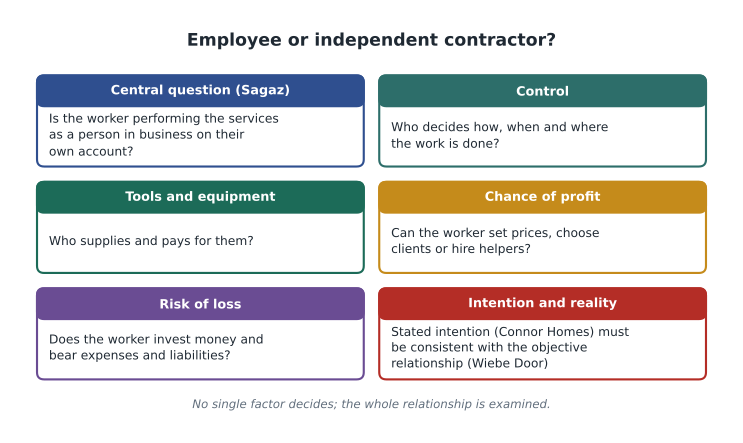
In Wiebe Door Services Ltd. v. M.N.R., [1986] 3 F.C. 553, the Federal Court of Appeal considered door installers who worked for a door company under agreements describing them as independent contractors. Justice MacGuigan rejected a mechanical application of any single test and adopted the approach of looking at the whole relationship, considering control, ownership of tools, chance of profit and risk of loss. The question is whose business it is.
The Supreme Court of Canada endorsed that approach in 671122 Ontario Ltd. v. Sagaz Industries Canada Inc., 2001 SCC 59, a vicarious liability case about a sales consultant. Justice Major stated that the central question is whether the person who has been engaged to perform the services is performing them as a person in business on his own account. The level of control over the worker's activities will always be a factor, together with whether the worker provides his own equipment, whether the worker hires helpers, the degree of financial risk taken, the degree of responsibility for investment and management, and the worker's opportunity for profit in the performance of tasks. No list is exhaustive and no factor is determinative.
The parties' intention has a role, but a limited one. In 1392644 Ontario Inc. (Connor Homes) v. Canada (National Revenue), 2013 FCA 85, the Federal Court of Appeal described a two-step approach: first ascertain the parties' subjective intention, usually from their written contract, and then determine whether the objective reality of the relationship, assessed through the Wiebe Door factors, is consistent with that intention. A contract that calls a worker a contractor is evidence, but a label cannot change the substance of a relationship that is in fact employment.
Arjun Mehta applies the factors to the courier drivers. Control points to employment: the company set routes, required uniforms and could terminate for refusing work. Tools point both ways: the drivers owned their vans, but the company supplied the scanners and the dispatch system. Chance of profit points to employment if the drivers could not set their prices, choose their customers or hire substitutes. Risk of loss points mildly to business, because the drivers bore fuel and vehicle costs. 'On balance,' Arjun concludes, 'they look like employees who were made to pay for their own vans.' Petrakis notes that the Tax Court has decided such cases both ways depending on the facts, which is why advice on classification must be built on the specific relationship, not on the contract alone.
One more category deserves mention. An individual who incorporates and provides services through the corporation to a single client, in circumstances where the individual would reasonably be regarded as an employee of the client but for the corporation, causes the corporation to carry on a personal services business, defined in section 125(7). The corporation is denied the small business deduction, pays an additional federal tax on that income, and may deduct only limited expenses under section 18(1)(p). The rule removes most of the advantage of incorporating an employee.
Employment income: sections 5 and 6
Section 5(1) includes in income the salary, wages and other remuneration, including gratuities, received by the taxpayer in the year. The cash basis means that a bonus declared in December but paid in January is income of the year it is received. Section 6 then adds a long list of other amounts. The most important is paragraph 6(1)(a), which includes the value of board, lodging and other benefits of any kind whatever received or enjoyed by the taxpayer in the year in respect of, in the course of, or by virtue of an office or employment.
The language is deliberately broad. In The Queen v. Savage, [1983] 2 S.C.R. 428, an employee of a life insurance company received 300 dollars from her employer for passing three courses in life insurance, which the employer encouraged but did not require. The Supreme Court held that the payments were benefits received in respect of employment and were taxable. Justice Dickson said that the words 'in respect of' are words of the widest possible scope, and that a benefit need not be remuneration for services to be taxable; it is enough that it was received because of the employment relationship.
The breadth of section 6(1)(a) is limited by the requirement that the employee receive an economic advantage, and by the principle that an amount that is primarily for the benefit of the employer is not a taxable benefit. In Lowe v. The Queen, 96 DTC 6226, the Federal Court of Appeal held that an insurance company manager whose employer paid for him and his wife to accompany top brokers on a trip to New Orleans did not receive a taxable benefit, because he spent most of his time working and the trip was primarily for the employer's business purposes, with any personal enjoyment incidental. Employer-paid training that mainly serves the employer, uniforms required for work and reimbursement of expenses incurred on the employer's business are generally not benefits, while personal travel, gym memberships for general use and gift cards generally are.
The CRA has administrative policies that give some certainty. It does not tax non-cash gifts and awards to an arm's length employee up to a total value of 500 dollars a year, although cash and near-cash gifts such as gift cards are always taxable. It values employer-provided parking, meals and loyalty points under published guidelines. Courts are not bound by these policies, but they reflect the practical difficulty of valuing small benefits.
Specific rules govern the most common benefits. An employee who has the use of an employer-provided automobile is taxed on a standby charge under section 6(2), generally 2 percent of the car's cost per month of availability, reduced where personal use is low, plus an operating cost benefit under section 6(1)(k) for operating costs the employer pays for personal driving. An employee who receives a loan at a low or zero rate of interest because of employment is deemed by section 80.4 to receive a benefit equal to interest at the prescribed rate minus the interest actually paid. Employer contributions to a registered pension plan, a group sickness or accident insurance plan, a private health services plan and a deferred profit sharing plan are excluded from section 6(1)(a), which is why employer-paid dental and drug plans are tax-free while employer-paid group term life insurance premiums are taxable under section 6(4).
Allowances
An allowance is an amount paid to an employee for which the employee does not have to account, such as a fixed monthly car allowance. Section 6(1)(b) includes all allowances for personal or living expenses or for any other purpose, and then excludes several categories, including reasonable allowances for travel expenses paid to sales employees and reasonable allowances for the use of a motor vehicle for travelling in the performance of the duties of employment. A motor vehicle allowance is not reasonable if it is not based solely on the number of kilometres driven for employment, so a flat monthly car allowance is generally taxable while a per-kilometre allowance at a reasonable rate is not. A reimbursement, for which the employee accounts with receipts, is not an allowance at all and is not income if it covers employment expenses.
Stock options
Section 7 governs options to acquire shares of the employer or a related corporation. When an employee exercises an option, the employee is deemed to receive a benefit from employment equal to the fair market value of the shares at that time minus the exercise price and any amount paid for the option. For a Canadian-controlled private corporation dealing at arm's length with the employee, section 7(1.1) defers the benefit until the employee sells the shares. If conditions are met, notably that the exercise price was not less than the fair market value of the shares when the option was granted, the employee may deduct one half of the benefit under section 110(1)(d), so that the benefit is taxed at the same effective rate as a capital gain. Since July 1, 2021, the deduction for options granted by large employers that are not Canadian-controlled private corporations has been limited to options on 200,000 dollars of shares vesting in a year.
Retiring allowances and damages for dismissal
The Lakeshore file supplies the next example. Students in business associations followed the dismissal of Simon Bellamy as sales manager after eleven years. Suppose that Simon's wrongful dismissal claim settles and Lakeshore agrees to pay him 120,000 dollars. How is it taxed?
Section 248(1) defines a retiring allowance as an amount received on or after retirement in recognition of long service, or in respect of a loss of an office or employment, whether or not received as damages or under a court order. Damages for wrongful dismissal, including settlement payments, therefore fall within the definition and are included in income under section 56(1)(a)(ii), not as employment income but as other income in subdivision d. Lakeshore must withhold tax on the payment at the rates for lump sums. Simon can deduct legal fees paid to obtain the retiring allowance under section 60(o.1), up to the amount received. A portion of a retiring allowance relating to years of service before 1996 can be transferred to a registered retirement savings plan without using contribution room, but because Simon's service began in 2015, that rule does not help him.
Theo Marchetti, who handled many dismissal files as a law clerk, asks about the common practice of allocating part of a settlement to general damages for something other than loss of employment, such as human rights damages. Petrakis answers that genuine damages for a human rights violation or other injury that is not compensation for loss of employment may be non-taxable, but only if the allocation reflects the real claims. 'The CRA looks at the substance of the claim and the evidence. An allocation that has no basis in the pleadings will not survive an audit.'
Employment deductions: section 8
Section 8(2) is one of the strictest provisions in the Act. Employees may deduct only what section 8 expressly allows. The main deductions are legal expenses paid to collect salary or establish a right to it (section 8(1)(b)); expenses of a commission salesperson who is required to pay their own expenses and is ordinarily required to carry on duties away from the employer's place of business, up to the amount of commissions (section 8(1)(f)); travel expenses of employees ordinarily required to work away from the employer's place of business and required to pay their own travel costs (section 8(1)(h) and (h.1)); union and professional dues (section 8(1)(i)); certain costs of supplies used up directly in the work, and of an assistant's salary, where the contract requires the employee to pay them (section 8(1)(i)); and workspace in the home that is the employee's principal place of work or is used exclusively and regularly to meet customers, subject to section 8(13). Most deductions require a form signed by the employer certifying the conditions of employment. Federal Budget 2026 proposes to let commission employees claim general vehicle and travel deductions as well as the commission-specific ones from 2027, a change that remains a proposal until enacted.
Section 8 does not allow deductions for capital outlays except specified ones, such as capital cost allowance and interest on a car or aircraft used in employment. In Gifford v. Canada, 2004 SCC 15, an investment adviser employed by a brokerage paid a departing colleague 100,000 dollars for his client list and notes and tried to deduct the payment as an expense of a commission salesperson. The Supreme Court held that the payment was a capital outlay, made to acquire an enduring asset in the form of a client base, and that section 8(1)(f) expressly excludes outlays on account of capital. Employees therefore cannot deduct the cost of acquiring a long-term income-earning asset in the way a business could claim capital cost allowance.
Business income: the starting point
Section 9(1) provides that a taxpayer's income for a taxation year from a business or property is the taxpayer's profit from that business or property for the year. Section 248(1) defines 'business' to include a profession, calling, trade, manufacture or undertaking of any kind whatever and, except for some purposes, an adventure or concern in the nature of trade. The last phrase captures isolated transactions entered into with the intention of reselling at a profit, such as a single purchase of land with the intention of flipping it, which are taxed as business income rather than capital gains. That boundary is discussed in lesson 7.
Profit is a net concept: revenue minus the expenses incurred to earn it, computed according to legal principles and well-accepted business principles, and subject to the specific inclusions in section 12 and the prohibitions in section 18. Lesson 5 takes up the computation of profit, the deductibility of expenses and the line between a business and a personal pursuit.
Worked problem
Two ways of paying Raj Gill
Lakeshore's production manager, Raj Gill, is an employee with a salary of 95,000 dollars. In the year, Lakeshore also pays his gym membership of 1,200 dollars, gives him a gift card of 300 dollars at Christmas and a framed print worth 250 dollars for twenty-five years of service, lends him 50,000 dollars interest-free to help buy a house, provides group dental coverage, and pays a flat car allowance of 600 dollars a month though he rarely drives for work. Raj asks whether he can deduct his work boots and the cost of his home internet. What is his employment income, and can he claim those deductions?
Show solution
- Salary: 95,000 dollars under section 5.
- Gym membership: a taxable benefit under section 6(1)(a) unless the facility is on the employer's premises and available to all employees, or the membership is primarily for the employer's benefit, neither of which appears here; include 1,200 dollars.
- Gift card: a near-cash gift, always taxable under the CRA's policy; include 300 dollars. The framed print is a non-cash long-service award; under the CRA's policy a separate exemption of up to 500 dollars applies to non-cash long-service awards for at least five years of service, so it is not taxed.
- Interest-free loan: section 80.4 deems a benefit equal to interest at the prescribed rate on 50,000 dollars for the period outstanding; if the loan is a home purchase loan, the rate is capped at the rate in effect when the loan was made for five years.
- Dental plan: excluded from section 6(1)(a) as a private health services plan.
- Car allowance: 7,200 dollars for the year is taxable under section 6(1)(b) because it is not based solely on kilometres driven for employment.
- Deductions: section 8(2) bars any deduction not listed in section 8. Work boots are personal clothing; home internet is deductible only within the home workspace rules and supplies consumed directly in the work, with an employer certification. Raj very likely cannot deduct either.
Common mistakes
MistakeTreating the contract's label as conclusive of contractor status.
InsteadUnder Connor Homes the parties' intention is the starting point, but the objective reality of control, tools, profit and risk must be consistent with it (Wiebe Door, Sagaz).
MistakeAllowing an employee to deduct any reasonable expense of earning salary.
InsteadSection 8(2) permits only deductions listed in section 8, most requiring employer certification.
MistakeCalling a settlement for wrongful dismissal non-taxable damages.
InsteadDamages for loss of employment are a retiring allowance taxed under section 56(1)(a)(ii); only genuine damages for other injuries may be non-taxable.
MistakeExempting a flat monthly car allowance as reasonable.
InsteadA motor vehicle allowance is reasonable only if based solely on kilometres driven for employment; a flat allowance is taxable.
MistakeDeducting the cost of buying a client list as an employee's commission expense.
InsteadGifford held such a payment is a capital outlay that section 8(1)(f) excludes.
Practice problems
Work each problem on paper first, then reveal the answer to check.
State the central question in Sagaz and list four factors relevant to it.
Show answer
Whether the worker is performing services as a person in business on their own account. Factors: control, ownership of equipment, hiring helpers, financial risk and investment, and opportunity for profit.
What did Savage decide?
Show answer
A payment from an employer for passing courses was a benefit received in respect of employment and taxable under section 6(1)(a); "in respect of" has the widest possible scope.
An employer pays for an employee to attend a conference where the employee staffs the employer's booth all day. Is there a taxable benefit?
Show answer
Generally no; the trip is primarily for the employer's benefit, and any personal enjoyment is incidental (Lowe).
How are options granted by a Canadian-controlled private corporation to an arm's length employee taxed?
Show answer
The benefit (fair market value at exercise minus exercise price) is deferred until the shares are sold under section 7(1.1), and the employee may deduct half under section 110(1)(d) if conditions are met.
What is a personal services business, and why does it matter?
Show answer
A business of providing services through a corporation where the individual would reasonably be regarded as the client's employee but for the corporation; the corporation loses the small business deduction, pays extra tax and has restricted deductions.
Summary and key terms
- Employment income is taxed on receipt with employer withholding, and section 8(2) restricts deductions to those listed in section 8; business income is profit under section 9, with broad deductibility.
- Whether a worker is an employee turns on whether they are in business on their own account (Sagaz), weighing control, tools, profit and risk (Wiebe Door) and testing stated intention against reality (Connor Homes).
- Section 6(1)(a) taxes benefits of any kind received in respect of employment (Savage), but not advantages primarily for the employer (Lowe); specific rules govern cars, loans, allowances and group plans.
- Stock options produce an employment benefit on exercise, deferred for Canadian-controlled private corporations, with a possible one-half deduction.
- Damages for loss of employment are retiring allowances taxed under section 56(1)(a)(ii).
- Contract of service
- An employment relationship.
- Contract for services
- A relationship with an independent contractor carrying on business.
- Taxable benefit
- An economic advantage received in respect of employment and included under section 6(1)(a).
- Allowance
- A fixed amount paid to an employee without any requirement to account for its use.
- Standby charge
- The benefit under section 6(2) for the availability of an employer-provided automobile.
- Retiring allowance
- An amount received on retirement for long service or for loss of an office or employment, including damages.
- Personal services business
- An incorporated business providing services where the individual would otherwise be the client's employee.
Lesson quiz · 5 questions
Score 60% or more to complete this lesson.
Create a free account to save your progress, take quizzes and earn a certificate.