
LAWC-301 · Lesson 7 of 12 · 25 min
Capital gains
▶ Video coming soon A video version of this lesson is on the way.
Margot Bellamy has three questions for the Brannock clinic, which Petrakis has turned into the day's problem. She owns the family's house in Corwin and a cottage on Loon Lake. She wants to know which property she should treat as her principal residence. She has held shares of a Canadian bank for twenty years and wants to sell some to fund a gift to her grandchildren. And Norland Home has proposed to buy Lakeshore Furniture. If Norland buys her shares, she wants to know how much of her gain will be taxed. 'Three questions,' Petrakis says, 'and all of them are about capital gains, the most privileged and most litigated form of income in the Act.'
This lesson covers the line between capital gains and income gains, the computation of capital gains and losses, dispositions and deemed dispositions, the principal residence exemption, the residential property flipping rule, the main stop-loss rules and the lifetime capital gains exemption.
Capital gain or income?
Section 38 includes in income only one half of a capital gain, while business income is fully taxable. The line between them is therefore worth a great deal. A capital gain arises on the disposition of capital property, meaning property held as an investment or for personal use. A gain on property held as inventory of a business, or acquired as part of an adventure or concern in the nature of trade, is business income under section 9.
The adventure in the nature of trade captures isolated transactions. In Regal Heights Ltd. v. M.N.R., [1960] S.C.R. 902, a company bought land in Calgary intending to develop a shopping centre. When the plan failed, it sold the land at a profit. The Supreme Court held that the profit was income, because the promoters had a secondary intention, from the outset, to sell the land at a profit if the shopping centre did not proceed. In Irrigation Industries Ltd. v. M.N.R., [1962] S.C.R. 346, a company borrowed money to buy shares of a mining company and sold them within weeks at a profit. The Supreme Court held that the gain was capital: the purchase of shares is not an adventure in the nature of trade merely because they are sold quickly, because shares are a common investment and produce income through dividends. Land, by contrast, often produces no income and can be turned to account only by sale, so speculative land transactions are frequently found to be adventures in the nature of trade.
Courts consider several factors: the taxpayer's intention at the time of acquisition, including any secondary intention; the nature of the property; the period of ownership; the frequency of similar transactions; work done to make the property more saleable; the circumstances of the sale; and the relationship between the transaction and the taxpayer's ordinary business. A real estate agent who buys and resells houses will find it hard to argue that a gain is capital; a teacher who bought a single condominium, lived in it for six years and sold it when she married will usually succeed.
Section 39(4) lets a taxpayer elect to treat every disposition of Canadian securities, in the year of election and all later years, as a disposition of capital property, eliminating uncertainty for share and bond investors. The election is not available to traders or dealers in securities. Hannah Kowalczyk asks why the election is not more widely used. Petrakis replies that it is irrevocable and applies to losses as well as gains, so a taxpayer who might want to claim a fully deductible business loss on a bad investment gives that up.
Computing the gain
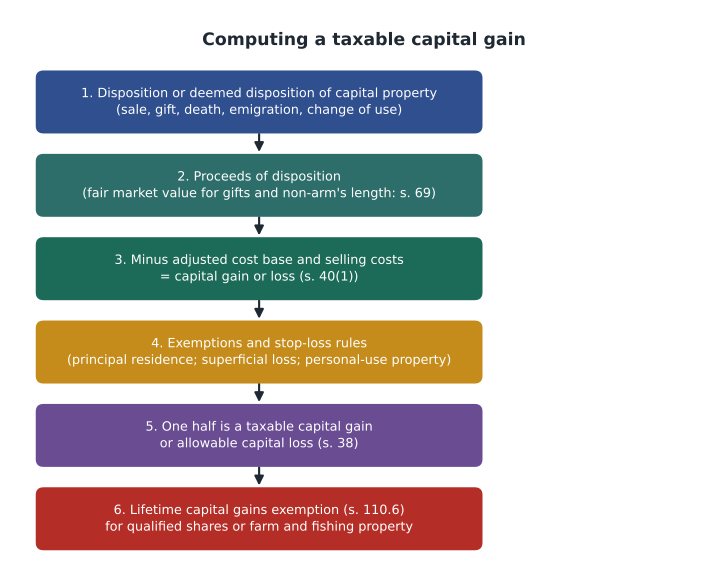
Section 40(1)(a) computes a gain as the proceeds of disposition minus the total of the adjusted cost base and any outlays and expenses of disposition. Section 40(1)(b) computes a loss in the reverse case. 'Disposition' is defined broadly in section 248(1) to include a sale, a redemption or cancellation of shares, the expiry of an option, and the settlement or extinguishment of a debt. 'Proceeds of disposition' in section 54 include the sale price, compensation for property taken or destroyed, and insurance proceeds. 'Adjusted cost base' is generally the cost of the property, adjusted under section 53 for items such as capital contributions to a corporation and returns of capital.
Several deeming rules fix the proceeds where there is no arm's length sale. Section 69(1) deems a taxpayer who gives property away, or sells it to a non-arm's length person for less than fair market value, to have received proceeds equal to fair market value, while a non-arm's length purchaser who pays more than fair market value is deemed to acquire the property at fair market value, which can lead to double taxation. Section 70(5) deems a taxpayer to dispose of capital property at fair market value immediately before death, unless a rollover to a spouse, common-law partner or spousal trust applies under section 70(6). Section 128.1(4) applies on emigration. Section 45 deems a disposition when property changes from personal use to income-earning use, or the reverse, subject to elections that can defer the gain on a principal residence.
Margot's gift of bank shares to her grandchildren is a disposition at fair market value under section 69. If the shares are worth 300,000 dollars and her adjusted cost base is 120,000 dollars, she realizes a capital gain of 180,000 dollars, half of which, 90,000 dollars, is a taxable capital gain, even though she receives nothing. Because the grandchildren are minors, the attribution rules in lesson 8 will also attribute dividends on the shares back to Margot until each grandchild turns eighteen, although later capital gains will be taxed in the grandchildren's hands.
Capital losses and their limits
Half of a capital loss is an allowable capital loss under section 38(b), deductible only against taxable capital gains under paragraph 3(b), with any excess carried back three years or forward indefinitely as a net capital loss under section 111(1)(b). An important exception is the allowable business investment loss: half of a loss on shares or debt of a small business corporation, in circumstances set out in section 39(1)(c), is deductible against any income under paragraph 3(d).
Several rules restrict losses. Section 40(2)(g)(iii) denies losses on most personal-use property, such as a car, boat or furniture, because personal use property ordinarily declines in value through consumption. Section 46 deems the cost and proceeds of personal-use property to be at least 1,000 dollars, so small items are ignored. Listed personal property, such as art, jewellery, rare books, stamps and coins, can produce losses, but only against gains on other listed personal property. The superficial loss rule in the definition in section 54 and section 40(2)(g)(i) denies a loss where the taxpayer or an affiliated person, including a spouse, acquires identical property within thirty days before or after the disposition and still owns it thirty days after; the denied loss is added to the cost of the substituted property.
Section 40(2)(g)(ii) denies a loss on a debt unless it was acquired to earn income, and section 40(1)(a)(iii) allows a taxpayer who has not yet received all the proceeds to claim a reserve, spreading the gain over up to five years, with at least one fifth of the gain recognized each year (ten years for transfers of family farms, fishing property and small business shares to children).
The principal residence exemption
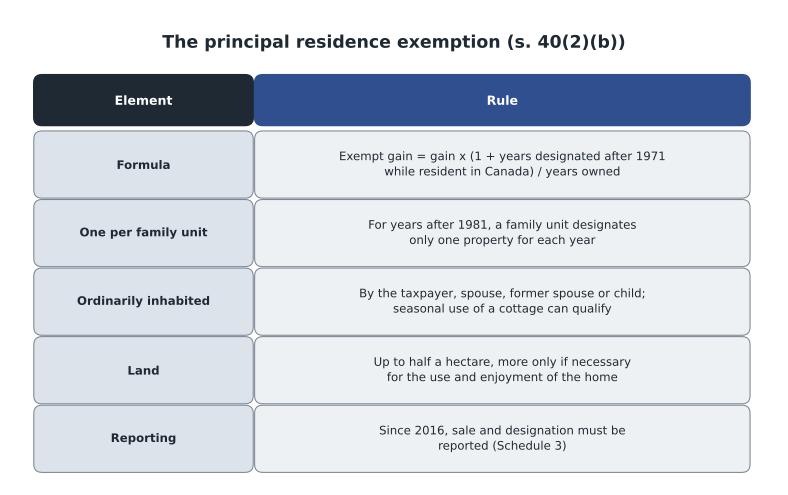
Section 40(2)(b) reduces the gain on a principal residence by a fraction: one plus the number of taxation years after 1971 for which the property is designated as the taxpayer's principal residence and during which the taxpayer was resident in Canada, divided by the number of taxation years ending after the acquisition date in which the taxpayer owned the property. If every year is designated, the formula exempts the whole gain, and the 'plus one' allows a family that sells one home and buys another in the same year to exempt both.
'Principal residence' is defined in section 54. It can be a house, condominium, cottage, cabin, mobile home or share of a co-operative housing corporation, owned alone or jointly, that was ordinarily inhabited in the year by the taxpayer, a spouse or common-law partner, a former spouse or a child. A cottage used for a few weeks every summer can qualify as ordinarily inhabited. The land on which the home stands qualifies up to half a hectare, and more only if the taxpayer shows it was necessary for the use and enjoyment of the housing unit. For years after 1981, a family unit, consisting of the taxpayer, a spouse or common-law partner and unmarried minor children, can designate only one property for each year.
Margot's choice is therefore a calculation. She can designate either property for any given year, but not both for the same year. The usual approach is to compare the gain per year of ownership on each property and designate the one with the larger gain per year for the years they were owned simultaneously. Arjun Mehta works the numbers on the board. If the Corwin house has gained 600,000 dollars over twenty years, or 30,000 dollars a year, and the cottage has gained 500,000 dollars over ten years, or 50,000 dollars a year, the cottage is the better property to designate for the ten years of overlap, with the house designated for its other ten years. Because a designation is made only when a property is sold, Margot need not designate now, but whichever property she sells first will use up years she cannot use for the other.
Since the 2016 taxation year, taxpayers must report the sale of a principal residence and the designation on Schedule 3 of their return to claim the exemption, and the normal reassessment period is extended indefinitely if the sale is not reported. The CRA may accept a late designation, generally with a penalty. The exemption is limited for non-residents: years of non-residence do not count in the numerator, and since 2016 the 'plus one' is unavailable to a taxpayer who was not resident in Canada in the year the property was acquired.
The residential property flipping rule
Since January 1, 2023, section 12(12) deems a gain on the disposition of a housing unit in Canada, including a rental property, owned for less than 365 consecutive days to be business income, not a capital gain, and section 12(13) deems the loss to be nil. The rule removes the need to argue intention in the case of short holdings. It does not apply where the disposition results from a listed life event, such as death, a new member of the household, separation, a threat to safety, disability or illness, a new job requiring a move, insolvency or involuntary disposition. Petrakis notes that the rule is a deeming provision, not a presumption: a property held for longer than 365 days can still produce business income if the ordinary tests show an adventure in the nature of trade.
The lifetime capital gains exemption
Section 110.6 allows an individual resident in Canada to deduct, in computing taxable income, capital gains realized on qualified small business corporation shares, qualified farm property and qualified fishing property, up to a lifetime limit. The limit was raised to 1.25 million dollars of gains for dispositions after June 24, 2024, a measure enacted in March 2026, and is to be indexed to inflation from 2026. A qualified small business corporation share is, in general terms, a share of a Canadian-controlled private corporation that uses all or substantially all, interpreted by the CRA as 90 percent or more, of its assets at the time of sale in an active business carried on mainly in Canada, and that met a 50 percent asset test throughout the twenty-four months before the sale, during which the shares were owned by the taxpayer or a related person. The exemption is claimed in Division C, so it reduces taxable income, not net income, which matters for income-tested benefits; the alternative minimum tax may also apply. A cumulative net investment loss account, built up from investment expenses, reduces the amount that can be claimed.
If Norland buys Margot's Lakeshore shares, she may be able to shelter up to 1.25 million dollars of her gain with the exemption, provided Lakeshore meets the asset tests. If Lakeshore holds large amounts of cash or investments, a pre-sale purification, moving those assets out of the corporation, may be necessary. Claire, Simon and Raj Gill each have their own lifetime limit if their shares qualify. If Norland instead buys Lakeshore's assets, the gain is realized by the corporation, not the shareholders, and the exemption is not available. That difference is one of the main reasons sellers of private businesses prefer share sales and buyers often prefer asset purchases.
Federal Budget 2026, tabled on November 5, 2026, proposes a further exemption, the Canada Growth Incentive, that would shelter up to 15 million dollars of gains per qualifying business on certain shares issued after Budget Day and before 2037 and held for at least thirty-six months, with many exclusions. It is a proposal only. Petrakis tells the class that Margot's Lakeshore shares, issued long ago, would not qualify in any event.
Gains, inflation and the inclusion rate
Before 2000, the inclusion rate changed several times, as described in lesson 2. Since October 18, 2000, it has been one half. The 2024 proposal to raise it to two thirds for most taxpayers was deferred and then cancelled on March 21, 2025. Students should note that an increase in the inclusion rate does not change the computation of the gain; it changes only the fraction included in income. The cancellation means that every example in this course uses one half.
Worked problem
Margot's three questions
Margot bought the Corwin house in 2006 for 300,000 dollars; it is now worth 900,000 dollars. She bought the Loon Lake cottage in 2016 for 250,000 dollars; it is now worth 750,000 dollars. Both have been ordinarily inhabited by her family in every year. She plans to give bank shares worth 300,000 dollars (cost 120,000) to her grandchildren, and Norland proposes to buy her Lakeshore shares for 3.3 million dollars (adjusted cost base 100,000 dollars). Advise her on each question.
Show solution
- Principal residence. Gain per year: the house, 600,000 dollars over about twenty years, roughly 30,000 dollars a year; the cottage, 500,000 dollars over about ten years, roughly 50,000 dollars a year. For the years of overlap (2016 onward), designating the cottage shelters more gain per year. If she sells the house first while keeping the cottage, she should consider designating the house only for 2006 to 2015 (plus one), paying tax on the house's gain attributable to the later years, and preserving those years for the cottage.
- Gift of bank shares. Section 69 deems proceeds of 300,000 dollars; capital gain 180,000 dollars; taxable capital gain 90,000 dollars on her return. Dividends on the shares while the grandchildren are minors attribute back to her; future gains do not.
- Sale to Norland. Capital gain of 3.2 million dollars. If the Lakeshore shares are qualified small business corporation shares, she may deduct up to 1.25 million dollars of the gain under section 110.6, leaving 1.95 million dollars of gain, half of which is a taxable capital gain. She must check the 90 percent and 50 percent asset tests and her cumulative net investment loss, and consider whether the alternative minimum tax applies.
- Structure. If Norland insists on an asset purchase, the gain is realized in Lakeshore, recapture may arise on depreciable property, and no lifetime exemption is available; Margot would then receive the after-tax proceeds as dividends or on a wind-up. The difference should be reflected in price negotiations.
- Timing. A reserve under section 40(1)(a)(iii) may spread the gain if part of the price is paid over time.
Common mistakes
MistakeAssuming a quick sale of shares makes the gain business income.
InsteadIrrigation Industries held that shares are not traded merely because they are sold quickly; consider all factors, and the section 39(4) election for Canadian securities.
MistakeTreating a gift as producing no gain because nothing was received.
InsteadSection 69 deems proceeds equal to fair market value on gifts and non-arm's length transfers.
MistakeDesignating two properties as principal residences for the same year.
InsteadFor years after 1981, a family unit may designate only one property per year.
MistakeForgetting to report the sale of a principal residence.
InsteadSince 2016 the sale and designation must be reported; failure extends the reassessment period and can cost the exemption.
MistakeClaiming the lifetime exemption on an asset sale by the corporation.
InsteadThe exemption applies to individuals' gains on qualified shares or property; a corporation's gain on selling its assets does not qualify.
Practice problems
Work each problem on paper first, then reveal the answer to check.
What is a secondary intention, and which case established its relevance?
Show answer
An intention at the time of acquisition to sell at a profit if the primary plan fails; Regal Heights held that such an intention can make a gain on land income from an adventure in the nature of trade.
A taxpayer sells shares at a loss on December 10 and her husband buys the same shares on December 20. What happens?
Show answer
The superficial loss rule denies the loss because an affiliated person acquired identical property within thirty days and held it after; the denied loss is added to his cost of the shares.
State the principal residence exemption formula.
Show answer
Exempt gain = gain x (1 + years designated after 1971 while resident in Canada) / years owned ending after acquisition.
What does the residential property flipping rule do?
Show answer
Since 2023, gains on housing units owned for less than 365 consecutive days are business income and losses are nil, unless a listed life event explains the sale.
What is the current lifetime capital gains exemption limit?
Show answer
1.25 million dollars of gains on qualified small business corporation shares and qualified farm or fishing property, for dispositions after June 24, 2024, enacted in March 2026 and indexed from 2026.
Summary and key terms
- Only half of a capital gain is taxable; gains on inventory or from an adventure in the nature of trade are fully taxable business income (Regal Heights, Irrigation Industries).
- A gain equals proceeds minus adjusted cost base and disposition costs; gifts, non-arm's length transfers, death, emigration and change of use trigger deemed dispositions.
- Allowable capital losses offset only taxable capital gains, except allowable business investment losses; personal-use losses, superficial losses and some debt losses are denied.
- The principal residence exemption shelters gains for years designated, one property per family unit per year, and must be reported.
- The flipping rule treats gains on homes held under 365 days as business income; the lifetime capital gains exemption shelters up to 1.25 million dollars on qualified property.
- Capital property
- Property held as an investment or for personal use, whose disposition produces a capital gain or loss.
- Adventure in the nature of trade
- An isolated transaction undertaken with the intention of resale at a profit, taxed as business income.
- Adjusted cost base
- The tax cost of capital property, as adjusted under section 53.
- Deemed disposition
- A disposition the Act treats as having occurred, such as on death or emigration.
- Superficial loss
- A loss denied because identical property is reacquired by the taxpayer or an affiliated person within thirty days.
- Principal residence
- A housing unit ordinarily inhabited by the taxpayer or family and designated for exemption.
- Qualified small business corporation share
- A share meeting the asset and holding tests for the lifetime capital gains exemption.
Lesson quiz · 5 questions
Score 60% or more to complete this lesson.
Create a free account to save your progress, take quizzes and earn a certificate.