
LAWC-301 · Lesson 3 of 12 · 28 min
Residence and liability
▶ Video coming soon A video version of this lesson is on the way.
Ingrid Solberg's file is on the screen when the class begins. She is moving to Houston for three years. Her husband, Mats, and their two children, aged eleven and eight, will stay in Corwin until June and then decide whether to join her. The family will keep the house on Linden Crescent. Ingrid will keep her Ontario driver's licence for now, her registered retirement savings plan and her investment account at a Canadian bank, and her membership in the Corwin curling club. She asks one question: 'Where do I pay tax?'
Petrakis tells the class that the answer begins with residence, because residence is the connecting factor on which the Canadian income tax rests. 'Citizenship does not matter for Canadian income tax. A Canadian citizen who has really left pays no Canadian tax on foreign income. A foreign citizen who lives here pays tax on everything she earns anywhere in the world.' This lesson covers the charging provisions in section 2, the residence of individuals under the common law and the deeming rules, part-year residence, departure and arrival, treaty tie-breakers, the residence of corporations and trusts, the taxation of non-residents, and the exemption in section 87 of the Indian Act.
The charging provisions
Section 2(1) imposes tax on the taxable income for each taxation year of every person resident in Canada at any time in the year. Section 2(2) defines taxable income as income for the year minus the Division C deductions. Because section 3 includes income from sources inside or outside Canada, a Canadian resident is taxable on worldwide income. To prevent double taxation, section 126 allows a foreign tax credit for income or profits tax paid to another country on foreign-source income, generally limited to the Canadian tax otherwise payable on that income.
Section 2(3) taxes non-residents only on narrower categories: income from duties of an office or employment performed in Canada, income from a business carried on in Canada, and gains from dispositions of taxable Canadian property, such as Canadian real estate and certain shares that derive their value from Canadian real estate or resource property. Division D computes a non-resident's taxable income earned in Canada. Separately, Part XIII imposes a flat 25 percent withholding tax on certain passive amounts paid by Canadian residents to non-residents, including dividends, rents, royalties, management fees and interest paid to non-arm's length non-residents. The payer must withhold and remit. Treaties commonly reduce the rate, for example to 15 or 5 percent on dividends.
The consequences of residence are therefore stark. A resident pays Canadian tax on everything. A non-resident pays Canadian tax only on Canadian employment and business income, gains on taxable Canadian property, and withholding tax on passive Canadian income.
Factual residence: the common law test
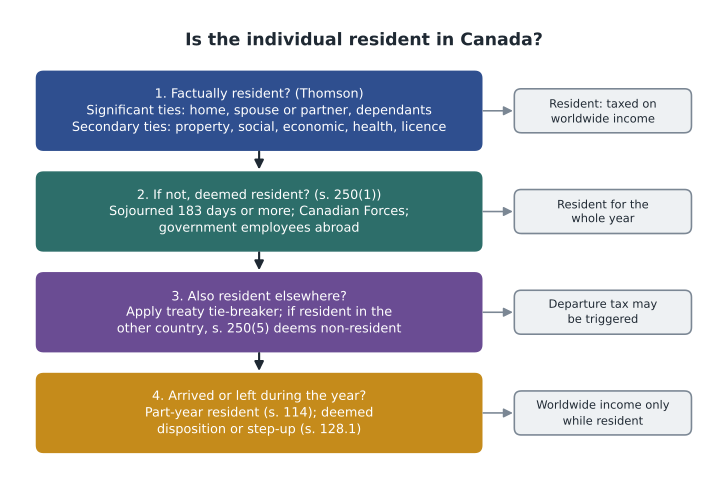
The Act does not define 'resident'. Courts apply a common law test drawn from Thomson v. Minister of National Revenue, [1946] S.C.R. 209. Thomson was a wealthy man who had moved to North Carolina but kept a large house in New Brunswick, which was maintained year-round and which he used for part of each year. The Supreme Court held that he was resident in Canada. Justice Rand described residence as a matter of the degree to which a person, in mind and fact, settles into or maintains or centralizes his ordinary mode of living, with its accessories in social relations, interests and conveniences, at or in the place in question. A person can be resident in more than one country at once, and residence is a question of fact in each case.
The CRA's approach, set out in Income Tax Folio S5-F1-C1, Determining an Individual's Residence Status, sorts the relevant facts into residential ties. Significant ties are a dwelling place in Canada, a spouse or common-law partner in Canada, and dependants in Canada. Secondary ties include personal property such as cars and furniture, social ties such as memberships in Canadian clubs and religious organizations, economic ties such as Canadian bank accounts, credit cards and employment, provincial health insurance coverage, a provincial driver's licence, and seasonal property. Courts are not bound by the folio, but they look at the same kinds of facts, and they also consider the length and purpose of the stay abroad and whether the person intended to return.
Petrakis asks Theo Marchetti to apply the test to Ingrid. Theo starts with the significant ties. For at least the first months, Ingrid's spouse and dependants remain in Corwin, and the family home is kept and available to her. Her stay abroad is for a defined period of three years, after which she expects to return. Her secondary ties, including her bank account, her licence and her club membership, all point to Canada. 'If she leaves on those facts,' Theo concludes, 'she is still factually resident in Canada. She has a job in Houston, but her life is still here.' Petrakis agrees and adds that the courts have generally treated a temporary absence with a fixed return date and a home kept available as continuing residence.
What would change the answer? If Mats and the children move to Houston in June, the family home is sold or leased at arm's length on a long-term basis, Ingrid's Ontario health coverage ends, her licence is exchanged and her intention becomes indefinite, the facts would support a finding that she ceased to be resident on the date she severed her significant ties. Theo notes that Ontario health coverage generally requires physical presence for a minimum number of days a year, so the loss of coverage is often a consequence of departure rather than an independent factor.
Deemed residence
Section 250(1) deems certain persons resident in Canada throughout the year even if they are not factually resident. The most important is paragraph 250(1)(a): a person who sojourned in Canada in the year for a period or periods totalling 183 days or more is deemed resident for the whole year. A sojourner is someone who is temporarily present, not someone who lives here; the rule applies to people who are not factually resident but spend long periods in Canada, such as a retiree who lives abroad but visits for six months. The rule does not apply to a person who becomes or ceases to be factually resident during the year, because that person is a part-year resident instead.
Section 250(1) also deems resident members of the Canadian Forces serving abroad, ambassadors and other officers and servants of Canada or a province who were resident immediately before their appointment, and their families in some circumstances. Section 250(5) works in the opposite direction: a person who would otherwise be resident in Canada but is, under a tax treaty, resident in another country is deemed not to be resident in Canada. That provision, added in 1998, means that the treaty tie-breaker result governs for all purposes of the Act.
Part-year residence, arrival and departure
An individual who becomes resident or ceases to be resident during the year is taxed on worldwide income only for the part of the year in which they were resident, and on Canadian-source income under the non-resident rules for the rest of the year (section 114). The date of departure is generally the latest of the date the person leaves Canada, the date the spouse and dependants leave, and the date the person becomes resident in the new country, although a court looks at all the facts.
Departure has a price. Section 128.1(4) deems an individual who ceases to be resident to have disposed of each property, with listed exceptions, at fair market value immediately before ceasing to be resident, and to have reacquired it at that value. This departure tax ensures that gains accrued while the person was resident are taxed in Canada. The main exceptions are Canadian real property, property of a business carried on in Canada through a permanent establishment, pension and registered plan rights such as registered retirement savings plans, and certain other rights. Canadian real property is excluded because Canada can still tax gains on it later under section 2(3), since it is taxable Canadian property. The emigrant may post security and defer payment of the departure tax until the property is actually sold, and must report property holdings above a threshold on departure.
Arrival has the mirror image. Section 128.1(1) deems an immigrant to have acquired most property at fair market value on becoming resident, so that Canada taxes only gains that accrue after arrival. Petrakis points out the logic: residence is the gateway for worldwide taxation, and the deemed dispositions at entry and exit mark the boundaries of Canada's claim.
Worked problem
Ingrid stays in Texas
Two years after leaving, Ingrid decides to stay in Houston permanently. Mats and the children joined her eighteen months ago, and they sold the Corwin house last month. She owns a portfolio of shares of Canadian public companies worth 400,000 dollars with an adjusted cost base of 250,000 dollars, an RRSP worth 180,000 dollars and a rental condominium in Toronto. What are the tax consequences of her departure?
Show solution
- Identify the departure date. On these facts, Ingrid probably ceased to be factually resident when her family joined her and the significant ties shifted, or at the latest when the house was sold. The date is a factual question, and the advice should identify the most defensible date with evidence.
- Departure tax. Under section 128.1(4), her shares are deemed disposed of at 400,000 dollars, producing a capital gain of 150,000 dollars, half of which (75,000 dollars) is a taxable capital gain on her final return as a resident. She may elect to post security and defer payment until she sells.
- Excluded property. Her RRSP is excluded from the deemed disposition; future withdrawals will be subject to Part XIII withholding at 25 percent, reduced to 15 percent for periodic pension payments under the Canada-United States treaty. The Toronto condominium is Canadian real property and is excluded too, but it remains taxable Canadian property: a future sale will be taxed in Canada, and the buyer will require a section 116 clearance certificate or withhold.
- The house. If the Corwin house was her principal residence for every year she owned it, the gain on its sale is generally exempt, subject to the designation rules in lesson 7. Non-resident years can count only within the limits of the plus-one rule and the residence requirement.
- Ongoing Canadian tax. After departure, rent from the condominium is subject to Part XIII withholding of 25 percent of gross rent unless she elects under section 216 to file a return and pay tax on net rental income, which is usually better.
Treaty tie-breakers
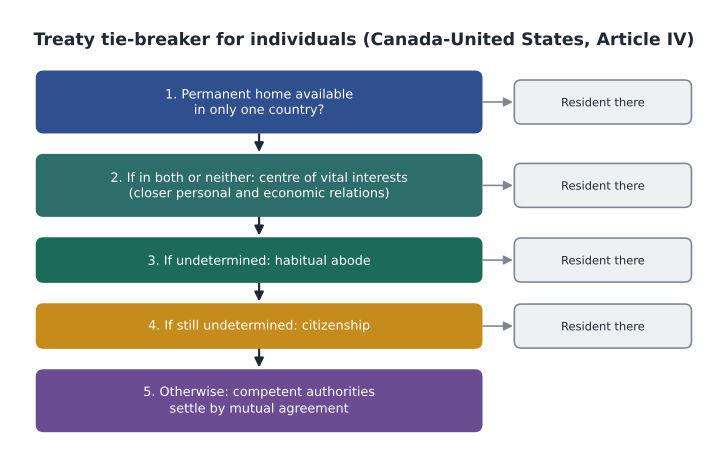
An individual can be resident in two countries at once under their domestic laws. Ingrid, during her first year in Houston, may well be resident in Canada under Thomson and resident in the United States because she meets the American substantial presence test. Tax treaties resolve dual residence through tie-breaker rules. Article IV of the Canada-United States Tax Convention, which follows the OECD model, asks a series of questions in order: where the person has a permanent home available; if in both, where the centre of vital interests is, meaning closer personal and economic relations; if that cannot be determined, where the person has an habitual abode; then citizenship; and finally, the competent authorities decide by mutual agreement.
Arjun Mehta works through Ingrid's first year. She has a permanent home available in Corwin, because the family house is kept for her, and she probably has one in Houston as well, if she rents an apartment on a long-term lease. The centre of vital interests is then decisive, and with her husband and children in Corwin and her assets in Canada, it points to Canada. She is resident in Canada for treaty purposes, so the United States may tax her Texas employment income as income from employment exercised there, and Canada gives a foreign tax credit for the American tax under section 126 and the treaty's relief article. Because Texas has no state income tax and American federal rates on her salary may be lower than combined Canadian rates, she may owe some additional Canadian tax.
Sophie Tremblay-Hart asks what happens to a dual resident who is resident in the United States under the tie-breaker. Petrakis answers that section 250(5) then deems the person non-resident of Canada for all purposes of the Act, and that the change of status triggers the departure tax under section 128.1(4), even if the person has not physically left. American citizens add another layer, because the United States taxes its citizens on worldwide income wherever they live; the treaty contains a saving clause preserving that right, and relief comes mainly through foreign tax credits on the American side.
Corporations
Section 250(4) deems a corporation incorporated in Canada after April 26, 1965 to be resident in Canada throughout the year. A corporation incorporated earlier is deemed resident if, at any time after that date, it was resident in Canada or carried on business in Canada. A corporation incorporated abroad is resident in Canada at common law if its central management and control is exercised here, under the test from De Beers Consolidated Mines Ltd. v. Howe, [1906] A.C. 455, in which a South African mining company was held resident in England because its directors' meetings, and the real control of the business, took place in London. The question is where the real business is carried on, which usually means where the board actually makes its decisions, not merely where it formally meets. Where a board is a rubber stamp for decisions made by a shareholder elsewhere, the residence may follow the place where the decisions are really made.
Lakeshore Furniture Co. Ltd., incorporated under the Ontario Business Corporations Act, is deemed resident in Canada by section 250(4), and its worldwide income is taxable here. If Claire Bellamy's online venture, Lakeshore Direct Inc., were to set up a subsidiary in Delaware to sell into the United States, the subsidiary would be a foreign affiliate whose active business income is generally taxed in the United States, while certain passive income would be taxable in Lakeshore Direct's hands as it is earned under the foreign accrual property income rules.
Trusts
For many years it was assumed that a trust was resident where its trustee resided. Fundy Settlement v. Canada, 2012 SCC 14, rejected that assumption. Two discretionary trusts had a corporate trustee in Barbados, St. Michael Trust Corp., and held shares of Canadian holding companies that they sold for a gain of more than 450 million dollars. They claimed an exemption under the Canada-Barbados treaty as Barbados residents. The Supreme Court unanimously held that the residence of a trust is determined by the same central management and control test that applies to corporations. On the facts found at trial, the Barbados trustee performed only administrative functions, and the real decisions about the trusts were made by Canadian-resident beneficiaries. The trusts were resident in Canada, and the treaty exemption did not apply.
Section 94 adds deeming rules that treat certain non-resident trusts as resident in Canada for some purposes where Canadian residents have contributed property to them, and section 104 and the trust reporting rules impose detailed filing obligations on trusts generally. These rules are covered in advanced courses, but the lesson of Fundy Settlement is general: a structure is respected for residence purposes only if decisions are really made where the documents say they are.
Non-residents and the buyer's obligation
Non-residents who sell taxable Canadian property must notify the CRA and obtain a clearance certificate under section 116. If they do not, the purchaser is liable for tax equal to 25 percent of the purchase price, or 50 percent for certain property such as depreciable property, and therefore withholds that amount from the purchase price. Real estate lawyers in Ontario deal with section 116 in every purchase from a seller who might be non-resident, and the purchaser's lawyer must make a reasonable inquiry about residence.
Non-residents who carry on business in Canada pay tax on the business income, subject to treaties, which generally allow Canada to tax business profits only if they are attributable to a permanent establishment in Canada, such as an office or a factory. Non-residents employed in Canada pay tax on their Canadian employment income, and employers must withhold, although treaties often exempt short-term assignments with low pay or a foreign employer that bears the cost.
The Indian Act exemption
Daniel Whitecloud raises a question from his years working in band administration. Section 87 of the Indian Act provides that the personal property of an Indian or a band situated on a reserve is exempt from taxation, and section 87 is incorporated into the Income Tax Act through section 81(1)(a), which excludes from income amounts declared exempt by another Act. Income is treated as personal property for this purpose, and the question is whether the income is situated on a reserve.
In Nowegijick v. The Queen, [1983] 1 S.C.R. 29, a status Indian living on a reserve worked as a logger off the reserve for a company whose head office was on the reserve. The Supreme Court held that his wages were exempt and stated that treaties and statutes relating to Indians should be liberally construed and doubtful expressions resolved in favour of the Indians. In Williams v. Canada, [1992] 1 S.C.R. 877, the Court replaced a simple residence-of-the-debtor test with a connecting factors test: courts identify the factors that connect the income to a reserve, such as the residence of the employer and employee, the place where the work is performed and the nature of the benefit, and weigh them in light of the purpose of the exemption, which is to protect property held by Indians on reserves from erosion by taxation. In Bastien Estate v. Canada, 2011 SCC 38, the Court held that interest earned on term deposits with a caisse populaire located on a reserve was exempt.
Daniel explains that, in practice, employment income is generally exempt where the employee lives on a reserve and the duties are performed on a reserve, and that employment for organizations based on a reserve whose activities benefit reserve communities is often exempt even where some work is done elsewhere, but that the analysis is fact-specific. 'The exemption is not a tax holiday for Indigenous people,' he says. 'It is narrow, it is tied to reserves, and a lot of First Nations people who live in cities pay full tax.' Petrakis adds that the CRA publishes guidelines for applying the connecting factors test to employment income, and that self-government agreements in some nations replace section 87 with a negotiated tax arrangement.
Common mistakes
MistakeAssuming that a Canadian citizen who works abroad stops paying Canadian tax.
InsteadResidence, not citizenship, is the connecting factor; a person who keeps significant residential ties in Canada remains resident and is taxed on worldwide income, with foreign tax credits.
MistakeApplying the 183-day sojourning rule to someone who moved to Canada partway through the year.
InsteadSection 250(1)(a) applies to sojourners who are not factually resident; a person who becomes resident during the year is a part-year resident under section 114.
MistakeForgetting the departure tax when a client emigrates.
InsteadSection 128.1(4) deems most property disposed of at fair market value on ceasing to be resident; Canadian real property and registered plans are among the exceptions.
MistakeTreating a trust as resident wherever its trustee lives.
InsteadFundy Settlement applies the central management and control test; where real decisions are made in Canada, the trust is resident here.
MistakeClosing a purchase from a non-resident seller without dealing with section 116.
InsteadObtain a clearance certificate or withhold, because the purchaser is otherwise liable for 25 percent (or 50 percent for some property) of the price.
Practice problems
Work each problem on paper first, then reveal the answer to check.
A retired Floridian spends five months a year at her Muskoka cottage and seven in Florida, where she has her home and family. Is she resident in Canada?
Show answer
She is probably not factually resident, because her significant ties are in Florida. Five months is fewer than 183 days, so she is not a deemed resident sojourner. If she stayed 183 days or more, section 250(1)(a) would deem her resident, and the treaty tie-breaker would then apply.
What did Fundy Settlement decide?
Show answer
The residence of a trust is determined by where its central management and control is actually exercised; the Barbados-trusteed trusts were resident in Canada because Canadian-resident beneficiaries made the real decisions, so the Barbados treaty exemption did not apply.
Why is Canadian real property excluded from the departure tax?
Show answer
It is taxable Canadian property, so Canada can tax a later gain on it under section 2(3) even after the owner becomes non-resident; there is no need to tax it on departure.
Under the Canada-United States treaty tie-breaker, what is the first question, and what comes next if it does not resolve residence?
Show answer
Where the person has a permanent home available; if both or neither, where the centre of vital interests (closer personal and economic relations) lies; then habitual abode, citizenship and mutual agreement.
What test does Williams v. Canada establish for section 87 of the Indian Act?
Show answer
A connecting factors test that identifies and weighs the factors connecting income to a reserve, in light of the purpose of protecting property held by Indians on reserves from taxation.
Summary and key terms
- Residents are taxed on worldwide income under section 2(1); non-residents are taxed on Canadian employment and business income and gains on taxable Canadian property, and Part XIII withholding applies to passive income.
- Factual residence turns on the degree to which a person settles into a mode of living in Canada (Thomson), with significant ties (home, spouse, dependants) carrying the most weight.
- Section 250 deems sojourners of 183 days or more and certain government personnel resident, and section 250(5) gives effect to treaty tie-breakers.
- Departure triggers a deemed disposition under section 128.1(4), with exceptions such as Canadian real property and registered plans; arrival steps up cost under section 128.1(1).
- Corporations incorporated in Canada after April 26, 1965 are deemed resident; foreign corporations and trusts are resident where central management and control is exercised (De Beers, Fundy Settlement).
- Section 87 of the Indian Act, applied through the connecting factors test in Williams, exempts income situated on a reserve.
- Factual residence
- Residence under the common law test, based on the person's ties to Canada.
- Sojourner
- A person temporarily present in Canada; 183 days or more of sojourning in a year triggers deemed residence.
- Departure tax
- The deemed disposition of property at fair market value when a taxpayer ceases to be resident.
- Central management and control
- The test for the residence of foreign corporations and of trusts: where the real decisions are made.
- Taxable Canadian property
- Property, such as Canadian real estate, that Canada taxes on disposition even when owned by a non-resident.
- Part XIII tax
- A flat 25 percent withholding tax on certain passive payments to non-residents, often reduced by treaty.
- Tie-breaker rule
- A treaty rule that assigns a dual-resident person to one country.
Lesson quiz · 5 questions
Score 60% or more to complete this lesson.
Create a free account to save your progress, take quizzes and earn a certificate.