
LAWC-301 · Lesson 1 of 12 · 32 min
The Income Tax Act: structure, sources and interpretation
▶ Video coming soon A video version of this lesson is on the way.
Professor Colm Petrakis walks into the Lister Room carrying a book so thick that he sets it down with both hands. It is a consolidated edition of the Income Tax Act and its regulations, more than two thousand pages of small print. 'Most of you have been told,' he says, 'that tax law is arithmetic. It is not. The arithmetic is the easy part. Tax law is the study of four questions, and I will ask them in every class until you ask them in your sleep.' He writes them on the board: Whose income? What kind? Which year? How much?
Petrakis spent fourteen years in the tax group of a Toronto firm and then five years as counsel with the federal Department of Justice, appearing for the Crown in the Tax Court of Canada, before joining the Brannock University Faculty of Law. He tells the third-year class that he has seen the same mistake from both sides of the courtroom. 'Lawyers who lose tax cases usually lose them in the first ten minutes of their research, because they read the section the client asked about and never read the definitions it depends on. Read the section, then read the definition section. Then read the section again.'
This lesson introduces the constitutional basis of income tax in Canada, the architecture of the Income Tax Act, the computation of income under section 3, the path from net income to tax payable, the sources of tax law beyond the statute, and the approach the Supreme Court of Canada takes to interpreting tax legislation.
The constitutional basis
The Constitution Act, 1867 gives both orders of government the power to tax income. Section 91(3) gives Parliament authority over 'the raising of money by any mode or system of taxation', which includes income tax. Section 92(2) gives the provinces authority over direct taxation within the province in order to raise revenue for provincial purposes. An income tax is the classic direct tax, because the person who pays it is the person who is meant to bear it. Income tax is therefore a shared field.
Parliament first imposed a federal income tax in 1917 as a temporary wartime measure, the Income War Tax Act. It was never repealed in substance, and after the Second World War the federal government and the provinces negotiated arrangements under which the provinces largely left personal and corporate income tax to Ottawa in exchange for payments. Those arrangements evolved into today's tax collection agreements. Under them, the Canada Revenue Agency administers and collects provincial personal income tax for every province except Quebec, and provincial corporate income tax for every province except Quebec and Alberta.
Ontario's personal and corporate income taxes are imposed by an Ontario statute, the Taxation Act, 2007, but they are calculated on the federal definition of taxable income and collected by the CRA on a single return. A resident of Corwin files one T1 return each spring and pays both federal and Ontario tax through it. Sophie Tremblay-Hart, who grew up in Gatineau, points out that her parents file two returns: a federal return with the CRA and a Quebec return with Revenu Québec under Quebec's own Taxation Act. Petrakis nods. 'Quebec runs its own personal income tax system. The concepts are close to the federal ones, and Quebec usually harmonizes, but the statute, the administration and the case law are separate. If you practise in Montreal, you will learn two acts.'
The architecture of the Act
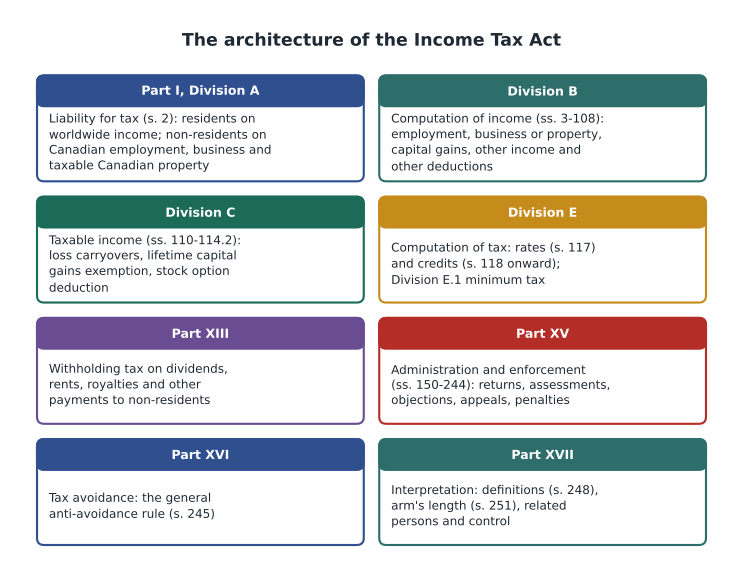
The Income Tax Act, R.S.C. 1985, c. 1 (5th Supp.), is organized into Parts, and Part I, which imposes the basic income tax, is divided into Divisions. Students who understand the architecture can find their way through any provision, because every section sits somewhere in a logical sequence that runs from liability, to computation of income, to taxable income, to tax.
Division A, consisting of section 2, imposes liability. Section 2(1) provides that an income tax shall be paid on the taxable income for each taxation year of every person resident in Canada at any time in the year. Section 2(3) extends tax to non-residents who were employed in Canada, carried on business in Canada, or disposed of taxable Canadian property. Residence is the subject of lesson 3. 'Person' is defined broadly in section 248(1) to include corporations, and section 104(2) treats a trust as an individual for most purposes.
Division B, running from section 3 to section 108, computes income. It contains subdivision a (income or loss from an office or employment), subdivision b (income or loss from a business or property), subdivision c (taxable capital gains and allowable capital losses), subdivision d (other sources of income, such as pensions, support payments and retiring allowances), and subdivision e (other deductions, such as registered retirement savings plan contributions, child care expenses and moving expenses). Later subdivisions deal with special rules for particular situations, deferred income plans, corporations and their shareholders, partnerships and trusts.
Division C, from section 110 to section 114.2, converts net income into taxable income by allowing further deductions that are not related to computing income from a particular source: loss carryovers under section 111, the lifetime capital gains exemption under section 110.6, the employee stock option deduction under section 110(1)(d) and the deduction for intercorporate dividends under section 112. Division D deals with non-residents' taxable income earned in Canada. Division E computes tax: section 117 sets the federal rates, and sections 118 onward provide credits that reduce tax, such as the basic personal amount, the age amount, the charitable donations credit and the tuition credit. Division E.1 contains the alternative minimum tax.
Outside Part I, three Parts matter in almost every file. Part XV, from section 150 to section 244, deals with administration and enforcement: returns, assessments, objections, appeals, collection, audits, penalties and offences. Part XVI contains the general anti-avoidance rule in section 245. Part XVII contains the interpretation provisions, including the long list of definitions in section 248(1), the rules on arm's length dealing in section 251 and the definition of control and related persons. Part XIII imposes a flat withholding tax on certain payments to non-residents, such as dividends and royalties.
The Act is supported by the Income Tax Regulations, made under section 221, which contain the capital cost allowance classes, the prescribed interest rate, rules for payroll withholding and much else. Canada's tax treaties, more than ninety of them, are given force of law by statute, and the Income Tax Conventions Interpretation Act governs their interaction with the domestic Act.
Section 3: the computation of income
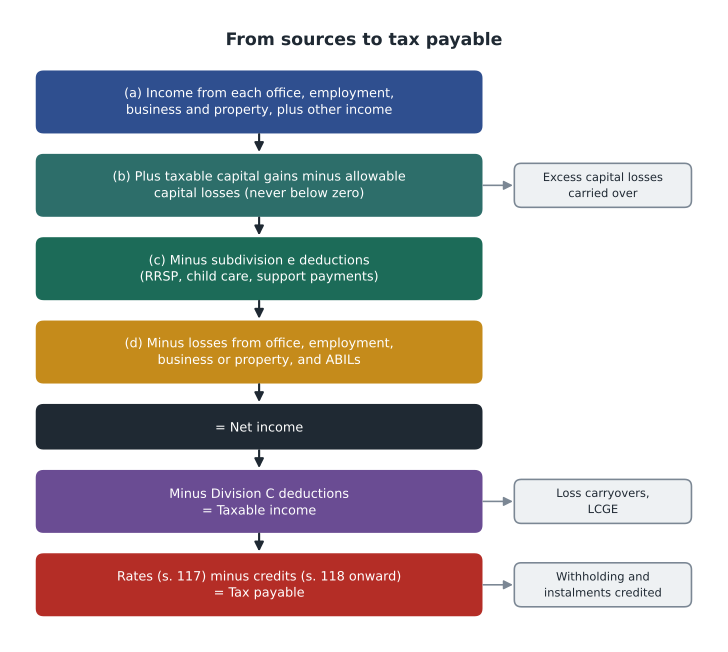
Section 3 is the engine of Division B. Petrakis asks Arjun Mehta, who is known for his flowcharts, to read it aloud and turn it into steps. Arjun's version goes on the board.
Paragraph 3(a) adds up the taxpayer's income for the year from each office, employment, business and property, together with other income listed in subdivision d. The word 'each' matters: income is computed source by source. A taxpayer who has a salary, a rental property and a consulting business computes three separate amounts. Paragraph 3(b) adds the amount by which taxable capital gains exceed allowable capital losses for the year, and if the losses exceed the gains, the result is zero rather than a negative number. Capital losses can only shelter capital gains. Paragraph 3(c) subtracts the deductions permitted by subdivision e. Paragraph 3(d) subtracts losses for the year from an office, employment, business or property, and allowable business investment losses. The result is the taxpayer's income for the year, usually called net income.
Two features of section 3 shape the whole subject. First, the source concept. Section 3(a) begins with the words 'income for the year from a source inside or outside Canada, including, without restricting the generality of the foregoing,' and then lists the four named sources. The Supreme Court has said that the list is open in principle, but in practice courts have been reluctant to find income from an unnamed source. Receipts that are not from any source, such as gifts, inheritances, most lottery winnings and windfalls, are generally not income at all. The Canadian system therefore taxes income from recognized sources, not every increase in wealth.
Second, the treatment of losses. A loss from a business or property can reduce income from other sources, including employment income, through paragraph 3(d). This is why governments and courts care so much about whether an activity is really a business: a hobby that loses money cannot reduce tax on a salary, but a business that loses money can. Stewart v. Canada, 2002 SCC 46, which governs this question, is the subject of lesson 5.
From net income to tax payable
Net income is not the end of the calculation. Division C deductions produce taxable income. The rates in section 117 apply to taxable income. Credits under sections 118 to 118.95 reduce the tax calculated, generally by multiplying an amount by the lowest federal rate. Ontario applies its own rates and credits to the same taxable income, and adds a surtax on high levels of provincial tax. The amounts withheld at source by employers, and any instalments paid, are then credited against the total, and the taxpayer either pays the balance or receives a refund.
Petrakis distinguishes deductions from credits with an example. A deduction reduces taxable income, so its value depends on the taxpayer's marginal rate: a one thousand dollar deduction saves much more for a taxpayer in the top bracket than for one in the lowest bracket. A non-refundable credit reduces tax by the same amount for every taxpayer who has enough tax to absorb it, but is worthless to someone with no tax payable. A refundable credit, such as the Canada child benefit or the GST/HST credit, is paid even to people with no tax. Choosing between deductions and credits is a policy choice about who should benefit, which is the subject of lesson 2.
The taxation year and the taxpayer
Two of Petrakis's four questions are about the frame of the calculation rather than its content. Whose income? Income tax is levied on persons, and the individual, not the family, is the unit of taxation in Canada. A married couple files two returns, and the attribution rules discussed in lesson 8 stop couples from shifting income from the higher earner to the lower earner simply by moving assets. Corporations are separate taxpayers from their shareholders, and trusts are taxed as individuals. Which year? Section 249 makes an individual's taxation year the calendar year, while a corporation chooses a fiscal period of up to fifty-three weeks. Timing rules determine whether income falls into one year or the next, and much tax planning consists of deferring income or accelerating deductions.
Theo Marchetti, who spent ten years as a litigation law clerk before law school, asks whether this means the same dollar can be taxed differently depending on which year it lands in. 'It can,' Petrakis says. 'Rates change, credits change, and a taxpayer's other income changes. That is why timing is half of tax planning, and why a reassessment that moves an amount from one year to another can produce interest and penalties even when the total income over the years is unchanged.'
Sources of tax law beyond the statute
The Act and the Regulations are the law. Several other sources are important in practice, and students need to know their weight.
Case law. Tax appeals are heard first by the Tax Court of Canada, then by the Federal Court of Appeal, and occasionally by the Supreme Court of Canada with leave. Tax Court decisions in the general procedure are precedents, though not binding on other Tax Court judges; decisions under the informal procedure are not precedents at all. The Federal Court of Appeal binds the Tax Court. The Supreme Court of Canada decides only a handful of tax cases a decade, but each one shapes the field.
Administrative publications. The CRA publishes income tax folios, which have largely replaced the older interpretation bulletins, together with information circulars, guides and forms. It also issues advance income tax rulings, which bind the CRA on a proposed transaction for the taxpayer who requested the ruling, and technical interpretations, which do not bind anyone. Administrative publications are not law, and courts are not bound by them. In Nowegijick v. The Queen, [1983] 1 S.C.R. 29, the Supreme Court said that administrative policy and interpretation are not determinative but are entitled to weight and can be an important factor in case of doubt about the meaning of legislation. In practice, a lawyer who advises a client to take a position contrary to a published CRA view must tell the client that an audit and a dispute are likely.
Draft legislation and budgets. Canada has a long practice of announcing tax changes in a federal budget, releasing draft legislation and applying the changes from the announcement date even before Parliament enacts them. Taxpayers generally file on the basis of announced measures, and the CRA generally administers them that way. A measure is not law, however, until it is enacted, and some announced measures never are. The proposed increase in the capital gains inclusion rate, announced in 2024 and cancelled in March 2025, is the leading recent example, discussed in lessons 2 and 7. Federal Budget 2026, tabled on November 5, 2026, contains a new set of proposals, including a later filing deadline for individuals, which remain proposals until enacted.
Tax treaties. A treaty can override the Act's charge to tax for a particular taxpayer, for example by limiting the rate of withholding tax on dividends or by assigning residence to one country. Treaties do not impose tax; they relieve it.
Interpreting tax legislation
For much of the twentieth century, Canadian courts interpreted tax statutes strictly. The English principle was that a taxpayer could be taxed only if the words of the statute clearly applied, and that a taxpayer was entitled to arrange affairs to minimize tax. In Commissioners of Inland Revenue v. Duke of Westminster, [1936] A.C. 1, the House of Lords upheld an arrangement under which the Duke paid his household staff through deeds of covenant rather than wages, which made the payments deductible. Lord Tomlin's statement that every person is entitled, if he can, to order his affairs so that the tax attaching under the appropriate Acts is less than it otherwise would be, has been quoted in Canadian tax cases ever since.
The modern Canadian approach begins with Stubart Investments Ltd. v. The Queen, [1984] 1 S.C.R. 536. A profitable company sold its business to a sister company with accumulated losses, which then carried on the business as the profitable company's agent, so that the profits could be sheltered by the losses. The Minister argued that the transaction lacked a business purpose and should be disregarded. The Supreme Court, in reasons by Justice Estey, rejected a general business purpose test: a transaction is not invalid for tax purposes merely because it was undertaken to save tax. At the same time, the Court abandoned strict construction and adopted Elmer Driedger's modern principle, under which the words of an Act are read in their entire context, in their grammatical and ordinary sense, harmoniously with the scheme of the Act, its object and the intention of Parliament. Parliament responded to Stubart by enacting the general anti-avoidance rule in 1988, discussed in lesson 10.
In Shell Canada Ltd. v. Canada, [1999] 3 S.C.R. 622, Shell borrowed New Zealand dollars at a high interest rate and immediately converted them into American dollars, a currency with lower interest rates, under a forward contract. The arrangement produced large deductible interest payments and a capital gain on the currency exchange. The Minister argued that the economic reality was a borrowing of American dollars and that only the lower American interest rate should be deductible. The Supreme Court disagreed. Absent a specific provision to the contrary or a finding of sham, the taxpayer's legal relationships must be respected; the economic realities of a situation cannot be used to recharacterize a bona fide legal relationship. Petrakis writes his second catchphrase on the board: 'Tax follows the legal relationship.'
Canada Trustco Mortgage Co. v. Canada, 2005 SCC 54, states the approach that governs today. The interpretation of a provision of the Income Tax Act must be textual, contextual and purposive, seeking a meaning that is harmonious with the Act as a whole. Where the words are precise and unequivocal, their ordinary meaning plays a dominant role. Where the words can support more than one reasonable meaning, their ordinary meaning plays a lesser role. Because the Act is detailed and complex, and because taxpayers are entitled to rely on it to plan their affairs, the text usually carries significant weight in tax cases.
Two more interpretive principles appear regularly. First, a residual presumption in favour of the taxpayer: where, after applying the ordinary rules of interpretation, a genuine doubt remains about the meaning of a provision, the doubt is resolved in the taxpayer's favour. The Supreme Court applied this principle in Johns-Manville Canada Inc. v. The Queen, [1985] 2 S.C.R. 46, which is discussed in lesson 6. It is a last resort, not a starting point. Second, in cases involving the tax exemption in section 87 of the Indian Act, Nowegijick held that treaties and statutes relating to Indigenous peoples should be liberally construed and doubtful expressions resolved in their favour. That principle is discussed with the exemption in lesson 3.
Sham is the main exception to the rule that legal relationships govern. A sham exists where the parties create documents or transactions that give a false impression of their legal rights and obligations, intending to deceive the tax authority. A transaction that the parties intend to have real legal effect is not a sham merely because it was tax-motivated. Petrakis is emphatic on this point. 'Planning is lawful. Pretending is not. A taxpayer who actually does what the documents say is planning, and the question is whether the Act applies. A taxpayer whose documents say one thing while the real arrangement is another is pretending, and that leads to reassessment, penalties and sometimes prosecution.'
The files we will follow
Petrakis introduces two files that run through the course. The first is familiar to the class from business associations: the Bellamy family and Lakeshore Furniture Co. Ltd., an Ontario corporation owned mostly by Margot Bellamy, with shares held by her children Claire and Simon and non-voting shares held by the production manager, Raj Gill. 'Professor Okwuosa taught you the corporate law of that file. I will teach you the tax law, which is what the family actually worries about.' The Lakeshore file will raise questions about salaries and bonuses, dividends, shareholder benefits, the redemption of shares, the dismissal of an employee and the sale of the business.
The second file is new. Ingrid Solberg, a petroleum engineer who grew up in Corwin, has accepted a three-year posting in Houston with her employer's American affiliate. Her husband and their two children will stay in Corwin until the school year ends, and the family plans to keep their house. She wants to know where she will pay tax, whether she will pay tax twice, what happens to her investments and her house when she leaves, and what changes if she stays in Texas permanently. Her file will anchor the lesson on residence.
Worked problem
Reading section 3 for a mixed-income taxpayer
Ingrid Solberg's tax year before her move has these amounts: salary of 160,000 dollars; net rental income of 6,000 dollars from a basement apartment; a loss of 9,000 dollars from a small consulting business she started on weekends; a taxable capital gain of 4,000 dollars on shares; an allowable capital loss of 7,000 dollars on other shares; and an RRSP deduction of 15,000 dollars. Apply section 3 and identify what happens to each amount.
Show solution
- Paragraph 3(a): add income from each source with positive income. Employment income is 160,000 dollars and property income from the apartment is 6,000 dollars, for 166,000 dollars. The consulting business has a loss, which is dealt with under paragraph 3(d), not netted inside paragraph 3(a).
- Paragraph 3(b): taxable capital gains of 4,000 dollars minus allowable capital losses of 7,000 dollars is negative, so the paragraph contributes zero. The 3,000 dollar excess of losses is not lost; it becomes part of a net capital loss that can be carried back three years or forward indefinitely against taxable capital gains under section 111(1)(b).
- Paragraph 3(c): subtract the subdivision e deduction for the RRSP contribution of 15,000 dollars, leaving 151,000 dollars.
- Paragraph 3(d): subtract the business loss of 9,000 dollars, leaving net income of 142,000 dollars, provided the consulting activity is a genuine source of business income under Stewart. If it were a personal hobby, the loss would not be deductible at all.
- Division C and beyond: if Ingrid has a net capital loss carried forward from an earlier year, she may deduct it in computing taxable income only to the extent of the year's taxable capital gains. Tax is then calculated at the federal and Ontario rates and reduced by credits, and the tax withheld by her employer is credited.
Why the structure matters
The class spends the last part of the hour on a practical point. Most tax questions reach a lawyer as questions about a transaction or a payment: a client has received a settlement, is selling a cottage, wants to pay a child, or has been told by an accountant that a structure will save tax. Petrakis insists that the answer always begins with the frame. Whose income is it, given the attribution rules and the separate existence of corporations and trusts? What kind of income is it, given that employment income, business income, property income and capital gains are taxed in very different ways? Which year does it fall into? And only then, how much?
Hannah Kowalczyk, who worked in an oil and gas regulatory office before law school, asks why the Act is so long when the basic idea seems simple. Petrakis answers with a sentence he says he learned from a judge of the Federal Court of Appeal: complexity in a tax statute is the price of trying to be fair to millions of people in millions of different situations, and of trying to stop the few who would exploit any gap. 'Every page of this book,' he says, tapping the consolidation, 'is either a rule that tries to measure income accurately, a rule that gives someone a deliberate break, or a rule that closes a door someone else walked through. When you meet a provision, ask which of the three it is.'
Common mistakes
MistakeReading a charging provision without checking the defined terms it uses.
InsteadRead section 248(1) and any specific definitions; words like "business", "property", "taxable Canadian property" and "principal residence" have statutory meanings that differ from ordinary speech.
MistakeNetting a business loss against business income from another source inside paragraph 3(a).
InsteadIncome is computed source by source; losses from a source enter the computation under paragraph 3(d), and capital losses can only offset capital gains under paragraph 3(b).
MistakeTreating a CRA folio or technical interpretation as binding law.
InsteadAdministrative publications are entitled to weight in case of doubt (Nowegijick), but only the Act, the Regulations, treaties and case law bind the courts.
MistakeArguing that a transaction should be ignored because it has no business purpose apart from saving tax.
InsteadStubart rejected a general business purpose test; the question is what the Act provides, subject to sham, specific anti-avoidance rules and the GAAR.
MistakeRelying on an announced budget measure as if it were law.
InsteadAnnounced measures are often administered from their effective date, but they are not law until enacted, and some (such as the 2024 inclusion rate increase) are withdrawn.
Practice problems
Work each problem on paper first, then reveal the answer to check.
Which constitutional provisions allow both Parliament and Ontario to impose income tax?
Show answer
Section 91(3) of the Constitution Act, 1867 (raising money by any mode or system of taxation) for Parliament, and section 92(2) (direct taxation within the province for provincial purposes) for the provinces. Income tax is a direct tax, so the field is shared.
A taxpayer has 20,000 dollars of taxable capital gains and 30,000 dollars of allowable capital losses in a year. What does paragraph 3(b) contribute, and what happens to the excess?
Show answer
Zero. The 10,000 dollar excess becomes part of a net capital loss that may be carried back three years or forward indefinitely and deducted under section 111(1)(b) against taxable capital gains of those years.
What did Shell Canada decide about economic substance?
Show answer
Absent a specific provision or a sham, the taxpayer's bona fide legal relationships must be respected; economic realities cannot be used to recharacterize them. Shell could deduct the interest actually paid on its New Zealand dollar borrowing.
When does the residual presumption in favour of the taxpayer apply?
Show answer
Only where a genuine, reasonable doubt about the meaning of a provision remains after the textual, contextual and purposive analysis; it is a last resort (Johns-Manville).
Why does the distinction between a deduction and a non-refundable credit matter for policy?
Show answer
A deduction is worth more to taxpayers with higher marginal rates; a non-refundable credit gives the same value to everyone with enough tax to use it and nothing to those with no tax; a refundable credit reaches people with no tax at all.
Summary and key terms
- Income tax is a shared field under sections 91(3) and 92(2) of the Constitution Act, 1867; the CRA collects Ontario income tax with federal tax, while Quebec administers its own personal income tax.
- Part I of the Act moves from liability (Division A) to computation of income (Division B), taxable income (Division C) and tax (Division E); Parts XV, XVI and XVII cover administration, avoidance and interpretation.
- Section 3 computes income source by source, confines capital losses to capital gains and allows other losses to reduce income from all sources.
- Stubart rejected a business purpose test and adopted the modern principle; Shell Canada held that legal relationships govern absent sham or specific provision; Canada Trustco requires a textual, contextual and purposive reading.
- Every tax problem begins with four questions: whose income, what kind, which year and how much.
- Source
- An office, employment, business or property (or other listed item) from which income arises; receipts with no source, such as gifts and windfalls, are generally not income.
- Net income
- The result of the section 3 computation, before Division C deductions.
- Taxable income
- Net income minus Division C deductions such as loss carryovers and the lifetime capital gains exemption.
- Non-refundable credit
- An amount that reduces tax payable but cannot reduce it below zero.
- Advance income tax ruling
- A binding statement by the CRA of how it will treat a specific proposed transaction for the taxpayer who requested it.
- Modern principle
- Driedger's rule that statutory words are read in context, in their ordinary sense, harmoniously with the scheme and object of the Act.
- Sham
- A transaction or document that gives a false impression of the parties' real legal rights and obligations, intended to deceive.
Lesson quiz · 5 questions
Score 60% or more to complete this lesson.
Create a free account to save your progress, take quizzes and earn a certificate.