
LAWC-301 · Lesson 8 of 12 · 26 min
Families and individuals: attribution, income splitting, support and credits
▶ Video coming soon A video version of this lesson is on the way.
Petrakis begins with a simple arithmetic exercise. A married couple has one earner with taxable income of 240,000 dollars and one with no income. If the earner could shift 120,000 dollars of income to the other spouse, the family's total tax would fall by tens of thousands of dollars a year, because each spouse would use the lower brackets and the personal credits. 'Progressive rates plus the individual as the taxpaying unit equals a permanent incentive to split income,' he says. 'Most of today's lesson is about the rules Parliament has built to stop it, and the few places where it lets families do it.'
This lesson covers the attribution rules, the tax on split income, the rules for transfers between spouses, support payments on marriage breakdown, the main personal credits and benefits, and the taxation of individuals at death. It connects to family law and to wills and estates, which the class took in second year.
Why the individual is the unit
As lesson 2 explained, Canada rejected the Carter Commission's proposal to tax the family as a unit. Each individual files a return and pays tax at graduated rates on their own income. Many credits and benefits, however, are calculated using family income, including the Canada child benefit, the GST/HST credit and the spouse or common-law partner amount, so the system is a hybrid. 'Spouse' and 'common-law partner' are defined broadly: a common-law partner is a person who cohabits with the taxpayer in a conjugal relationship and either has done so for a continuous period of at least twelve months or is a parent of the taxpayer's child, a definition that applies to same-sex and opposite-sex couples alike.
The attribution rules
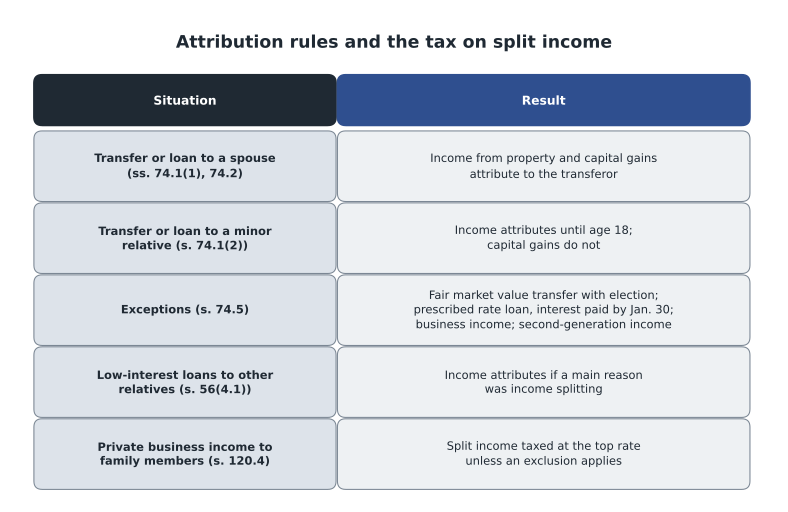
Section 74.1(1) provides that where an individual transfers or lends property, directly or indirectly, to or for the benefit of a spouse or common-law partner, or a person who has since become one, any income or loss from the property, or from property substituted for it, is deemed to be the transferor's income or loss and not the transferee's, while the transferor is resident in Canada and the couple is not living separate and apart because of a breakdown of the relationship. Section 74.2 does the same for taxable capital gains and allowable capital losses on the disposition of the property.
Section 74.1(2) applies to transfers and loans to a person under eighteen who does not deal at arm's length with the individual, which includes the individual's children and grandchildren, or who is a niece or nephew. Income from the property, but not capital gains, attributes to the transferor until the year the child turns eighteen. This is why families commonly give minor children assets expected to grow rather than assets that pay income, and why gains on growth investments held for minors are taxed in the children's hands.
The rules apply only to income from property and capital gains. Business income earned by the spouse or child using transferred property is not attributed, although section 96(1.8) and other rules can catch income from a partnership in which the spouse is not actively engaged. Second-generation income, meaning income earned on income that was itself attributed, is not attributed, so a spouse who receives dividends that attribute to the transferor can reinvest the dividends and earn non-attributed income on them.
Section 74.5 sets out the main exceptions. Attribution does not apply to a transfer for consideration equal to fair market value, if the transferor elects out of the automatic spousal rollover in section 73 so that any accrued gain is taxed on the transfer. It does not apply to a loan that bears interest at a rate at least equal to the lesser of the prescribed rate in effect when the loan was made and an arm's length rate, if the interest for each year is actually paid no later than thirty days after the end of the year, that is, by January 30. A prescribed rate loan locks in the prescribed rate for the life of the loan, so a couple who made such a loan when the prescribed rate was 1 percent could keep it at 1 percent indefinitely, which made these loans a popular planning tool during periods of low rates. Section 74.5(3) also turns off attribution once spouses are living separate and apart because of a breakdown of their relationship, for income, and on a joint election for gains.
Section 56(4.1) extends attribution to low-interest or interest-free loans to other non-arm's length individuals, such as adult children, if one of the main reasons for the loan was to reduce tax by having income from the loaned property included in the borrower's income. Gifts to adult children are not caught, which is why parents often give adult children money outright rather than lending it.
Theo Marchetti asks what happens if a spouse transfers property to a corporation of which the other spouse is a shareholder. Petrakis answers that section 74.4 can deem the transferor to receive interest at the prescribed rate on the transferred property, unless the corporation is a small business corporation, a common reason for ensuring that family holding companies are structured carefully.
Lipson and the limits of planning
The attribution rules can sometimes produce an unexpected tax benefit, and that is when the general anti-avoidance rule appears. In Lipson v. Canada, 2009 SCC 1, Mrs. Lipson borrowed money from a bank to buy shares from her husband at fair market value. The couple then took out a mortgage to repay the bank loan and used the money from the sale of shares to buy their house. Because Mr. Lipson had not elected out of the section 73 rollover, the attribution rules deemed the dividends on the shares and the interest expense on the borrowing to be his, so the interest deduction reduced his income, which was taxed at a higher rate. The Supreme Court, by a majority, held that the use of the attribution rules to allow the higher-income spouse to deduct the interest was a misuse that frustrated their purpose, which is to prevent spouses from reducing tax by shifting income, not to let them shift deductions to the spouse who benefits more. The general anti-avoidance rule applied to deny the tax benefit. Lesson 10 returns to this case.
The tax on split income
Before 2018, private corporations were the main vehicle for income splitting. A business owner could issue shares to a spouse and adult children and pay them dividends, which are not subject to the attribution rules. In Neuman v. Minister of National Revenue, [1998] 1 S.C.R. 770, the Supreme Court held that section 56(2), which taxes a payment made at the direction of a taxpayer to another person, did not apply to dividends paid on a spouse's shares, even though the spouse had contributed nothing to the company. Dividends to family members were a legitimate return on share ownership.
Parliament responded in stages. In 2000 it introduced the 'kiddie tax' in section 120.4, taxing certain dividends and other private company income received by minors at the top marginal rate. From the 2018 taxation year, it extended the tax on split income to adults. Split income includes dividends from private corporations, certain interest and capital gains, and income from partnerships and trusts that derive from a related business, and it is taxed at the top rate with no personal credits other than the dividend tax credit and certain others. The rules then provide excluded amounts, which are taxed normally. The main exclusions are: amounts received by a person who has been actively engaged in the business on a regular, continuous and substantial basis in the year or any five prior years, with a bright line of an average of twenty hours a week; amounts from excluded shares owned by a person aged twenty-five or more who holds at least 10 percent of the votes and value of a corporation that is not a professional corporation and earns less than 90 percent of its business income from services; amounts received by the spouse of an owner who is sixty-five or older, if the amount would have been excluded in the owner's hands; and a reasonable return for persons aged eighteen to twenty-four, based on their capital contribution and risk.
Petrakis asks Sophie Tremblay-Hart to apply the rules to the Lakeshore family. Margot is the active owner, so her dividends are excluded. Claire, vice-president of design, has worked in the business for years, so dividends on her shares are excluded under the active engagement test. Simon was sales manager for eleven years, so his dividends are excluded too, even after his dismissal, because the five-prior-years rule looks back. Raj Gill is not related to the Bellamys and is outside the regime. If Margot were to issue shares to her nineteen-year-old grandchild through a family trust, dividends would be split income taxed at the top rate unless the grandchild contributed capital or worked in the business.
Transfers between spouses
Section 73(1) provides an automatic rollover for capital property transferred to a spouse or common-law partner, or to a spousal trust, during their lives: the transferor is deemed to dispose of the property at its adjusted cost base, or undepreciated capital cost for depreciable property, and the transferee takes over that cost. The transferor can elect out of the rollover and transfer at fair market value instead, which is needed for the fair market value exception to attribution. Section 73(1) also applies to transfers to a former spouse in settlement of rights arising out of the marriage or partnership. Section 70(6) provides a similar rollover on death.
Support payments
When spouses separate, the tax treatment of support depends on its nature. Periodic spousal support paid under a written agreement or court order while the parties live separate and apart is deductible by the payer under section 60(b) and included in the recipient's income under section 56(1)(b). The amount must be payable on a periodic basis, for the maintenance of the recipient, and the recipient must have discretion over its use, although section 60.1 extends the rules to certain third-party payments, such as mortgage payments, if the agreement says so.
Child support is treated differently. For agreements and orders made after April 1997, child support is neither deductible by the payer nor taxable to the recipient. The change followed Thibaudeau v. Canada, [1995] 2 S.C.R. 627, in which a separated mother argued that including child support in her income discriminated against her under section 15 of the Charter. The Supreme Court rejected the claim, reasoning that the family law system was expected to adjust support amounts for tax, but Parliament changed the rule in 1997, at the same time as the Federal Child Support Guidelines were introduced. Where an agreement or order does not identify an amount as spousal support, the whole amount is treated as child support under the definitions in section 56.1(4). Family lawyers draft support provisions carefully for this reason.
Lump sum payments and property division payments are neither deductible nor taxable, because they are not periodic maintenance. Equalization payments under Ontario's Family Law Act are property payments, not support. Legal fees to obtain or enforce support are deductible by the recipient; legal fees to reduce or resist support are not deductible by the payer, under a longstanding CRA position.
Credits and benefits for individuals
Most personal tax relief comes through credits. The basic personal amount, under section 118(1)(c), is enhanced for lower and middle incomes and phased down for high incomes. The spouse or common-law partner amount and the eligible dependant amount, commonly used by single parents, provide equivalent relief for a dependent spouse or child. The age amount and the pension income amount help seniors. The disability tax credit under section 118.3 is available for a severe and prolonged impairment certified by a medical practitioner and is the gateway to the registered disability savings plan. The medical expense credit under section 118.2 covers expenses above a threshold. The charitable donations credit under section 118.1 is calculated at the lowest rate on the first 200 dollars and at 29 percent above that, or 33 percent for donations by top-bracket taxpayers to the extent of income in the top bracket. Tuition fees generate a credit under section 118.5 that students can carry forward or transfer to a parent within limits.
Refundable benefits deliver support to people with little or no tax. The Canada child benefit under sections 122.6 to 122.63 is paid monthly to the primary caregiver of children under eighteen and is reduced as adjusted family net income rises. The GST/HST credit and the Canada workers benefit are also refundable. Pension income splitting under section 60.03 lets a taxpayer allocate up to half of eligible pension income to a spouse, an exception to the general policy against income splitting introduced in 2007. Registered retirement savings plans, tax-free savings accounts and, since 2023, first home savings accounts provide deductions, deferral and exemption for savings.
Daniel Whitecloud notes how often people miss benefits by not filing. A person with no income still needs to file to receive the Canada child benefit and the GST/HST credit, and clinics in Corwin run free tax clinics each spring for that reason. Federal Budget 2026 includes proposals to make the Canada caregiver credit refundable from 2027, which would extend it to caregivers with little income; it is a proposal until enacted.
Death
The terminal return is filed for the year of death. Section 70(5) deems the deceased to dispose of capital property at fair market value immediately before death, which is how Canada taxes accrued gains in the absence of an estate tax. Section 70(6) defers the gain on property left to a spouse, a common-law partner or a qualifying spousal trust, which takes the deceased's cost. Registered retirement savings plans and registered retirement income funds are fully included in the terminal return unless they pass to a spouse or, in some cases, a financially dependent child or grandchild. Several optional 'rights or things' and business income returns allow certain income to be taxed separately with additional credits.
After death, the estate is a trust. Since 2016, an estate may qualify as a graduated rate estate for up to thirty-six months after death, which is taxed at graduated rates, can choose a non-calendar year end and can carry back losses and donations to the terminal return. After thirty-six months, the estate is taxed at the top rate on retained income. Section 159 makes the legal representative personally liable for the deceased's and the estate's unpaid tax to the extent of property distributed without a clearance certificate, which is why estate trustees obtain one before final distribution. Students who followed the Holloway estate in wills and estates will recognize these steps.
Worked problem
The Solberg family's investments
Before leaving for Houston, Ingrid Solberg earns 160,000 dollars and her husband Mats earns 45,000 dollars. Ingrid has 200,000 dollars in a non-registered investment account. She asks whether she can (a) give the account to Mats, (b) lend it to him at no interest, (c) lend it at the prescribed rate, or (d) give 20,000 dollars each to their children, aged eleven and eight, to invest in growth shares. What are the tax results?
Show solution
- (a) A gift to a spouse rolls over at cost under section 73(1), and sections 74.1(1) and 74.2 attribute all income and capital gains back to Ingrid while they are married, living together and she is resident in Canada. No tax saving.
- (b) An interest-free loan is also caught by section 74.1(1): all income and gains attribute to Ingrid.
- (c) A prescribed rate loan escapes attribution under section 74.5(2) if Mats pays interest at the prescribed rate in effect when the loan is made by January 30 of each following year. Mats includes the investment income and deducts the interest; Ingrid includes the interest. The family saves tax on the spread between the investment return and the prescribed rate, at the difference between their marginal rates.
- (d) Gifts to minor children: income from property such as interest and dividends attributes to Ingrid until each child turns eighteen, but capital gains on the growth shares are taxed to the children, who have little or no other income. This is the common approach for growth investments held for minors.
- If Ingrid becomes non-resident, attribution under section 74.1 stops for income earned while she is non-resident, but her departure has its own consequences under section 128.1.
Common mistakes
MistakeAssuming a gift to an adult child is subject to attribution.
InsteadSections 74.1 and 74.2 apply to spouses and minors; gifts to adult children are not attributed, although low-interest loans may be caught by section 56(4.1).
MistakeForgetting to pay prescribed rate loan interest by January 30.
InsteadIf the interest for any year is paid late, the section 74.5(2) exception is lost for that year and every later year.
MistakeRelying on Neuman to pay dividends to adult family members who do not work in the business.
InsteadSince 2018, such dividends are generally split income taxed at the top rate under section 120.4 unless an exclusion applies.
MistakeDrafting a separation agreement that lumps spousal and child support together.
InsteadAn undifferentiated amount is treated as child support, so none of it is deductible.
MistakeDistributing an estate without a clearance certificate.
InsteadSection 159 makes the legal representative personally liable for unpaid tax to the extent of property distributed.
Practice problems
Work each problem on paper first, then reveal the answer to check.
Do capital gains on property given to a minor child attribute back to the parent?
Show answer
No. Section 74.1(2) attributes income from property to the transferor until the child turns eighteen, but section 74.2 applies only to spouses, so capital gains are taxed to the child.
What did Neuman decide, and how did Parliament respond?
Show answer
Neuman held that section 56(2) did not apply to dividends paid on a spouse's shares. Parliament introduced the tax on minors' split income in 2000 and extended the tax on split income to adults from 2018.
Name two excluded amounts under the tax on split income.
Show answer
Amounts received by a person actively engaged in the business on a regular, continuous and substantial basis in the year or any five prior years (twenty hours a week bright line); amounts on excluded shares held by persons aged twenty-five or more owning at least 10 percent of votes and value of a non-service, non-professional corporation.
How is periodic spousal support taxed?
Show answer
Deductible by the payer under section 60(b) and included by the recipient under section 56(1)(b), if paid under a written agreement or court order while living separate and apart.
What is a graduated rate estate?
Show answer
An estate that qualifies for up to thirty-six months after death for graduated tax rates, a flexible year end and carrybacks to the terminal return.
Summary and key terms
- The individual is the taxpaying unit, so progressive rates create incentives to split income within families.
- Sections 74.1 and 74.2 attribute income and gains from property transferred or lent to a spouse, and income (not gains) from property transferred to minors; section 74.5 provides fair market value and prescribed rate loan exceptions.
- Lipson applied the general anti-avoidance rule to a use of the attribution rules that shifted an interest deduction to the higher earner.
- The tax on split income (section 120.4), extended to adults in 2018, taxes private company income received by family members at the top rate unless an exclusion applies.
- Periodic spousal support is deductible and taxable; child support under post-April 1997 agreements and orders is neither.
- Death triggers deemed dispositions with a spousal rollover, and estates may be taxed as graduated rate estates for thirty-six months.
- Attribution
- The deeming of income or gains from transferred or lent property to be the transferor's.
- Prescribed rate loan
- A loan at the prescribed interest rate, with interest paid by January 30, that escapes attribution.
- Second-generation income
- Income earned on attributed income, which is not itself attributed.
- Split income
- Private business income received by family members and taxed at the top rate under section 120.4.
- Excluded amount
- Split income that is taxed at normal rates because an exclusion applies.
- Spousal rollover
- A transfer to a spouse at tax cost under section 73(1) or section 70(6).
- Graduated rate estate
- An estate taxed at graduated rates for up to thirty-six months after death.
Lesson quiz · 5 questions
Score 60% or more to complete this lesson.
Create a free account to save your progress, take quizzes and earn a certificate.