
LAWC-301 · Lesson 11 of 12 · 27 min
Administration, objections and appeals
▶ Video coming soon A video version of this lesson is on the way.
Tamarack Millwork Ltd., the small company Lakeshore bought in March, has a problem that every business lawyer eventually meets. In November its general manager, Petra Lindgren, told Lakeshore's board that Tamarack had not remitted source deductions withheld from employees' pay for several months before the sale, or the HST it had collected. Its former founder, Arne Halvorsen, had been the sole director at the time. Lakeshore wants to know who is liable, how much, and what happens next. Petrakis says that the file is a good introduction to tax administration. 'The substantive law tells you what is owed. Administration tells you who pays it, by when, how it is checked, and how to fight about it.'
This lesson covers self-assessment and returns, assessments and reassessments, the CRA's audit powers and their limits, objections, appeals to the Tax Court of Canada and beyond, judicial review in the Federal Court, collection, interest and penalties, directors' liability, offences and relief from interest and penalties. It notes the changes to deadlines proposed in Federal Budget 2026.
Self-assessment and returns
Canada's income tax system relies on self-assessment. Taxpayers determine their own income and tax and file returns, and the CRA reviews and assesses them. Section 150(1) requires individuals to file by April 30 of the following year, or June 15 for individuals carrying on business and their spouses or common-law partners, although any balance owing is due by April 30. Corporations must file within six months after the end of their taxation year. Trusts generally file within ninety days after year end. Federal Budget 2026, tabled on November 5, 2026, proposes to move the filing and balance-due date for all individuals, including the self-employed, to May 15, starting with the 2027 taxation year; that is a proposal until enacted.
Taxpayers who do not have tax withheld at source, such as self-employed individuals and investors, must pay instalments, generally quarterly for individuals and monthly for corporations, if their net tax owing exceeds a threshold. Employers must withhold income tax, Canada Pension Plan contributions and employment insurance premiums from employees' pay and remit them, generally by the fifteenth of the following month, with more frequent remittance for large employers. Source deductions are held in trust for the Crown under section 227(4) and have a deemed trust priority over secured creditors in many situations, which makes them among the most serious liabilities a business can have.
Assessments and reassessments
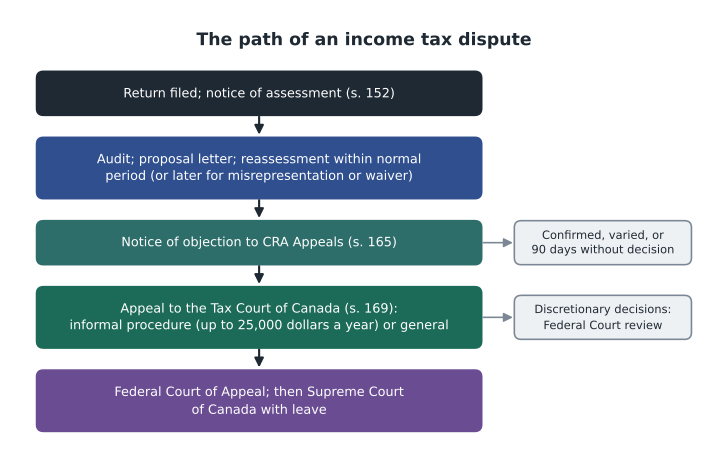
After a return is filed, the Minister examines it with all due dispatch and issues a notice of assessment under section 152(1), which states the tax payable. An assessment is valid and binding even if it contains errors, subject to being varied on objection or appeal (section 152(8)). The Minister may reassess within the normal reassessment period in section 152(3.1): three years after the day the original notice of assessment was sent for individuals and Canadian-controlled private corporations, and four years for other corporations. Several extensions apply: three additional years for reassessments arising from transactions with non-arm's length non-residents and certain other matters; three additional years for assessments under the general anti-avoidance rule where the transaction was not disclosed; and an unlimited period where the taxpayer failed to report the disposition of a principal residence or certain foreign property.
After the normal period, section 152(4)(a)(i) allows the Minister to reassess at any time if the taxpayer or the person filing the return made a misrepresentation attributable to neglect, carelessness or wilful default, or committed fraud, in filing the return or supplying information. The Minister bears the burden of proving the misrepresentation. The taxpayer may also sign a waiver under section 152(4)(a)(ii), limited to specified matters, which keeps the year open; taxpayers sometimes agree to waivers to give themselves time to respond to an audit, and can revoke them on six months' notice.
In an appeal of an assessment, the Minister's pleadings set out the assumptions of fact on which the assessment was based. Under Hickman Motors Ltd. v. Canada, [1997] 2 S.C.R. 336, the taxpayer has the initial onus of demolishing those assumptions, on a balance of probabilities. Once the taxpayer makes out a prima facie case, the burden shifts to the Minister to rebut it. Theo Marchetti, the class's veteran of litigation files, summarizes the practical lesson: 'The taxpayer starts the trial behind. The case is won or lost on the documents the client kept and the witnesses who can explain them.'
Audits and their limits
Section 231.1 allows an authorized person to inspect, audit or examine books, records and property, to enter business premises, and to require the owner or manager to provide reasonable assistance and answer questions, for any purpose related to the administration or enforcement of the Act. Entering a dwelling house requires consent or a warrant. Section 231.2 allows the Minister to require any person to provide information or documents by a written notice called a requirement. A requirement relating to unnamed persons, such as the clients of a bank or the merchants using an e-commerce platform, needs prior judicial authorization under section 231.2(2) and (3), which a judge may grant only if the group is ascertainable and the requirement is made to verify compliance. In 2025, the Federal Court refused the CRA's applications to require Shopify to disclose information about large numbers of unnamed merchants, finding that the statutory preconditions were not met; the Crown appealed.
The CRA's powers are limited by the Charter and by solicitor-client privilege. In R. v. Jarvis, 2002 SCC 73, the Supreme Court held that the CRA may use its audit powers to determine tax liability, but once the predominant purpose of an inquiry is the determination of penal liability, as in a criminal investigation for evasion, the relationship between the state and the taxpayer becomes adversarial and the Charter protections in sections 7 and 8 apply. Investigators must then obtain search warrants, and information compelled under the audit powers cannot be used to build the criminal case. In Canada (Attorney General) v. Chambre des notaires du Québec, 2016 SCC 20, the Court held that the requirement power in section 231.2, combined with the definition of solicitor-client privilege in section 232, was unconstitutional as applied to notaries and lawyers, because it allowed the CRA to compel privileged information without adequate protection. Lawyers' accounting records are generally not privileged, but communications with clients for the purpose of legal advice are.
Objections
A taxpayer who disagrees with an assessment must first object. Section 165(1) requires a notice of objection, setting out the reasons and relevant facts, to be filed with the Minister within ninety days after the day the notice of assessment was sent or, for an individual (other than a trust) or a graduated rate estate, by the later of that date and one year after the taxpayer's filing due date for the year. Large corporations must describe each issue, the relief sought and the facts and reasons relied on, and are limited in a later appeal to the issues and amounts described. If the deadline is missed, the taxpayer may apply for an extension under section 166.1 within one year after the deadline, showing that they were unable to act or had a bona fide intention to object, that it would be just and equitable to grant the application, and that they applied as soon as circumstances permitted.
Objections are reviewed by the CRA's Appeals Division, which is separate from the audit branch. Appeals officers can vary the assessment, settle issues on a principled basis and consider new information. Many disputes end at this stage. Federal Budget 2026 proposes to extend the objection period to one year for most taxpayers, and for individuals and graduated rate estates to the later of one year after the notice is sent and two years after the filing due date, and to eliminate applications for extensions, for assessments sent on or after a date three months after Royal Assent. Those changes are proposals until enacted.
Appeals to the Tax Court of Canada
After objecting, a taxpayer may appeal to the Tax Court of Canada under section 169 once the Minister has confirmed or varied the assessment, or after ninety days have passed without a decision. The appeal must be filed within ninety days after the notice of confirmation or reassessment is sent, with an extension available under section 167 within one year. The Tax Court is a superior court whose jurisdiction is to determine whether an assessment is correct. It may dismiss the appeal, vacate the assessment, vary it, or refer it back to the Minister for reconsideration and reassessment. It cannot grant equitable relief, review the Minister's discretionary decisions or consider whether the CRA behaved fairly in the audit, except to the extent that conduct affects the correctness of the assessment.
The informal procedure is available where the amount of federal tax and penalties in dispute is 25,000 dollars or less for each year, or where the only issue is the amount of a loss of 50,000 dollars or less, with a separate limit for GST and HST appeals. It is simpler and faster, the taxpayer can appear personally or through an agent, the rules of evidence are flexible, and costs are limited. Informal procedure decisions are not precedents, and review in the Federal Court of Appeal is by judicial review on limited grounds. Budget 2025 said the government would explore increasing the thresholds, which have not been updated since 2013. The general procedure applies to all other appeals and follows rules similar to civil litigation in the superior courts, with pleadings, documentary discovery and examinations for discovery, and costs awards that can be significant.
Appeals from the general procedure go as of right to the Federal Court of Appeal, and from there to the Supreme Court of Canada only with leave, which is granted in a few tax cases each year. Settlement is possible at every stage, but the Crown can settle only on a principled basis consistent with the law and facts, not by splitting the difference.
Judicial review in the Federal Court
Some CRA decisions are not assessments. They include decisions to waive or cancel interest and penalties under the taxpayer relief provision in section 220(3.1), decisions to accept late elections, decisions on requests for transfer pricing adjustments and many collection decisions. These are discretionary decisions reviewable only by judicial review in the Federal Court under the Federal Courts Act, on the reasonableness standard. In Dow Chemical Canada ULC v. Canada, 2024 SCC 23, the Supreme Court held that the Tax Court had no jurisdiction to review the Minister's refusal to allow a downward transfer pricing adjustment under section 247(10), because that decision is discretionary and separate from the assessment, and the proper forum is the Federal Court. In a companion case decided the same day, Iris Technologies Inc. v. Canada, 2024 SCC 24, the Court held the converse: a challenge that is in substance an attack on the correctness of an assessment belongs in the Tax Court, not in an application for judicial review. Choosing the right forum is the first strategic decision in any tax dispute.
Collection, interest and penalties
For most taxpayers, section 225.1 prevents the CRA from taking collection action on an amount assessed while an objection or appeal is pending, or until ninety days after the assessment, although interest continues to accrue. Large corporations must pay half of the disputed amount. Amounts withheld at source and certain other amounts can be collected immediately. Once collection is allowed, the CRA has strong tools, including requirements to pay under section 224, which work like garnishment of bank accounts and receivables, certificates registered in the Federal Court that operate as judgments, and liens on property.
Interest on unpaid tax accrues at the prescribed rate plus four percentage points, compounded daily, and is not deductible. Penalties include the late-filing penalty in section 162(1), which is 5 percent of the unpaid tax plus 1 percent for each full month late up to twelve months, doubled for repeat failures; the penalty in section 163(1) for repeatedly failing to report income; and the gross negligence penalty in section 163(2), which applies to a person who knowingly, or in circumstances amounting to gross negligence, makes a false statement or omission in a return, and is generally the greater of 100 dollars and 50 percent of the understatement of tax. Gross negligence involves a high degree of negligence tantamount to intentional acting, or indifference as to whether the law is complied with, and the Minister bears the burden of proof. Wilful blindness, such as signing a return prepared by someone else without reading it despite obvious red flags, can meet the standard.
Directors' liability
Back to Tamarack. Section 227.1(1) makes the directors of a corporation that fails to deduct, withhold or remit source deductions jointly and severally liable, with the corporation, for the unremitted amounts plus interest and penalties. The Excise Tax Act contains a parallel rule for unremitted HST. The CRA must first try to collect from the corporation, for example by registering a certificate that is returned unsatisfied, or by the corporation's bankruptcy or dissolution, and it may not assess a director more than two years after the director last ceased to be a director (section 227.1(4)).
The main defence is due diligence. Under section 227.1(3), a director is not liable if they exercised the degree of care, diligence and skill to prevent the failure that a reasonably prudent person would have exercised in comparable circumstances. In Canada v. Buckingham, 2011 FCA 142, the Federal Court of Appeal held that the standard is objective and that the director's efforts must be directed to preventing the failure to remit, not to curing it after the fact; a director who keeps the business running by paying suppliers and employees while hoping to catch up on remittances later is not diligent. Outside directors with less involvement may be treated differently from inside directors who manage the business, but the standard is still objective.
Arne Halvorsen, Tamarack's sole director when the failures occurred, is the person most exposed. He resigned when Lakeshore bought the shares, so the two-year clock started then. Lakeshore's nominees became directors after the sale, and they are liable for any failures that occur on their watch, so they must ensure that Tamarack's current remittances are made and set up a process to catch up on the arrears. Petrakis adds a corporate point: Lakeshore's share purchase agreement may contain representations that Tamarack's tax filings and remittances were current, and an indemnity. 'The tax law makes Tamarack and its old director liable to the Crown. The contract decides who ultimately bears the cost between Lakeshore and Halvorsen.'
Offences, voluntary disclosure and relief
Section 238 makes failure to file or comply an offence, and section 239 makes tax evasion, false statements and the destruction of records offences punishable on summary conviction by a fine of 50 to 200 percent of the tax evaded and up to two years' imprisonment, or on indictment by a fine of 100 to 200 percent and up to five years' imprisonment. Prosecutions are brought by the Public Prosecution Service of Canada after a criminal investigation by the CRA.
The Voluntary Disclosures Program allows taxpayers who come forward before the CRA begins enforcement action to correct past errors, such as unreported foreign income, and obtain relief from penalties and partial relief from interest, and protection from prosecution. The program's terms have been revised several times, so the current information circular must be checked, but a disclosure must always be voluntary and complete and must involve a potential penalty. Separately, section 220(3.1) allows the Minister to waive or cancel interest and penalties for the ten calendar years before the year of the request, on grounds such as extraordinary circumstances, CRA error, or financial hardship. Refusals are reviewable in the Federal Court.
Worked problem
Ingrid's reassessment
Ingrid Solberg filed her return for the year she left Canada on April 30 of the following year and was assessed as filed on June 10. Four years later, in the course of an audit of her employer's assignees, the CRA proposes to reassess that year on the basis that she did not report the departure tax on her share portfolio. She says her accountant told her that departure tax applies only to people who renounce citizenship. What can she do?
Show solution
- Normal reassessment period: for an individual, three years from June 10 of the assessment year. Four years later, the normal period has expired.
- Can the Minister reassess? Only under section 152(4)(a)(i), by proving a misrepresentation attributable to neglect, carelessness or wilful default. Failing to report a deemed disposition is a misrepresentation; the question is whether it was careless. Reliance on a professional adviser may be a defence if the reliance was reasonable and Ingrid gave the adviser full information, but a court may find that a reasonable person would have checked.
- Burden: the Minister must prove the misrepresentation and carelessness. If reassessment is permitted, Ingrid then bears the initial onus (Hickman Motors) on the merits, such as the value of the shares on departure.
- Penalties: a gross negligence penalty under section 163(2) requires more than carelessness. Relying in good faith on an accountant is not gross negligence unless the circumstances show indifference.
- Process: respond to the proposal letter with documents. If reassessed, file a notice of objection by the later of one year after her filing due date and ninety days after the notice is sent; collection is generally suspended while the objection is pending. If the amount is 25,000 dollars or less of federal tax and penalties for the year, she may choose the informal procedure in the Tax Court. A request for interest relief would go under section 220(3.1), with judicial review in the Federal Court if refused.
Common mistakes
MistakeFiling an appeal in the Tax Court before filing a notice of objection.
InsteadSection 169 requires an objection first; the appeal follows confirmation or ninety days without a decision.
MistakeAsking the Tax Court to cancel penalties on fairness grounds or because the CRA was rude in the audit.
InsteadThe Tax Court decides whether the assessment is correct; discretionary relief under section 220(3.1) is reviewed in the Federal Court (Dow Chemical).
MistakeAssuming the CRA can never reassess after three years.
InsteadMisrepresentation attributable to carelessness, fraud, a waiver or one of several extensions can keep a year open.
MistakeAdvising a struggling business to pay suppliers first and catch up on source deductions later.
InsteadDirectors are personally liable for unremitted source deductions, and due diligence requires efforts to prevent the failure (Buckingham).
MistakeTreating every CRA inquiry as an audit after a criminal investigation has begun.
InsteadUnder Jarvis, once the predominant purpose is penal liability, Charter protections apply and audit powers cannot be used to build the case.
Practice problems
Work each problem on paper first, then reveal the answer to check.
What is the normal reassessment period for an individual?
Show answer
Three years after the day the original notice of assessment was sent (section 152(3.1)), subject to extensions and to reassessment at any time for misrepresentation attributable to neglect, carelessness, wilful default or fraud.
What did Hickman Motors decide about the burden of proof?
Show answer
The taxpayer must first demolish the Minister's assumptions on a balance of probabilities; once a prima facie case is made, the burden shifts to the Minister.
When must an individual file a notice of objection?
Show answer
By the later of ninety days after the notice of assessment is sent and one year after the filing due date for the year; extensions may be sought under section 166.1 within one year after the deadline.
Which court reviews a refusal to waive interest under section 220(3.1)?
Show answer
The Federal Court, on judicial review; the Tax Court has no jurisdiction over discretionary decisions (Dow Chemical, 2024 SCC 23).
State the director's due diligence defence.
Show answer
Under section 227.1(3), a director is not liable if they exercised the care, diligence and skill to prevent the failure that a reasonably prudent person would have exercised in comparable circumstances; the standard is objective and focused on prevention (Buckingham).
Summary and key terms
- Taxpayers self-assess; individuals file by April 30 (June 15 if self-employed), corporations within six months; Budget 2026 proposes May 15 for individuals from 2027.
- The normal reassessment period is three years for individuals and Canadian-controlled private corporations and four for other corporations, with extensions; misrepresentation attributable to carelessness permits later reassessment.
- Audit and requirement powers are broad but limited by Jarvis, judicial authorization for unnamed persons and solicitor-client privilege (Chambre des notaires).
- Disputes proceed by objection, then appeal to the Tax Court (informal procedure up to 25,000 dollars of federal tax and penalties per year), then the Federal Court of Appeal and, with leave, the Supreme Court.
- Discretionary decisions are reviewed in the Federal Court (Dow Chemical); correctness of assessments belongs in the Tax Court (Iris Technologies).
- Directors are liable for unremitted source deductions unless they show due diligence, and must be assessed within two years after ceasing to be directors.
- Assessment
- The Minister's determination of tax payable, binding unless varied on objection or appeal.
- Normal reassessment period
- The period during which the Minister may reassess without proving misrepresentation.
- Waiver
- A taxpayer's agreement to extend the reassessment period for specified matters.
- Objection notice
- The first step in disputing an assessment, filed with the CRA Appeals Division.
- Informal procedure
- A simplified Tax Court procedure for smaller disputes; decisions are not precedents.
- Requirement
- A written demand under section 231.2 for information or documents.
- Due diligence defence
- A director's defence to liability for unremitted amounts, based on reasonable efforts to prevent the failure.
Lesson quiz · 5 questions
Score 60% or more to complete this lesson.
Create a free account to save your progress, take quizzes and earn a certificate.