
LAWC-301 · Lesson 2 of 12 · 26 min
Tax policy
▶ Video coming soon A video version of this lesson is on the way.
Petrakis opens the second class with a question. 'Two people each earn one hundred thousand dollars this year. One earns it as a salary. The other earns it as a capital gain on shares she bought ten years ago. Should they pay the same tax?' Hands go up immediately, and the class splits. Hannah Kowalczyk, who studied economics before law school, says no: the investor took risk, inflation has eaten part of her gain, and taxing savings discourages investment. Daniel Whitecloud says yes: a dollar is a dollar, and the people who earn capital gains are mostly people who are already well off. Petrakis lets the argument run for ten minutes and then stops it. 'Congratulations. You have just reenacted fifty years of Canadian tax policy debate, and nobody has won it yet.'
This lesson introduces the criteria used to evaluate taxes, the idea of income as a tax base, the Carter Commission and the 1971 reform that shaped the modern Act, the structure of Canadian rates, tax expenditures, and the policy debates that recur throughout the course: the taxation of capital gains, the unit of taxation, integration of corporate and personal tax, and the use of the tax system to deliver social programs. Lawyers need policy for practical reasons. Courts interpret provisions by reference to their purpose, the general anti-avoidance rule asks whether a transaction abuses the object, spirit and purpose of a provision, and clients ask whether a rule is likely to change.
The criteria for judging a tax
Adam Smith, in The Wealth of Nations in 1776, offered four maxims for a good tax: people should contribute in proportion to their abilities; the tax should be certain, not arbitrary; it should be levied at the time and in the manner most convenient for the payer; and it should take out of people's pockets as little as possible beyond what it brings into the treasury. Modern tax policy uses similar criteria under different names.
Equity has two dimensions. Horizontal equity requires that people in similar circumstances, with the same ability to pay, pay the same tax. Vertical equity requires that people with greater ability to pay pay more, and most Canadians accept that they should pay a larger share of their income, which is the argument for progressive rates. Both require a measure of ability to pay, and income is the measure most systems use, although consumption and wealth are alternatives.
Neutrality, often called efficiency, asks that a tax distort economic decisions as little as possible. If two investments produce the same return before tax, a neutral tax would leave them producing the same return after tax, so that people choose between them on their merits. Departures from neutrality are sometimes deliberate: a tax credit for research and development is designed to encourage research. Unintended distortions, such as a rule that makes it cheaper to borrow than to raise equity, impose costs on the economy without any corresponding benefit.
Simplicity asks that rules be understandable, cheap to comply with and cheap to administer. Canadian taxpayers spend billions of dollars a year on compliance, and complexity also creates uncertainty and opportunities for avoidance. Revenue adequacy asks that the tax raise enough money, predictably, to fund public services. Petrakis adds a fifth criterion that he says lawyers often forget: legitimacy. A tax system works because most people comply voluntarily, and people comply when they believe the system is broadly fair and that others are paying too.
The criteria conflict constantly. A comprehensive income tax that measured every benefit accurately would be fair and neutral but extremely complex. A flat tax with no deductions would be simple but less progressive. Petrakis tells the class that every provision they read is a compromise among these goals, and that the useful question about a rule is not whether it is perfect but what it trades off, and for whom.
Income as a tax base
Economists usually define income using the Haig-Simons definition: a person's income for a period is the market value of what they consumed in the period plus the change in the value of their net wealth. Under this definition, a gift received is income, an unrealized increase in the value of shares is income, the rental value of living in one's own house is income, and an employer-provided benefit is income. No real tax system uses this definition fully, because it would require annual valuation of every asset and would tax people on gains they have not turned into cash.
The Canadian Act departs from the Haig-Simons ideal in many ways. It taxes income only from sources, so gifts, inheritances and windfalls are not taxed as income. It generally taxes gains only when property is sold or deemed to be sold, not as they accrue, which is called the realization principle. It does not tax the imputed rent of owner-occupied housing and exempts most gains on a principal residence. It includes only half of capital gains. It allows deferral through registered plans such as registered retirement savings plans and registered pension plans, and exempts income earned inside tax-free savings accounts. Each departure is a policy choice, and each creates pressure at the boundary, as taxpayers try to fit income into the favoured category.
The Carter Commission and the 1971 reform
The Royal Commission on Taxation, chaired by Kenneth Carter, a Toronto chartered accountant, reported in 1966. Its report is remembered for the phrase 'a buck is a buck': the Commission recommended that all increases in economic power, whatever their form, be taxed the same way. It proposed full taxation of capital gains, taxation of gifts and inheritances as income, the family as the unit of taxation, and full integration of corporate and personal income tax so that income earned through a corporation would bear the same total tax as income earned directly.
The government did not adopt the Carter proposals in full, but the tax reform enacted in 1971 and effective from January 1, 1972 rebuilt the Act around many of its ideas. For the first time, Canada taxed capital gains, at an inclusion rate of one half. At the same time, Parliament abolished the federal estate tax and gift tax and replaced them with a deemed disposition of capital property at death, so that accrued gains are taxed on the deceased's final return. The reform also introduced the small business deduction and a partial system of integration through the dividend tax credit. The modern Act, renumbered in the 1985 revision, still reflects this structure.
Hannah asks why the family unit was rejected. Petrakis explains that taxing families jointly would have penalized marriage for two-earner couples, because combining incomes under progressive rates pushes income into higher brackets, and that it would have entrenched a model of household finances that was already changing. Canada kept the individual as the unit, and it has spent the half century since then building rules to stop income from being shifted inside families, which is the subject of lesson 8.
The structure of Canadian rates
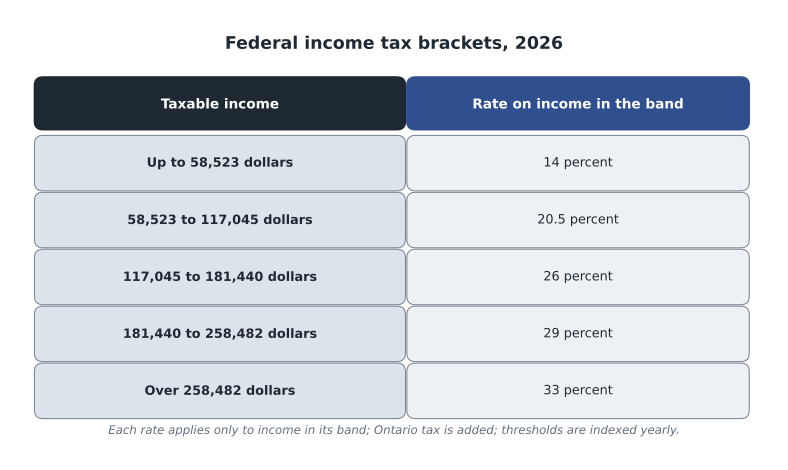
Federal personal income tax is levied at graduated rates under section 117. For 2026, the rates are 14 percent on the first 58,523 dollars of taxable income, 20.5 percent on the next band to 117,045 dollars, 26 percent to 181,440 dollars, 29 percent to 258,482 dollars, and 33 percent above that. The thresholds are indexed to inflation every year under section 117.1. The lowest rate was cut from 15 percent to 14.5 percent for 2025 and to 14 percent for 2026 and later years, and because most non-refundable credits are calculated at the lowest rate, the government added a top-up credit so that credits above the first bracket threshold continue to be calculated at 15 percent.
Each rate applies only to income within its band. A taxpayer whose income rises into a new bracket pays the higher rate only on the dollars above the threshold, not on all of their income. Petrakis spends several minutes on this point because, he says, clients routinely refuse raises out of a mistaken belief that moving into a higher bracket will reduce their take-home pay. The relevant measure for a decision is the marginal rate, which is the combined federal and provincial rate on the next dollar of income. The relevant measure for fairness comparisons is the average rate, which is total tax divided by total income.
Ontario adds its own graduated rates, a surtax on high levels of Ontario tax and the Ontario Health Premium. Combined federal and Ontario top marginal rates on ordinary income have been a little over 53 percent for several years. The rates on eligible dividends and capital gains are lower, because of the dividend tax credit and the half inclusion of capital gains. The alternative minimum tax, reformed with effect from 2024, imposes a minimum level of tax on high-income individuals who would otherwise pay little because of preferences such as capital gains, by recomputing income on a broader base at a flat rate and comparing the result with ordinary tax.
Marginal rates are not only a feature of the rate schedule. Income-tested benefits such as the Canada child benefit and the GST/HST credit are reduced as family income rises. For a low-income family, the combined effect of tax and benefit reductions can produce effective marginal rates well above those of high-income earners, which is a recurring criticism of the system's design.
Tax expenditures
Every year the Department of Finance publishes a report on federal tax expenditures, which estimates the revenue cost of provisions that depart from a benchmark tax system: the partial inclusion of capital gains, the principal residence exemption, the deferral provided by registered plans, the charitable donations credit, the small business deduction and hundreds of others. The concept treats a tax preference as equivalent to a spending program delivered through the tax system. A non-refundable credit for public transit, for example, is economically similar to a subsidy for transit users who pay tax, but it does not appear in the spending estimates and is not reviewed in the same way.
Tax expenditures are popular with governments because they look like tax cuts rather than spending, and they are often criticized because they deliver most of their value to people with higher incomes and are rarely evaluated. Petrakis asks Daniel to identify who benefits most from the principal residence exemption. 'Homeowners with large gains,' Daniel says, 'which in Ontario means people who bought houses in Toronto twenty years ago. Renters get nothing.' Petrakis agrees, and adds that the exemption is also one of the most politically protected provisions in the Act.
The capital gains debate
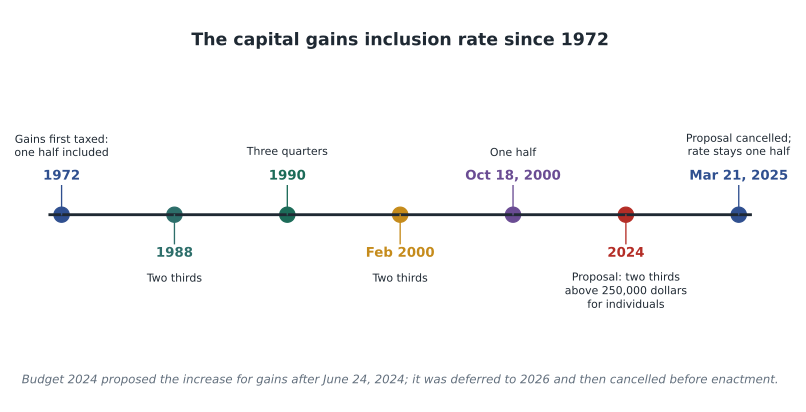
Capital gains have been taxed at different inclusion rates since 1972. The inclusion rate was one half from 1972 to 1987, rose to two thirds for 1988 and 1989 and to three quarters from 1990, fell back to two thirds in February 2000 and to one half on October 18, 2000, where it has remained. Because only part of a gain is included, the effective rate on capital gains is a fraction of the rate on ordinary income.
The arguments for preferential treatment include the effect of inflation, since part of a nominal gain merely reflects the declining value of money; the bunching of gains that accrue over many years into the year of sale; the lock-in effect, since a high tax on realization discourages people from selling assets and reallocating capital; double taxation, since corporate profits are taxed before they are reflected in share values; and international competitiveness. The arguments against include equity, since capital gains are heavily concentrated among high-income taxpayers; neutrality, since a preference creates a strong incentive to convert ordinary income into capital gains; and complexity, since much of the case law and many anti-avoidance rules exist only to police the boundary.
In Budget 2024, the federal government proposed to increase the inclusion rate to two thirds for capital gains realized on or after June 25, 2024, for corporations and most trusts on all gains, and for individuals on the portion of gains above 250,000 dollars a year. The measure met strong opposition from business groups, doctors and other professionals who held investments in corporations, and draft legislation was introduced but not enacted. In January 2025 the government deferred the effective date to January 1, 2026. On March 21, 2025, Prime Minister Mark Carney announced that the increase was cancelled. The inclusion rate remains one half. The increase in the lifetime capital gains exemption to 1.25 million dollars, announced alongside the inclusion rate change, was kept and was enacted in March 2026.
Petrakis uses the episode to make two points. First, about policy: the debate over the inclusion rate is a debate about equity against neutrality and growth, and it will return. Second, about practice: many taxpayers sold assets or restructured in the spring of 2024 to realize gains before the announced effective date, and some of those decisions turned out to be unnecessary. 'Never let a client make an irreversible decision on the strength of a measure that is not yet law, unless the client understands and accepts the risk.' Federal Budget 2026, tabled on November 5, 2026, proposes a new exemption for gains on certain newly issued shares of growing Canadian private companies, the Canada Growth Incentive; it, too, is a proposal until enacted.
Integration and the corporate income tax
If a corporation pays tax on its profits and its shareholders pay tax again on the dividends, income earned through a corporation is taxed twice. Integration is the policy of adjusting the corporate and personal taxes so that the total tax is roughly the same whether income is earned directly or through a corporation. Canada achieves approximate integration through the dividend gross-up and tax credit, and through refundable taxes on investment income earned by private corporations. The mechanics are covered in lesson 9.
Integration is never perfect, and the gaps create planning opportunities. When corporate rates are much lower than personal rates, an owner-manager can leave income in a corporation and defer personal tax until dividends are paid, and can use the corporation to split income with family members. Parliament has responded with rules such as the tax on split income, extended in 2018, and the reduction of the small business deduction for corporations with significant passive investment income. Each response is a trade-off between neutrality, simplicity and the policy of supporting small business.
Delivering social policy through the tax system
Canada delivers a large share of its income support through the tax system: the Canada child benefit, the GST/HST credit, the Canada workers benefit, the disability tax credit and others. The tax system has advantages as a delivery mechanism, because it already collects income information for almost everyone, but it also has weaknesses: people who do not file returns miss out, and benefits are based on the previous year's income. Courts have occasionally been asked to review such provisions under the Charter. In Symes v. Canada, [1993] 4 S.C.R. 695, a self-employed lawyer argued that denying a business deduction for her nanny's wages discriminated against women; the majority held that the child care expense deduction in section 63 was a complete code and found no breach of section 15. In Thibaudeau v. Canada, [1995] 2 S.C.R. 627, the Court rejected a challenge to the then-existing rule that taxed child support in the recipient's hands. Parliament changed the child support rule anyway in 1997, an example of policy moving faster than litigation.
Sophie points out that Quebec makes some different policy choices through its own Act, including a more generous system of refundable credits for child care. Petrakis encourages comparison: provinces are laboratories, and the federal system has borrowed ideas from them more than once.
Worked problem
Average and marginal rates
Using only the 2026 federal brackets and ignoring credits, compute the federal tax on taxable income of 120,000 dollars, the taxpayer's average federal rate and the marginal federal rate on the next dollar. Then explain to a client who earns 116,000 dollars whether a raise of 4,000 dollars could reduce her income after tax.
Show solution
- First band: 58,523 dollars at 14 percent is about 8,193 dollars.
- Second band: from 58,523 to 117,045 dollars is 58,522 dollars at 20.5 percent, about 11,997 dollars.
- Third band: the remaining 2,955 dollars (120,000 minus 117,045) at 26 percent is about 768 dollars.
- Total federal tax before credits is about 20,958 dollars. The average federal rate is about 17.5 percent (20,958 divided by 120,000). The marginal federal rate on the next dollar is 26 percent.
- For the client: moving from 116,000 to 120,000 dollars puts only the dollars above 117,045 into the 26 percent band. The raise is taxed at 20.5 percent on its first 1,045 dollars and 26 percent on the rest, plus Ontario tax. Her income after tax rises; a higher bracket never reduces take-home pay on its own. Income-tested benefits can produce high effective rates for lower-income families, but a raise in this range does not lose money.
Policy in the courtroom
The class ends with a warning about how policy enters legal argument. Courts interpret provisions purposively, but they look for the purpose of the specific provision, found in its text, context and legislative history, not for a general policy of the Act that a party would like to assert. Under the general anti-avoidance rule, the question is whether a transaction frustrates the object, spirit and purpose of the provisions relied on, again identified provision by provision. Budget documents, technical notes from the Department of Finance and explanatory notes are admissible as evidence of purpose, and lawyers who use them well win cases. Petrakis's advice: 'Know the policy, but argue it through the words of the section. A judge will not tax your client because the Act is unfair, and will not relieve your client because the Act is harsh.'
Common mistakes
MistakeTelling a client that moving into a higher bracket taxes all of her income at the higher rate.
InsteadEach rate applies only to income within its band; the marginal rate governs the next dollar, and a raise always increases after-tax income from the rate schedule alone.
MistakeStating that capital gains are taxed at two thirds because of the 2024 budget.
InsteadThe proposed increase was deferred and then cancelled on March 21, 2025; the inclusion rate remains one half.
MistakeTreating the Haig-Simons definition as the law.
InsteadThe Act taxes income from sources, generally on realization, with many deliberate departures from comprehensive income.
MistakeArguing that a transaction is taxable because it offends a general policy of fairness.
InsteadCourts identify the purpose of specific provisions; general policy arguments do not create tax liability without a provision that applies.
Practice problems
Work each problem on paper first, then reveal the answer to check.
Distinguish horizontal and vertical equity, and give an example of a provision that raises a horizontal equity concern.
Show answer
Horizontal equity: equal treatment of people with equal ability to pay; vertical equity: more tax from those with more ability to pay. The partial inclusion of capital gains raises a horizontal concern because a person earning 100,000 dollars of gains pays much less than a person earning 100,000 dollars of salary.
What were the main recommendations of the Carter Commission, and which were adopted in 1971?
Show answer
Carter recommended taxing all accretions to economic power ("a buck is a buck"), full taxation of gains, gifts and inheritances as income, the family unit and full integration. The 1971 reform taxed half of capital gains, replaced estate and gift taxes with deemed dispositions at death, kept the individual unit and introduced partial integration and the small business deduction.
What is a tax expenditure?
Show answer
A departure from a benchmark tax system, such as an exemption, deduction, credit or deferral, that delivers a benefit through the tax system and whose revenue cost is estimated annually by the Department of Finance.
What is the current status of the capital gains inclusion rate and the lifetime capital gains exemption?
Show answer
The inclusion rate is one half; the proposed increase was cancelled on March 21, 2025. The lifetime capital gains exemption increase to 1.25 million dollars was kept and enacted in March 2026.
Summary and key terms
- Taxes are judged by equity (horizontal and vertical), neutrality, simplicity, revenue adequacy and legitimacy, and these criteria conflict.
- The Act departs from the comprehensive Haig-Simons definition of income through the source concept, realization, partial inclusion of gains and many preferences.
- The 1971 reform, influenced by the Carter Commission, introduced taxation of half of capital gains and deemed dispositions at death in place of estate tax.
- For 2026, federal rates run from 14 to 33 percent; Ontario adds its own rates and surtax; marginal and average rates serve different purposes.
- The 2024 proposal to raise the capital gains inclusion rate was cancelled in March 2025; the rate remains one half.
- Marginal rate
- The combined rate of tax on the next dollar of income.
- Average rate
- Total tax divided by total income.
- Haig-Simons income
- Consumption plus change in net wealth over a period; a benchmark definition of income.
- Realization principle
- The rule that gains are taxed when property is sold or deemed sold, not as value accrues.
- Tax expenditure
- A tax preference that functions like a spending program, measured against a benchmark tax system.
- Integration
- Coordination of corporate and personal tax so that income bears similar total tax whether earned directly or through a corporation.
- Inclusion rate
- The fraction of a capital gain or loss that is included in income; currently one half.
Lesson quiz · 5 questions
Score 60% or more to complete this lesson.
Create a free account to save your progress, take quizzes and earn a certificate.