
LAWC-214 · Lesson 9 of 12 · 21 min
Ethics in criminal practice: defence and prosecution
▶ Video coming soon A video version of this lesson is on the way.
Professor Ruth Castellano, who taught the class criminal law and criminal procedure, joins Ogilvie for this lesson. She spent twelve years as a Crown prosecutor in Toronto and six as a legal aid defence lawyer in Corwin, so she has done both jobs. Ogilvie asks her the question every criminal lawyer is asked at dinner parties: how can you defend someone you know is guilty? Castellano answers with her catchphrase. 'Prove it, element by element. That is not my client's job. It is the state's. My job is to make sure the state actually does it.'
This lesson covers the ethical rules that apply specially to criminal practice: defending a client who has admitted guilt, plea agreements, the prosecutor's duty, incriminating physical evidence after R. v. Murray, and withdrawing from a criminal case after R. v. Cunningham. The class uses R. v. Calder, the fictional Corwin manslaughter file that has run through their criminal law courses since first year.
Defending the client who has admitted guilt
The commentary to rule 5.1-1 answers the dinner party question directly. A lawyer may properly defend a client the lawyer believes, or even knows, to be guilty. The presumption of innocence and the Crown's burden of proof beyond a reasonable doubt are fundamental, and a defence lawyer who refused to act for anyone she thought was guilty would be substituting her own judgment for the trial. Admissions by the client do, however, limit what the lawyer may do. If the client has admitted facts that clearly establish guilt, and the lawyer is satisfied that the admissions are true, the lawyer may take objection to the jurisdiction of the court, the form of the indictment or the admissibility or sufficiency of the evidence, and may argue that the evidence is insufficient to amount to proof of guilt. But the lawyer must not suggest that some other person committed the offence, must not call any evidence that, by reason of the admissions, the lawyer believes to be false, and must not set up an affirmative case inconsistent with the admissions, such as an alibi the lawyer knows is untrue. The lawyer may test the Crown's evidence vigorously, including by cross-examining a witness the lawyer believes to be truthful in order to show that the witness's evidence is unreliable on some point, but must not mislead the court.
In the Calder file, Owen Calder tells his lawyer, Dan Kerrigan, that he shoved Mark Dorey hard outside the bar on Ridley Street, harder than he told the police, and that Dorey hit his head on the curb. Kerrigan may still defend him on a charge of manslaughter. He can challenge whether the Crown can prove causation, given the pathologist's evidence of an unusually thin skull and the possibility of another blow; he can challenge the admissibility of Calder's statements to the police; he can argue that the Crown has not proved the unlawful act beyond a reasonable doubt. What he cannot do is call Calder to testify that he never touched Dorey, or suggest to the jury that the bouncer, Brendan Hollis, pushed Dorey instead. Theo Marchetti, who knows the Calder file better than anyone, notes that this is a narrow but workable space. Castellano agrees: 'Most good defences are about the Crown's evidence, not about a story.'
If the client insists on a defence the lawyer knows is false, such as testifying to an alibi after admitting the offence, the lawyer must refuse to present it and, if the client will not change course, must withdraw, as long as withdrawal is permitted in the circumstances.
Plea agreements
Most criminal cases end with a guilty plea, often after discussions between defence counsel and the Crown. The rules permit those discussions. Before a lawyer reaches an agreement with the prosecutor about a plea, the lawyer must advise the client about the prospects of an acquittal or finding of guilt, the implications and possible consequences of a guilty plea, and the sentencing authority and discretion of the court, including the fact that the court is not bound by any agreement about the sentence to be imposed. The lawyer may then enter into an agreement only if the client is fully informed and the client voluntarily instructs the lawyer to do so. The commentary adds that the lawyer must be satisfied that the client is prepared to admit the necessary factual and mental elements of the offence. A lawyer should not help a client plead guilty to something the client says she did not do simply because the deal is good.
Collateral consequences matter. In R. v. Wong, 2018 SCC 25, the Supreme Court considered when an accused may withdraw a guilty plea entered without knowing of a legally relevant collateral consequence, such as removal from Canada. The decision reinforces the professional duty: before a client pleads, the lawyer must make sure the client understands not only the sentence but consequences such as immigration status, professional licensing, firearms prohibitions and sex offender registration. Arjun Mehta asks whether a lawyer who does not practise immigration law can meet that duty. Castellano says the competence rule answers it: if you do not know, find out or consult someone who does.
The prosecutor's duty
The prosecutor is not the defence counsel's mirror image. Rule 5.1-3 provides that when acting as a prosecutor, a lawyer must act for the public and the administration of justice resolutely and honourably within the limits of the law while treating the tribunal with candour, fairness, courtesy and respect. The commentary says that the prosecutor's prime duty is not to seek to convict but to see that justice is done through a fair trial on the merits, and that the prosecutor must make timely disclosure to the defence of all relevant and known facts and witnesses, whether tending to show guilt or innocence.
The idea is old. In Boucher v. The Queen, [1955] S.C.R. 16, Justice Rand wrote that the purpose of a criminal prosecution is not to obtain a conviction but to lay before a jury what the Crown considers credible evidence relevant to what is alleged to be a crime, and that the role of prosecutor excludes any notion of winning or losing. In R. v. Stinchcombe, [1991] 3 S.C.R. 326, the Court made disclosure a constitutional obligation: the Crown must disclose all relevant information in its possession, whether inculpatory or exculpatory, subject to privilege and the Crown's discretion on timing and relevance, and the fruits of the investigation are not the property of the Crown for use in securing a conviction but the property of the public to be used to ensure that justice is done.
Prosecutors are lawyers, and the Law Society regulates them, but with a limit. In Krieger v. Law Society of Alberta, 2002 SCC 65, a prosecutor was the subject of a complaint for delaying disclosure of test results. The Supreme Court held that the law society could discipline a Crown prosecutor for conduct that is dishonest or in bad faith, including a deliberate failure to disclose, but that the core elements of prosecutorial discretion, such as the decision to bring, continue or stay a charge, are not subject to review by the law society. Castellano tells the class that the best prosecutors she worked with were the ones who disclosed the thing that hurt them first.
Incriminating physical evidence
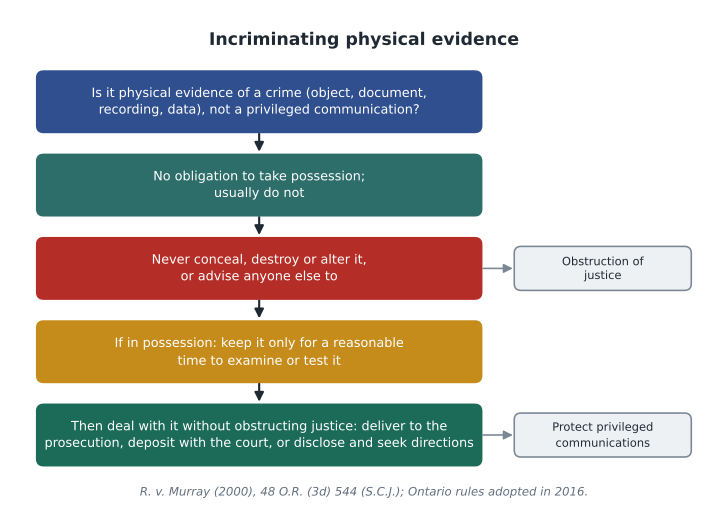
The most notorious Canadian professional responsibility case concerns physical evidence. In R. v. Murray (2000), 48 O.R. (3d) 544 (S.C.J.), Kenneth Murray was defence counsel to Paul Bernardo, who was charged with the murders of two teenage girls. Acting on his client's instructions, Murray retrieved videotapes hidden in the house where the crimes had occurred. The tapes recorded the sexual assaults of the victims. Murray kept them for about seventeen months without telling the Crown, while the Crown, unaware of them, negotiated a plea agreement with Bernardo's former partner, who was later shown by the tapes to have been more involved than she had admitted. Murray eventually withdrew, the tapes were passed by new counsel to the police, and Murray was charged with attempting to obstruct justice.
Justice Gravely of the Superior Court acquitted Murray because the Crown had not proved beyond a reasonable doubt that he intended to obstruct justice; Murray may have believed, given the lack of clear guidance at the time, that he was entitled to keep the tapes for use in the defence. But the judge was clear that the tapes were not privileged. They were not communications between lawyer and client but products and instruments of the crimes, and concealing them had a tendency to obstruct justice. Counsel may keep such evidence for a reasonable time to examine or test it, but not conceal it until trial. Because returning the tapes to their hiding place was not a real option, the judge said Murray had three legitimate choices: turn them over to the prosecution; deposit them with the trial judge; or disclose their existence to the prosecution and prepare to fight over whether he could keep them.
The case led the Law Society to adopt specific rules in 2016. A lawyer must not counsel or participate in the concealment, destruction or alteration of incriminating physical evidence, or otherwise act to obstruct or attempt to obstruct the course of justice. The commentary explains that physical evidence includes documents, electronic information, objects and substances relevant to a crime, whether or not it would be admissible and whether or not charges have been laid. The lawyer has no obligation to take possession of such evidence and often should not. If she does, she must handle it consistently with her duties: she may examine or test it for a reasonable time, and then must deal with it so as not to obstruct justice, while protecting privileged communications about it. Lawyers in this position should seek advice from a senior criminal practitioner or the Law Society. Sophie Tremblay-Hart asks whether telling the client to keep the item at home is better. Castellano says that depends on what the lawyer says: a lawyer may advise the client of the law, but must never advise the client to destroy or hide evidence, which would itself be obstruction.
Withdrawal in criminal cases
Criminal clients often run out of money or lose legal aid funding. In R. v. Cunningham, 2010 SCC 10, a defence lawyer in the Yukon sought to withdraw because the client's legal aid funding had been suspended. The Supreme Court held that a court has the authority to refuse a request to withdraw for non-payment of fees where withdrawal would cause serious harm to the administration of justice. If the request is made sufficiently in advance of trial that the accused can find new counsel and the trial date is not threatened, the court should generally allow it. If counsel seeks to withdraw for ethical reasons, the court must accept counsel's word and cannot inquire into the confidential reasons. If counsel seeks to withdraw for non-payment close to trial, the court may consider factors such as the feasibility of the accused representing himself, other means of obtaining representation, the impact on the accused of delay, the conduct of counsel, the impact on the Crown and co-accused, the impact on complainants and witnesses, the history of the proceedings and the public interest.
The professional rules are consistent with Cunningham. A lawyer who has agreed to act in a criminal case may withdraw for non-payment only if the interval between withdrawal and the trial is sufficient for the client to obtain other counsel and for that counsel to prepare, and the lawyer must not use the threat of withdrawal as a device to force payment at the last minute. Lesson 10 covers withdrawal more generally.
Worked problem
The hoodie in the closet
A hypothetical twist on the Calder file: before the police search, Owen Calder's girlfriend Tess Halloran brings a grey hoodie with blood on the cuff to Dan Kerrigan's office in a shopping bag. She says Owen asked her to give it to his lawyer 'for safekeeping'. Kerrigan has not looked inside the bag. He calls Professor Castellano, a former colleague, for advice.
Show solution
- Identify what it is. The hoodie is potential physical evidence of the offence, not a privileged communication. What Calder told Kerrigan about it is privileged; the object is not.
- Decline possession if possible. Kerrigan has no obligation to take the bag. The safest course is usually not to accept it, while making sure he says nothing that encourages Tess to hide or destroy it.
- Never advise concealment or destruction. Telling Tess to wash the hoodie or get rid of it would be obstructing justice. Kerrigan may explain the law, including that destroying evidence is a crime.
- If he has already taken it, act promptly. He may examine it for a reasonable time, but then must deal with it in a way that does not obstruct justice, such as delivering it to the police or Crown through independent counsel without disclosing privileged communications, or seeking directions from the court.
- Get advice and record it. Kerrigan should consult a senior practitioner or the Law Society, document what he did and why, and tell Calder what he must do with the item before he does it.
Common mistakes
MistakeBelieving a lawyer may not defend a client who has admitted guilt.
InsteadThe lawyer may defend by testing the Crown's case and raising legal objections, but must not present a defence the lawyer knows is false or blame someone else.
MistakeTreating incriminating physical evidence as privileged because the client delivered it to the lawyer.
InsteadPhysical evidence is not a communication and is not privileged. Concealing it can be obstruction of justice, as R. v. Murray explains.
MistakeSaying a prosecutor's job is to win convictions.
InsteadThe prosecutor acts for the public and the administration of justice, must not seek a conviction at any cost, and must disclose relevant information under Stinchcombe.
MistakeAssuming defence counsel may always withdraw for non-payment.
InsteadUnder Cunningham, a court may refuse withdrawal for non-payment where it would seriously harm the administration of justice, especially close to trial.
Practice problems
Work each problem on paper first, then reveal the answer to check.
What must a defence lawyer do before entering into a plea agreement with the Crown?
Show answer
Advise the client about the prospects at trial, the implications and consequences of a plea including collateral consequences, and the court's sentencing discretion; then act only on the fully informed, voluntary instructions of a client prepared to admit the elements of the offence.
What did Krieger v. Law Society of Alberta hold about disciplining prosecutors?
Show answer
That a law society may discipline a prosecutor for dishonest or bad faith conduct, but cannot review the core elements of prosecutorial discretion.
Why was Kenneth Murray acquitted, and what did the court say about the tapes?
Show answer
The Crown did not prove that he intended to obstruct justice. The court held the tapes were not privileged and that concealing them had a tendency to obstruct justice; he had to turn them over, deposit them with the court or disclose them and litigate.
Summary and key terms
- A lawyer may defend a client who has admitted guilt by testing the Crown's case, but must not present a false defence or blame someone else.
- Plea agreements require full advice, including collateral consequences, and the client's informed and voluntary instructions.
- Rule 5.1-3 and Boucher make the prosecutor a minister of justice; Stinchcombe requires disclosure; Krieger protects core prosecutorial discretion from law society review.
- Incriminating physical evidence is not privileged; after R. v. Murray, Ontario's rules prohibit concealing, destroying or altering it, and a lawyer who takes it must deal with it without obstructing justice.
- Under Cunningham, a court may refuse a criminal lawyer's withdrawal for non-payment where it would seriously harm the administration of justice.
- Admission of guilt
- A client's statement to the lawyer that establishes guilt, which limits but does not end the lawyer's ability to defend.
- Plea agreement
- An agreement between defence counsel and prosecutor about a plea and, often, a joint position on sentence.
- Minister of justice
- A description of the prosecutor's role, acting for the public interest rather than to win.
- Stinchcombe disclosure
- The Crown's constitutional obligation to disclose all relevant information to the defence.
- Incriminating physical evidence
- Objects, documents, electronic data or substances relevant to a crime, which are not privileged.
- Collateral consequence
- A consequence of a conviction beyond the sentence, such as removal from Canada or loss of a licence.
Lesson quiz · 5 questions
Score 60% or more to complete this lesson.
Create a free account to save your progress, take quizzes and earn a certificate.