
LAWC-214 · Lesson 6 of 12 · 19 min
Confidentiality
▶ Video coming soon A video version of this lesson is on the way.
Ogilvie walks into the Lister Room, sits down and begins telling the class about a client: a man in his fifties, recently divorced, who runs a car dealership in a town near Corwin and is worried that his business partner is skimming money. After two minutes he stops. 'I have just breached rule 3.3-1 four times,' he says. 'I have not told you his name. I do not need to. Anyone in this room who grew up near Corwin could identify him from what I have said.' The client, he adds, is invented. The lesson is not.
Confidentiality is the duty most often breached by accident: in an elevator, on social media, at a family dinner, in an email sent to the wrong address, in a document uploaded to the wrong tool. This lesson distinguishes the ethical duty of confidentiality from solicitor-client and litigation privilege, explains the exceptions, and looks at the cases in which the Supreme Court of Canada has given privilege near-constitutional status.
The ethical duty
Rule 3.3-1 provides that a lawyer at all times must hold in strict confidence all information concerning the business and affairs of a client acquired in the course of the professional relationship and must not divulge any such information unless expressly or impliedly authorized by the client, required by law or by a court to do so, required to deliver the information to the Law Society, or otherwise permitted by the rules. The duty is very broad. It covers all information, not just communications. It does not matter where the information came from: something a lawyer learns from a news report, a court file or a third party about a client, in the course of the retainer, is confidential. It applies whether or not the information is already known to others. And it continues indefinitely, after the retainer ends and after the client dies.
The commentary explains why. A client must feel completely free to tell the lawyer everything, including embarrassing or damaging facts, so that the lawyer can give proper advice. A lawyer who gossips about clients, even anonymously, undermines that trust for everyone. The commentary also warns against indiscreet conversations, even with the lawyer's own spouse or family, and against using a client's confidential information for the lawyer's own benefit, such as trading on a client's undisclosed corporate news.
Implied authority covers what is necessary to do the work: a lawyer may share information with staff, with experts retained for the client, and with opposing counsel as needed in negotiations. It does not cover talking about the file at a dinner party. Sophie Tremblay-Hart asks about a lawyer who wants to write about a famous case years later. Ogilvie answers that the duty does not expire. Without the client's consent, the lawyer may write about what is in the public record but must not reveal confidential information, including the client's private reactions and instructions.
Privilege is different
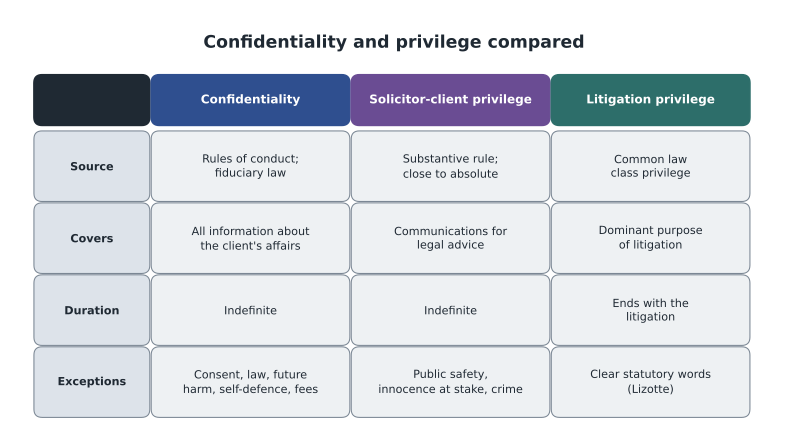
Solicitor-client privilege is a related but distinct legal rule. It protects confidential communications between a client and a lawyer made for the purpose of seeking or giving legal advice. It belongs to the client, who alone can waive it. The ethical duty tells a lawyer what she may say; privilege tells a court, a regulator or an investigator what they may compel. A fact may be confidential without being privileged, such as the client's address learned from a court file, and a privileged communication is always confidential too.
The Supreme Court has elevated privilege over four decades. In Descôteaux v. Mierzwinski, [1982] 1 S.C.R. 860, the Court held that privilege is not only a rule of evidence but a substantive rule, so that state intrusions must be limited to what is absolutely necessary. In Lavallee, Rackel and Heintz v. Canada (Attorney General), 2002 SCC 61, the Court struck down the Criminal Code's procedure for searching law offices because it did not adequately protect privilege, and described privilege as needing to remain as close to absolute as possible. In Canada (Attorney General) v. Federation of Law Societies of Canada, 2015 SCC 7, the Court held that the federal anti-money-laundering law's provisions allowing warrantless searches of law offices violated section 8 of the Charter, and that requirements forcing lawyers to collect and keep client information beyond what their professional duties required violated section 7, because the state may not impose duties that undermine the lawyer's commitment to the client's cause. The Court read the regime down so it did not apply to lawyers, while noting that Parliament could design a compliant scheme.
Litigation privilege is separate again. It protects documents and communications whose dominant purpose is existing or reasonably contemplated litigation, including communications with third parties such as investigators and experts, and it ends when the litigation and closely related proceedings end, as the Court explained in Blank v. Canada (Minister of Justice), 2006 SCC 39. In Lizotte v. Aviva Insurance Company of Canada, 2016 SCC 52, the Court held that litigation privilege is a class privilege, so a document within it is presumptively protected, and that it can be abrogated only by clear, explicit and unequivocal statutory language. A Quebec statute giving an insurance regulator's investigator access to any document did not meet that standard. Professor Quaye covered these cases in evidence; in this course the question is how they shape what a lawyer must refuse to hand over. Rule 3.3-1 is the floor. Privilege is the shield the lawyer must assert on the client's behalf when someone asks for the file.
Exceptions to confidentiality
The rules permit disclosure of confidential information in a small number of situations. Each is narrow, and each allows disclosure of only what is necessary.
Client consent. A client may authorize disclosure expressly, or impliedly by the nature of the retainer.
Required by law or a court. A lawyer must disclose when a statute validly requires it or a court orders it, although the lawyer must first assert any privilege and resist disclosure that the law does not actually require. A subpoena is not an order to waive the client's privilege; the lawyer must take the objection and let a judge decide.
Future harm. Rule 3.3-3 permits a lawyer to disclose confidential information, but must not disclose more information than is required, when the lawyer believes on reasonable grounds that there is an imminent risk of death or serious bodily harm and disclosure is necessary to prevent the death or harm. The rule is permissive. It allows disclosure; it does not require it. The commentary suggests that a lawyer considering disclosure record the circumstances and, where practicable, seek advice, including from the Law Society.
Defending the lawyer. Rule 3.3-4 permits a lawyer to disclose confidential information to defend against allegations, whether criminal, civil or regulatory, that the lawyer or her employees are involved in a client's crime or are responsible for misconduct in the matter, but only to the extent necessary.
Collecting fees. Rule 3.3-5 permits disclosure of confidential information to establish or collect the lawyer's fees, again only to the extent necessary.
Getting advice. Rule 3.3-6 permits disclosure to another lawyer to secure legal or ethical advice about the lawyer's proposed conduct.
Conflicts checks. Rule 3.3-7 permits limited disclosure of information needed to detect and resolve conflicts of interest when a lawyer changes firms or firms merge, as long as it does not prejudice the client.
There is no general exception for past crimes. A client who tells her lawyer that she stole money from her employer last year has given the lawyer information the lawyer must keep confidential. The lawyer must not help conceal the theft or mislead anyone about it, but she is not permitted to report it.
The future harm exception and Smith v. Jones
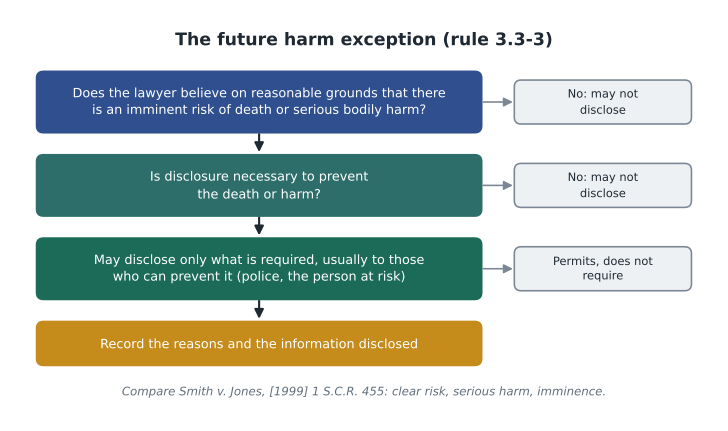
The leading case is Smith v. Jones, [1999] 1 S.C.R. 455. The accused, charged with aggravated sexual assault of a sex worker, was referred by his defence lawyer to a psychiatrist for an assessment that would help with the defence. The assessment was covered by solicitor-client privilege. During it, the accused described in detail a plan to kidnap, sexually assault and kill sex workers. The psychiatrist concluded that the accused was dangerous and would likely commit future offences, and brought an application to be allowed to disclose. A majority of the Supreme Court held that the public safety exception allowed privilege to be set aside where three factors are present: a clear risk to an identifiable person or group of persons, a risk of serious bodily harm or death, and imminence of the danger. The disclosure must be limited to what is necessary to prevent the harm. On the facts, the psychiatrist was permitted to disclose his opinion about the accused's dangerousness and the information on which it was based.
Law societies revised their future harm rules after Smith v. Jones to bring the professional rule closer to the case. The two are not identical: Smith v. Jones is about when a court will set aside privilege, while rule 3.3-3 is about when a lawyer may break confidence. In both, the threshold is high. Daniel Whitecloud points out that the identifiable group in Smith v. Jones was a vulnerable group whose members are often ignored, and that the Court treated them as worth protecting. Ogilvie says that is the right way to read the case.
Arjun Mehta asks what imminent means. The Court in Smith v. Jones said the nature of the threat must create a sense of urgency, though imminence may be satisfied by a deadline that is not immediate, if the threat is clear and serious. A vague statement of anger is not enough. A detailed plan with a date, a target and the means is.
Protecting confidences in practice
Most confidentiality breaches are careless rather than deliberate, so the duty includes taking reasonable care. That means keeping files secure, using encrypted devices, being careful with email autocomplete, not discussing files in public places, and thinking about what happens to client information when it is put into a cloud service or a generative artificial intelligence tool, as lesson 3 explained. It means being careful with metadata in documents sent to the other side, and with social media: a lawyer who posts that she had a great win in court today, with a photo outside the Corwin courthouse, may disclose enough for someone to identify the client. And it means training staff, who are bound by the lawyer's duty through the lawyer's supervision.
Worked problem
A client's threat
Wade Dunlevy, a Pardee & Lowe client in a wrongful dismissal claim, calls Maren late on a Friday. He is angry that the employer's lawyer has rejected his settlement offer. He says that his former supervisor, Gil Harker, ruined his life, that Harker will be at the company's warehouse on Monday morning, that he still has his hunting rifle in the truck, and that 'Harker is going to find out what it feels like.' Then he hangs up. Maren calls back and gets no answer.
Show solution
- Identify the duty. Everything Wade said is confidential under rule 3.3-1, and some of it may be privileged. Maren may disclose only if an exception applies.
- Apply rule 3.3-3. Does Maren believe on reasonable grounds that there is an imminent risk of death or serious bodily harm? A named target, a time, a place and a weapon point strongly toward yes. The urgency is real even though the threat is for Monday.
- Ask whether disclosure is necessary. Maren has tried to reach Wade and failed. If she cannot speak to him and satisfy herself that the risk has passed, disclosure to the police may be necessary to prevent the harm.
- Limit the disclosure. Maren should disclose only what is needed: the threat, the target, the time and place and the weapon. She should not disclose Wade's claim strategy or other confidential information.
- Seek advice and record it. If time permits, Maren should consult Warren Elsworth or the Law Society's practice management helpline, and she should make a careful note of what she knew, what she decided and what she disclosed.
Common mistakes
MistakeThinking information in the public record is not confidential.
InsteadRule 3.3-1 covers all information about the client's affairs acquired in the relationship, whatever its source and whether or not others know it.
MistakeTreating confidentiality and privilege as the same thing.
InsteadConfidentiality is an ethical duty covering all information; privilege is a legal rule protecting communications for legal advice, or for the dominant purpose of litigation, from compelled disclosure.
MistakeReporting a client's past crime to the police.
InsteadThere is no exception for past crimes. The lawyer must not assist concealment, but disclosure is permitted only under the listed exceptions.
MistakeBelieving the future harm exception requires disclosure.
InsteadRule 3.3-3 permits disclosure; it does not require it. Where disclosure is made, it must be limited to what is necessary to prevent the harm.
Practice problems
Work each problem on paper first, then reveal the answer to check.
What three factors did Smith v. Jones identify for the public safety exception?
Show answer
A clear risk to an identifiable person or group, a risk of serious bodily harm or death, and imminence of the danger.
An investigator under a provincial statute demands a lawyer's file, relying on a provision giving access to "any document". What should the lawyer do?
Show answer
Assert privilege on the client's behalf. Under Lizotte, a general provision does not abrogate litigation privilege without clear, explicit and unequivocal language, and solicitor-client privilege is even more strongly protected. The lawyer should not hand over privileged material unless a court orders it.
A former client sues the lawyer for negligence. May the lawyer disclose confidential information in her defence?
Show answer
Yes, under rule 3.3-4, but only to the extent necessary to defend against the allegations.
Summary and key terms
- Rule 3.3-1 requires strict confidence about all information concerning the client's affairs acquired in the relationship; the duty is indefinite.
- Solicitor-client privilege, a substantive and near-absolute rule after Descôteaux, Lavallee and Federation of Law Societies, protects communications for legal advice; litigation privilege is a class privilege after Lizotte and ends with the litigation.
- Exceptions to confidentiality include consent, legal compulsion, future harm under rule 3.3-3, the lawyer's self-defence, fee collection, seeking advice and conflict checks.
- Smith v. Jones allows privilege to yield where there is a clear risk to an identifiable person or group, of serious bodily harm or death, that is imminent.
- Most breaches are careless; reasonable care with technology, staff, social media and conversations is part of the duty.
- Duty of confidentiality
- The ethical duty in rule 3.3-1 to hold in strict confidence all information about a client's affairs acquired in the professional relationship.
- Solicitor-client privilege
- The legal protection of confidential communications made for the purpose of seeking or giving legal advice.
- Litigation privilege
- Protection of documents and communications made for the dominant purpose of existing or contemplated litigation, ending when the litigation ends.
- Future harm exception
- Rule 3.3-3, permitting limited disclosure to prevent an imminent risk of death or serious bodily harm.
- Public safety exception
- The exception to privilege recognized in Smith v. Jones.
- Waiver
- The client's giving up of privilege, expressly or by conduct; only the client can waive.
Lesson quiz · 5 questions
Score 60% or more to complete this lesson.
Create a free account to save your progress, take quizzes and earn a certificate.