
LAWC-214 · Lesson 12 of 12 · 23 min
Capstone: solving a professional responsibility problem
▶ Video coming soon A video version of this lesson is on the way.
On the last day of term Ogilvie asks the class to take out the folded paper from the first class, the one on which each of them wrote something they would refuse to do for a client. He does not ask anyone to read theirs aloud. He asks whether anyone wants to change what they wrote. About half the class raise their hands. 'Good,' he says. 'That means you learned that some of the things you thought were obviously wrong are sometimes required, and some of the things you thought were fine are not.' Then he hands out the capstone problem and the five rules for examination answers that he has repeated all term.
Ogilvie's five rules are these. First, spot every issue before writing about any of them; professional responsibility problems hide issues inside ordinary facts. Second, for each issue, name the interests, the duty and the decision-maker: whose interest, which duty, who decides. Third, cite the rule by number and the leading case by name, and explain them in a sentence; do not quote. Fourth, apply the rule to the facts, including the facts that cut the other way. Fifth, recommend concrete steps in the order the lawyer should take them, and say what she should write down.
The problem
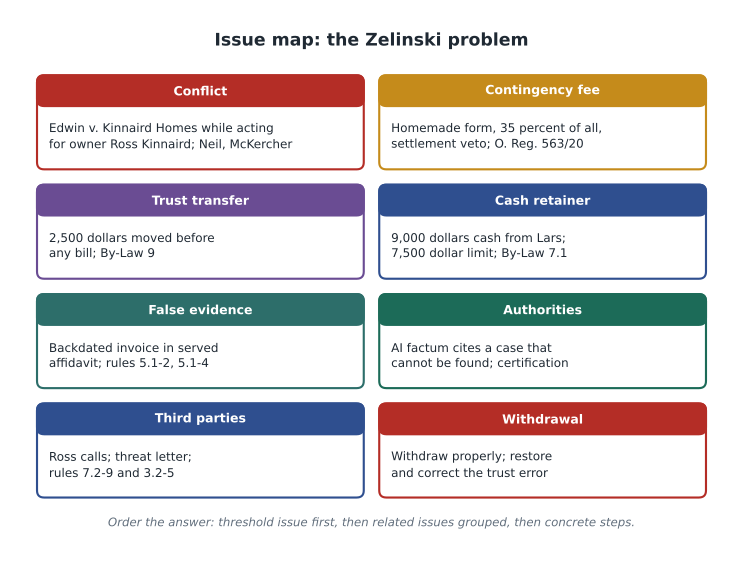
Renata Zelinski has practised alone on Kingsbury Street in Corwin for six years, doing civil litigation and some family law. Everything in this problem is hypothetical.
Two years ago Renata began acting for Ross Kinnaird in his separation from his wife. That matter is ongoing: the parties are negotiating a separation agreement, and Renata is waiting for financial disclosure. Ross owns Kinnaird Homes Ltd., a renovation company. Renata has never acted for the company, but in the family file she has reviewed its financial statements to value Ross's shares.
Three months ago, Edwin Sundqvist, a retired teacher, asked Renata to sue Kinnaird Homes for a botched kitchen renovation. He says the company took a 30,000 dollar deposit, did half the work badly and walked away. Renata's conflict check searched only for 'Sundqvist', so Kinnaird did not come up. She signed a retainer on her own one-page contingency fee form: 35 percent of any recovery, including costs, with a clause that Edwin will not settle without her written consent. Edwin cannot afford hourly rates.
Edwin's brother, Lars, came to the office with 9,000 dollars in cash in an envelope 'to cover the disbursements and anything else'. Renata did not ask where it came from. She deposited it into her trust account the same day. A week later, short of money to pay her assistant, she transferred 2,500 dollars of it to her general account, intending to bill for the work she had done once she found time to prepare an account. She has not yet billed.
In preparing Edwin's affidavit of documents, Renata noticed that one invoice, showing that Edwin paid an extra 4,000 dollars for upgraded cabinets, looks newer than the others. When she asked, Edwin admitted he typed it up last month 'to match what really happened', because the original was lost. The affidavit, with the invoice listed, was served last week.
Kinnaird Homes brought a motion to dismiss the claim on a technical ground. With the motion two days away, Renata used a generative tool to draft her factum. It cited five cases. She found four on CanLII. The fifth, which the tool described as a recent Divisional Court decision directly on point, she cannot find anywhere.
Yesterday, Kinnaird Homes' lawyer got off the record. Ross Kinnaird phoned Renata, upset. He said, 'Renata, you're my lawyer, what is going on? Can we just sort this out between us?' Edwin, meanwhile, wants Renata to send a letter saying that unless Kinnaird Homes pays his claim in full within seven days, he will report the company to the Ministry for working without permits and to the police for fraud. He also said, 'One way or another, Ross Kinnaird is going to pay for this.'
Identify the professional responsibility issues and advise Renata on what she must do, in order.
Model answer: issue spotting
A strong answer starts by listing the issues: the conflict of interest between Ross and Edwin; the defective conflict check; the contingency fee agreement; the cash retainer and client identification; the trust transfer; the backdated invoice and the served affidavit; the unverified authority in the factum; Ross's phone call and the represented and unrepresented person rules; the proposed threat letter; Edwin's remark about Ross; and the consequences, including withdrawal and Renata's own duty to correct her trust error. The rest of the answer works through them, beginning with the issue that affects everything else: whether Renata can act at all.
Issue 1: the conflict
Whose interest and which duty? Renata currently acts for Ross in his separation and, at the same time, for Edwin against Ross's company. Under the bright line rule in R. v. Neil and Canadian National Railway Co. v. McKercher LLP, a lawyer may not act for one current client against another current client whose immediate legal interests are directly adverse, even in an unrelated matter, without informed consent from both. Is Ross's interest directly adverse? The defendant is Kinnaird Homes, not Ross personally. But Ross is the company's sole owner, the claim affects the value of the very shares Renata is valuing in the separation, and Ross plainly sees Renata as his lawyer. A careful answer argues both sides and concludes that the risk of material adverse effect on Renata's loyalty to Ross is substantial under rule 3.4-1, whether or not the strict bright line rule is triggered by the corporate form. She also holds confidential information about Kinnaird Homes' finances from the family file, which could be used against the company in Edwin's claim, raising the concerns behind rule 3.4-10 and MacDonald Estate v. Martin even though Ross is a current, not former, client.
Can consent cure it? Rule 3.4-2 requires informed consent from both clients and a reasonable conclusion that Renata can act for each without material adverse effect. Ross is unlikely to consent to his own lawyer suing his company, and Renata cannot use what she knows from his file. It is not reasonable to conclude she could represent both properly. Ross is not a professional litigant. The conclusion: Renata cannot continue for Edwin against Kinnaird Homes. Whether she can continue for Ross depends on whether her work for Edwin has compromised her loyalty to him; at minimum she must tell Ross, as McKercher's duty of candour requires, and he may choose new counsel. Renata must not drop Ross to keep Edwin, which would repeat McKercher's hot potato error. The defective conflict check is itself a competence and practice management failure under rule 3.1-2: a conflict search must cover the opposing parties and related persons, not just the new client.
Issue 2: the contingency fee agreement
Renata's agreement does not comply with O. Reg. 563/20. A percentage-based agreement with an individual client must use the Law Society's standard form, which hers is not. The fee must be calculated on a recovery that excludes disbursements allowed against the other side, and the total fee may never exceed what Edwin recovers, including costs and excluding disbursements and taxes; her form says 35 percent of any recovery including costs, without the cap or the disbursement rule. And the settlement veto is prohibited: the regulation forbids terms requiring the lawyer's consent before the client may settle. A non-compliant agreement is open to challenge on an assessment, and the fee must still be fair and reasonable under rule 3.6-1. If Edwin's matter continues with new counsel, Renata's entitlement for work done will be assessed on a fair and reasonable basis; she should not try to enforce the defective agreement.
Issues 3 and 4: the cash and the trust account
By-Law 9 prohibits receiving cash of 7,500 dollars or more in respect of a client matter, subject to exceptions that do not apply to a retainer from a client's brother. Renata should not have accepted the 9,000 dollars. She also had to identify her client and, because she was receiving funds, verify his identity and ask about the source of the funds under By-Law 7.1; she did neither for Lars's money. The cash should be returned, by trust cheque rather than in cash, to the person who provided it, after taking advice on how to do so properly, and the facts recorded.
The 2,500 dollar transfer is more serious. Money on account belongs to the client until the lawyer has delivered a bill. Transferring it to pay the assistant, before any bill, is a withdrawal from trust for an unauthorized purpose. Even if Renata had done work worth more than 2,500 dollars, the transfer was premature, and her trust ledger for Edwin is now wrong. She must immediately restore the money to trust from her own funds, correct her records, and get advice about whether and how to report the trust error to the Law Society. Hiding it would turn a serious error into misappropriation and dishonesty. She should seek advice from the Society's practice management helpline today. Ogilvie reminds the class that a lawyer who restores a shortfall, reports it and fixes her systems is in a very different position before the Tribunal from one who conceals it.
Issue 5: the backdated invoice
Edwin has created a document and Renata has served an affidavit of documents listing it as if it were original. Renata did not know when the affidavit was served, but she knows now. Rule 5.1-4 provides that a lawyer who has unknowingly done something that would have breached the rules if done knowingly must, subject to confidentiality, disclose the error and do all that can reasonably be done to rectify it. She must not rely on the invoice. She must urge Edwin to correct the record by serving a corrected affidavit of documents that identifies the document for what it is, a reconstruction prepared last month, and explains that the original was lost. If Edwin refuses, Renata cannot continue and must withdraw, without disclosing his confidences beyond what the rules permit. Since she must withdraw anyway because of the conflict, she should explain to Edwin in writing that any successor counsel will face the same obligation.
Issue 6: the factum
Renata cannot file a factum citing a case she cannot find. Competence under rule 3.1-2 and the duty not to misstate the law under rule 5.1-2 forbid it, and Ontario's Rules of Civil Procedure require her to certify that she is satisfied as to the authenticity of every authority and the accuracy of quotations. Zhang v. Chen and Ko v. Li show the consequences: personal costs and the threat of contempt. She must remove the fifth case and read the four she found to confirm they say what the tool claimed. But because of the conflict, she should not be arguing this motion for Edwin at all. The urgent step is to tell Edwin she cannot continue, help him get new counsel quickly, and, if necessary, seek an adjournment so that he is not prejudiced by her withdrawal.
Issue 7: Ross's call and the threat letter
When Ross called, Kinnaird Homes was unrepresented, but Ross himself is Renata's client in the family matter. That makes the call a striking illustration of the conflict: Ross thinks she is his lawyer and wants to sort out the dispute with her. Renata must not negotiate Edwin's claim with Ross and must not give Ross advice about it. On the company's behalf, rule 7.2-9 would require her to urge it to get a lawyer and make clear she is acting only for Edwin, but she should not be acting for Edwin at all. She should tell Ross that she cannot discuss the claim and that she will be writing to him about the situation.
The proposed letter is prohibited regardless. Rule 3.2-5 forbids a lawyer from threatening a criminal or regulatory complaint to gain a benefit for the client. Renata must refuse to send it and explain to Edwin why. He is free to report a crime himself, but she cannot use the threat as leverage.
Issue 8: Edwin's remark
Edwin's statement that Ross 'is going to pay for this, one way or another' is confidential. Under rule 3.3-3, Renata may disclose confidential information only if she believes on reasonable grounds that there is an imminent risk of death or serious bodily harm and disclosure is necessary to prevent it. Nothing here suggests violence: no weapon, no plan, no time, no history of threats, and in context the remark is most naturally read as about money. Applying Smith v. Jones by analogy, there is no clear, serious and imminent danger. She may not disclose it. A careful answer notes the analysis and records that she considered it.
The recommended steps, in order
First, today, restore the 2,500 dollars to trust from her own funds, correct her records and call the Law Society's practice management helpline about the trust error, the cash and the conflict. Second, write to Edwin explaining that she has a conflict and must withdraw, that he needs new counsel immediately, that the agreement she used does not comply with the regulation and she will not enforce it, that the invoice must be corrected, and that she cannot send the threat letter. Third, take steps to protect Edwin from prejudice: seek an adjournment of the motion, or a consent extension, and, if she is the lawyer of record, bring a motion under rule 15.04 to be removed if he has not appointed new counsel. Fourth, return Lars's cash by trust cheque after taking advice and record the transaction. Fifth, tell Ross, in writing, that she had been retained by a client against his company, that she has withdrawn from that matter, and that he is free to seek other counsel for his separation; continue for Ross only if she reasonably concludes her loyalty to him has not been compromised. Sixth, cooperate fully with new counsel for Edwin, transferring the file and accounting for the trust money. Seventh, fix her systems: a conflict check that searches all parties and related persons, a trust procedure that never moves money without a bill, and a rule that nothing goes into a factum until she has read it.
Reflection
Ogilvie asks the class what went wrong for Renata, at bottom. Theo Marchetti says she was busy and alone. Sophie Tremblay-Hart says she did not have systems. Daniel Whitecloud says she treated each problem as separate, when they were connected. Ogilvie agrees with all three and adds the last word of the course: 'Ask early, write it down, and remember that the rule is the floor.' Then he tells them that examinations are in April, and that he will be in his office all week.
Worked problem
Ranking the issues
In the examination, a student has ninety minutes for the Zelinski problem. She has spotted eight issues. How should she allocate time and order her answer?
Show solution
- Start with the threshold issue. Whether Renata can act at all, the conflict, shapes every other recommendation, so it comes first and gets the most time.
- Group related issues. The cash and the trust transfer are both By-Law 9 and 7.1 issues; the invoice and the factum are both duties to the court.
- Give the most serious regulatory risk real attention. The premature trust transfer can end a career if mishandled; explain why restoring and reporting matters.
- Keep short issues short. The threat letter and Edwin's remark each need a rule, an application and a conclusion in a paragraph.
- Finish with steps. A numbered list of what Renata does, in order, shows judgment and earns marks that a summary of rules cannot.
Common mistakes
MistakeWriting about each issue as soon as it is spotted.
InsteadSpot every issue first, then order them, beginning with threshold issues such as conflicts that determine whether the lawyer can act.
MistakeConcluding that there is no conflict because the defendant is a corporation.
InsteadAnalyze the substance: the owner is a current client, the claim affects his interests and the lawyer holds his confidential information. Rule 3.4-1 asks about substantial risk of material adverse effect.
MistakeRecommending that the lawyer quietly put the trust money back and move on.
InsteadRestore it, correct the records, get advice and consider the duty to report. Concealment converts an error into dishonesty.
MistakeRecommending withdrawal without addressing prejudice to the client.
InsteadWithdrawal requires reasonable notice and steps such as an adjournment, file transfer and, for a lawyer of record, a rule 15.04 motion.
Practice problems
Work each problem on paper first, then reveal the answer to check.
Why should Renata not simply end her retainer with Ross to keep acting for Edwin?
Show answer
Because McKercher holds that a lawyer cannot terminate a current client to escape the duty of loyalty; that would breach the duty of commitment to Ross's cause, and she would still hold his confidential information.
What three features of Renata's contingency fee agreement breach O. Reg. 563/20?
Show answer
It is not the Law Society's standard form; it applies the percentage to the whole recovery including costs, without the cap at the client's recovery or the exclusion of disbursements; and it requires her consent to settle.
May Renata disclose Edwin's remark about Ross to anyone?
Show answer
No. Nothing suggests an imminent risk of death or serious bodily harm, so rule 3.3-3 does not permit disclosure. She should record that she considered it.
Summary and key terms
- Spot all issues first, then analyze each by interests, duty and decision-maker, citing the rule and leading case and applying them to the facts.
- Threshold issues such as conflicts come first; a lawyer who cannot act must withdraw properly and protect the client from prejudice.
- Trust and cash errors must be corrected immediately and openly; concealment is far worse than the original mistake.
- Duties to the court require correcting misleading evidence under rule 5.1-4 and verifying every authority before certifying a factum.
- Finish with concrete, ordered steps and a record of what the lawyer considered and did.
- Issue spotting
- Identifying every legal and ethical problem in a fact pattern before analyzing any of them.
- Threshold issue
- An issue, such as a conflict of interest, whose answer determines whether other issues arise.
- Hot potato
- Dropping a current client to take on a matter against it, which McKercher condemns.
- Trust shortfall
- A situation in which a trust account holds less for a client than the ledger requires.
- Corrected affidavit of documents
- A further affidavit correcting an earlier affidavit of documents that was inaccurate or incomplete.
- Practice management helpline
- The Law Society's confidential advisory service for licensees with questions about the rules.
Lesson quiz · 5 questions
Score 60% or more to complete this lesson.
Create a free account to save your progress, take quizzes and earn a certificate.