
LAWC-214 · Lesson 3 of 12 · 21 min
Competence, quality of service and technology
▶ Video coming soon A video version of this lesson is on the way.
Ogilvie starts with a story he says he has told at every bar admission course for a decade, with the details changed. A capable lawyer with a busy practice took on a slip and fall claim as a favour for a friend's mother. The file went into a drawer while a trial took over his month. When he took it out, the limitation period had passed by eleven days. 'He was not dishonest,' Ogilvie says. 'He was not stupid. He was busy, and he said yes to something he did not have the system to handle. Most complaints against lawyers are not about lying. They are about files that went quiet.'
This lesson covers the duties of competence and quality of service in sections 3.1 and 3.2 of the Model Code, the separate question of what to do when a lawyer makes a mistake, and the rapidly developing law on technology and generative artificial intelligence.
What competence means
Rule 3.1-2 requires a lawyer to perform all legal services undertaken on a client's behalf to the standard of a competent lawyer. Rule 3.1-1 defines a competent lawyer as one who has and applies the relevant knowledge, skills and attributes in a manner appropriate to each matter undertaken. The definition then lists what that includes: knowing the general legal principles and procedures and the substantive law and procedure for the areas in which the lawyer practises; investigating facts, identifying issues, ascertaining client objectives and considering possible options; implementing the chosen course of action through legal research, analysis, writing, advocacy, negotiation and the like; communicating at all relevant stages in a timely and effective manner; performing all functions conscientiously, diligently and in a timely and cost-effective manner; applying intellectual capacity, judgment and deliberation; complying in letter and spirit with the rules; recognizing limitations in one's ability to handle a matter and taking steps to address them; managing one's practice effectively; and pursuing appropriate professional development.
Two features of the definition matter in practice. First, competence is matter-specific. A senior tax lawyer is not competent to run a jury trial simply because she is senior. The commentary says a lawyer should not undertake a matter without honestly feeling competent to handle it, or being able to become competent without undue delay, risk or expense to the client. The alternatives are to decline, to refer the client, or to work with or consult a lawyer who is competent in the area, with the client's consent. Second, competence includes practice management. A lawyer with excellent legal knowledge who has no system for tracking limitation periods is not competent, as Ogilvie's story shows.
Competence also has a cultural dimension. Lesson 2 noted that the Federation has consulted on amendments that would make express what the rule already implies: a lawyer acting for Indigenous clients, or in matters touching Aboriginal and treaty rights, needs the knowledge those matters require. The same logic applies to clients who speak another language, who have disabilities, or who come from communities with distinct experiences of the justice system.
Competence, negligence and discipline
Incompetence is not the same thing as negligence, although they overlap. Negligence is a civil wrong: the client sues for the loss caused by a lawyer's failure to meet the standard of care, and LawPRO, the mandatory insurer, usually responds. Incompetence is a regulatory concept: the Law Society can investigate and the Law Society Tribunal can make orders when a licensee fails to meet the standards of competence. A single honest mistake, such as a missed deadline, may be negligent without being professional misconduct. A pattern of neglected files, unanswered calls and missed dates is likely to be both. The Law Society Act also allows a competence application, which can lead to orders such as a practice review, supervision or restrictions, rather than punishment.
Ontario requires licensees to keep up their competence through continuing professional development: twelve hours a year, of which at least three must be on professionalism topics such as ethics, professional responsibility and practice management. The Society also runs practice reviews, spot audits of trust accounts and a practice management helpline that licensees can call for confidential guidance on the rules. Ogilvie tells the class that calling the helpline early is one of the best habits a lawyer can have. A lawyer who called the helpline, followed the advice and documented the call is in a much better position than one who guessed.
Quality of service
Rule 3.2-1 requires a lawyer to provide courteous, thorough and prompt service to clients, and the quality of service must be competent, timely, conscientious, diligent, efficient and civil. The commentary lists examples of expected practices: keeping the client reasonably informed, answering reasonable requests from the client for information, responding to the client's telephone calls and emails within a reasonable time, meeting deadlines unless the lawyer can offer a reasonable explanation and give advance notice, and advising the client promptly when the lawyer will not be able to meet a commitment. None of this is glamorous. Ogilvie points out that most complaints to the Law Society are about service, not ethics in the dramatic sense.
Rule 3.2-2 requires a lawyer to be honest and candid when advising clients. A lawyer must tell the client the truth about the strength of the case, even when the client does not want to hear it, and must not give advice that the lawyer knows the client wants to hear but is wrong. Rule 3.2-4 requires a lawyer to advise and encourage a client to compromise or settle a dispute whenever it is possible to do so on a reasonable basis, and to discourage the client from commencing or continuing useless legal proceedings. A lawyer whose fee depends on the case continuing has an obvious incentive to ignore this rule, which is part of why it exists.
Limited scope retainers
Many people cannot afford a lawyer for an entire case. A limited scope retainer, sometimes called unbundled services, lets a lawyer provide part of the work, such as advice on a motion, drafting a document or appearing at one hearing, while the client does the rest. The Model Code permits limited scope retainers, and Ontario's rules expressly provide for them, but the lawyer must make sure the client understands the limits. Before undertaking a limited scope retainer, the lawyer must advise the client honestly and candidly about the nature, extent and scope of the services and whether they can be provided within the financial means of the client, and should confirm the arrangement in writing. A limited scope retainer does not reduce the standard of care for the services the lawyer does provide. It only limits which services those are. Lesson 11 returns to limited scope work as an access to justice tool.
When the lawyer makes a mistake
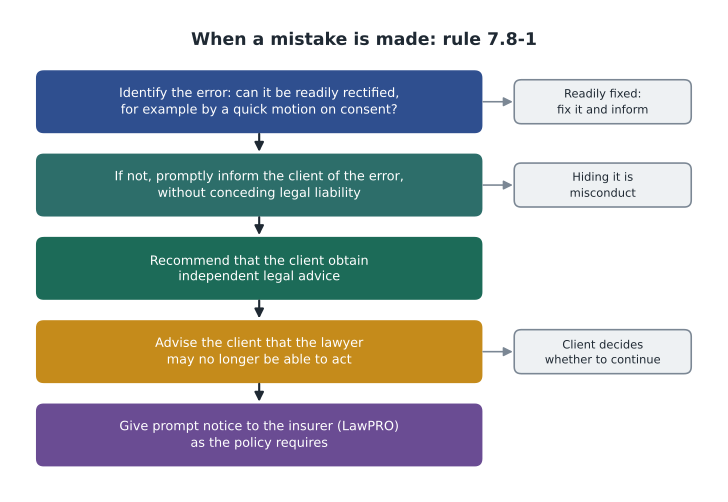
Every lawyer makes mistakes. The rules care most about what the lawyer does next. Rule 7.8-1, on errors and omissions, provides that when a lawyer discovers an error or omission in a matter for which she is responsible that is or may be damaging to the client and cannot be rectified readily, she must promptly inform the client of the error or omission without conceding legal liability, recommend that the client obtain legal advice elsewhere about any rights the client may have, and advise the client that in the circumstances the lawyer may no longer be able to act. The lawyer must also give prompt notice to the insurer as the policy requires. LawPRO's policy depends on early notice, and a lawyer who sits on a claim can jeopardize coverage.
The rule reflects a basic truth about the relationship. The lawyer's interest, once a mistake is made, is to minimize it; the client's interest is to know about it and decide what to do. The lawyer cannot resolve that conflict alone. Hiding the error, or quietly trying to fix it without telling the client, is a much more serious breach than the error itself. Theo Marchetti says that in his years as a law clerk the files that turned into disasters were never the ones where somebody made an error. They were the ones where somebody hid it.
Technology and competence
Since 2019 the Model Code commentary on competence has said expressly that a lawyer should develop an understanding of, and ability to use, technology relevant to the nature and area of the lawyer's practice and responsibilities, and should understand the benefits and risks of that technology, including risks to confidentiality. In practical terms, a litigator must know how to manage electronic documents and preserve electronic evidence, a real estate lawyer must understand electronic registration and the risks of title fraud, and every lawyer must understand email security and the danger of payment instructions that arrive by email. Technological competence is not a separate duty. It is part of what competence now means.
Generative artificial intelligence
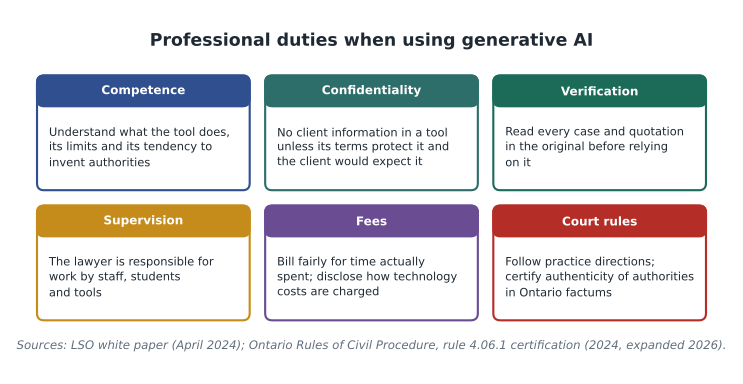
Generative artificial intelligence tools that draft text, summarize documents and answer legal questions are now widely used in law offices. They create risks that fit neatly into existing rules. In April 2024 the Law Society of Ontario published a white paper on licensee use of generative artificial intelligence, with a checklist and practice tips. It does not create new rules. It explains how the existing rules apply: competence requires a lawyer to understand what a tool does and how it can fail; confidentiality requires care before entering client information into a tool whose terms allow the provider to use or store it; the duty to supervise applies to work produced by tools as it does to work produced by staff; fees must be fair and reasonable, which means a lawyer cannot bill for hours a tool saved; and the duty of candour may require a lawyer to tell the client how the work is being done.
The best-known risk is that generative tools can produce authorities that do not exist, or misstate real ones, in fluent and confident prose. Courts have responded in two ways. The first is through rules and practice directions. The Federal Court issued a notice in December 2023, updated in May 2024, requiring parties to declare in the first paragraph of a document if it contains content created or generated by artificial intelligence. In Ontario, amendments to the Rules of Civil Procedure that came into force on December 1, 2024 require a factum to include a statement by the lawyer certifying that she is satisfied as to the authenticity of every authority cited, and further amendments in force on September 1, 2026 require a certification about the accuracy of quotations. Expert reports must carry a similar certification.
The second response is through costs and contempt. In Zhang v. Chen, 2024 BCSC 285, a lawyer filed a notice of application in a family case citing two cases that did not exist, which had been generated by an artificial intelligence tool. She withdrew them when opposing counsel could not find them. The court declined to award special costs against her but ordered her to personally pay the costs caused by the fictitious citations, and stressed that the tools are no substitute for the professional expertise the justice system requires of lawyers. In Ko v. Li, 2025 ONSC 2766, an Ontario judge found that a factum cited cases that did not exist or did not say what they were cited for, and required the lawyer to show cause why she should not be cited for contempt. The lawyer acknowledged the errors, apologized and undertook to complete professional development, and the court did not proceed further. In Hussein v. Canada (Immigration, Refugees and Citizenship), 2025 FC 1060, the Federal Court awarded costs where counsel had relied on non-existent authorities and had not been candid about the use of artificial intelligence.
Ogilvie's conclusion is blunt. 'The rule has not changed since the first lawyer copied a citation from someone else's brief without reading the case. If you did not read it, you cannot cite it.' He credits the line to Professor Saltire, who taught the class legal research and writing in first year.
Worked problem
Maren and the research memo
Warren Elsworth asks Maren for a memo by morning on whether Rosa Ingram can rely on an exception to the sixty-day notice requirement in section 6.1 of the Occupiers' Liability Act. Maren is tired and asks a generative tool licensed by the firm to summarize the case law. It produces a tidy list of six Ontario decisions with neutral citations and short quotations. She has an hour before she must send the memo.
Show solution
- Check the tool's terms before using it. The firm's licensed tool is approved for client work, but Maren should not paste privileged documents from Rosa's file into it unless firm policy and the terms allow it.
- Treat the output as a lead list, not research. Maren must find each decision on CanLII or a commercial service and read the relevant parts. Any case she cannot find must be discarded.
- Check quotations against the original. A real case can be misquoted, and under Ontario's rules any later factum will need a certification of authenticity and, since September 2026, of accurate quotations.
- Be candid about limits. If she cannot verify all six by morning, the memo should say which authorities have been confirmed and which have not, rather than presenting unverified results as research.
- Record time fairly. Maren should bill for the time she actually spent, not for the time the task would have taken without the tool.
Common mistakes
MistakeThinking competence is about general seniority or experience.
InsteadCompetence is matter-specific. A lawyer must have, or be able to acquire without undue delay, risk or expense, the knowledge and skills each matter requires, or decline or associate with someone who has them.
MistakeFixing an error quietly without telling the client.
InsteadRule 7.8-1 requires prompt disclosure of an error that may damage the client and cannot be readily rectified, a recommendation of independent advice, and notice to the insurer.
MistakeBelieving a limited scope retainer lowers the standard of care.
InsteadIt limits which services are provided. Those services must still be competent, and the client must understand the limits, preferably in writing.
MistakeTreating the LSO white paper as a new set of rules about artificial intelligence.
InsteadIt applies existing rules on competence, confidentiality, supervision, fees and candour to the use of generative tools. Court rules and practice directions add specific certification requirements.
Practice problems
Work each problem on paper first, then reveal the answer to check.
A real estate lawyer agrees to defend a client on an impaired driving charge because the client is a long-standing friend. What should she consider?
Show answer
Whether she is competent to handle the matter or can become competent without undue delay, risk or expense to the client. If not, she should decline, refer the client or, with consent, work with a competent criminal lawyer.
What must an Ontario lawyer now certify in a factum, and since when?
Show answer
That she is satisfied as to the authenticity of every authority cited, since December 1, 2024, and, since September 1, 2026, as to the accuracy of quotations.
What was the main consequence for the lawyer in Zhang v. Chen?
Show answer
She was ordered to personally pay the costs caused by the fictitious citations. The court declined to order special costs.
Summary and key terms
- Rule 3.1-2 requires the standard of a competent lawyer; competence is matter-specific and includes practice management.
- Rule 3.2-1 sets the quality of service expected; rules 3.2-2 and 3.2-4 require candour and encouraging reasonable settlement.
- Limited scope retainers are allowed if the client understands the limits; the standard of care for services provided is unchanged.
- Rule 7.8-1 requires prompt disclosure of damaging errors, a recommendation of independent advice and notice to the insurer.
- Technological competence is part of competence; generative AI use is governed by existing rules, the LSO white paper of April 2024, court practice directions and Ontario's factum certification rules.
- Competent lawyer
- Under rule 3.1-1, a lawyer who has and applies the relevant knowledge, skills and attributes appropriately to each matter undertaken.
- Quality of service
- The duty in rule 3.2-1 to provide courteous, thorough, prompt and competent service.
- Limited scope retainer
- An arrangement in which a lawyer provides only part of the legal services in a matter, with the client handling the rest.
- Continuing professional development
- The annual learning hours Ontario licensees must complete, including hours on professionalism.
- Hallucinated authority
- A case, statute or quotation generated by an artificial intelligence tool that does not exist or does not say what the tool claims.
- Errors and omissions notice
- The prompt notice a lawyer must give to the insurer of a potential claim arising from a mistake.
Lesson quiz · 5 questions
Score 60% or more to complete this lesson.
Create a free account to save your progress, take quizzes and earn a certificate.