
LAWC-214 · Lesson 7 of 12 · 22 min
Conflicts of interest
▶ Video coming soon A video version of this lesson is on the way.
Ogilvie draws a small table on the board with four chairs around it. 'A lawyer is the person who sits on one side of this table,' he says. 'A conflict of interest is any situation in which you find yourself drifting toward the other side, or wanting to sit at both ends at once, or bringing your own chair.' He adds the lesson's most practical sentence: most conflict disasters are not caused by bad faith. They are caused by a firm that did not run a conflict check, or ran one and did not read it.
This lesson covers the definition of a conflict of interest, the rules on consent, current clients, joint retainers, former clients and the lawyer's own interests, and the four Supreme Court of Canada cases that every Canadian lawyer must know: MacDonald Estate v. Martin, R. v. Neil, Strother v. 3464920 Canada Inc. and Canadian National Railway Co. v. McKercher LLP.
What a conflict is
Rule 1.1-1 defines a conflict of interest as the existence of a substantial risk that a lawyer's loyalty to or representation of a client would be materially and adversely affected by the lawyer's own interest or the lawyer's duties to another client, a former client or a third person. Three words in the definition do the work. The risk must be substantial: a speculative or remote possibility is not enough. The effect must be material and adverse: it must matter, and it must cut against the client. And the source can be any competing interest or duty, including the lawyer's own business, family or financial interests.
Rule 3.4-1 provides that a lawyer must not act or continue to act for a client where there is a conflict of interest, except as permitted under the rules. The commentary explains that conflicts can arise at the start of a retainer or develop during it, and that the duty is continuing: a lawyer who had no conflict when she took a file must withdraw or obtain consent if one arises later.
Consent
Rule 3.4-2 permits a lawyer to act despite a conflict if there is express or implied consent from all affected clients and it is reasonable for the lawyer to conclude that she is able to represent each client without having a material adverse effect upon the representation of or loyalty to the other client. Both parts matter. Consent must be informed: the client must understand the relevant circumstances and the reasonably foreseeable ways the conflict could affect its interests. A lawyer cannot obtain informed consent without disclosing enough information to make it meaningful, and sometimes the lawyer's duty of confidentiality to the other client makes that impossible. Consent should be in writing, or confirmed in writing. And consent does not cure everything: if a reasonable lawyer could not conclude that she can represent both clients properly, consent is not enough.
The commentary recognizes implied consent in a narrow situation: some sophisticated clients, such as governments, financial institutions and publicly traded corporations, can reasonably be taken to accept that their lawyers will act against them in unrelated matters, given how often they retain many firms. This idea, the professional litigant, became important in McKercher.
Current clients and the bright line
The most important source of conflicts is acting against a current client. In R. v. Neil, 2002 SCC 70, a law firm in Edmonton acted for Neil, a paralegal facing fraud charges, and at the same time acted for a former associate of Neil's in another matter, using Neil's legal troubles to that client's advantage. Justice Binnie, for the Supreme Court, described the duty of loyalty and stated what has become known as the bright line rule: a lawyer may not represent one client whose interests are directly adverse to the immediate interests of another current client, even if the two mandates are unrelated, unless both clients consent after receiving full disclosure and the lawyer reasonably believes that she is able to represent each client without adversely affecting the other. The Court found a breach of loyalty in Neil but did not order a new trial, because the conflict had not impaired the defence in the trial itself.
In Canadian National Railway Co. v. McKercher LLP, 2013 SCC 39, the Court restated the rule. McKercher, a large Saskatchewan firm, was acting for CN on several matters when it accepted a retainer to act for a representative plaintiff in a proposed class action against CN claiming 1.75 billion dollars. It did not tell CN first. When CN was served, the firm terminated some of its CN retainers. Chief Justice McLachlin, for a unanimous Court, held that the bright line rule applies when the immediate legal interests of two current clients are directly adverse in the matters on which the lawyer is acting, whether or not the matters are related. Directly adverse means adverse legal interests, not merely commercial or strategic ones: acting for a client's competitor in an unrelated matter is generally not a conflict. The rule does not apply where it would be unreasonable for a client to expect that its law firm will not act against it in unrelated matters, which is the professional litigant point; nor may a party invoke it for tactical abuse.
McKercher breached three duties. It breached the bright line rule by accepting the class action retainer without CN's informed consent. It breached its duty of commitment to CN's cause by terminating CN's retainers to get out of the conflict; a firm cannot fire a client like a hot potato to take on a more lucrative matter against it. And it breached its duty of candour by not telling CN it was taking on the class action. On remedy, the Court held that disqualification may be required to prevent misuse of confidential information, to prevent impaired representation, or to maintain public confidence in the administration of justice, and that a breach of the bright line rule normally supports disqualification even where the relationship has ended. Factors such as delay in bringing the motion, prejudice to the new client and the firm's good faith may weigh against it. The Court sent the remedy question back to the trial court.
The lawyer's own interests
A lawyer's own interests can conflict with the client's. Strother v. 3464920 Canada Inc., 2007 SCC 24, is the leading example: a lawyer advising a client on tax-assisted film financing went into business, while still retained, exploiting a similar opportunity for himself, and told the client nothing. The Court held that he breached his fiduciary duty and required him to disgorge his profits. Rules in section 3.4 deal with specific personal interests: doing business with a client, borrowing from a client, guaranteeing a client's debts, receiving gifts or testamentary benefits from a client, and acting where the lawyer has a family or personal relationship with someone involved. The common requirements are full disclosure, fairness, and, in most cases, that the client receive independent legal advice. A lawyer generally may not borrow money from a client unless the client is a lending institution or a related person, and a lawyer asked to draft a will that gives her a gift should insist that the client receive independent legal advice, if she accepts the work at all.
Third-party payers, such as an insurer paying defence counsel or a parent paying for a child's lawyer, create another kind of conflict. The client is the person the lawyer represents, not the person who pays. The lawyer must make sure the payer does not direct the representation in a way that harms the client, and must not share confidential information with the payer without the client's consent. Insurance defence work is the classic example: the lawyer acts for the insured and often for the insurer as well, and if their interests diverge, for example on a coverage question, the lawyer must not advise the insurer against the insured.
Joint retainers
Lawyers often act for more than one client in the same matter: spouses buying a house, partners forming a business, co-plaintiffs in an accident claim. Rule 3.4-5 requires that before accepting a joint retainer, the lawyer advise each client that the lawyer has been asked to act for both or all of them, that no information received in connection with the matter from one client can be treated as confidential so far as the others are concerned, and that if a conflict develops that cannot be resolved, the lawyer cannot continue to act for both or all of them and may have to withdraw completely. Joint retainers are efficient but fragile. When co-plaintiffs disagree about how to divide a settlement, or business partners fall out, the lawyer usually cannot pick a side, and both clients must find new lawyers.
Ontario adds a specific rule for real estate. Subject to narrow exceptions, a lawyer must not act for both the transferor and the transferee in a transfer of title to real property. The risks of acting for both sides of a sale, where price, conditions and closing problems put the parties in direct conflict, are considered too great.
Former clients
Rule 3.4-10 provides that, unless the former client consents, a lawyer must not act against a former client in the same matter, in any related matter, or, save as provided by the rules, in any new matter if the lawyer has relevant confidential information arising from the representation of the former client that may prejudice that client. The duty is about confidential information and loyalty to past work: a lawyer cannot change sides in the same dispute, cannot attack the work she did for the former client, and cannot use what she learned.
The leading case is MacDonald Estate v. Martin, [1990] 3 S.C.R. 1235. A junior lawyer who had worked on one side of a lawsuit, and had been privy to the client's confidences, moved to the firm acting for the other side. Justice Sopinka, for the majority, set out a two-part test. First, did the lawyer receive confidential information attributable to a solicitor-client relationship relevant to the matter at hand? Once a previous relationship sufficiently related to the current retainer is shown, the court should infer that confidential information was imparted unless the lawyer satisfies the court that no information was imparted that could be relevant; the burden is heavy. Second, is there a risk that it will be used to the prejudice of the client? The court will infer that lawyers who work together share confidences, unless there is clear and convincing evidence that all reasonable measures have been taken to ensure that no disclosure will occur. The standard is whether a reasonably informed member of the public would be satisfied that no use of confidential information would occur. The firm in MacDonald Estate was disqualified.
Changing firms and screens
MacDonald Estate led to detailed rules on lawyers who move between firms. The rules require the new firm to determine whether the transferring lawyer has relevant confidential information about a matter the new firm is handling against the lawyer's former clients and, if so, either decline to act, obtain the former client's consent, or show that it is reasonable to continue in the circumstances with appropriate measures, typically a screen. A screen, sometimes still called an ethical wall, isolates the transferring lawyer from the file: she does not work on it, discuss it or have access to its documents, and the other lawyers and staff are told so in writing. A screen must be put in place before any risk of disclosure arises and its existence should be communicated to the former client. A screen will not always be enough: if the transferring lawyer was deeply involved in the very matter, or the firm is small and physically integrated, a court may conclude that no screen can satisfy the reasonably informed member of the public.
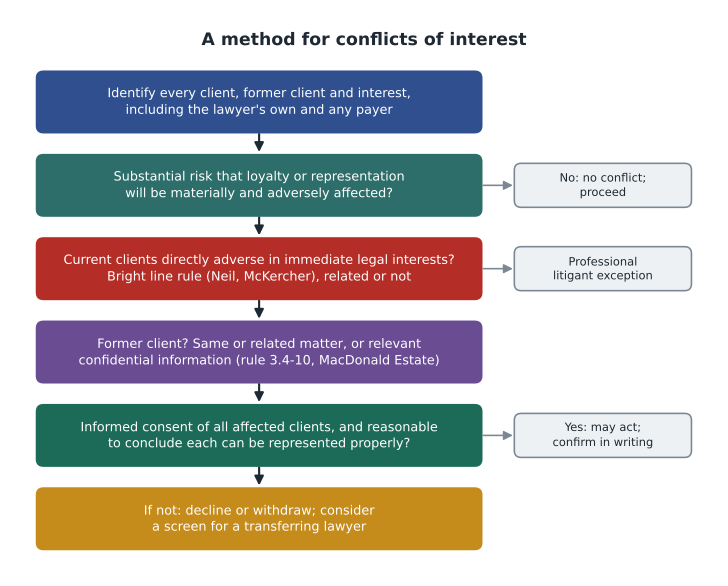
A method
Ogilvie gives the class a checklist. First, identify every party, client, former client and interested person, including the lawyer's own interests and any payer. Second, ask whether there is a substantial risk of material adverse effect. Third, if there are two current clients whose immediate legal interests are directly adverse, apply the bright line rule. Fourth, if a former client is involved, apply rule 3.4-10 and MacDonald Estate. Fifth, ask whether every affected client can give informed consent and whether it is reasonable to conclude the lawyer can act for each properly. Sixth, if not, decline or withdraw, and consider screening where a lawyer has moved. Arjun Mehta has already turned it into a flowchart, which Ogilvie says he will steal.
Worked problem
Northline wants Pardee & Lowe
Northline Snow Services, the snow-clearing contractor brought into Ingram v. Corwin Plaza Holdings as a third party by Corwin Plaza, calls Pardee & Lowe. Its owner liked the way Warren Elsworth handled a cross-examination at a motion. He wants the firm to sue a fuel supplier for breach of contract, an entirely unrelated matter, and offers a generous retainer. Elsworth asks Maren whether the firm can take it.
Show solution
- Identify the clients and their interests. Pardee & Lowe acts for Rosa Ingram. Northline is a party in Ingram whose position, that it salted properly and is not responsible, is directly adverse to Rosa's interest in establishing that the parking lot was negligently maintained.
- Apply the bright line rule. If the firm took Northline on, it would have two current clients whose immediate legal interests are directly adverse in the Ingram matter. Under Neil and McKercher, the rule applies even though the fuel supplier claim is unrelated.
- Consider the professional litigant exception. Northline is a small local contractor, not a bank or government that could reasonably expect its lawyers to act against it. The exception does not apply.
- Consider consent. Both Rosa and Northline would have to give informed consent, and the firm would have to reasonably conclude that it could act for both without material adverse effect. Explaining the risk to Northline might require disclosing information about Rosa's strategy, which the firm cannot do. Rosa has every reason to refuse.
- Recommend. Decline the Northline retainer, without disclosing anything confidential about Ingram, and refer Northline elsewhere. Record the conflict check and the decision.
Common mistakes
MistakeTreating any commercial rivalry between clients as a conflict.
InsteadThe bright line rule is about immediate legal interests that are directly adverse in the matters the lawyer is handling. Acting for a client's competitor in an unrelated matter is generally not a conflict.
MistakeEnding a retainer with an existing client to clear the way for a new matter against it.
InsteadMcKercher holds that a firm cannot terminate a client to avoid its duty of loyalty; doing so breaches the duty of commitment to the client's cause.
MistakeAssuming consent always cures a conflict.
InsteadConsent must be informed, and the lawyer must also reasonably conclude she can represent each client without material adverse effect. Some conflicts cannot be cured.
MistakePutting up a screen after the transferring lawyer has already joined and talked about the file.
InsteadA screen must be in place before any risk of disclosure, and courts look for clear and convincing evidence that it is effective.
Practice problems
Work each problem on paper first, then reveal the answer to check.
What is the two-part test in MacDonald Estate v. Martin?
Show answer
Did the lawyer receive confidential information attributable to a solicitor-client relationship relevant to the matter, and is there a risk it will be used to the prejudice of the client? The standard is whether a reasonably informed member of the public would be satisfied no use will occur.
Two business partners ask a lawyer to incorporate their company and draft a shareholders' agreement. What must the lawyer tell them first?
Show answer
That she has been asked to act for both, that nothing either tells her can be kept confidential from the other, and that if a conflict develops she cannot continue for both and may have to withdraw entirely. She should consider whether their interests on the agreement are already too divergent for a joint retainer.
What remedy did the Supreme Court order in McKercher?
Show answer
It held that a breach of the bright line rule normally supports disqualification, subject to factors like delay, prejudice and good faith, and sent the remedy question back to the trial court.
Summary and key terms
- A conflict is a substantial risk that loyalty or representation will be materially and adversely affected by the lawyer's own interest or duties to others; rule 3.4-1 prohibits acting except as permitted.
- Rule 3.4-2 allows acting with informed consent of all affected clients if it is reasonable to conclude each can be represented properly.
- Neil and McKercher establish the bright line rule against acting directly adverse to a current client's immediate legal interests, even in unrelated matters, subject to the professional litigant exception.
- Strother shows that a lawyer's own business interests can breach loyalty; joint retainers require advance warnings under rule 3.4-5.
- Former client conflicts are governed by rule 3.4-10 and MacDonald Estate; screens may allow a firm to act after a lawyer transfers, if put in place in time.
- Conflict of interest
- A substantial risk that a lawyer's loyalty to or representation of a client would be materially and adversely affected by the lawyer's own interest or duties to another.
- Bright line rule
- The rule that a lawyer may not act directly adverse to the immediate legal interests of a current client without informed consent, even in an unrelated matter.
- Professional litigant
- A sophisticated client, such as a bank or government, that cannot reasonably expect its firms not to act against it in unrelated matters.
- Joint retainer
- A retainer in which a lawyer acts for two or more clients in the same matter.
- Screen
- Measures isolating a lawyer with confidential information from a matter so that the information is not shared within the firm.
- Informed consent
- Consent given by a client who understands the relevant circumstances and the reasonably foreseeable ways a conflict could affect its interests.
Lesson quiz · 5 questions
Score 60% or more to complete this lesson.
Create a free account to save your progress, take quizzes and earn a certificate.