
LAWC-214 · Lesson 1 of 12 · 27 min
The legal profession
▶ Video coming soon A video version of this lesson is on the way.
Professor Lachlan Ogilvie begins the course by asking the class to stand up if they have ever told a lie to get out of trouble. Nobody stands. He waits, smiles, and sits on the edge of the desk in the Lister Room. 'Good. Then you already understand the problem. Every one of you would lie in the right circumstances, and every one of you knows it is socially awkward to say so. This course is about the circumstances in which a lawyer must not lie, must not stay silent, or must not take the case, even when the client, the firm, the money and your own instincts all point the other way.'
Ogilvie practised commercial and insurance litigation in Toronto for thirteen years and then spent nine years as ethics counsel to a large firm, the lawyer other lawyers phoned when they had a conflict, a client who had lied, or a partner who had done something odd with a trust cheque. He now chairs the professional responsibility committee of the Brannock legal clinic. On the board he writes three questions and leaves them up for the term: Whose interest? Which duty? Who decides? His rule for the course is short: 'The rule is the floor, not the ceiling.' A lawyer who does only what the rules strictly require will usually stay out of the discipline system, but will not always be a good lawyer.
This first lesson describes the legal profession in Ontario as a regulated profession: who regulates it, under what law, with which rules, and why the arrangement is under pressure in 2026. The rest of the course looks at the duties those rules impose.
What professional responsibility is
Professional responsibility is the law and ethics of being a lawyer. It is not a single code. It is a set of overlapping sources that together tell a lawyer what she must do, what she may do and what she must never do. The most visible source is the rules of professional conduct made by the law society. But a lawyer is also a fiduciary of her client, which brings equitable duties of loyalty and good faith enforced by the courts. She is an officer of the court, which gives judges an inherent power to control who appears before them and to remove a lawyer who has a conflict. She can be sued in negligence and in contract. She is subject to the criminal law like anyone else, and some offences, such as obstructing justice, are especially relevant to her work. And she operates under statutes aimed specifically at lawyers, such as the Solicitors Act, which governs fees and their assessment.
Ogilvie draws the sources as four overlapping circles: regulatory rules, fiduciary and common law duties, court supervision, and the general law. 'Most of the hard problems sit where two circles overlap,' he says. A conflict of interest can be a breach of the rules, a breach of fiduciary duty, and a ground for a court to remove the lawyer from the record, all at once, with different tests and different consequences. A student who knows only the rule will miss the injunction; a student who knows only the case law will miss the discipline hearing.
The Law Society of Ontario
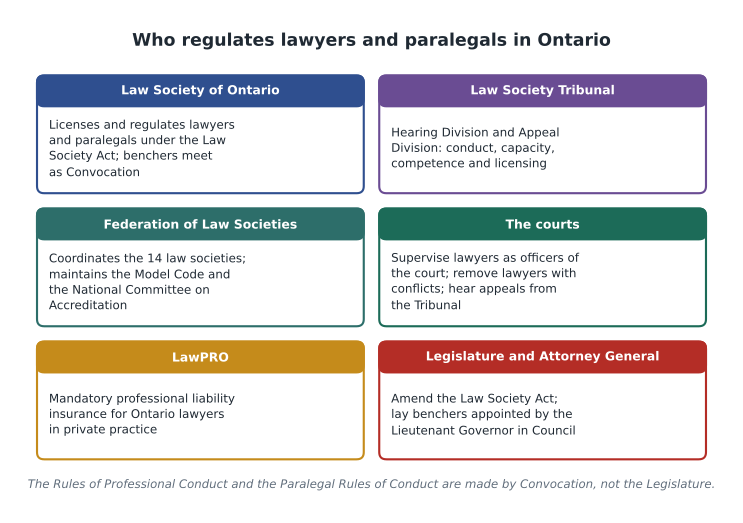
The Law Society of Upper Canada was created by an Act of the Legislature of Upper Canada in 1797, which makes it one of the oldest professional regulators in North America. It was renamed the Law Society of Ontario in 2018. Its powers now come from the Law Society Act, R.S.O. 1990, c. L.8. The Act makes it an offence for a person who is not licensed to practise law or provide legal services in Ontario, subject to exceptions, and gives the Law Society the power to license, investigate, prosecute and discipline.
Two short sections of the Act set the tone for everything else. Section 4.1 makes it a function of the Society to ensure that all persons who practise law or provide legal services in Ontario meet standards of learning, professional competence and professional conduct appropriate to the services they provide, and that the standards of learning, competence and conduct for the provision of a particular legal service in a particular area of law apply equally to lawyers and paralegals. Section 4.2 lists principles the Society must have regard to: a duty to maintain and advance the cause of justice and the rule of law, a duty to act so as to facilitate access to justice for the people of Ontario, a duty to protect the public interest, a duty to act in a timely, open and efficient manner, and a principle that standards should be proportionate to the significance of the regulatory objectives pursued. Ogilvie asks the class to notice what the list does not say. It does not say the Society exists to protect or promote lawyers. Its statutory mandate is public protection.
The Society is governed by its benchers, who meet as Convocation. Most are elected: forty lawyer benchers, chosen by lawyers from regions inside and outside Toronto, and five paralegal benchers, chosen by paralegals. Eight lay benchers, who are not licensees, are appointed by the Lieutenant Governor in Council. Convocation elects a Treasurer, the Society's head, and sets policy, makes by-laws under the Act and approves the Rules of Professional Conduct and the Paralegal Rules of Conduct. Staff led by a chief executive officer run the day-to-day work: licensing, practice audits, complaints and investigations, and the prosecution of discipline cases. Adjudication is separated out. The Law Society Tribunal, with a Hearing Division and an Appeal Division, decides conduct, capacity, competence and licensing applications. Lesson 11 follows a complaint through that system.
Two other bodies matter to almost every Ontario lawyer in private practice. LawPRO, the Lawyers' Professional Indemnity Company, provides the mandatory professional liability insurance policy, so a negligent lawyer's clients can be compensated. And the Law Society runs a Compensation Fund, which can reimburse clients who lose money through a licensee's dishonesty, such as a theft from a trust account. Neither replaces discipline, but together they show the three goals of regulation: preventing harm, compensating it, and sanctioning those who cause it.
Two professions: lawyers and paralegals
Ontario is unusual in Canada in licensing two classes of legal professional. Since 2007, after the Access to Justice Act, 2006 amended the Law Society Act, the Society has licensed paralegals as well as lawyers. A lawyer holds a Class L1 licence and may practise law in all areas. A paralegal holds a Class P1 licence and may provide legal services within a defined scope set out in By-Law 4, which includes Small Claims Court matters, many tribunals such as the Landlord and Tenant Board, provincial offences and some summary conviction matters in the Ontario Court of Justice. Paralegals follow the Paralegal Rules of Conduct, which track the lawyers' rules closely but are written for their scope of practice.
The paralegal profession is part of the access to justice story told in lesson 11. In 2024, Convocation approved by-law and rule changes for a Family Legal Services Provider licence, which allows specially trained paralegals to provide a limited range of family law services, such as joint and uncontested divorce applications, name changes and some motions to change child support. Training through a college program began in January 2025. The changes are cautious, and family lawyers were divided about them, but they show the regulator using its licensing power to widen who may help people with legal problems.
Theo Marchetti, who spent ten years as a litigation law clerk in Hamilton before law school, points out that the largest group of people doing legal work in many offices holds no licence at all. Ogilvie agrees. Law clerks, legal assistants and students work under a licensee's supervision, and the licensee is responsible for what they do. Chapter 6 of the rules, on relationships to students, employees and others, says what a lawyer may delegate and what she may not, such as giving legal advice or accepting instructions she has not reviewed.
The Model Code and Ontario's rules
Each provincial and territorial law society makes its own rules, because the regulation of the profession is a provincial matter. But since 2009 the Federation of Law Societies of Canada has maintained the Model Code of Professional Conduct, a national template that law societies adopt with variations. The aim is harmonization: a lawyer who moves from Calgary to Corwin, or who acts in a national class action, should face substantially the same ethical rules everywhere. Ontario revised its Rules of Professional Conduct in 2014 to follow the Model Code's structure and numbering, so that a rule such as 3.3-1 on confidentiality or 3.4-1 on conflicts has the same number in Ontario as in the Model Code, even where the Ontario wording or commentary differs.
The Model Code has seven chapters. Chapter 1 contains interpretation and definitions, including the definition of a client and of a conflict of interest. Chapter 2 sets out the overarching duty of integrity. Chapter 3 covers the relationship to clients: competence, quality of service, confidentiality, conflicts, preservation of property, fees and withdrawal. Chapter 4 deals with marketing. Chapter 5 covers the relationship to the administration of justice, including the lawyer as advocate. Chapter 6 deals with students, employees and others, including discrimination and harassment. Chapter 7 covers the relationship to the society and other lawyers, including courtesy, undertakings and the duty to report misconduct.
Each rule is followed by commentary. The commentary is not decoration. Law society tribunals and courts use it to interpret the rules, and much of the most useful guidance, such as what a lawyer should do when a client in a criminal case admits guilt, appears only in commentary. Sophie Tremblay-Hart asks about Quebec. Quebec's Barreau has its own Code of Professional Conduct of Lawyers, adopted under the province's Professional Code, which governs dozens of professional orders. The Barreau participates in the Federation but has not adopted the Model Code as such. Many core duties, such as confidentiality and loyalty, are recognizably the same.
Students should cite the rule they are applying precisely. In this course, a reference to a rule number means the Model Code rule, which Ontario's Rules of Professional Conduct share unless the lesson says otherwise. On an Ontario examination or in an Ontario practice, the binding text is Ontario's.
Other sources of the law of lawyering
The courts supervise lawyers independently of the law society. In MacDonald Estate v. Martin, [1990] 3 S.C.R. 1235, the Supreme Court of Canada held that the courts have an inherent jurisdiction to remove a lawyer from the record where a conflict of interest threatens the integrity of the justice system, and that the law society's rules, while important, do not bind the court. Courts also decide whether a lawyer breached a fiduciary duty, award damages for negligence, disallow fees on an assessment under the Solicitors Act, order costs personally against a lawyer who caused costs to be wasted, and punish contempt.
Statutes outside the Law Society Act matter as well. The Solicitors Act governs fees, assessments and contingency fee agreements, discussed in lesson 5. Privacy and anti-money-laundering laws affect how lawyers handle information and money. Rules of court impose duties directly on lawyers, such as the certification that authorities cited in a factum are authentic, discussed in lessons 3 and 8. And the Charter limits the state's power to interfere with the lawyer-client relationship, as the Supreme Court held in Canada (Attorney General) v. Federation of Law Societies of Canada, 2015 SCC 7, a case that returns in lesson 6.
Why self-regulation?
Ontario's lawyers regulate themselves, through benchers they mostly elect, under powers delegated by the Legislature. The traditional justification is the independence of the bar. In a society governed by the rule of law, people must be able to get advice and representation from lawyers who are not answerable to the state, because the state is often the opposing party: the prosecutor in a criminal case, the government in a constitutional challenge, the regulator in a licensing dispute. If the government controlled who could practise law and on what terms, it could punish lawyers who took unpopular cases. In Pearlman v. Manitoba Law Society Judicial Committee, [1991] 2 S.C.R. 869, the Supreme Court accepted that the legislature may give the profession the power to govern itself in the public interest, and that lawyers' disciplinary bodies need not be independent of the profession in the way that courts must be independent of the parties.
In Federation of Law Societies, the Supreme Court went further and recognized as a principle of fundamental justice under section 7 of the Charter that the state cannot impose duties on lawyers that undermine their duty of commitment to their clients' causes. The case struck down parts of the federal anti-money-laundering law as they applied to lawyers, partly because lawyers would have been made to act, in effect, as agents of the state against their own clients. The case does not say that self-regulation is constitutionally required. It says that the lawyer's loyalty to the client has constitutional weight.
Critics of self-regulation make three main points. First, any profession that regulates itself is at risk of putting its members' interests ahead of the public's: slow discipline, light sanctions, and rules that restrict competition. Second, elected benchers are chosen by lawyers, not clients, so the governing body can become a site of professional politics rather than public protection. Third, the profession has been slow to deal with access to justice, a problem the statute now tells it to address. Defenders reply that the alternatives, such as a government-appointed board, risk exactly the loss of independence the arrangement exists to prevent, and that public members already sit on the board and the adjudicative function has been separated from the prosecutorial one.
The debate in 2024 to 2026
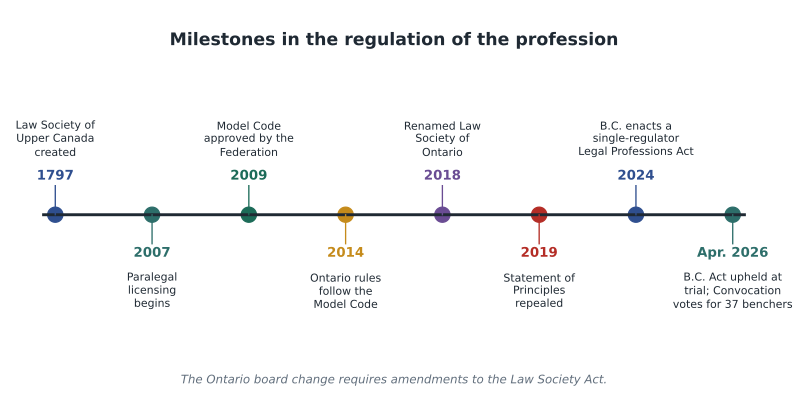
The debate is no longer theoretical. In 2024, British Columbia enacted a Legal Professions Act that will replace the Law Society of British Columbia, the province's notaries and its licensed paralegals with a single regulator, governed by a board of which only some members are elected by licensees, the rest appointed. The Law Society of British Columbia and the Trial Lawyers Association of British Columbia challenged the Act. In a decision released on April 29, 2026, the Supreme Court of British Columbia upheld it. The court accepted that the independence of the bar is an unwritten constitutional principle, but held that self-governance by lawyers is a historical choice made by the legislature, not a constitutional requirement for an independent bar. The Law Society of British Columbia filed an appeal to the Court of Appeal in May 2026.
In Ontario, the pressure has come partly from inside. Since 2019 Convocation has been divided between two slates of elected benchers, and in 2024 the Society proposed governance reforms that would have shrunk the board and removed the elected lawyer majority, a proposal that drew strong criticism from lawyers worried about self-regulation. In 2025, news that the chief executive officer had received a large pay increase without Convocation's approval led to an independent review by a former associate chief justice of Ontario and to new governance and salary disclosure measures. On April 30, 2026, Convocation approved a revised plan to reduce the board from fifty-three seats to thirty-seven: twenty-four elected lawyers, four elected paralegals, six lay benchers appointed by the Lieutenant Governor in Council, and three benchers appointed by Convocation, including seats for a Francophone licensee and an Indigenous licensee. Because the composition of Convocation is set by the Law Society Act, the change requires the Legislature to amend the Act, so the Society asked the Attorney General to do so. In June 2026, Convocation created a standing Governance Committee and Shalini Konanur took office as Treasurer.
Licensing is under review too. In late 2025 the Society consulted on a proposal to replace the barrister and solicitor licensing examinations with a mandatory skills-based course and assessments. The Attorney General publicly said that eliminating the written examinations would not be acceptable, and many legal organizations urged the Society to keep standardized examinations while reforming them. The consultation closed on January 31, 2026, and the Society has not yet decided. Hannah Kowalczyk, who once worked for an energy regulator in Calgary, says the pattern is familiar: a self-regulating body proposes reform, and the government makes clear that it is watching. Ogilvie writes one more line on the board: 'Self-regulation is a privilege the Legislature can take back.'
How to read a professional responsibility problem
Ogilvie's three questions organize the course. Whose interest is at stake: the client's, a former client's, the lawyer's own, a third party's, or the public's? Which duty applies: loyalty, confidentiality, candour, competence, or a duty to the court? And who decides: the client, who makes the major decisions about the objectives of the retainer; the lawyer, who decides how to conduct the case within the law; the law society; or the court? A good answer identifies the interests, names the rule and any case law, explains the tension, and recommends a step the lawyer can actually take this week: a letter, a conversation, a refusal, a withdrawal, a call to the Law Society's practice management helpline.
Throughout the course the class will follow a new lawyer, Maren Pellegrini, through her first year as an associate at Pardee & Lowe LLP, the Corwin personal injury and litigation firm that the class first met in legal research and writing. The firm acts for Rosa Ingram in Ingram v. Corwin Plaza Holdings, and the senior partner, Warren Elsworth, has a habit of handing Maren files with problems in them. All the facts are hypothetical, and each lesson adds one more.
Worked problem
Maren reads the rules
On her first day at Pardee & Lowe, Maren is given three tasks: sign the firm's internal policy acknowledgment, review a draft retainer letter for a new client, and check whether a law clerk may meet a client alone to collect documents. She asks which rules apply and where to find them.
Show solution
- Identify the regulator. Maren is a lawyer licensed by the Law Society of Ontario under the Law Society Act. The Rules of Professional Conduct made by Convocation bind her, as do the Society's by-laws, including By-Law 9 on trust accounting.
- Identify the national template. Ontario's rules follow the Model Code's numbering. She can read the Model Code commentary for interpretation, but the Ontario text governs.
- Check the court's role. If a retainer creates a conflict, a court can remove the firm from the record under its inherent jurisdiction, whatever the rules say.
- Apply chapter 6 to the law clerk. A law clerk may collect documents and give factual information, under supervision, but may not give legal advice. Maren remains responsible for the clerk's work.
- Note the insurance and compensation backstop. LawPRO insurance and the Compensation Fund protect clients, but they do not excuse a breach of the rules.
Looking ahead
The next lesson looks at how a person becomes a licensee in the first place, and at the good character requirement and equality questions that have divided the profession. Ogilvie closes the first class by asking each student to write down one thing they would refuse to do for a client, fold the paper and keep it until the capstone class.
Common mistakes
MistakeTreating the rules of professional conduct as the only source of a lawyer's duties.
InsteadFiduciary law, the court's inherent jurisdiction, negligence, contract, criminal law and statutes such as the Solicitors Act all apply, often at the same time and with different tests.
MistakeAssuming the Model Code itself binds Ontario lawyers.
InsteadThe Model Code is a template. Ontario's Rules of Professional Conduct, which follow its numbering, are the binding text.
MistakeSaying the Law Society exists to promote the interests of lawyers.
InsteadSections 4.1 and 4.2 of the Law Society Act give it a public protection mandate, including duties to advance the rule of law and to facilitate access to justice.
MistakeAssuming self-regulation is constitutionally guaranteed.
InsteadFederation of Law Societies gives constitutional weight to the lawyer's commitment to the client, and the independence of the bar is an unwritten principle, but a 2026 British Columbia decision held that self-governance itself is a legislative choice. That decision is under appeal.
Practice problems
Work each problem on paper first, then reveal the answer to check.
A friend says the Law Society of Ontario is a branch of the provincial government. Is that right?
Show answer
No. It is a self-governing body created by statute. The Legislature sets its powers in the Law Society Act and the government appoints lay benchers, but most benchers are elected by licensees and the Society, not the government, makes the rules of conduct and prosecutes discipline.
Why might a court remove a lawyer from the record even though the Law Society has not found any breach of its rules?
Show answer
Because the court has an inherent jurisdiction over lawyers as officers of the court and applies its own test, focused on the integrity of the administration of justice, as held in MacDonald Estate v. Martin. The rules are relevant but not binding on the court.
Name two changes to the Law Society of Ontario's governance or licensing that were under discussion in 2026, and say what step each still requires.
Show answer
Reducing Convocation from fifty-three to thirty-seven benchers, approved by Convocation in April 2026, requires amendments to the Law Society Act by the Legislature. Replacing the licensing examinations with a skills-based course was the subject of a consultation that closed in January 2026 and still requires a decision by Convocation.
Summary and key terms
- Professional responsibility draws on law society rules, fiduciary and common law duties, the court's inherent supervisory jurisdiction and the general law.
- The Law Society of Ontario regulates lawyers and paralegals under the Law Society Act, with a public protection mandate in sections 4.1 and 4.2.
- Ontario's Rules of Professional Conduct follow the Federation of Law Societies' Model Code; commentary is used to interpret the rules.
- Self-regulation is justified by the independence of the bar but is under pressure: British Columbia created a single regulator in 2024, upheld at trial in 2026, and Ontario's Convocation voted in 2026 to ask for a smaller board.
- Work through problems by asking whose interest, which duty and who decides.
- Bencher
- A member of the governing board of a law society; in Ontario, benchers meet as Convocation.
- Convocation
- The governing body of the Law Society of Ontario, made up of elected lawyer and paralegal benchers, appointed lay benchers and the Treasurer.
- Model Code
- The Federation of Law Societies of Canada's Model Code of Professional Conduct, a template adopted with variations by Canadian law societies.
- Paralegal licensee
- A person holding a Class P1 licence from the Law Society of Ontario to provide legal services within the scope set by By-Law 4.
- Self-regulation
- An arrangement in which a profession, through a body its members largely elect, licenses and disciplines its own members under delegated statutory powers.
- Inherent jurisdiction
- The power of a superior court, not derived from statute, to control its own process, including the lawyers who appear before it.
Lesson quiz · 5 questions
Score 60% or more to complete this lesson.
Create a free account to save your progress, take quizzes and earn a certificate.