
LAWC-214 · Lesson 4 of 12 · 19 min
Duty to the client
▶ Video coming soon A video version of this lesson is on the way.
Ogilvie writes the word fiduciary on the board and asks the class what it means. Arjun Mehta says it means you have to put the other person's interests first. Ogilvie agrees, and then adds the complication that drives the rest of the course: a lawyer owes duties to the client, but also to the court, to opposing parties, to the public and to the profession, and sometimes those duties point in different directions. 'Your client is the person you are most loyal to,' he says. 'Your client is not the only person you owe anything to.'
This lesson looks at the lawyer-client relationship itself: when it starts, what loyalty requires, who decides what, and what a lawyer must do when a client, including an organizational client or a client with diminished capacity, wants to do something wrong.
When does the relationship begin?
Many ethical problems begin with confusion about whether a person is a client at all. The Model Code defines a client in rule 1.1-1 as a person who consults a lawyer and on whose behalf the lawyer renders or agrees to render legal services, or who, having consulted the lawyer, reasonably concludes that the lawyer has agreed to render legal services on his or her behalf. The second part of the definition matters most. A lawyer can acquire a client without a signed retainer, a fee or even an intention to do so, if the person reasonably concludes from the lawyer's conduct that the lawyer is acting. A long conversation at a barbecue about someone's wrongful dismissal, ending with 'leave it with me', can create a relationship and the duties that go with it.
Even a person who never becomes a client is owed some duties. A prospective client who shares information in an initial consultation is protected by confidentiality, and that information can create a conflict that prevents the lawyer, and possibly the firm, from acting against the person later. Good practice is to limit what a prospective client tells the lawyer until a conflict check is done, and to send a short non-engagement letter whenever the lawyer decides not to act, making clear that the lawyer is not acting and, where relevant, that limitation periods may be running.
A retainer should be confirmed in writing. A good retainer letter identifies the client, which matters greatly when the person paying is not the person instructing, describes the scope of the work, explains how fees and disbursements will be charged, and records any limits on the lawyer's services. Lesson 5 looks at fees in detail.
Loyalty and its parts
The lawyer's duties to the client are fiduciary. In R. v. Neil, 2002 SCC 70, the Supreme Court of Canada described the duty of loyalty as having three dimensions: a duty to avoid conflicting interests, including the lawyer's own; a duty of commitment to the client's cause, sometimes called zealous representation, which means the lawyer must not soft-pedal the defence to avoid offending another client or a third party; and a duty of candour with the client on matters relevant to the retainer. In Federation of Law Societies the Court gave the duty of commitment to the client's cause constitutional weight. In Strother v. 3464920 Canada Inc., 2007 SCC 24, the Court held that a lawyer who had advised a client about a tax shelter and then, while the retainer continued, went into business exploiting the same opportunity for himself, breached his fiduciary duty and had to disgorge his profits. Loyalty is not only about avoiding conflicts in court; it is about not using the relationship for the lawyer's own advantage.
Loyalty is limited by law and the rules. Rule 5.1-1 describes the advocate's duty to represent the client resolutely and honourably within the limits of the law, and the commentary says the lawyer must raise fearlessly every issue and argument that will help the client's case. But resolute representation never includes deceiving the court, assisting a crime or harassing a witness. Ogilvie's phrase is that a lawyer is the client's champion, not the client's accomplice.
Who decides?
The client decides the objectives of the retainer. Whether to sue or settle, whether to accept an offer, whether to plead guilty, whether to testify in a criminal trial and whether to appeal are the client's decisions, made after the lawyer's advice. A lawyer who settles without authority can be liable to the client and disciplined. The lawyer decides the conduct of the case within those objectives: which witnesses to call, what questions to ask, what legal arguments to make, what procedural steps to take. A good lawyer consults the client about tactics, but the lawyer cannot be required to run the case in a way that breaches the rules, wastes the court's time or is incompetent. If the disagreement goes to the heart of the relationship, the lawyer may need to withdraw, as lesson 10 explains.
Rule 3.2-2 requires honesty and candour. The lawyer must tell the client what the client needs to know to make decisions: the real strengths and weaknesses of the case, the likely costs, the risks of proceeding and the alternatives. Rule 3.2-1 and its commentary require keeping the client reasonably informed. A lawyer who keeps bad news from a client to avoid an awkward conversation is not respecting the client's right to decide.
Clients with diminished capacity
Rule 3.2-9 provides that when a client's ability to make decisions is impaired because of minority, mental disability or some other reason, the lawyer must, as far as reasonably possible, maintain a normal lawyer-client relationship. The commentary explains that capacity is decision-specific and can fluctuate: a client who cannot manage complex investments may still be able to decide who should inherit her house or whether to accept a settlement. The lawyer should assess capacity for the particular decision, may consult others with the client's consent, and in some cases may need to take steps such as recommending that a litigation guardian be appointed. If the lawyer has no reasonable doubt about capacity, the lawyer must take the client's instructions, even if the decision seems unwise.
Elderly clients raise a related problem: undue influence. When a relative brings an older client to the office, does most of the talking and pays the bill, the lawyer must make sure the instructions are the client's own. The basic practices are simple. Meet the client alone for at least part of the meeting, ask open questions, make notes of the client's own words, and be cautious when the person who stands to benefit is driving the process. Ogilvie reminds the class of Professor Ellerby's rule from wills and estates: read the will, then read the family.
When the client wants to do something wrong
Rule 3.2-7 provides that a lawyer must never knowingly assist in or encourage any dishonesty, fraud, crime or illegal conduct, or instruct the client on how to violate the law and avoid punishment. The commentary distinguishes advising a client about the law, which a lawyer may do even when the client may misuse the advice, from helping the client break it. A lawyer may tell a client what the penalties are for an offence. She may not plan the offence. The commentary also warns lawyers to be on guard against being used as tools of fraud, especially by unscrupulous clients or people they deal with, and to make inquiries when a transaction has features of possible money laundering: unusual payment instructions, funds from unexplained sources, a client in a hurry and indifferent to cost. The commentary now says expressly that a lawyer who has suspicions should make reasonable inquiries, record them, and withdraw if the client persists in an improper purpose. Lesson 5 links this rule to the trust account.
If a lawyer learns that a client is engaged in dishonest conduct in the matter, the first step is to advise the client that the conduct is wrong and should stop. If the client persists, the lawyer must withdraw. The lawyer cannot simply keep acting and look away. Whether the lawyer may also disclose the conduct is a separate question governed by the confidentiality rules, discussed in lesson 6; in most cases the duty is to stop helping, not to report.
The organization as client
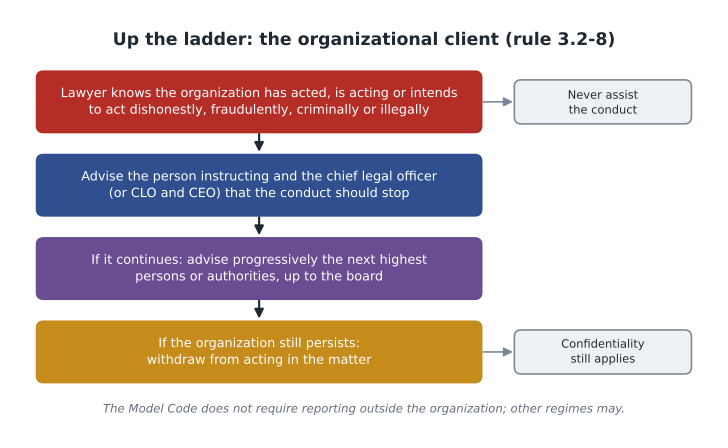
When a lawyer acts for a corporation, a government, a union or another organization, the client is the organization itself, acting through its officers and employees. The lawyer's loyalty runs to the organization, not to the chief executive who happens to give instructions. Rule 3.2-3 requires the lawyer to act on the instructions of duly authorized persons. Rule 3.2-8 deals with the hardest case, where the lawyer knows that the organization has acted, is acting or intends to act dishonestly, fraudulently, criminally or illegally. The lawyer must advise the person giving instructions and the chief legal officer, or both the chief legal officer and the chief executive officer, that the conduct is or would be dishonest or illegal and should be stopped. If the conduct continues, the lawyer must advise progressively the next highest persons or authorities, including ultimately the board of directors. If the organization still persists, the lawyer must withdraw from acting in the matter. This is called reporting up the ladder. The Model Code does not require the lawyer to report outside the organization, though some securities and other regimes impose separate duties.
Hannah Kowalczyk recalls her work in an energy regulator's office, where in-house lawyers sometimes faced pressure to sign off on reports. Ogilvie says in-house counsel face this rule more often than anyone, because their only client is also their employer. The rule protects them by giving them a script: say no, say it higher up, and if necessary leave the matter.
Client property
Section 3.5 of the Model Code requires a lawyer to care for a client's property as a careful and prudent owner would care for similar property, to identify it clearly, to keep records of it and to return it promptly when the client is entitled to it. Original wills, share certificates, jewellery held for an estate and the client's documents all count. A lawyer may have a lien over some client documents for unpaid fees, but the commentary cautions against exercising it in a way that prejudices the client's position, especially in a matter that is still before the courts. Money is property too, and the far more detailed rules about money in trust appear in lesson 5.
Worked problem
Duncan Beaton's new will and his daughter
Duncan Beaton, 81, a retired machinist in Corwin, has been a client of Pardee & Lowe since a car accident claim twelve years ago. His daughter Colleen calls Maren to say her father wants a new will leaving his house to her alone and wants Pardee & Lowe to act on his accident benefits dispute as well. Colleen will pay. At the meeting, Colleen answers most questions. Duncan seems tired and asks twice what the meeting is for.
Show solution
- Identify the client. Duncan is the client, not Colleen, even though she is paying. The retainer letter should say so and Colleen should understand that the firm takes instructions only from Duncan.
- Check competence. Pardee & Lowe is a personal injury firm. Maren should decide whether the firm can competently prepare a will or should refer Duncan to a wills lawyer for that part.
- Meet Duncan alone. Maren should speak to Duncan without Colleen for at least part of the meeting, ask open questions about his wishes and record his words.
- Assess capacity for each decision. Duncan may have capacity to instruct on the benefits dispute even if a will is more doubtful. If there is real doubt, Maren may, with his consent, seek a medical opinion and should keep careful notes.
- Watch for undue influence. Colleen benefits from the proposed will and is driving the process. If Maren is not satisfied that the instructions are Duncan's own, she must not act on them.
Common mistakes
MistakeAssuming there is no client until a retainer is signed.
InsteadA person who reasonably concludes that the lawyer has agreed to act is a client, and prospective clients are owed confidentiality and protection from conflicts.
MistakeTaking instructions from whoever pays the bill.
InsteadThe client is the person on whose behalf services are rendered. A third-party payer has no right to instruct unless the client authorizes it, and its involvement may create a conflict.
MistakeReporting a corporate client's wrongdoing to the authorities as the first step.
InsteadRule 3.2-8 requires reporting up the ladder within the organization and, if the conduct persists, withdrawal. Outside disclosure depends on the confidentiality exceptions.
MistakeTreating a client with some cognitive decline as having no capacity.
InsteadCapacity is decision-specific. Rule 3.2-9 requires maintaining a normal relationship as far as reasonably possible and taking the client's instructions where capacity for the decision exists.
Practice problems
Work each problem on paper first, then reveal the answer to check.
Name the three dimensions of the duty of loyalty identified in R. v. Neil.
Show answer
Avoiding conflicting interests, including the lawyer's own; commitment to the client's cause; and candour with the client on matters relevant to the retainer.
A client asks whether he can avoid tax by moving funds to an offshore account in his brother's name. What may the lawyer say?
Show answer
The lawyer may explain the law, including that concealing income is illegal and what the consequences are. She must not plan or assist the concealment, and if the client proceeds in a matter where she is acting, she must withdraw.
Why did the lawyer in Strother have to give up his profits?
Show answer
Because, while still retained by the client, he used the opportunity he had advised on for his own business advantage, putting his personal interest ahead of his duty of loyalty.
Summary and key terms
- A lawyer-client relationship exists when a person reasonably concludes that the lawyer has agreed to act; prospective clients are owed confidentiality.
- Loyalty under R. v. Neil includes avoiding conflicts, commitment to the client's cause and candour; Strother shows that a lawyer must not profit from the relationship.
- The client decides objectives such as settlement and plea; the lawyer decides the conduct of the case within the law.
- Rule 3.2-9 requires maintaining a normal relationship with a client of diminished capacity as far as reasonably possible; watch for undue influence.
- Rule 3.2-7 forbids assisting dishonesty or crime; rule 3.2-8 requires reporting up the ladder in an organization and withdrawal if the organization persists.
- Client
- Under rule 1.1-1, a person for whom a lawyer renders or agrees to render legal services, including a person who reasonably concludes the lawyer has agreed to act.
- Fiduciary
- A person who has undertaken to act in another's interests and must act with loyalty and good faith; lawyers are fiduciaries of their clients.
- Non-engagement letter
- A letter confirming that a lawyer is not acting for a person who consulted her.
- Duty of commitment to the client's cause
- The lawyer's duty to represent the client resolutely and not soften the representation to please others.
- Reporting up the ladder
- The duty in rule 3.2-8 to report an organization's wrongdoing to progressively higher authorities within it.
- Diminished capacity
- An impairment of a client's ability to make a particular decision, which the lawyer must assess decision by decision.
Lesson quiz · 5 questions
Score 60% or more to complete this lesson.
Create a free account to save your progress, take quizzes and earn a certificate.