
LAWC-214 · Lesson 2 of 12 · 20 min
Entry to the profession: licensing, good character and equality
▶ Video coming soon A video version of this lesson is on the way.
Ogilvie opens the second class by projecting a single question from a licensing application, paraphrased: have you ever been charged with an offence, been the subject of a complaint by a regulator, or been found to have committed academic misconduct? 'Somebody in this room will answer yes to some version of that question,' he says. 'Most of you will be fine. A few of you will be in my office in third year, terrified. And one of the things I want you to leave with today is that the most dangerous answer is not yes. It is a no that should have been yes.'
This lesson looks at how a person becomes a licensee: the licensing process, the good character requirement in section 27 of the Law Society Act, and the equality questions that have divided Ontario's profession for a decade, from the Trinity Western University law school litigation to the repeal of the Statement of Principles and the profession's response to the Truth and Reconciliation Commission.
The path to a licence
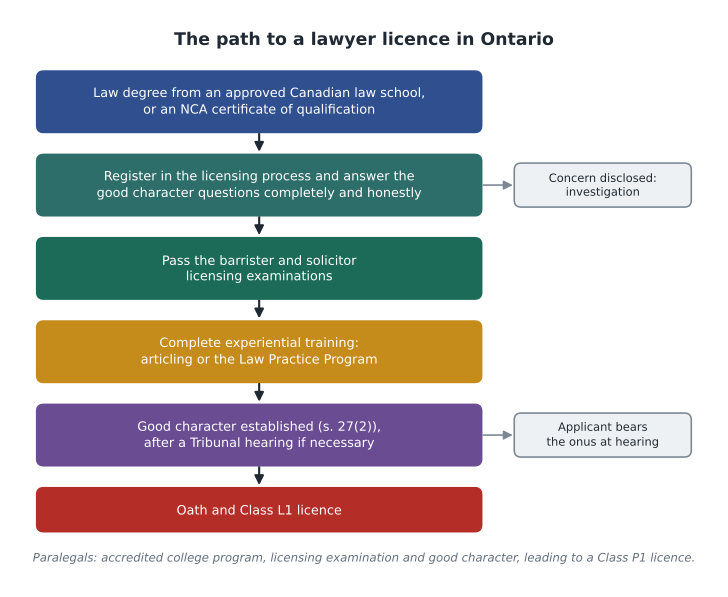
A lawyer licence in Ontario is the end of a regulated process, not a degree. An applicant needs a law degree from an approved Canadian common law school, or, if trained abroad or in a civil law system, a certificate of qualification from the National Committee on Accreditation, a body of the Federation of Law Societies that assesses foreign credentials and assigns examinations. The applicant then registers in the Law Society's lawyer licensing process, which has three components: the barrister and solicitor licensing examinations, experiential training, and the good character requirement. Experiential training is usually articling, a period of supervised work in a law office under a principal, or the Law Practice Program, a course followed by a work placement. When all three components are complete, the candidate takes the barristers' and solicitors' oath and receives a Class L1 licence.
The licensing examinations are open-book and test entry-level competence, including professional responsibility. As lesson 1 noted, in 2025 the Society consulted on replacing them with a skills-based course and assessments; the consultation closed in January 2026 and no decision has been announced. Paralegal applicants follow a parallel path: an accredited college program that includes a field placement, a paralegal licensing examination and the same good character requirement, leading to a Class P1 licence.
Arjun Mehta, who likes flowcharts, asks what happens if one component goes wrong. The examinations can be rewritten within limits. An articling placement that ends early can be completed elsewhere. But the good character requirement is different, because it is not about knowledge or skill. It is about whether the Society can trust the applicant with the public.
The good character requirement
Section 27(2) of the Law Society Act makes it a requirement for the issuance of every licence that the applicant be of good character. The Act does not define the phrase. The Society may not refuse a licence on that ground without giving the applicant a hearing before the Law Society Tribunal's Hearing Division, and at that hearing the applicant bears the burden of proving, on a balance of probabilities, that she is of good character at the time of the hearing. The requirement continues after licensing: a licensee whose conduct shows a lack of integrity can be disciplined, and the rules impose a general duty of integrity in rule 2.1-1.
Tribunals applying the requirement have described good character in terms of honesty, integrity, a respect for the rule of law and the rights of others, and a willingness to be candid with the regulator. The question is forward-looking: the Tribunal is not punishing the applicant for the past but asking whether, today, the public can trust the applicant to practise ethically. Past misconduct is therefore not a permanent bar. The decided cases look at the nature and seriousness of the past conduct, how long ago it happened and the applicant's age at the time, whether the applicant has taken responsibility for it, what the applicant has done since, including treatment, restitution and community work, the evidence of people who know the applicant now, and above all the applicant's candour in the licensing process itself.
That last factor explains Ogilvie's warning. An applicant who discloses a shoplifting conviction from age nineteen, explains it and shows ten clean years will usually be licensed without a hearing. An applicant who hides the same conviction, and is found out, has created a new and present character problem: she has been dishonest with her regulator, which is exactly the trait the requirement exists to screen out. Applicants who are unsure whether something must be disclosed should disclose it and explain it. Daniel Whitecloud, who worked for years in band administration, asks whether the question about past regulatory complaints covers complaints made against a former employer's program that named him. Ogilvie's answer is the same: when in doubt, disclose, with context.
The requirement has critics. The phrase is vague, and vague standards can be applied unevenly. Applicants with criminal records are disproportionately poor, racialized or Indigenous, because those groups are over-represented in the criminal justice system, so a requirement that treats every past charge as a red flag can reproduce that over-representation inside the profession. Applicants with mental health histories have argued that questions about their health deter them from seeking treatment. Law societies have responded by narrowing questions about health and by emphasizing rehabilitation, but the tension remains: the profession wants to protect the public without excluding people whose past is the reason they would be good at the work.
Equality and access to the profession
Entry to the profession has also been shaped by equality law. In Andrews v. Law Society of British Columbia, [1989] 1 S.C.R. 143, the first equality rights case decided by the Supreme Court under section 15 of the Charter, a requirement that lawyers be Canadian citizens was struck down as discrimination against permanent residents. The case set the framework for section 15 for a generation, and it is a reminder that a law society's licensing rules are state action subject to the Charter.
Rule 6.3 of the Model Code prohibits harassment and discrimination by lawyers in their professional dealings, and the Ontario Human Rights Code applies to law firms as employers and service providers. The Law Society funds an independent Discrimination and Harassment Counsel program to assist members of the public, licensees and students who have experienced discrimination or harassment by a licensee.
Trinity Western University
The most important recent case about law societies and equality concerned not an individual applicant but a law school. Trinity Western University is a private evangelical Christian university in British Columbia. In 2012 it proposed a law school. All students would have been required to sign a Community Covenant that, among other things, prohibited sexual intimacy except between a husband and wife. Several law societies, including the Law Society of Upper Canada in 2014, decided not to accredit the proposed school, which meant its graduates would not be eligible to enter their licensing processes.
In Law Society of British Columbia v. Trinity Western University, 2018 SCC 32, and Trinity Western University v. Law Society of Upper Canada, 2018 SCC 33, the Supreme Court of Canada upheld the law societies' decisions by a majority of seven to two. The majority accepted that the refusal limited the religious freedom of the evangelical community at Trinity Western, but held that the law societies were entitled to consider the public interest broadly, including equal access to the profession, diversity within it and the prevention of harm to LGBTQ students, who would have faced a choice between their dignity and a law school place. The decisions were a proportionate balance of the Charter protections at play with the law societies' statutory objectives, under the framework the Court had developed in Doré v. Barreau du Québec, 2012 SCC 12, and Loyola High School v. Quebec (Attorney General), 2015 SCC 12. Two judges dissented, finding that the law societies had no authority to deny accreditation on that basis and that the decision unreasonably limited religious freedom. Later in 2018 the university made the covenant voluntary for students. It has not opened a law school.
Hannah Kowalczyk thinks the dissent had the better of the argument about statutory authority: a law society's job is to assess whether graduates are competent, not to police a university's admissions values. Sophie Tremblay-Hart disagrees, pointing out that a law society that must facilitate access to justice and protect the public interest is entitled to ask who is being kept out of the profession. Ogilvie lets the argument run. 'This is the course in which you learn that the profession's values are contested,' he says. 'The rules tell you what was decided. They do not tell you it was easy.'
The Statement of Principles
Ontario's sharpest internal fight was over the Statement of Principles. In 2016, Convocation adopted the report of a working group on the challenges faced by racialized licensees, which found widespread barriers in hiring, advancement and treatment. Among its recommendations was a requirement that every licensee adopt and abide by a statement of principles acknowledging an obligation to promote equality, diversity and inclusion generally and in their behaviour towards colleagues, employees, clients and the public. Many licensees supported it. Others objected that it compelled speech and belief, and a court challenge was launched. In the 2019 bencher election, candidates opposed to the requirement won twenty-two of the forty elected lawyer seats.
On September 11, 2019, Convocation repealed the requirement. In its place, Convocation passed a motion, by a vote of twenty-seven to eighteen, requiring licensees to acknowledge annually their existing special responsibility to respect the requirements of human rights laws in force in Ontario and their obligations under the rules of professional conduct. The other recommendations of the 2016 report, such as data collection, inclusion indices and programs for racialized licensees, have had a mixed history since. Ogilvie asks the class to separate two questions. Whether the Statement of Principles was wise policy is debatable. What the rules require is not: rule 6.3 and the Human Rights Code prohibit discrimination and harassment, and a licensee who breaches them can be disciplined regardless of what statement she has or has not signed.
Truth and Reconciliation
In 2015, the Truth and Reconciliation Commission of Canada released its final report on the residential school system and its legacy, with ninety-four Calls to Action. Call to Action 27 is addressed to the Federation of Law Societies: it calls on the Federation to ensure that lawyers receive appropriate cultural competency training, including the history and legacy of residential schools, the United Nations Declaration on the Rights of Indigenous Peoples, Treaties and Aboriginal rights, Indigenous law, and Aboriginal-Crown relations, and skills-based training in intercultural competency, conflict resolution, human rights and anti-racism. Call to Action 28 makes a similar call to law schools.
The Federation has consulted twice, in 2023 and 2024, on draft amendments to the Model Code that would say more expressly that competence includes the knowledge and skills needed to serve Indigenous clients and that lawyers must not discriminate against Indigenous peoples, and in 2025 it reported that it was still revising the proposals with law societies and its Indigenous advisory council. Individual law societies have moved on training. In 2026, Convocation made a six-hour online course, Shared Pathways: Legal Education About Indigenous Ontario, mandatory for all licensees with continuing professional development requirements. The course opened in September 2026, and current licensees must complete it by December 31, 2028. British Columbia's law society made a similar course mandatory earlier in the decade.
Daniel Whitecloud, who took Indigenous Peoples and Canadian Law with Professor Morningside in first year, says the course is a floor too. A lawyer acting for a First Nation in a consultation dispute, or for an Indigenous accused at a Gladue sentencing, needs much more than six hours. But he notes that the competence rule already demands that: a lawyer who takes on a matter must have or acquire the knowledge it requires, a point lesson 3 develops.
Worked problem
Maren's articling student
Pardee & Lowe hires an articling student, Ezra Ravel, for next year. Before he starts, Ezra tells Maren privately that at nineteen he was charged with assault after a fight at a party; the charge was withdrawn after he completed a diversion program. He did not mention it on his licensing application because the charge was withdrawn. He asks whether he has a problem.
Show solution
- Identify the requirement. Section 27(2) requires good character for every licence, and the applicant must answer the Society's questions completely and honestly.
- Read the question. If the application asked about charges, not only convictions, a withdrawn charge falls within it. Withdrawal is relevant context, not a reason to omit it.
- Assess the risk. The underlying event, an old withdrawn charge followed by diversion, is unlikely on its own to prevent licensing. The non-disclosure is the more serious issue, because candour with the regulator is central to good character.
- Recommend the step. Ezra should promptly contact the Law Society to correct his application, explain the circumstances and provide documents. Prompt voluntary correction weighs strongly in his favour.
- Mind Maren's own position. Maren may give Ezra general guidance, but if he wants advice on his own regulatory exposure, he should consult a lawyer of his own, and she should not promise him any outcome.
Common mistakes
MistakeTreating good character as a finding about the applicant's past.
InsteadIt is a present, forward-looking assessment of whether the public can trust the applicant now. Past conduct is evidence, and rehabilitation counts.
MistakeLeaving out a withdrawn charge or an old complaint because it did not lead to a finding.
InsteadAnswer the question asked, completely. Non-disclosure that is later discovered is often treated as more serious than the event itself.
MistakeSaying the Supreme Court held in Trinity Western that religious freedom was not engaged.
InsteadThe majority accepted that religious freedom was limited but held that the law societies' decisions were a proportionate balance with their statutory objectives.
MistakeAssuming the 2019 repeal of the Statement of Principles removed any duty about discrimination.
InsteadRule 6.3 and the Human Rights Code still prohibit discrimination and harassment; licensees now acknowledge those obligations annually.
Practice problems
Work each problem on paper first, then reveal the answer to check.
Who bears the burden at a good character hearing, and as of what date is character assessed?
Show answer
The applicant must prove good character on a balance of probabilities, assessed as of the time of the hearing.
What did Andrews v. Law Society of British Columbia decide about licensing requirements?
Show answer
That a requirement of Canadian citizenship for admission to the bar violated section 15 of the Charter, confirming that licensing rules are subject to the Charter.
What did Convocation require of licensees in 2026 in response to the Truth and Reconciliation Commission, and by when?
Show answer
Completion of a six-hour mandatory course on Indigenous Ontario, Shared Pathways, by December 31, 2028 for current licensees with continuing professional development requirements.
Summary and key terms
- An Ontario lawyer licence requires an approved law degree or NCA certificate, the licensing examinations, experiential training and good character.
- Section 27(2) of the Law Society Act requires good character; the applicant bears the onus at a Tribunal hearing, and candour with the Society is central.
- Licensing rules are subject to the Charter, as Andrews showed for citizenship.
- The Supreme Court upheld law societies' refusals to accredit Trinity Western's proposed law school in 2018 SCC 32 and 33.
- Convocation repealed the Statement of Principles in 2019 but rule 6.3 and human rights law still apply; in 2026 Ontario made Indigenous cultural training mandatory in response to Call to Action 27.
- Good character
- The licensing requirement in section 27(2) of the Law Society Act, focused on honesty, integrity, respect for the rule of law and candour.
- Articling
- A period of supervised practical training in a law office under a principal, one route to completing experiential training.
- Law Practice Program
- An alternative to articling consisting of a training course followed by a work placement.
- National Committee on Accreditation
- A body of the Federation of Law Societies that assesses the legal education of applicants trained outside Canadian common law schools.
- Statement of Principles
- A 2016 Ontario requirement that licensees adopt a statement acknowledging an obligation to promote equality, diversity and inclusion, repealed in 2019.
- Call to Action 27
- The Truth and Reconciliation Commission's call on the Federation of Law Societies to ensure lawyers receive appropriate cultural competency training.
Lesson quiz · 5 questions
Score 60% or more to complete this lesson.
Create a free account to save your progress, take quizzes and earn a certificate.