
LAWC-214 · Lesson 11 of 12 · 21 min
Discipline, the Law Society Tribunal and access to justice
▶ Video coming soon A video version of this lesson is on the way.
Ogilvie hands out a one-page summary of an imaginary discipline decision and asks the class to grade it. The lawyer had stopped answering clients, missed two filing deadlines and, when the Law Society wrote to her, did not reply for eight months. The panel suspended her for three months and ordered a practice review. Hannah Kowalczyk thinks it is too lenient. Daniel Whitecloud wants to know why she stopped answering, and whether anyone asked. 'That,' Ogilvie says, 'is the whole debate about discipline in one exchange. Is it about punishment, about protecting the public, or about getting a struggling professional back on her feet? The answer in Ontario is that it is mostly about protecting the public, and the other two matter to the extent they serve that.'
This lesson follows a complaint through the Law Society's process and the Law Society Tribunal, explains the standards of review that apply when a decision goes to court, applies Law Society of Saskatchewan v. Abrametz on delay, and ends with the profession's statutory duty to facilitate access to justice.
Complaints and investigations
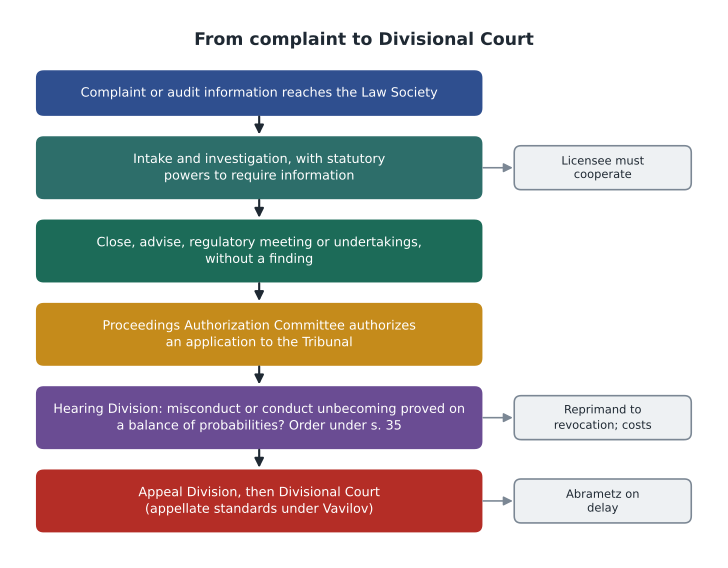
Anyone can complain to the Law Society about a lawyer or paralegal: a client, an opposing party, a judge, another licensee or a member of the public. Many matters also start inside the Society, through spot audits of trust accounts, annual report filings, or reports from other licensees under the duty to report in rule 7.1-3. Most complaints are about service: delay, failure to communicate, rudeness, fees. A smaller number concern integrity: dishonesty, misleading the court, misappropriation.
The Society's staff assess each complaint. Many are closed because they fall outside its mandate, such as a complaint that amounts to a disagreement with a court's decision, or because there is no evidence of a breach. Others are resolved informally, for example by giving the licensee advice or a caution. Where an investigation is warranted, the Law Society Act gives the Society substantial powers to require the licensee and others to provide information and documents, including privileged information, which the Act protects from further disclosure. A licensee must cooperate with an investigation, and failing to respond to the Society is itself a ground for discipline.
Not every finding of a problem leads to a hearing. The Society can resolve matters through a regulatory meeting, sometimes called an invitation to attend, at which the licensee discusses the concern with senior benchers; through undertakings, such as agreeing to complete a course or practise under supervision; or through a practice review. Serious matters go to the Proceedings Authorization Committee, a committee of benchers that decides whether to authorize the Society to bring an application to the Tribunal.
The Law Society Tribunal
Since 2014, adjudication has been carried out by the Law Society Tribunal, which operates at arm's length from the Society's investigation and prosecution staff under a chair who is not a bencher. It has two divisions. The Hearing Division hears applications at first instance, usually in panels of three that include lawyers or paralegals and a public member. The Appeal Division hears appeals from the Hearing Division. Hearings are generally public.
Section 33 of the Law Society Act provides that a licensee shall not engage in professional misconduct or conduct unbecoming a licensee. Professional misconduct generally refers to conduct in the course of practice that falls below the standards the rules require. Conduct unbecoming refers to conduct, often in a licensee's private life, that brings discredit on the profession, such as a fraud conviction unrelated to practice. Under section 34, the Society may apply to the Tribunal for a determination of whether a licensee has contravened section 33, and if so, the Hearing Division may make the orders set out in section 35. Those orders range from a reprimand, a fine and conditions on practice, through suspension, to permission to surrender the licence and revocation. Costs may be ordered against the licensee. The Society bears the burden of proof on a balance of probabilities, the civil standard that the Supreme Court confirmed in F.H. v. McDougall, 2008 SCC 53, applies in civil and administrative cases, with clear, convincing and cogent evidence required.
The Act also provides for capacity proceedings, where a licensee's physical or mental condition may be affecting her ability to practise, and competence proceedings, where a licensee is failing to meet the standards of competence. These are not punitive: the orders aim at treatment, supervision or restriction until the problem is addressed. Administrative suspensions for failing to pay fees, file the annual report or complete required professional development operate separately and end when the licensee complies. In urgent cases, the Society can seek an interlocutory suspension or restriction before the hearing to protect the public.
Penalty principles
The Tribunal's penalty decisions are guided by the purposes of regulation: protection of the public, maintaining public confidence in the profession, specific and general deterrence and, where appropriate, rehabilitation. Panels look at the nature and seriousness of the misconduct, whether it involved dishonesty, the harm caused, the licensee's prior record, whether the licensee admitted the misconduct and cooperated, evidence of remorse and insight, and any mitigating personal circumstances such as illness, if they are causally connected to the misconduct. Misappropriation of trust money, as lesson 5 explained, generally leads to revocation. Many cases are resolved by agreed statements of facts and joint submissions on penalty, which panels accept unless the proposed penalty would bring the administration of justice into disrepute or is otherwise contrary to the public interest.
Standards of review after Vavilov
A licensee or the Society can appeal from the Hearing Division to the Appeal Division, and from the Appeal Division to the Divisional Court. Because the Law Society Act provides a statutory appeal to the court, the framework from Canada (Minister of Citizenship and Immigration) v. Vavilov, 2019 SCC 65, which the class studied with Professor Delisle in administrative law, directs that the court apply appellate standards: correctness on questions of law, and palpable and overriding error on questions of fact and of mixed fact and law, unless there is an extricable legal error. The Appeal Division itself, as an internal appeal body, applies the standards set by its own rules and case law.
That framework is newer than some of the cases the class has read. Groia, decided in 2018, applied reasonableness review to the Law Society Appeal Panel's decision under the pre-Vavilov law. Abrametz shows how the post-Vavilov framework works in a law society case.
Delay and abuse of process: Abrametz
In Law Society of Saskatchewan v. Abrametz, 2022 SCC 29, a lawyer with decades of practice in Prince Albert was audited in 2012. The audit led to charges of conduct unbecoming relating to his trust accounting and to high-interest loans to clients. The Law Society's Hearing Committee found him guilty of four charges in 2018 and later disbarred him. He argued that the delay in the proceedings was an abuse of process. The Hearing Committee disagreed. The Court of Appeal for Saskatchewan, hearing a statutory appeal, found that the delay was an abuse of process and stayed the proceedings.
The Supreme Court allowed the Law Society's appeal by a majority of eight to one. Justice Rowe, for the majority, first confirmed that because the statute provided a right of appeal, appellate standards applied: whether there was an abuse of process is a question of law reviewable for correctness, but the Hearing Committee's underlying findings of fact, such as how long the delay was, what caused it and whether it caused prejudice, are entitled to deference absent palpable and overriding error. The Court of Appeal had erred by substituting its own findings of fact.
On the substance, the Court reaffirmed the test from Blencoe v. British Columbia (Human Rights Commission), 2000 SCC 44, for when delay in administrative proceedings is an abuse of process. First, the delay must be inordinate, judged in context: the nature and purpose of the proceedings, the length and causes of the delay, and the complexity of the facts and issues. Second, the delay must itself have caused significant prejudice, such as psychological harm, stigma or disruption of family or work life. If both are shown, the court asks whether the delay is manifestly unfair to the party or in some other way brings the administration of justice into disrepute. A stay is the most drastic remedy and is reserved for the clearest cases; lesser remedies, such as reducing the penalty or the costs award, may be appropriate where delay is serious but does not warrant a stay. The majority declined to impose fixed time limits like those for criminal trials under R. v. Jordan. On the facts, the delay was long but not inordinate given the complexity of the audit, and Abrametz had not shown significant prejudice. Justice Côté dissented.
Arjun Mehta draws the Abrametz test as three boxes. Sophie Tremblay-Hart points out that the decision cuts both ways for regulators: it protects them from automatic stays, but it also tells them that unexplained delay can reduce penalties. Ogilvie adds that the Law Society's own statute requires it to act in a timely manner, so delay is not only a legal risk but a breach of its mandate.
Access to justice
Section 4.2 of the Law Society Act requires the Society to have regard to a duty to act so as to facilitate access to justice for the people of Ontario. That duty sits uneasily beside the realities of practice. Many Ontarians with legal problems, especially in family, housing, employment and immigration matters, never see a lawyer, and courts and tribunals deal with large numbers of self-represented litigants. Legal aid, funded by the province and federal government through Legal Aid Ontario under the Legal Aid Services Act, 2020, covers only people with very low incomes and only some kinds of matters. Community legal clinics, student legal clinics like Brannock's, duty counsel and pro bono programs fill some of the gap.
The regulator has several tools. Licensing paralegals since 2007 has widened who may provide legal services in areas such as tenant disputes and small claims, and the Family Legal Services Provider licence, approved in 2024 with training beginning in 2025, extends that to some family law matters. The rules permit limited scope retainers, discussed in lesson 3, so that people can buy part of a lawyer's help. In 2021 the Society launched a regulatory sandbox, called Access to Innovation, allowing some technology-based legal service providers to operate under supervision. And the Law Foundation of Ontario, funded by interest on lawyers' mixed trust accounts, supports access to justice projects.
Each tool has critics. Some lawyers argue that allowing non-lawyers into family law risks harm to vulnerable clients. Some access to justice advocates argue that the reforms are too cautious, and that the profession protects its monopoly while millions go without help. The debate over self-regulation in lesson 1 is partly a debate about this: the British Columbia government justified its single-regulator law in part as a way to improve access to justice. Daniel Whitecloud says that in the community where he worked, the nearest lawyer was hours away, and the people who actually helped with legal problems were band staff, friendship centre workers and an overworked legal aid office. Ogilvie writes the last line of the day on the board: 'Access to justice is a professional duty, not a charity.'
The individual lawyer's role
For individual lawyers, access to justice shows up in ordinary decisions: offering limited scope services, accepting legal aid certificates, doing pro bono work, writing in plain language, charging fair fees, treating self-represented litigants with respect, and not taking unnecessary procedural steps that make litigation more expensive. The commentary to the Model Code encourages lawyers to make legal services available to the public efficiently and conveniently, and to provide services to people of limited means. These are not mandatory in the way the trust account rules are. They are the part of the profession's duty that depends on what Ogilvie calls the ceiling, not the floor.
Worked problem
The Elsworth investigation
A hypothetical: a Law Society spot audit at Pardee & Lowe finds that, five years ago, a bookkeeper who has since left made a series of unauthorized transfers from trust, leaving a 40,000 dollar shortfall that Warren Elsworth did not notice for eleven months because monthly reconciliations were not reviewed. Elsworth repaid the money immediately once he learned of it and reported it. The Society takes four years to bring an application. Elsworth, now 63, says the delay has made him anxious and has cost him two referral relationships.
Show solution
- Identify the allegations. The bookkeeper's theft is not Elsworth's dishonesty, but he is responsible for his trust account under By-Law 9. The likely allegation is failure to supervise and maintain proper records, not misappropriation by him.
- Consider the process. Elsworth must cooperate with the investigation. The Proceedings Authorization Committee decides whether to authorize an application, and the Hearing Division decides on a balance of probabilities.
- Apply Abrametz to the delay. Elsworth must show that the delay was inordinate in context and that it caused him significant prejudice. Anxiety and lost referrals may count, but the Tribunal will ask whether they flow from the delay itself rather than from the investigation. A stay is unlikely; a reduced penalty or costs award is possible if delay is inordinate.
- Consider penalty factors. His prompt repayment and self-report, lack of personal dishonesty and clean record weigh in his favour. The length of the undetected shortfall and the lack of reconciliation review weigh against him.
- Note the appeal route. Any appeal goes to the Appeal Division and then the Divisional Court, where findings about delay and prejudice receive deference under Vavilov and Abrametz.
Common mistakes
MistakeAssuming every complaint leads to a hearing.
InsteadMost complaints are closed or resolved informally; only serious matters authorized by the Proceedings Authorization Committee go to the Tribunal.
MistakeApplying reasonableness review to every Law Society Tribunal decision in court.
InsteadBecause the Law Society Act provides a statutory appeal, Vavilov requires appellate standards: correctness on law, palpable and overriding error on facts and mixed questions.
MistakeTreating long delay in a discipline case as automatically requiring a stay.
InsteadAbrametz requires inordinate delay and significant prejudice caused by it, and then manifest unfairness or disrepute; a stay is a last resort and lesser remedies are available.
MistakeThinking access to justice is only the government's problem.
InsteadSection 4.2 of the Law Society Act makes facilitating access to justice part of the Society's mandate, and individual lawyers contribute through their own practices.
Practice problems
Work each problem on paper first, then reveal the answer to check.
What is the difference between professional misconduct and conduct unbecoming a licensee?
Show answer
Professional misconduct concerns conduct in practice that breaches professional standards; conduct unbecoming usually concerns conduct outside practice that brings discredit on the profession.
State the test for abuse of process by delay as confirmed in Abrametz.
Show answer
The delay must be inordinate in context and must itself have caused significant prejudice; if so, the question is whether it is manifestly unfair or brings the administration of justice into disrepute. A stay is reserved for the clearest cases.
Name three ways the Law Society has tried to facilitate access to justice.
Show answer
Licensing paralegals, creating the Family Legal Services Provider licence, permitting limited scope retainers, and supporting innovation through a regulatory sandbox; interest on mixed trust accounts also funds the Law Foundation of Ontario.
Summary and key terms
- Complaints are assessed and investigated by the Law Society, which can resolve many matters informally; serious matters go to the Tribunal after authorization.
- The Law Society Tribunal's Hearing Division decides whether professional misconduct or conduct unbecoming is proved on a balance of probabilities and makes orders under section 35.
- Appeals go to the Appeal Division and then the Divisional Court, where Vavilov requires appellate standards on a statutory appeal.
- Abrametz confirms the Blencoe test for delay: inordinate delay, significant prejudice, then manifest unfairness or disrepute; stays are rare and lesser remedies are available.
- Section 4.2 makes access to justice part of the Society's mandate; paralegal licensing, the FLSP licence, limited scope retainers and innovation measures are among its tools.
- Professional misconduct
- Conduct in the course of practice that falls below the standards required of a licensee.
- Conduct unbecoming
- Conduct, often outside practice, that brings discredit on the profession.
- Law Society Tribunal
- The adjudicative body that hears Law Society applications and appeals, with a Hearing Division and an Appeal Division.
- Proceedings Authorization Committee
- A committee of benchers that decides whether to authorize an application to the Tribunal.
- Abuse of process by delay
- Delay in proceedings that is inordinate, causes significant prejudice and is manifestly unfair or brings the administration of justice into disrepute.
- Access to justice
- The ability of people to obtain fair and affordable resolution of their legal problems, which the Law Society must have regard to facilitating.
Lesson quiz · 5 questions
Score 60% or more to complete this lesson.
Create a free account to save your progress, take quizzes and earn a certificate.