
LAWC-214 · Lesson 10 of 12 · 20 min
Duties to opposing parties and third parties, and withdrawal
▶ Video coming soon A video version of this lesson is on the way.
Ogilvie opens with a confession. Early in his career, opposing counsel's assistant sent him, by mistake, an email meant for her boss: the other side's settlement authority, the highest number they could pay. 'I read it,' he says. 'I could not unread it. And for about ten minutes I thought it was the luckiest thing that had ever happened to me.' Then he called his own mentor, who told him what the rule required. The class will get to that rule shortly.
Lawyers owe their primary loyalty to their clients, but they also owe duties to opposing counsel, to the people on the other side, to witnesses and to the public. This lesson covers those duties and then turns to how a lawyer ends a relationship with a client: when a lawyer may withdraw, when she must, and how to do it without harming the client.
Courtesy and good faith
Rule 7.2-1 requires a lawyer to be courteous and civil and to act in good faith with all persons with whom the lawyer has dealings in the course of practice. Rule 7.2-2 requires a lawyer to avoid sharp practice and not to take advantage of or act without fair warning upon slips, irregularities or mistakes on the part of other lawyers not going to the merits or involving the sacrifice of a client's rights. The classic example is noting a party in default the day after its time to defend expires, when its lawyer has said she is preparing the defence. The rule does not require a lawyer to give up a client's substantive rights out of courtesy, but it does require fair warning before taking advantage of a technical slip. Rule 7.2-4 prohibits communications with other lawyers or any other person that are abusive, offensive or otherwise inconsistent with the proper tone of a professional communication.
Theo Marchetti says that in ten years as a law clerk the lawyers he most respected were the ones who returned calls from the other side. Ogilvie agrees and adds a practical reason: courts decide many costs and procedural disputes on the record of how counsel behaved, and judges read correspondence. A lawyer who writes letters she would be embarrassed to see in a motion record should not send them.
Undertakings
An undertaking is a personal promise by a lawyer, and the system depends on lawyers keeping them. Rule 7.2-11 requires a lawyer to not give an undertaking that cannot be fulfilled, to fulfil every undertaking given, and to honour every trust condition once accepted. Undertakings are given constantly: to deliver documents, to hold funds in trust until a condition is met, to discharge a mortgage after closing, to produce a witness. A lawyer who wants to limit personal responsibility must say so clearly, for example by undertaking only on behalf of the client or only to use best efforts. Breaching an undertaking is a serious disciplinary matter even if the lawyer did not benefit, because it damages the trust that lets transactions close and litigation proceed.
Represented and unrepresented persons
Rule 7.2-6 provides that, subject to narrow exceptions, if a person is represented by a lawyer in respect of a matter, another lawyer must not, except through or with the consent of that person's lawyer, approach, communicate or deal with the person on the matter, or attempt to negotiate or compromise the matter directly with the person. The rule protects the represented person from being outmanoeuvred and protects the lawyer-client relationship. It applies even if the represented person makes the contact. If the opposing party phones Maren directly, she should politely decline to discuss the matter and suggest the person talk to her own lawyer. The rule does not prevent the parties themselves from talking to each other, and it does not prevent a lawyer from giving a second opinion to a person who seeks one, as long as the lawyer is not acting in the matter for someone else. When the other side is an organization, rule 7.2-7 limits communications with its managers and employees whose acts or statements might bind it, while allowing contact with other employees, subject to care.
Unrepresented persons raise the opposite problem. Rule 7.2-9 provides that when a lawyer deals on a client's behalf with an unrepresented person, the lawyer must urge the person to obtain independent legal representation, take care to see that the person is not proceeding under the impression that the lawyer will protect his or her interests, and make clear that the lawyer is acting exclusively in the interests of the client. The lawyer may negotiate with the unrepresented person and must be honest with her, but must not give her legal advice. Self-represented litigants now appear in a large share of family and civil matters in Ontario. Treating them fairly, without becoming their lawyer, is one of the most common ethical tasks in practice.
Honesty toward others
Loyalty to the client never permits dishonesty toward others. A lawyer negotiating for a client may decline to reveal the client's bottom line and may present the client's position forcefully, but must not knowingly make false statements of fact to the other side. The duty of integrity in rule 2.1-1 and the prohibition in rule 3.2-7 on assisting fraud apply in negotiations as in court. A lawyer who tells opposing counsel that her client has no other insurance, knowing that he does, has crossed the line, whatever the strategic advantage.
Rule 3.2-5 adds a specific prohibition. A lawyer must not, in an attempt to gain a benefit for the client, threaten, or advise a client to threaten, to initiate or proceed with a criminal or quasi-criminal charge or to make a complaint to a regulatory authority. A demand letter that says 'pay the invoice or we will report you to the police for fraud' breaches the rule. The rule does not prevent a client from reporting a crime, or a lawyer from advising a client of her right to do so. It prevents using the threat of criminal or regulatory process as leverage in a civil matter.
Inadvertent disclosure
Rule 7.2-10 provides that a lawyer who receives a document relating to the representation of the lawyer's client and knows or reasonably should know that the document was inadvertently sent must promptly notify the sender. That is what Ogilvie's mentor told him. The commentary explains that the rule does not itself decide whether the lawyer may read or use the document or whether privilege has been waived; those are questions of law, often decided by a court on a motion. But the professional obligation is clear and comes first: tell the sender. Ogilvie stopped reading, called opposing counsel, deleted the email and confirmed in writing that he had done so. 'The case settled anyway,' he says, 'for about what that email said.'
The duty to report
Lawyers owe a duty to the profession as well. Rule 7.1-3 requires a lawyer, unless to do so would be unlawful or would involve a breach of solicitor-client privilege, to report to the Law Society the misappropriation or misapplication of trust money, the abandonment of a law practice, participation in serious criminal activity related to a licensee's practice, conduct that raises a substantial question about another licensee's honesty, trustworthiness or competency, conduct that raises a substantial question about another licensee's capacity, and any situation in which a licensee's clients are likely to be severely prejudiced. The duty is not to report every rude email. It is to report conduct that puts the public at risk. Lawyers who are struggling with their own health or addiction can seek confidential help through member assistance programs, which the duty to report does not reach.
Ending the relationship: withdrawal
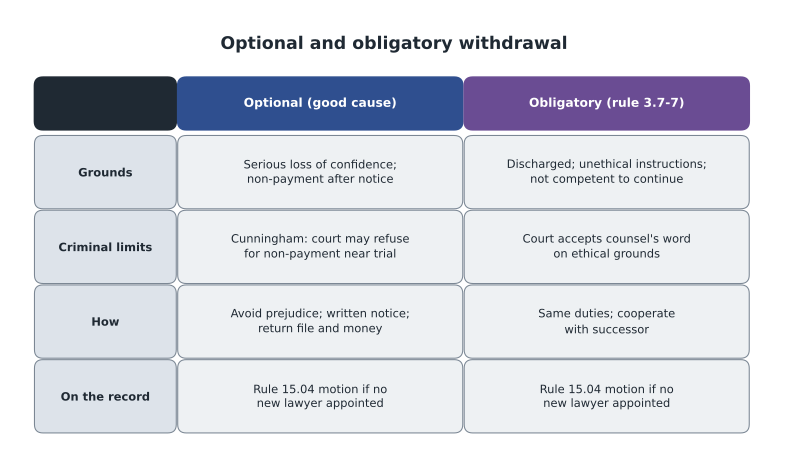
A client may end the retainer at any time. A lawyer may not. Rule 3.7-1 provides that a lawyer must not withdraw from representing a client except for good cause and on reasonable notice to the client. Good cause is not defined exhaustively, but the rules give examples. Rule 3.7-2 permits withdrawal where there has been a serious loss of confidence between the lawyer and the client, which may happen if the client deceives the lawyer, refuses to accept and act on advice on a significant point, or is persistently unreasonable or uncooperative. Rule 3.7-3 permits withdrawal for non-payment of fees, after reasonable notice, as long as the client is not prejudiced, and subject in criminal matters to the timing limits discussed in lesson 9.
Withdrawal is mandatory in some situations. Rule 3.7-7 requires a lawyer to withdraw if discharged by the client, if the client persists in instructing the lawyer to act contrary to professional ethics, or if the lawyer is not competent to continue with the matter. A lawyer who has a conflict that cannot be resolved must also withdraw, as lesson 7 explained.
How the lawyer withdraws matters as much as whether. Rule 3.7-8 requires a lawyer who withdraws to try to minimize expense and avoid prejudice to the client and to do all that can reasonably be done to facilitate the orderly transfer of the matter to the successor lawyer. The commentary and rule 3.7-9 list what that includes: notifying the client in writing of the withdrawal and the reasons where appropriate, accounting for all money received and returning any unearned retainer, delivering papers and property to which the client is entitled, giving the client all information that may be required in connection with the case, cooperating with the successor lawyer, and complying with the rules of the court or tribunal. The lawyer must not withdraw at a time or in a way that leaves the client without a reasonable opportunity to find another lawyer, for example on the eve of a hearing, unless the alternative is participating in misconduct.
When the lawyer is on the record in a court proceeding, withdrawal also requires the court's involvement. In civil proceedings in Ontario, a lawyer who wants to stop acting must ordinarily bring a motion under rule 15.04 of the Rules of Civil Procedure for an order removing her as lawyer of record, served on the client, unless the client has appointed a new lawyer or chosen to act in person. In criminal proceedings, Cunningham allows the court to refuse a withdrawal for non-payment where it would seriously harm the administration of justice.
A withdrawing lawyer must still protect the client's confidences. The motion to be removed should give only the information the court needs, usually that there has been a breakdown in the relationship or that the lawyer has been instructed in a way that makes continuing impossible, without disclosing privileged details. And a successor lawyer has duties too: before accepting the retainer, the new lawyer should be satisfied that the former lawyer has been discharged or has withdrawn, and may help the client resolve any dispute about the former lawyer's fees and the transfer of the file.
Worked problem
Maren's difficult week
Three things happen to Maren in one week. First, in a construction claim for a client of the firm, the defendant, Halina Tomczak, the owner of Tomczak Fabricating Ltd., has just lost her lawyer and calls Maren to ask what she should do about the upcoming examination for discovery. Second, the defendant's former lawyer's office emails Maren a memo marked privileged, clearly meant for Tomczak. Third, Wade Dunlevy, the wrongful dismissal client from the confidentiality lesson, has refused for the third time to follow her advice to accept a reasonable offer and now insists she send the employer a letter saying he will report the company to the Ministry of Labour unless it pays double.
Show solution
- Deal honestly with an unrepresented person. Tomczak Fabricating is now unrepresented. Maren must urge Halina to get a lawyer, make clear she acts only for the plaintiff and is not protecting the company's interests, and avoid giving advice about the discovery beyond procedural facts such as the date.
- Notify the sender. The memo was plainly sent by mistake. Under rule 7.2-10, Maren must promptly notify the former lawyer's office. She should not read further and should seek the firm's guidance before doing anything else with it.
- Refuse the threat. Wade's proposed letter would threaten a regulatory complaint to gain a benefit in the civil claim, which rule 3.2-5 prohibits. Maren must refuse to send it and explain why.
- Assess withdrawal. Repeated refusals of advice and an instruction to act unethically may amount to a serious loss of confidence under rule 3.7-2. If Wade persists in instructing her to breach the rules, withdrawal becomes mandatory under rule 3.7-7.
- Withdraw properly. If she withdraws, Maren must give Wade written notice with enough time to find new counsel, return his file and any unearned money, protect his confidences, cooperate with his new lawyer and, if she is on the record, bring a rule 15.04 motion.
Common mistakes
MistakeTalking to the opposing party directly because she called first.
InsteadRule 7.2-6 prohibits dealing with a represented person on the matter except through or with the consent of her lawyer, whoever initiates the contact.
MistakeUsing a document received by mistake because privilege may have been waived.
InsteadRule 7.2-10 requires prompt notice to the sender first. Whether privilege was waived is a legal question for later, often for a court.
MistakeThreatening criminal charges in a demand letter to encourage payment.
InsteadRule 3.2-5 prohibits threatening criminal, quasi-criminal or regulatory proceedings to gain a benefit for the client.
MistakeStopping work on a file without telling the client or the court.
InsteadWithdrawal requires good cause, reasonable notice, steps to avoid prejudice and, for a lawyer of record, compliance with the court's rules such as rule 15.04.
Practice problems
Work each problem on paper first, then reveal the answer to check.
What three things must a lawyer do when dealing with an unrepresented person on a client's behalf?
Show answer
Urge the person to obtain independent representation, make sure the person does not think the lawyer will protect her interests, and make clear the lawyer acts exclusively for the client.
When is a lawyer required to withdraw under rule 3.7-7?
Show answer
When discharged by the client, when the client persists in instructing the lawyer to act contrary to professional ethics, and when the lawyer is not competent to continue.
A lawyer learns that a colleague at another firm has abandoned her practice, leaving clients' files unattended. What must she do?
Show answer
Report it to the Law Society under rule 7.1-3, unless reporting would be unlawful or would breach privilege, because abandonment puts clients at risk.
Summary and key terms
- Rules 7.2-1, 7.2-2 and 7.2-4 require courtesy and good faith, no sharp practice and no abusive communications; rule 7.2-11 requires strict fulfilment of undertakings.
- Rule 7.2-6 forbids dealing with a represented person except through her lawyer; rule 7.2-9 sets duties toward unrepresented persons.
- Rule 3.2-5 forbids threatening criminal or regulatory proceedings for advantage; rule 7.2-10 requires notifying the sender of an inadvertently sent document.
- Rule 7.1-3 requires reporting serious misconduct, such as misappropriation or abandonment, to the Law Society, subject to privilege.
- Withdrawal requires good cause and reasonable notice and is mandatory in the circumstances in rule 3.7-7; the lawyer must avoid prejudice, transfer the file properly and comply with court rules such as rule 15.04.
- Sharp practice
- Taking unfair advantage of another lawyer's slips or mistakes that do not go to the merits.
- Undertaking
- A personal promise by a lawyer, which must be strictly fulfilled.
- Represented person
- A person who has a lawyer in the matter, with whom another lawyer may deal only through that lawyer.
- Unrepresented person
- A person without a lawyer in the matter, to whom a lawyer for another party owes duties of honesty and clarity.
- Inadvertent disclosure
- The sending of a document to the wrong person by mistake.
- Lawyer of record
- The lawyer named in court documents as acting for a party, who needs leave or a court order to stop acting in many cases.
Lesson quiz · 5 questions
Score 60% or more to complete this lesson.
Create a free account to save your progress, take quizzes and earn a certificate.