
LAWC-214 · Lesson 8 of 12 · 20 min
Duty to the court
▶ Video coming soon A video version of this lesson is on the way.
Ogilvie arrives with a gown over his arm and hangs it on the back of the door. 'When you put this on in the Superior Court,' he says, 'you are still your client's lawyer. But you are also an officer of the court, and the court is relying on you to tell it the truth about the law and not to lie to it about the facts. Those two jobs fit together almost all the time. This lesson is about the times they do not.'
This lesson covers the advocate's duties in section 5.1 of the Model Code: resolute advocacy, candour about the law and the facts, false evidence, civility as explained in Groia v. Law Society of Upper Canada, the lawyer as witness, and the newest form of misleading a court, citing authorities that do not exist.
Resolute and honourable
Rule 5.1-1 provides that when acting as an advocate, a lawyer must represent the client resolutely and honourably within the limits of the law, while treating the tribunal with candour, fairness, courtesy and respect. The commentary describes the role in the adversary system: the lawyer has a duty to raise fearlessly every issue, advance every argument and ask every question, however distasteful, that the lawyer thinks will help the client's case, and to endeavour to obtain for the client the benefit of every remedy and defence authorized by law. The lawyer must do so by fair and honourable means, without illegality and in a manner consistent with the duty to treat the tribunal with candour, fairness, courtesy and respect.
Resolute advocacy is not a minor value. It is the reason a person accused of a terrible crime can trust that her lawyer will test the evidence, and the reason a small business suing a large insurer can expect its lawyer not to fold. A lawyer who goes easy on the other side to keep a judge or opposing counsel happy breaches the duty of commitment to the client's cause. The limits come from the law and from the duties of candour and honesty to the court.
What an advocate must not do
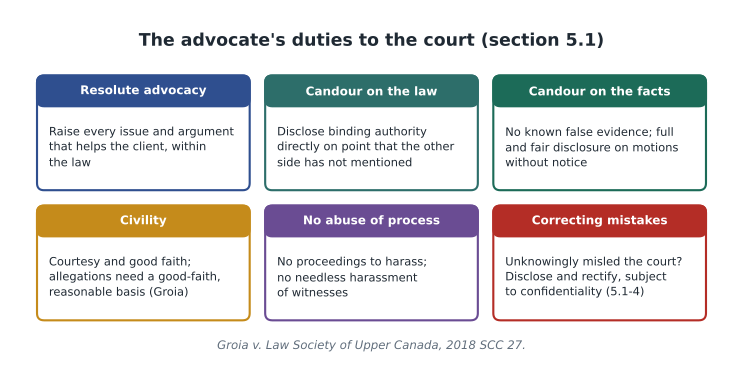
Rule 5.1-2 lists conduct an advocate must not engage in. Paraphrased and grouped, the list includes: abusing the process of the tribunal by bringing proceedings that are clearly motivated by malice or brought solely to injure the other party; knowingly assisting or permitting a client to do anything dishonest or dishonourable; attempting to influence a judge privately or appearing before a judge with whom the lawyer has a relationship that might give rise to a reasonable apprehension of bias; knowingly attempting to deceive a tribunal by offering false evidence, misstating facts or law, presenting false or deceptive affidavits or suppressing what ought to be disclosed; knowingly misstating the contents of a document, the testimony of a witness, the substance of an argument or the provisions of a statute; knowingly asserting as true a fact when its truth cannot reasonably be supported by the evidence; deliberately refraining from informing a tribunal of any binding authority that the lawyer considers to be directly on point and that has not been mentioned by another party; improperly dissuading a witness from giving evidence; and needlessly abusing, hectoring or harassing a witness.
Three themes run through the list. The lawyer must not lie, directly or by misleading half-truths. The lawyer must not let the client use her to lie. And the lawyer must not use the process for a purpose other than resolving the dispute.
Candour about the law
The duty to disclose adverse binding authority surprises students. A lawyer who finds a Court of Appeal decision directly against her client's position, which the other side has missed, must tell the court about it. She can then argue that it is distinguishable, wrongly decided or should be reconsidered; candour about the law does not require conceding the point. The duty applies to binding authority that is directly on point. It does not require a lawyer to cite every unhelpful trial decision from another province, although a careful lawyer often does, because judges remember who was candid with them.
Candour about the law now includes the authenticity of authorities. Lesson 3 described the cases in which lawyers cited cases that did not exist after relying on generative tools, and Ontario's requirement that a lawyer certify in every factum that she is satisfied as to the authenticity of every authority cited, and since September 1, 2026 as to the accuracy of quotations. Citing a hallucinated case is a misstatement of the law. Whether the lawyer knew it was false matters to discipline and to contempt, but the court's response in costs does not depend on intent.
Candour about the facts
An advocate in an adversarial proceeding is not generally required to volunteer facts that hurt her client. The other side has its own lawyer and its own means of discovery. But the lawyer must not misstate facts, must not offer evidence she knows to be false and must not present an affidavit she knows contains false statements. The line is between silence about unfavourable facts, which is usually permitted, and active deception, which never is.
The exception is a proceeding in which the other side is absent. On a motion without notice, rule 39.01(6) of Ontario's Rules of Civil Procedure requires the moving party to make full and fair disclosure of all material facts, and failure to do so is in itself sufficient ground for setting aside any order obtained. The professional rule is to the same effect. A lawyer who obtains an injunction without notice by leaving out the facts the other side would have raised has misled the court, even if every sentence she said was true.
False evidence
What must a lawyer do if her own client lies, or plans to? The rules distinguish timing and knowledge. If the lawyer knows that the client intends to give false evidence, she must explain to the client that she cannot call or rely on it and must try to dissuade the client. If the client insists, the lawyer must not participate, which usually means she must withdraw. If the lawyer learns after the fact that she has unknowingly misled the court, rule 5.1-4 provides that she must, subject to the rules on confidentiality, disclose the error or omission and do all that can reasonably be done in the circumstances to rectify it. Where the misleading evidence came from the client, the lawyer must urge the client to correct it, must not rely on it, and, if the client refuses, will usually have to withdraw.
Two features of the Canadian approach deserve emphasis. First, the trigger is knowledge, not suspicion or doubt. A lawyer who thinks her client's account is unlikely, or who has heard conflicting versions, does not know it is false, and the commentary is clear that it is for the court, not the lawyer, to assess credibility. Second, confidentiality limits what the lawyer may disclose. Unlike some American rules, the Model Code does not generally require a lawyer to tell the court that her client lied; the remedy is to refuse to participate and, if necessary, withdraw. Lesson 9 discusses the special version of this problem in criminal cases.
Civility and Groia
Rule 5.1-5 requires a lawyer to be courteous and civil and to act in good faith to the tribunal and all persons with whom the lawyer has dealings, and rule 7.2-1 sets the same standard toward other lawyers. Incivility matters because it damages trials: it distracts from the issues, intimidates witnesses, prolongs hearings and erodes public confidence. But a rule against incivility must not become a tool for punishing lawyers who fight hard for unpopular clients.
Groia v. Law Society of Upper Canada, 2018 SCC 27, sets out how the line is drawn. Joseph Groia defended John Felderhof, an executive of the mining company Bre-X, on securities charges in a long and bitter trial. Groia repeatedly accused the prosecutors of misconduct, often sarcastically, based on a mistaken view of their disclosure obligations, which the trial judge did not correct early on. The Law Society began proceedings years later. Its Appeal Panel found professional misconduct, suspended him for one month and ordered costs. The Divisional Court and the Court of Appeal upheld the finding.
A majority of the Supreme Court, in reasons by Justice Moldaver, held that the finding was unreasonable. The Court accepted the Appeal Panel's context-specific approach, which looks at what the lawyer said, the manner and frequency of the remarks and the presiding judge's reaction, but held that the panel had applied it unreasonably. Allegations of prosecutorial misconduct or attacks on opposing counsel's integrity can be professional misconduct if they lack a reasonable basis, but allegations made in good faith with a reasonable basis are not misconduct even if they rest on a mistaken legal view. A lawyer's honest but mistaken understanding of the law cannot be the basis of a finding of incivility, because that would chill resolute advocacy. The trial judge's response, including his failure to rein Groia in early, was relevant context. Three judges dissented, holding that the Law Society could reasonably find that Groia's repeated, unfounded attacks on the prosecutors' integrity crossed the line; Justice Côté concurred with the majority in the result for different reasons.
Groia was decided before Vavilov and applied the reasonableness standard to the Law Society's decision. Lesson 11 explains how review of Law Society Tribunal decisions works now. The substantive lesson is unchanged: lawyers may be forceful, may object, and may allege misconduct by the other side, but they need a reasonable, good-faith basis, and they must not make it personal.
Civility also limits what lawyers say about judges. In Doré v. Barreau du Québec, 2012 SCC 12, a lawyer wrote a private letter to a judge, after the judge had been harsh and insulting toward him in court, insulting the judge in strong personal terms. The Barreau's disciplinary council suspended him for twenty-one days, and the Supreme Court upheld the sanction, holding that it was a proportionate balance between the lawyer's freedom of expression and the profession's interest in civility. The Court said lawyers are expected to show a certain resilience. Lawyers may criticize judges and the justice system, in appropriate language and forums, and the commentary encourages good-faith criticism. They may not abuse them.
Other duties to the tribunal
Rule 5.2-1 provides that a lawyer who appears as advocate must not testify or submit her own affidavit evidence before the tribunal unless permitted by the rules of court or the matter is purely formal or uncontroverted. A lawyer who expects to be a witness on a contested issue should usually not act as counsel. The rules also govern communications with witnesses: a lawyer may interview any witness, but must not counsel a witness to give false evidence or to stay away, and must follow the restrictions on discussing evidence with a witness, including the client, who is in the middle of cross-examination.
Courts can respond directly to lawyers who abuse the process. Rule 57.07 of the Rules of Civil Procedure allows the court to order costs against a lawyer personally where the lawyer has caused costs to be incurred without reasonable cause or wasted by undue delay, negligence or other default. In criminal cases, the Supreme Court held in Quebec (Director of Criminal and Penal Prosecutions) v. Jodoin, 2017 SCC 26, that a court may award costs personally against defence counsel only for serious misconduct, such as conduct that is an abuse of process, and that the power must be used sparingly. Contempt remains available for the most serious cases.
Worked problem
Rosa Ingram's affidavit
Corwin Plaza Holdings has brought a summary judgment motion in Ingram v. Corwin Plaza Holdings. Maren drafts Rosa's responding affidavit. Rosa wants it to say that she was watching her step carefully when she fell. At her examination for discovery months earlier, Rosa said she 'wasn't really looking at the ground'. Maren also finds a recent Court of Appeal for Ontario decision on the Occupiers' Liability Act notice period that hurts Rosa's position and is not in Plaza's factum.
Show solution
- Spot the false evidence risk. Maren does not know which account is true, but she knows the proposed sentence contradicts Rosa's sworn discovery answer. She must not draft an affidavit she knows to be misleading.
- Talk to Rosa. Maren should explain that the affidavit must be true and complete, that the discovery transcript will be in the record, and that a contradictory affidavit will damage her credibility and could expose her to serious consequences.
- Draft honestly. If Rosa's honest evidence is that she was walking normally and did not notice the ice, the affidavit can say that, consistently with the discovery answer, and Maren can argue that the duty to clear ice does not depend on whether a pedestrian stares at the ground.
- Disclose the adverse authority. The Court of Appeal decision is binding and directly on point. Maren must bring it to the court's attention and may then argue that it is distinguishable.
- Certify the factum. Before signing the certification of authenticity and accuracy of quotations, Maren must read every authority cited in Rosa's factum in the original.
Common mistakes
MistakeBelieving an advocate must volunteer every unfavourable fact.
InsteadIn adversarial proceedings the lawyer need not volunteer harmful facts, but must never misstate facts or offer known false evidence. On a motion without notice, full and fair disclosure is required.
MistakeLeaving out binding authority that hurts the client because the other side missed it.
InsteadRule 5.1-2 requires informing the tribunal of binding authority directly on point not mentioned by another party; the lawyer may then distinguish it.
MistakeTreating any sharp allegation against opposing counsel as incivility.
InsteadUnder Groia, allegations made in good faith with a reasonable basis are not misconduct, even if based on a mistaken legal view; context, including the judge's reaction, matters.
MistakeWithdrawing whenever the lawyer doubts the client's account.
InsteadThe trigger is knowledge that evidence is false, not doubt. Credibility is for the court.
Practice problems
Work each problem on paper first, then reveal the answer to check.
What factors did the Appeal Panel in Groia use, and the Supreme Court accept, for assessing incivility?
Show answer
What the lawyer said, the manner and frequency of the remarks, and the presiding judge's reaction, all in context, with allegations of misconduct requiring a good-faith, reasonable basis.
A lawyer discovers after a hearing that an exhibit she filed was altered by the client. What does rule 5.1-4 require?
Show answer
Subject to confidentiality, she must disclose the error and do all she reasonably can to rectify it. She must urge the client to correct it, must not rely on the exhibit, and if the client refuses she will likely have to withdraw.
Why was the lawyer in Doré disciplined?
Show answer
For a private letter to a judge containing personal insults. The Supreme Court held that the sanction proportionately balanced his expression against the profession's interest in civility.
Summary and key terms
- Rule 5.1-1 requires resolute and honourable advocacy within the law, with candour, fairness, courtesy and respect toward the tribunal.
- Rule 5.1-2 prohibits deceiving the tribunal, misstating law or facts, suppressing binding adverse authority, abusing process and harassing witnesses.
- There is no general duty to volunteer harmful facts, except on motions without notice; known false evidence must never be called and must be corrected or withdrawn from.
- Groia holds that good-faith allegations with a reasonable basis are not incivility, even if legally mistaken; Doré upholds discipline for abusive language toward a judge.
- Courts can order costs personally against lawyers under rule 57.07 and, for serious misconduct, in criminal cases under Jodoin; authorities must be verified and certified.
- Officer of the court
- A description of the lawyer's role that carries duties of candour and honesty to the court.
- Resolute advocacy
- The duty to raise every issue and argument that helps the client, by fair and honourable means.
- Candour
- Honesty and openness with the tribunal about the law and the facts.
- Motion without notice
- A motion brought without notice to the other party, which requires full and fair disclosure of all material facts.
- Incivility
- Discourteous or abusive conduct by a lawyer that may amount to professional misconduct in context.
- Costs personally
- An order that a lawyer, rather than the client, pay costs caused by the lawyer's misconduct or default.
Lesson quiz · 5 questions
Score 60% or more to complete this lesson.
Create a free account to save your progress, take quizzes and earn a certificate.