
LAWC-214 · Lesson 5 of 12 · 21 min
Fees, retainers and trust accounting
▶ Video coming soon A video version of this lesson is on the way.
Ogilvie begins with a number: the most common reason Ontario lawyers lose their licences is not incompetence or rudeness or even dishonesty in court. It is taking money that belongs to clients. 'Nobody walks into law school planning to steal from a trust account,' he says. 'People walk into trouble one transfer at a time, usually when they are short of money and sure they will put it back next week.' He asks Theo Marchetti, who spent a decade as a law clerk, what a trust ledger looks like. Theo describes it in detail, and Ogilvie says that is the first time in fifteen years a student has answered without looking it up.
This lesson covers how lawyers charge for their work, including retainers, hourly and fixed fees and contingency fees under the Solicitors Act and O. Reg. 563/20, and how they must handle money that belongs to clients under the Law Society's By-Laws.
Fair and reasonable fees
Rule 3.6-1 provides that a lawyer must not charge or accept a fee or disbursement, including interest, unless it is fair and reasonable and has been disclosed in a timely fashion. The commentary lists factors that bear on whether a fee is fair and reasonable: the time and effort required and spent, the difficulty of the matter and the importance of the matter to the client, whether special skill or service was required and provided, the results obtained, fees authorized by statute or regulation, special circumstances such as the postponement of payment, uncertainty of reward or urgency, the likelihood, if made known to the client, that acceptance of the retainer will result in the lawyer's inability to accept other employment, any relevant agreement between the lawyer and the client, the experience and ability of the lawyer, any estimate or range of fees given by the lawyer, and the client's prior consent to the fee.
The rule is about two things, the amount and the disclosure. A fee that might be reasonable in the abstract can still breach the rule if the client was not told about it in time. The commentary says that breach of the rule on fees, especially in the form of overcharging or charging for work not done, can amount to professional misconduct. Padding dockets, billing two clients for the same hour, and charging an hourly rate for work done by a tool or a junior at a senior's rate are all examples. So is charging a client for the lawyer's own learning time on an area the lawyer should already know.
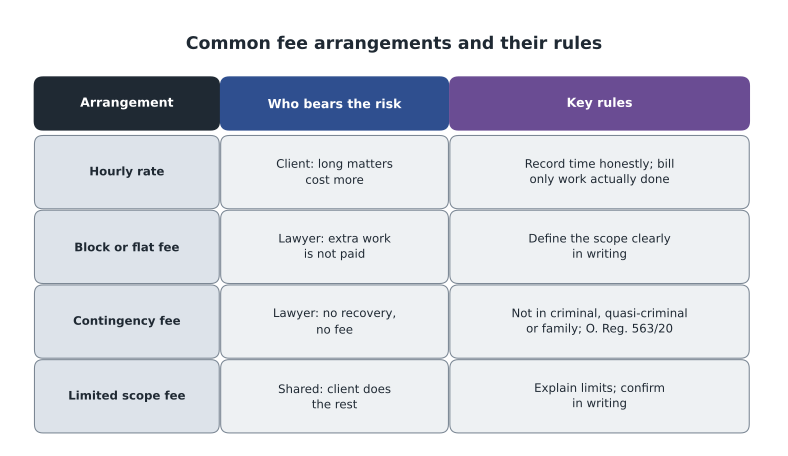
Most Ontario lawyers charge by the hour, recording time in six-minute units. Many also offer fixed or block fees for defined tasks, such as a simple real estate purchase, an uncontested divorce or a standard will, which give the client certainty and shift the risk of extra work to the lawyer. Fixed fees work only if the scope is defined clearly in writing. A retainer letter that promises a flat fee for 'the divorce' without saying what happens if the divorce becomes contested is an invitation to a fee dispute.
Retainers and money on account
The word retainer has two meanings in practice, and confusing them causes trouble. It can mean the contract between lawyer and client, the agreement to act. It can also mean money paid in advance. Money paid in advance on account of future fees and disbursements belongs to the client until the lawyer has done the work and delivered a bill. It must go into the trust account and can be transferred to the lawyer's general account only after a bill, called a statement of account, has been delivered to the client. A true general retainer, paid simply to secure the lawyer's availability and earned on receipt, is rare and must be clearly agreed; most money paid in advance is money on account.
Rule 3.6-3 requires a lawyer's statement of account to show clearly the amount charged for fees and disbursements separately. Clients have a statutory right under the Solicitors Act to have a lawyer's bill assessed by an assessment officer of the Superior Court of Justice, who can reduce it if it is not fair and reasonable. Strict time limits apply, and once a bill has been paid or a year has passed, an assessment is available only in special circumstances. Fee disputes are among the most common complaints to the Law Society, which generally leaves the amount of a fee to the assessment process unless the conduct suggests dishonesty.
Two related rules protect clients from hidden payments. Rule 3.6-7 forbids a lawyer from splitting fees with a person who is not a licensee, which keeps unlicensed people from directing clients to lawyers for a cut. Ontario permits referral fees between licensees only within the limits set by its rules, which require the referral to be made because of the expertise and ability of the receiving lawyer, require the arrangement to be fair and reasonable and fully disclosed to the client, and require the client's consent in writing. A lawyer acting under a legal aid certificate must not take any payment from the client beyond what the legal aid plan allows.
Contingency fees
A contingency fee is one in which the lawyer's fee depends on the outcome of the matter, usually as a percentage of what the client recovers. Contingency fees let people who cannot pay hourly rates pursue claims, especially personal injury claims, and they shift the risk of losing to the lawyer. They also create incentives that can conflict with the client's interest, such as settling early for less to avoid the work of a trial. Rule 3.6-2 permits a lawyer to enter into a written agreement providing that the fee is contingent on the successful disposition of the matter, except in criminal or quasi-criminal matters. In Ontario, section 28.1 of the Solicitors Act also prohibits contingency fee agreements in family law matters.
Ontario regulates contingency fees in detail. O. Reg. 563/20 under the Solicitors Act, which replaced the earlier regulation in 2021, sets out these requirements:
First, a cap. The lawyer for a claimant cannot recover more in fees than the client recovers, by way of damages or settlement, including costs but excluding disbursements and taxes. A fee that would leave the lawyer with more than the client is not allowed. Second, disbursements. Where the fee is a percentage of the recovery, the percentage must be applied to an amount that excludes disbursements the court allows or would allow against the other side, so the lawyer does not take a percentage of the client's reimbursed expenses. Third, payment in trust. The client must direct that fees, costs, taxes and disbursements be paid to the lawyer in trust out of any award or settlement, so the money passes through the trust account and the client can see the calculation.
Fourth, the form. A percentage-based contingency fee agreement must use the Standard Form Contingency Fee Agreement published by the Law Society, dated November 18, 2021, unless an exemption applies, such as where the client is a large organization or a court has approved the agreement. Any other agreement must contain prescribed statements, including how the fee is determined, the fee cap, how disbursements, taxes and costs are dealt with, the client's liability for costs if the claim fails, the client's right to have the account assessed and the time limits for doing so, how the agreement may be terminated and what fee is payable on termination, and the client's right to make all critical decisions about the conduct of the matter. Fifth, assessment. The client or the lawyer may apply to the Superior Court of Justice to assess the lawyer's bill within six months after it is delivered. Sixth, clients under disability. If the client is a minor or otherwise under a disability, the agreement must be approved by a judge, either before it is finalized or as part of a motion to approve the settlement. Finally, certain terms are prohibited: the agreement must not require the lawyer's consent before the client may abandon, discontinue or settle the claim, must not prevent the client from terminating the agreement or changing lawyers, and must not permit fee splitting except as the rules allow.
Kwabena Adjei's file illustrates the stakes. Ogilvie introduces him: a delivery cyclist struck by a truck on Harlow Street, now with a shattered pelvis and no income. Adjei cannot pay a lawyer by the hour, and Pardee & Lowe offers to act on a contingency fee. Hannah Kowalczyk asks whether a percentage fee is ever unfair to a client who settles in a month. Ogilvie says that is exactly why the regulation gives the client a right to an assessment, why the standard form explains it in plain language, and why the rule on fair and reasonable fees still applies on top of the regulation. A contingency percentage that is reasonable for a claim that goes to trial may be unreasonable if the matter settles with almost no work.
Trust accounting under By-Law 9
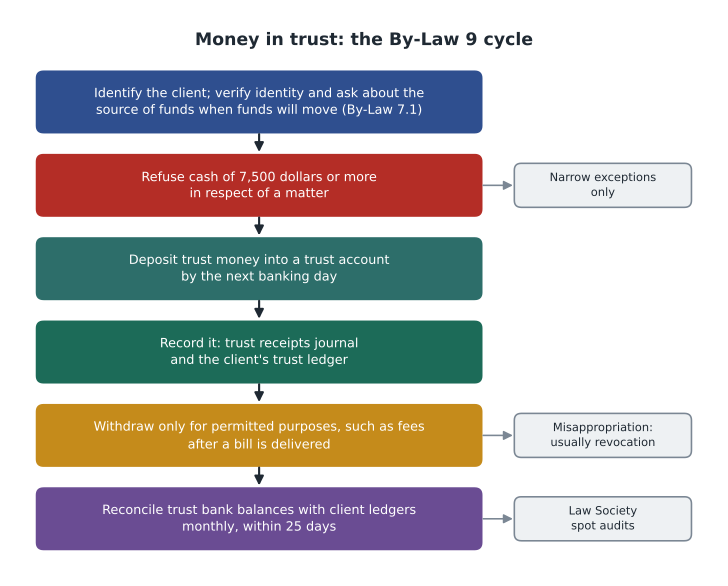
Money belonging to clients is held in trust. The Law Society's By-Law 9 sets out detailed requirements for how licensees receive, hold, record and pay out trust money, and its rules are strict because the consequences of failure are severe. The core rules are these. Money received in trust for a client must be deposited into a trust account, kept separate from the lawyer's own money, on or before the following banking day. Money may be withdrawn from trust only for permitted purposes, such as paying money on the client's behalf, reimbursing the lawyer for disbursements properly paid for the client, paying fees for which a bill has been delivered, and transferring money between trust accounts. A lawyer must never withdraw more for a client than is held for that client; using one client's money to cover another's shortfall is misappropriation even if the lawyer intends to repay it.
The By-Law also requires records. A licensee must keep a trust receipts journal, a trust disbursements journal and a client trust ledger showing every client's balance, and must reconcile the trust bank balance with the client ledgers each month, not later than the twenty-fifth day of the following month. Licensees file an annual report to the Society that includes information about their trust accounts, and the Society conducts spot audits and investigations. Interest earned on mixed trust accounts is paid to the Law Foundation of Ontario under the Law Society Act and funds legal aid and access to justice programs.
Trust accounts are attractive to money launderers because a payment from a lawyer's trust account looks legitimate. By-Law 9 therefore restricts cash. A licensee must not receive or accept cash of 7,500 dollars or more in respect of any one client matter, subject to narrow exceptions, such as cash received from a peace officer or by order of a court. Since amendments that took effect on January 1, 2022, the trust account may be used only in connection with legal services the licensee or firm is providing, and money must not be left in trust for an unreasonable time after the services are completed. By-Law 7.1 adds client identification and verification requirements: a licensee must identify every client and, where the licensee engages in or gives instructions in respect of receiving, paying or transferring funds, must verify the client's identity using reliable documents, ask about the source of funds, and monitor the retainer for activity inconsistent with the client's purpose. These rules work alongside rule 3.2-7, which requires a lawyer to make inquiries and withdraw rather than assist a client whose transaction appears designed to launder money.
In 2025 the Law Society's professional regulation committee began studying whether licensees should be required to authorize the Society to obtain account records directly from financial institutions in some circumstances, because licensees who do not cooperate with audits can delay investigations. No such rule has yet been made.
When trust money goes missing
Misappropriation of trust funds is treated as one of the most serious forms of professional misconduct. In most cases the Law Society Tribunal revokes the licence, regardless of whether the lawyer repaid the money, because the profession's trust account system depends on absolute integrity. Mitigating circumstances, such as serious illness, can matter at the margins, but the starting point is loss of licence. The Compensation Fund can reimburse clients who suffer losses from a licensee's dishonesty, up to set limits.
Ogilvie's practical advice is short. Never borrow from trust, even for an hour. Never pay yourself from trust without a bill. Reconcile every month even if you think nothing has changed. And never let a bookkeeper be the only person who understands your trust account. A lawyer is responsible for her trust account even if an employee does the entries.
Worked problem
Kwabena Adjei's contingency agreement
Warren Elsworth asks Maren to prepare a contingency fee agreement for Kwabena Adjei, 29, who was injured when a truck struck his bicycle. The firm's usual fee is 30 percent of the recovery. Kwabena's cousin offers to pay 5,000 dollars in cash for disbursements. Elsworth also suggests a clause requiring Kwabena to consult the firm before accepting any settlement offer.
Show solution
- Use the standard form. For a percentage-based agreement, Maren must use the Law Society's Standard Form Contingency Fee Agreement unless an exemption applies, which it does not for an individual client.
- Check the percentage. The fee is calculated on the recovery excluding disbursements allowed against the defendant, and the fee may never exceed what Kwabena himself recovers, including costs and excluding disbursements and taxes.
- Reject the settlement clause as drafted. The regulation prohibits terms requiring the lawyer's consent before the client settles. A clause promising to tell the firm about offers is fine; a veto is not.
- Handle the cash properly. The 5,000 dollars is below the 7,500 dollar cash limit, but it is still trust money for Kwabena's disbursements. Maren must identify Kwabena and record the source, consider whether the cousin's payment raises any concern, deposit it into trust by the next banking day and record it in his ledger.
- Explain the agreement. Kwabena should understand the fee, the cap, the costs risk if he loses, his right to an assessment within six months of a bill, and his right to make all critical decisions.
Common mistakes
MistakeTreating money paid in advance as the lawyer's money.
InsteadMoney on account of future fees belongs to the client and stays in trust until the lawyer delivers a bill for work done.
MistakeUsing a contingency fee in a family law matter.
InsteadThe Solicitors Act prohibits contingency fee agreements in family law matters, and the rules prohibit them in criminal and quasi-criminal matters.
MistakeApplying the contingency percentage to the whole recovery including reimbursed disbursements.
InsteadO. Reg. 563/20 requires the percentage to be applied to an amount that excludes disbursements allowed against the other side, and caps the fee at the client's own recovery.
MistakeCovering one client's shortfall with another client's trust money and repaying it later.
InsteadThis is misappropriation, which usually leads to revocation of the licence whatever the intention to repay.
Practice problems
Work each problem on paper first, then reveal the answer to check.
A client pays a lawyer 3,000 dollars "to get started" on a lawsuit. Where should the money go?
Show answer
Into the trust account by the next banking day, recorded in the client's ledger. It can be transferred to the lawyer only after a bill for work done is delivered.
May a lawyer accept 9,000 dollars in cash from a client as a retainer?
Show answer
No. By-Law 9 prohibits receiving cash of 7,500 dollars or more in respect of a client matter, subject to narrow exceptions that do not cover an ordinary retainer.
Within what time may a client or lawyer apply to assess a bill under a contingency fee agreement?
Show answer
Within six months after the bill is delivered, under O. Reg. 563/20.
Summary and key terms
- Rule 3.6-1 requires fees and disbursements to be fair and reasonable and disclosed in a timely fashion; overcharging can be misconduct.
- Money on account belongs to the client until a bill is delivered; clients can have bills assessed under the Solicitors Act.
- Contingency fees are allowed except in criminal, quasi-criminal and, in Ontario, family matters; O. Reg. 563/20 requires the standard form, caps fees at the client's recovery and prohibits terms limiting the client's right to settle or change lawyers.
- By-Law 9 governs trust accounts: prompt deposit, permitted withdrawals, records and monthly reconciliation, and a 7,500 dollar cash limit; By-Law 7.1 requires client identification and verification.
- Misappropriation of trust money usually leads to revocation.
- Retainer
- Either the agreement under which a lawyer acts or money paid in advance on account of fees and disbursements.
- Statement of account
- A lawyer's bill to a client, which must show fees and disbursements separately.
- Assessment
- Review of a lawyer's bill by an assessment officer of the Superior Court of Justice under the Solicitors Act.
- Contingency fee
- A fee that depends on the successful outcome of the matter, often a percentage of the recovery.
- Trust account
- A bank account in which a licensee holds money belonging to clients, separate from the licensee's own money.
- Misappropriation
- Using money held in trust for a purpose other than the one for which it is held, including for the lawyer or another client.
Lesson quiz · 5 questions
Score 60% or more to complete this lesson.
Create a free account to save your progress, take quizzes and earn a certificate.