
LAWC-213 · Lesson 9 of 12 · 23 min
Trusts
▶ Video coming soon A video version of this lesson is on the way.
Professor Ellerby begins the trusts lessons by drawing three stick figures on the board, labelled settlor, trustee and beneficiary, with arrows between them. 'A trust is a relationship, not a thing,' she says, borrowing Professor Asante's phrase from property law, 'but it is a relationship about a thing.' The settlor transfers property to the trustee, who holds the legal title and must manage it for the beneficiary, who has the beneficial or equitable interest. A will that leaves money 'to my trustee to hold for my grandchildren until they turn twenty-five' creates a trust. So does an estate trustee's position itself: Ruth Holloway holds her mother's estate as trustee for the beneficiaries until it is distributed.
This lesson covers express trusts: what a trust is and how it differs from other relationships, inter vivos and testamentary trusts, the three certainties, the constitution of trusts and the formalities required, secret trusts, the main trusts used in wills, the rule in Saunders v. Vautier and the variation of trusts. Lesson 10 covers trusts that arise by operation of law, charitable trusts and the duties of trustees.
What a trust is
A trust exists when a person, the trustee, holds property subject to a legally enforceable obligation to deal with it for the benefit of others, the beneficiaries, or for a permitted purpose. The trustee is the legal owner and can sell, invest and deal with the property, but must do so in accordance with the terms of the trust and the general law of trusts. The beneficiaries can enforce the trust in the courts. A trust is not a legal person; it is a relationship, and the trustee is the person who contracts, sues and is sued in respect of the trust property.
Trusts differ from contracts, because a beneficiary need not have given anything or agreed to anything to enforce the trust. They differ from agency, because a trustee holds title in their own name and does not act on behalf of the beneficiaries as principals. They differ from debts, because trust property is kept separate from the trustee's own property and is protected if the trustee becomes bankrupt. And they differ from powers, because a trustee must perform the trust, while a person with a mere power of appointment may choose not to exercise it.
An inter vivos trust is created during the settlor's life, such as when a grandparent transfers investments to a trustee for a grandchild's education, or when a person sets up an alter ego trust. A testamentary trust is created by will and takes effect on the testator's death. Trusts may be fixed, where each beneficiary's share is set, or discretionary, where the trustee decides which beneficiaries receive what and when. A bare trust is one in which the trustee has no active duties and simply holds title for a beneficiary who can call for it, as when a parent holds shares as nominee for an adult child.
The three certainties
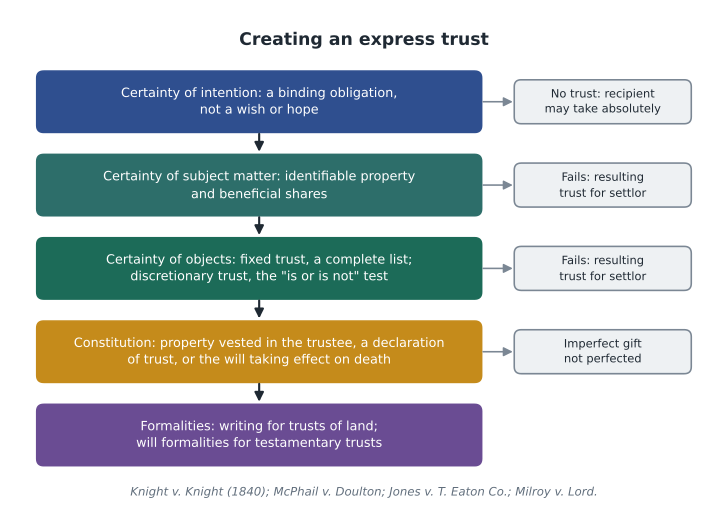
An express trust is valid only if three certainties are present, as Lord Langdale described in Knight v. Knight (1840). There must be certainty of intention, certainty of subject matter and certainty of objects. The doctrine ensures that the court can tell whether a trust was intended, what property it covers, and for whom it must be administered, so that it can enforce it if the trustee does not.
Certainty of intention means that the settlor must have intended to impose a binding obligation on the trustee. No particular words are needed; the word 'trust' is not essential, and its use is not conclusive. Precatory words, such as 'in the hope that', 'I wish' or 'I trust that she will look after the children', are generally not sufficient on their own, and a gift with such words usually passes absolutely to the recipient, who is under only a moral obligation. Courts look at the whole document. A gift 'to my wife, confident that she will provide for our daughter' has repeatedly been held to be an absolute gift to the wife.
Certainty of subject matter requires that the trust property be identifiable, and that each beneficiary's share be ascertainable. A trust of 'the bulk of my estate' fails for uncertainty, because nobody can say which part is meant; so does a trust of 'some of my shares'. A trust of 'my house and the residue of my estate' is certain. If the trust property is certain but the beneficial shares are not, the trust may fail, unless the trustee is given a discretion to fix them, which makes the trust discretionary rather than fixed.
Certainty of objects requires that the beneficiaries be identifiable. For a fixed trust, the test is whether a complete list of beneficiaries can be drawn up, because the trustee cannot divide property equally among a class whose members are unknown. For a discretionary trust, the test is less strict. In McPhail v. Doulton, [1971] A.C. 424, the House of Lords held that a discretionary trust is valid if it can be said with certainty of any given individual whether they are or are not a member of the class. The Supreme Court of Canada adopted this approach in Jones v. T. Eaton Co., [1973] S.C.R. 635, upholding a trust for 'needy or deserving' members of a company's long-service employees' club. A class may also fail if it is so wide as to be administratively unworkable, such as 'anyone in the world'.
If intention fails, there is no trust and the recipient usually takes absolutely. If subject matter or objects fail, the intended trustee cannot take beneficially, because the settlor clearly meant them to hold for others, so the property is held on a resulting trust for the settlor or the settlor's estate. In a will, the failed gift falls into residue, or, if the residue itself fails, passes on intestacy.
Constitution and formalities
A trust is not created until it is constituted. For an inter vivos trust, the settlor must either transfer the property to the trustee in the manner required for that kind of property, such as a registered transfer for land or a share transfer for shares, or declare that they themselves hold the property on trust. In Milroy v. Lord (1862), the English Court of Appeal in Chancery held that equity will not perfect an imperfect gift: if a settlor intended to transfer property to a trustee but failed to complete the transfer, the court will not treat the attempt as a declaration of trust. A testamentary trust is constituted when the will takes effect on death and the estate trustee holds the property for the trust.
Formalities are limited. Trusts of personal property can be created orally. Under section 9 of Ontario's Statute of Frauds, declarations of trust of land must be evidenced in writing signed by the person able to declare the trust, although trusts arising by operation of law are exempt. Testamentary trusts must meet the formal requirements of a will, because they are created by the will. That requirement raises the puzzle of secret trusts.
Secret trusts
A secret trust arises where a testator leaves property by will to a person, on an understanding, communicated to and accepted by that person, that they will hold it for someone else whose identity is not disclosed in the will. In a fully secret trust, the will appears to make an absolute gift: 'I leave 50,000 dollars to my friend Bea.' In a half-secret trust, the will shows that the recipient is to hold on trust but does not name the beneficiary: 'I leave 50,000 dollars to Bea, to be held on the trusts I have communicated to her.' Testators historically used secret trusts to provide for people they did not want named in a public document.
Courts enforce secret trusts despite the absence of will formalities, either on the theory that equity will not allow a statute to be used as an instrument of fraud, or on the theory that the trust operates outside the will. In Ottaway v. Norman, [1972] Ch. 698, an English court held that a fully secret trust requires the testator's intention to subject the recipient to an obligation, communication of that intention to the recipient, and the recipient's acceptance, express or by silence. For a fully secret trust, communication may occur at any time before the testator's death. For a half-secret trust, the communication must generally occur before or at the time the will is made, and the terms must be consistent with the will. Canadian courts have accepted these principles, although secret trusts are rare in modern practice.
Trusts commonly created by wills
Most well-drafted wills create at least one trust. A trust for minors holds a child's or grandchild's share until a stated age, often twenty-five or thirty, and gives the trustee power to pay income and capital for the child's education, health and support in the meantime. Without such a trust, a share for a minor must be paid into court or managed by a guardian of property and handed over outright at eighteen.
A spousal trust holds property for a surviving spouse for life, with the capital passing to the testator's children on the spouse's death. If the trust meets the conditions in the Income Tax Act, including that only the spouse may receive income or capital during their lifetime, property transferred to it on death rolls over at cost, deferring capital gains tax. Spousal trusts are common in blended families, where a testator wants to support a second spouse while protecting the capital for children of a first marriage.
A Henson trust is a fully discretionary trust for a beneficiary with a disability. In the Henson case (1989), the Court of Appeal for Ontario upheld a decision that, because the trustees had an absolute discretion and the beneficiary had no right to call for any payment, the trust property was not an asset of the beneficiary for the purpose of social assistance eligibility. Henson trusts are widely used to provide for adult children who receive Ontario Disability Support Program benefits, and Joelle Tobin recommends one for Maeve Vandermeer's share of her mother's investments. The trustee can pay for things that improve Maeve's life while protecting her eligibility for income support and benefits.
A life interest gives a person the income from, or the use of, property for their lifetime, with the capital passing to remainder beneficiaries on their death. Walter Holloway's life estate in Ferncliffe Farm is a legal life estate rather than a trust, but it raises the same issues: Walter may use the farm and take its income but must not commit waste, and the estate trustee, as trustee for the remainder beneficiaries, must keep an even hand between Walter's interest in income and Ruth and Colin's interest in the capital. Lesson 10 returns to the duty of even-handedness.
The Holloway grandchildren's shares
Margaret's gift of her co-operative shares 'to such of my grandchildren as attain the age of twenty-five' is a testamentary class trust. Ruth holds the shares as trustee until the class closes and the members' interests vest. The trust meets the three certainties: the intention to make the grandchildren's interests depend on reaching twenty-five is clear, the shares are identified, and a complete list of grandchildren who reach twenty-five can eventually be drawn up. Students who took property law will recall that the class remains open to grandchildren born later under the class-closing rules, and that Ontario's Perpetuities Act applies a wait-and-see approach and can reduce an age contingency to the extent necessary to save the gift. For administration purposes, Ruth must invest the shares prudently, keep the dividends separate and account to the grandchildren as they come of age.
Emma's twenty thousand dollar gift on condition that she not marry before twenty-five is also held by Ruth until the condition is satisfied or fails. Emma is nineteen. Ruth must invest the money prudently in the meantime. If Emma reaches twenty-five unmarried, she takes the gift with any income the will directs; if she marries earlier and the condition is valid, the gift falls into residue. Ellerby notes that partial restraints on marriage of this kind have been treated with suspicion by the courts, and that the validity of the condition was discussed in property law; for this course the point is that the money must be held in trust until the question is answered.
Saunders v. Vautier
Under the rule in Saunders v. Vautier (1841), beneficiaries who are all adults of full capacity and who together are entitled to the whole beneficial interest in trust property may, by agreement, end the trust and call for the property to be transferred to them, even if the trust instrument says the property must be held until a later date. In Saunders v. Vautier itself, a beneficiary who was entitled to stock absolutely, but was to receive it at twenty-five, was allowed to call for it at twenty-one. The rule reflects the idea that the beneficial owners of property should be able to deal with it.
The rule has limits. It cannot be used where some beneficiaries are minors, unborn or unascertained, or lack capacity, because they cannot consent. It cannot be used where the class of beneficiaries is still open. It does not allow beneficiaries to direct the trustee how to manage the trust while it continues, only to end it. Colin's sons cannot use the rule to take the co-operative shares, both because they are minors and because the class remains open. Walter, Ruth and Colin could, in principle, agree to end the arrangement over the farm, since together they hold the whole beneficial interest in it.
Variation of trusts
Where the rule in Saunders v. Vautier cannot be used because some beneficiaries cannot consent, Ontario's Variation of Trusts Act allows the Superior Court to approve, on behalf of minors, unborn or unascertained persons, and persons lacking capacity, an arrangement varying or revoking a trust or enlarging the trustees' powers, if the court is satisfied that the arrangement is for their benefit. The adult beneficiaries must consent for themselves. Variation applications are often brought to save tax, to give trustees wider investment powers or to adjust a trust to changed family circumstances. The Office of the Children's Lawyer represents minors and unborn beneficiaries on such applications.
Worked problem
Testing three clauses
A testator's will contains three clauses. (1) 'I leave my cottage to my son Arno in the hope that he will let his sister use it in the summer.' (2) 'I leave the bulk of my investments to my trustee to hold for my nieces and nephews.' (3) 'I leave 100,000 dollars to my trustee to distribute among such of my friends as my trustee thinks deserving.' Are these valid trusts?
Show solution
- (1) 'In the hope that' is precatory. There is no certainty of intention to impose an obligation. Arno takes the cottage absolutely, with at most a moral obligation to his sister.
- (2) 'The bulk of my investments' fails certainty of subject matter. The intention to create a trust is clear, so the trustee cannot keep the investments; they are held on a resulting trust for the estate and fall into residue.
- (3) This is a discretionary trust, so the McPhail v. Doulton test applies: can it be said of any given person whether they are or are not a 'friend' of the testator? Courts have found 'friends' conceptually uncertain for a discretionary trust, though some have upheld gifts to individual friends. The clause is at serious risk. A better draft would list the friends by name or give the trustee a power to choose among named people.
- Drafting lesson. Each problem could have been avoided with clear words: 'on trust', precise property and an objectively defined class.
Common mistakes
MistakeAssuming the word "trust" is needed, or always creates a trust.
InsteadCourts look for an intention to impose a binding obligation; the word is neither necessary nor conclusive.
MistakeApplying the complete list test to a discretionary trust.
InsteadFor discretionary trusts, McPhail v. Doulton and Jones v. T. Eaton Co. apply the "is or is not" test.
MistakeTreating a failed attempt to transfer property as a declaration of trust.
InsteadUnder Milroy v. Lord, equity will not perfect an imperfect gift.
MistakeThinking minor beneficiaries can end a trust under Saunders v. Vautier.
InsteadAll beneficiaries must be adults of full capacity and together entitled to the whole interest; otherwise use the Variation of Trusts Act.
MistakeLeaving a disabled beneficiary's share outright.
InsteadA fully discretionary Henson trust can protect the beneficiary's eligibility for disability support.
Practice problems
Work each problem on paper first, then reveal the answer to check.
A will leaves 200,000 dollars "to my sister Bettina on trust for my godchildren". Bettina has no list of the godchildren and the testator's records are incomplete. Is the trust valid?
Show answer
It is a fixed trust in equal shares, so a complete list of beneficiaries is required. If the godchildren cannot be identified completely, the trust fails for uncertainty of objects and the money is held on a resulting trust for the estate.
Before she made her will, a woman told her friend that a gift to him in the will was to be held for her grandson. He agreed. The will leaves the money to the friend absolutely. What is the result?
Show answer
A fully secret trust: intention, communication and acceptance are present (Ottaway v. Norman). The friend holds the money for the grandson.
Three adult siblings are the only beneficiaries of a trust that holds a house until the youngest turns thirty. All are over twenty-five. Can they end the trust?
Show answer
Yes, under Saunders v. Vautier, if together they are entitled to the whole beneficial interest and all have capacity.
Summary and key terms
- A trust is a relationship in which a trustee holds legal title to property for beneficiaries, who can enforce it.
- An express trust requires certainty of intention, subject matter and objects (Knight v. Knight); discretionary trusts use the "is or is not" test (McPhail v. Doulton; Jones v. T. Eaton Co.).
- A trust must be constituted by transfer or declaration; equity will not perfect an imperfect gift (Milroy v. Lord). Trusts of land need written evidence, and testamentary trusts need will formalities.
- Secret trusts are enforced where intention, communication and acceptance are proved (Ottaway v. Norman).
- Wills commonly create trusts for minors, spousal trusts, Henson trusts and class trusts.
- Adult beneficiaries entitled together can end a trust (Saunders v. Vautier); otherwise the Variation of Trusts Act allows the court to approve variations for those who cannot consent.
- Settlor
- The person who creates a trust.
- Beneficial interest
- The equitable right of a beneficiary to the benefit of trust property.
- Precatory words
- Words of wish or hope that do not impose a binding trust.
- Discretionary trust
- A trust in which the trustee decides which beneficiaries receive what.
- Secret trust
- A trust in which property left by will is held for a beneficiary not named in the will, by prior agreement.
- Henson trust
- A fully discretionary trust for a person with a disability that need not affect social assistance eligibility.
- Saunders v. Vautier
- The rule that adult beneficiaries entitled together may end a trust.
Lesson quiz · 5 questions
Score 60% or more to complete this lesson.
Create a free account to save your progress, take quizzes and earn a certificate.