
LAWC-213 · Lesson 10 of 12 · 24 min
Resulting, constructive and charitable trusts, and trustee duties
▶ Video coming soon A video version of this lesson is on the way.
Professor Ellerby opens the lesson with a question for the class: what do Margaret Holloway's credit union account, a woman who paid thirteen years of insurance premiums for her former husband, and Margaret's scholarship at Brannock have in common? Sophie Tremblay-Hart answers that each involves a trust nobody wrote down in the usual way. The credit union account may be held on a resulting trust, presumed by law. The insurance money in Moore v. Sweet was held on a constructive trust imposed by the court. And the scholarship is a charitable trust, which follows special rules. Ellerby adds the fourth topic: once a trust exists, the trustee owes duties, and Ruth is now trustee of several.
This lesson covers resulting trusts, constructive trusts for unjust enrichment and for wrongful conduct, charitable trusts and the cy-près doctrine, and the core duties of trustees, including the prudent investor rule in section 27 of the Trustee Act and the court's power to relieve trustees from liability.
Resulting trusts
A resulting trust is one in which the beneficial interest results, or jumps back, to the person who provided the property. Courts recognize two main kinds. An automatic resulting trust arises where an express trust fails, or does not exhaust the trust property. If a will leaves money to a trustee for a purpose that turns out to be impossible, or for a class of beneficiaries that is uncertain, the trustee cannot keep the money, so it is held on a resulting trust for the settlor's estate. Similarly, if a trust for a child's education ends with money left over and the trust says nothing about the surplus, the surplus results to the settlor or the settlor's estate.
A presumed resulting trust arises from a gratuitous transfer of property, or from a purchase of property in another person's name. If a mother pays for a condominium and has it registered in her adult son's name, the law presumes that the son holds the condominium on a resulting trust for her, unless the evidence shows she meant to give it to him. Lesson 7 applied this presumption to joint accounts under Pecore v. Pecore. The presumption is rebuttable, and the question is always the transferor's actual intention at the time of the transfer.
Resulting trusts are common in estate litigation. A beneficiary of a parent's estate may argue that a sibling who was added to the title of the parent's house, or who received a large transfer shortly before death, holds the property on a resulting trust for the estate. Because the presumption of resulting trust applies to gratuitous transfers to adult children, the sibling must show that a gift was intended. Evidence such as the parent's statements to a lawyer, the parent's will and the reason for the transfer is often decisive.
Constructive trusts for unjust enrichment
A constructive trust is imposed by the court, regardless of anyone's intention, where it would be unconscionable for the legal owner to keep property for themselves. In Canada, the constructive trust is primarily a remedy, most often for unjust enrichment. Students who took family law with Professor Ferreira met the leading case, Kerr v. Baranow, 2011 SCC 10, where Justice Cromwell restated the law in the context of unmarried couples. A claim for unjust enrichment has three elements: an enrichment of the defendant, a corresponding deprivation of the plaintiff, and the absence of a juristic reason for the enrichment.
On juristic reason, the court first asks whether the enrichment falls within an established category that justifies it, such as a contract, a disposition of law, a gift or another valid common law, equitable or statutory obligation. If it does not, the plaintiff has made out a prima facie case, and the defendant can still show another reason to deny recovery, by reference to the reasonable expectations of the parties and public policy. This two-stage approach comes from Garland v. Consumers' Gas Co., 2004 SCC 25.
The usual remedy is a monetary award. A constructive trust is available where a monetary award would be inadequate, and where there is a link, sometimes called a causal connection, between the plaintiff's contribution and the acquisition, preservation, maintenance or improvement of the property. In Kerr v. Baranow, the Court added that where the parties were engaged in a joint family venture and the plaintiff's contributions are linked to the accumulation of wealth, the monetary award may be calculated on a value survived basis, as a share of the wealth accumulated, rather than on the value of services received. Estate cases use the same principles: an unmarried partner who worked for years on a farm or in a business owned by the deceased may claim a share of it from the estate.
Moore v. Sweet
Moore v. Sweet, 2018 SCC 52, shows unjust enrichment operating against a statutory designation. Mr. Moore bought a life insurance policy in 1985 while married to Ms. Moore and named her as beneficiary. The couple separated in 1999. In 2000 they agreed orally that she would pay the premiums and that he would keep her as the sole beneficiary. She paid the annual premiums from then until his death in 2013. Meanwhile, without telling her, Mr. Moore named his new partner, Ms. Sweet, as the irrevocable beneficiary. The trial judge found for Ms. Moore. The Court of Appeal for Ontario held that Ms. Moore could recover only the premiums she had paid, about seven thousand dollars, and that Ms. Sweet could keep the rest.
The Supreme Court allowed Ms. Moore's appeal by a majority of seven to two. Justice Côté, for the majority, held that Ms. Sweet had been enriched by the proceeds and that Ms. Moore had suffered a corresponding deprivation: she had paid the premiums on the strength of an agreement that she would receive the proceeds, and her deprivation was the loss of the proceeds, not merely of the premiums. The deprivation need not be a benefit conferred directly by the plaintiff on the defendant. The Insurance Act did not supply a juristic reason, because although it governs whom an insurer must pay, it does not settle who is entitled to keep the money as between competing claimants. Ms. Sweet held the proceeds on a constructive trust for Ms. Moore. Justices Gascon and Rowe dissented, finding no unjust enrichment.
Constructive trusts for wrongful conduct
A constructive trust can also be imposed for wrongful conduct even where the plaintiff has not been deprived in the unjust enrichment sense. In Soulos v. Korkontzilas, [1997] 2 S.C.R. 217, a real estate agent learned of a property his client wanted to buy and bought it himself. The property fell in value, so the client suffered no loss, but the Supreme Court imposed a constructive trust requiring the agent to transfer the property to the client at cost. Justice McLachlin held that a constructive trust may be imposed where the defendant was under an equitable obligation in relation to the activities that gave rise to the property, the property resulted from deemed or actual agency activities in breach of that obligation, the plaintiff has a legitimate reason for seeking a proprietary remedy, and no factors make the trust unjust. Estate cases apply this reasoning to estate trustees and attorneys who take estate property for themselves.
Courts also use constructive trusts to enforce mutual wills, where two people, usually spouses, make wills in agreed terms and agree not to revoke them. If the survivor later changes their will in breach of the agreement, the court may impose a constructive trust on the survivor's estate in favour of the beneficiaries of the agreed wills. The agreement must be clearly proved; matching wills alone are not enough.
Charitable trusts
Private trusts must have ascertainable beneficiaries, because someone must be able to enforce them. Charitable trusts are an exception. A trust for a charitable purpose is valid even though no individual beneficiary can enforce it, and it is enforced by the Crown, which in Ontario acts through the Public Guardian and Trustee. Charitable trusts also escape some rules that limit private trusts, such as the requirement of certainty of objects in the private-trust sense, and may last indefinitely.
The legal meaning of charity comes from the classification in Commissioners for Special Purposes of Income Tax v. Pemsel, [1891] A.C. 531. Charitable purposes fall under four heads: the relief of poverty, the advancement of education, the advancement of religion, and other purposes beneficial to the community. The purpose must also be for the public benefit, and the trust must be exclusively charitable. A trust for 'charitable or benevolent purposes' has traditionally failed because benevolent purposes are wider than charitable ones.
In Vancouver Society of Immigrant and Visible Minority Women v. M.N.R., [1999] 1 S.C.R. 10, the Supreme Court considered whether a society that helped immigrant women find employment was charitable, for the purpose of registration under the Income Tax Act. Justice Iacobucci, for the majority, confirmed the Pemsel classification and held that the advancement of education is not limited to formal classroom instruction and can include structured information and training, but that the society's purposes as stated were too broad and vague to be exclusively charitable. The majority declined to make major changes to the law of charity, saying that was for Parliament. Justice Gonthier, for the dissent, would have found the purposes charitable as beneficial to the community. The case remains the leading Canadian statement of the common law of charity.
Cy-près and Margaret's scholarship
Where a charitable trust cannot be carried out as written, because its purpose is impossible, impracticable or, in some cases, illegal or contrary to public policy, the court may apply the property cy-près, meaning to a charitable purpose as close as possible to the original. If the failure exists from the start, the court applies cy-près only if the donor had a general charitable intention; otherwise the gift fails and results to the estate. If the trust fails after it has taken effect, the property remains devoted to charity and the court applies it cy-près without needing to find a general intention.
Margaret's will gives a fund to Brannock for a scholarship for a student from Severn Township who is a member of the United Church of Canada and who intends to farm. The gift advances education and is charitable. Students who took property law discussed Canada Trust Co. v. Ontario Human Rights Commission (1990), the Leonard Foundation case, in which the Court of Appeal for Ontario applied cy-près to remove racist and religious restrictions from a public scholarship trust on public policy grounds, and whether Margaret's religious restriction raises a similar concern. For administration, Ellerby adds two points. Under the Charities Accounting Act, an estate trustee must notify the Public Guardian and Trustee of a charitable gift in a will, and the Public Guardian and Trustee may ask for accounts. And if few or no students meet all three criteria in a given year, Brannock may eventually need a cy-près order to broaden them, which the court can make if the original terms become impracticable.
The duties of trustees
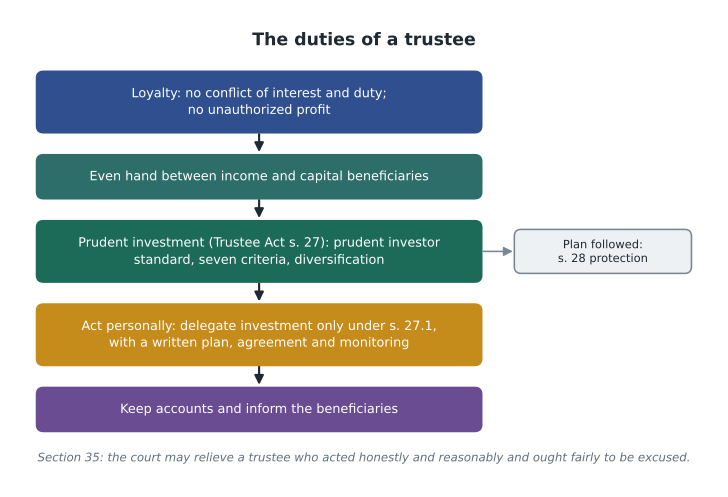
A trustee, including an estate trustee, owes fiduciary duties to the beneficiaries. The first is loyalty. A trustee must not put themselves in a position where their personal interest conflicts with their duty, and must not profit from the trust without the authority of the trust instrument, the beneficiaries or the court. The rule is strict. In Keech v. Sandford (1726), a trustee who renewed a lease for himself, after the landlord refused to renew it for the infant beneficiary, was required to hold the new lease for the beneficiary. A trustee who buys trust property, even at a fair price, can be required to give it up unless the purchase was authorized.
The second is the duty of even-handedness. Where a trust has beneficiaries with successive interests, such as Walter as life tenant of the farm and Ruth and Colin as remainder beneficiaries, the trustee must balance their interests, investing for both income and capital growth. A trustee who invests entirely in high-yield bonds favours the life tenant; one who invests entirely in growth shares paying no dividends favours the remainder. Ruth's position is delicate because she is herself a remainder beneficiary; she must not manage the farm or the estate assets to favour her own interest over Walter's.
The third is the duty of care. In Fales v. Canada Permanent Trust Co., [1977] 2 S.C.R. 302, the Supreme Court held that a trustee must act with the care that a person of ordinary prudence would use in managing their own affairs, and that a professional trust company is held to a higher standard. Ontario now sets an investment standard in section 27 of the Trustee Act. Under section 27(1), in investing trust property a trustee must exercise the care, skill, diligence and judgment that a prudent investor would exercise in making investments. Under section 27(2), a trustee may invest in any form of property in which a prudent investor might invest. Section 27(5) lists seven criteria a trustee must consider in planning investments: general economic conditions; the possible effect of inflation or deflation; the expected tax consequences; the role each investment plays within the overall portfolio; the expected total return from income and appreciation of capital; the needs for liquidity, regularity of income and preservation or appreciation of capital; and any asset's special relationship or special value to the purposes of the trust or to one or more beneficiaries. Section 27(6) requires diversification to an extent appropriate to the requirements of the trust and general economic and investment market conditions.
Sections 27(7) and 27(8) allow a trustee to obtain investment advice and protect a trustee who relies on advice that a prudent investor would rely on. Section 27.1 allows a trustee to delegate investment functions to an agent, but only if the trustee has a written investment plan or strategy, a written agreement requires the agent to comply with it and report regularly, and the trustee acts prudently in selecting the agent, establishing the terms of the authority and monitoring the agent's performance. Under section 28, a trustee is not liable for a loss arising from an investment if the conduct that led to it conformed to a plan or strategy, comprising reasonable assessments of risk and return, that a prudent investor could adopt in comparable circumstances. These provisions apply unless the trust instrument provides otherwise.
The fourth group of duties concern how a trustee acts. A trustee must act personally and may not delegate discretionary decisions except as the law allows, although they may employ agents for ministerial tasks such as bookkeeping. Co-trustees must act unanimously unless the trust provides otherwise. A trustee must keep accounts and give the beneficiaries information about the trust, and must exercise any discretion honestly, in good faith and with a real consideration of the relevant matters. Courts do not substitute their own view for a trustee's exercise of discretion, but will intervene if the trustee acted in bad faith, failed to consider the question at all, or took irrelevant considerations into account.
Breach of trust and relief
A trustee who breaches the trust is personally liable to restore the trust to the position it would have been in, with interest. Beneficiaries may also trace trust property into the hands of third parties who are not good-faith purchasers for value, and may seek a constructive trust over property bought with trust money. The court may remove a trustee whose continuation would harm the beneficiaries; the guiding consideration, from Letterstedt v. Broers (1884), is the welfare of the beneficiaries. Section 35 of the Trustee Act allows the court to relieve a trustee, wholly or partly, from personal liability for a breach of trust where the trustee acted honestly and reasonably and ought fairly to be excused. Courts apply section 35 more readily to unpaid family trustees acting in good faith than to professional trustees.
Worked problem
Ruth's investment decisions
Ruth holds the co-operative shares for the grandchildren, Emma's twenty thousand dollars and some estate cash. She has left Emma's money in a non-interest chequing account for a year. She proposes to sell the co-operative shares and invest everything in a single regional bank's shares, because her husband works there and says they are safe. Colin objects. Advise Ruth.
Show solution
- Emma's money. Leaving trust money idle for a year likely breaches section 27(1): a prudent investor would put it in at least a safe interest-bearing investment. Ruth may be liable for lost interest, although section 35 may relieve an honest family trustee in part.
- Single bank shares. Section 27(6) requires diversification appropriate to the trust. A whole trust fund in one company's shares is unlikely to meet that standard, whatever the bank's reputation.
- Conflict of interest. Her husband's employment raises at least the appearance of a conflict. Ruth should take independent advice and record her reasons.
- The co-operative shares. Section 27(5) requires Ruth to consider any asset's special relationship or value to the trust's purposes or to the beneficiaries. Margaret specifically left the co-operative shares, and the family's farming ties may make them special; she should not sell them without considering this, and the will may restrict her power to do so.
- Process. Ruth should prepare a written investment plan, obtain advice, and, if she wants to delegate management, follow section 27.1. Following a reasonable plan protects her under section 28.
Common mistakes
MistakeTreating a constructive trust as the automatic remedy for unjust enrichment.
InsteadUnder Kerr v. Baranow, a monetary award comes first; a constructive trust requires that money be inadequate and a link to the property.
MistakeSaying a statutory beneficiary designation is always a juristic reason.
InsteadIn Moore v. Sweet, the Insurance Act decided whom the insurer pays, not who was entitled to keep the proceeds.
MistakeCalling any good cause "charitable".
InsteadCharity has a legal meaning under the four Pemsel heads, with public benefit and exclusivity (Vancouver Society).
MistakeAssuming a trustee who acts honestly cannot be liable.
InsteadHonesty is not enough; a trustee must meet the prudent investor standard. Section 35 relief requires both honesty and reasonableness.
MistakeKeeping a whole trust in one investment because it seems safe.
InsteadSection 27(6) requires diversification appropriate to the trust and market conditions.
Practice problems
Work each problem on paper first, then reveal the answer to check.
A will leaves money to trustees "for such benevolent purposes as they choose". Is this a valid charitable trust?
Show answer
Probably not. Benevolent purposes are wider than charitable purposes, so the trust is not exclusively charitable. As a private purpose trust it also fails, and the money is held on a resulting trust for the estate.
An estate trustee buys the deceased's cottage from the estate at a price set by an appraiser, without consulting the beneficiaries. Can the sale be set aside?
Show answer
Yes. The self-dealing rule allows the beneficiaries to set aside a purchase of trust property by the trustee, regardless of fairness, unless the will, the beneficiaries with full information, or the court authorized it.
A trust was created in a will for a cottage museum. Ten years later, the cottage burns down. What happens to the remaining fund?
Show answer
If the trust is charitable and fails after taking effect, the property remains devoted to charity and the court may apply it cy-près to a similar purpose, without needing a general charitable intention.
Summary and key terms
- Resulting trusts arise automatically when express trusts fail and are presumed on gratuitous transfers, subject to evidence of intention.
- Constructive trusts remedy unjust enrichment where money is inadequate and there is a link to the property (Kerr v. Baranow), and wrongful conduct (Soulos v. Korkontzilas).
- In Moore v. Sweet, a former wife who paid premiums under an agreement recovered the insurance proceeds on a constructive trust despite an irrevocable designation of another person.
- Charitable trusts must fall under the Pemsel heads, be for public benefit and be exclusively charitable (Vancouver Society); cy-près saves charitable gifts that cannot be carried out.
- Trustees owe duties of loyalty, even-handedness, prudent investment under section 27 of the Trustee Act, personal performance and accounting.
- Section 35 lets the court relieve trustees who acted honestly and reasonably.
- Resulting trust
- A trust under which the beneficial interest returns to the person who provided the property.
- Constructive trust
- A trust imposed by the court to prevent unconscionable retention of property.
- Juristic reason
- A legal reason, such as a contract or gift, that justifies an enrichment.
- Cy-près
- Applying a charitable gift that cannot be carried out to the nearest possible charitable purpose.
- Prudent investor rule
- The standard of care for trustee investment in section 27 of the Trustee Act.
- Even-handedness
- The duty to balance the interests of income and capital beneficiaries.
- Self-dealing rule
- The rule that a trustee's purchase of trust property can be set aside unless authorized.
Lesson quiz · 5 questions
Score 60% or more to complete this lesson.
Create a free account to save your progress, take quizzes and earn a certificate.