
LAWC-213 · Lesson 3 of 12 · 23 min
Capacity and undue influence
▶ Video coming soon A video version of this lesson is on the way.
Joelle Tobin did not draft Rika Vandermeer's will on the day of their first meeting. She sent Rika home with a letter summarizing her instructions, asked her to think about them for two weeks, and with Rika's written consent wrote to her family doctor, Dr. Isaac Moorcroft, asking whether he had any concerns about her memory or judgment. Professor Ellerby reads the class Tobin's file note: 'Client clear and pleasant. Knows house and bank. Hazy on value of investments. Reasons for gift to N.P. plausible. Comment on Maeve puzzling: says M. ‘has her disability money’, but client pays part of M.'s rent monthly. N.P. drove client and asked to sit in.' Ellerby asks the class what Tobin is worried about. Arjun Mehta answers: everything that will matter if Pieter or Maeve challenges the will.
This lesson covers the test for testamentary capacity, the burdens of proof in a will challenge set out by the Supreme Court in Vout v. Hay, suspicious circumstances, knowledge and approval, undue influence and fraud, and the practical steps a drafting lawyer takes to protect a will against later attack. These doctrines decide most contested will cases in Ontario.
Testamentary capacity: Banks v. Goodfellow
The test for testamentary capacity comes from the English decision in Banks v. Goodfellow (1870), L.R. 5 Q.B. 549, which Canadian courts continue to apply. A testator must have a sound and disposing mind and memory. In modern terms, the testator must understand the nature and effect of making a will; know, in a general way, the nature and extent of their property; understand and appreciate the claims of those who might be expected to benefit, such as a spouse, children and dependants; and not be suffering from any disorder of the mind that poisons their affections, perverts their sense of right or prevents the exercise of their natural faculties in making the will.
The test is about understanding and appreciation, not about wise choices. A testator with capacity may make a will that is eccentric, unfair or even cruel. The testator need not remember every bank account or the exact value of the house; a general understanding is enough, and the more complex the estate, the more understanding is needed. What the testator must appreciate is who might reasonably expect to benefit and why, even if the testator then decides to leave them out. A testator who has forgotten that she has a daughter, or who believes, because of a delusion, that her son is trying to poison her, lacks capacity for a will that excludes that child on that basis.
Banks v. Goodfellow itself involved a testator who suffered from delusions that he was being pursued by spirits and by a man who was already dead. The court held that his will was valid, because the delusions had no connection with the dispositions he made in favour of his niece. The case established that a delusion defeats capacity only if it affects the will. A testator who believes he is persecuted by the government can still make a valid will leaving his estate to his children, if the belief has nothing to do with them.
Capacity is time-specific and decision-specific
Capacity is assessed at the time the will is made. A person with dementia may have periods of better and worse functioning, and a will made during a lucid interval can be valid. Under the rule in Parker v. Felgate (1883), if a testator had capacity when giving instructions to a lawyer, and the will is prepared in accordance with those instructions, the will may be valid even if the testator's capacity has declined by the time of signing, so long as the testator understands that they are signing a will prepared on their earlier instructions. Courts apply this rule cautiously.
Capacity is also specific to the decision. The capacity to make a will is different from the capacity to manage property, to make personal care decisions or to marry. A person under guardianship of property may still have testamentary capacity, and a person found incapable of managing property under the Substitute Decisions Act may still make a valid will if they meet the Banks v. Goodfellow test at the time. The capacity to marry is lower than the capacity to make a will; in Banton v. Banton (1998), an Ontario court held that an elderly man had capacity to marry his much younger caregiver even though he lacked capacity to make a will. That gap matters more since January 1, 2022, because marriage no longer revokes a will in Ontario, a change discussed in lesson 4.
A medical diagnosis is evidence but not the answer. Dementia, a stroke or a psychiatric illness may or may not deprive a person of testamentary capacity, depending on its effect on the person's understanding at the relevant time. Courts give weight to the evidence of the drafting lawyer, who tested the testator's understanding at the meeting, and of treating physicians, but no single witness is decisive. Retrospective capacity assessments by experts who review records after death are common in litigation and are given variable weight.
The burdens of proof: Vout v. Hay
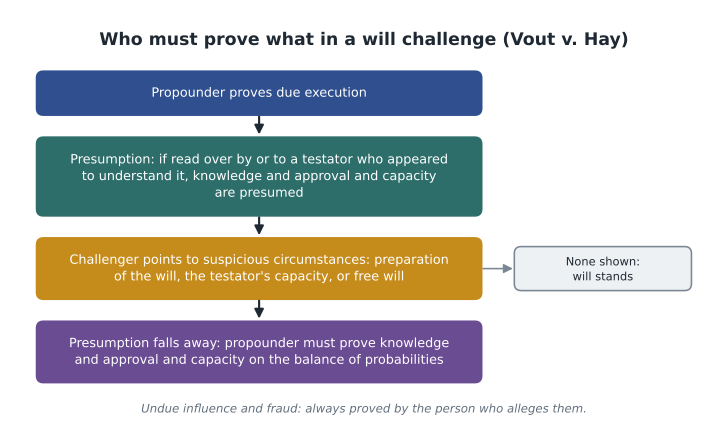
In Vout v. Hay, [1995] 2 S.C.R. 876, the Supreme Court of Canada clarified who must prove what in a will challenge. The person who propounds the will, usually the estate trustee named in it, bears the legal burden of proving due execution, knowledge and approval, and testamentary capacity. That person is assisted by a rebuttable presumption: on proof that the will was duly executed with the requisite formalities after having been read over by or to a testator who appeared to understand it, the testator is presumed to have known and approved of its contents and to have had the necessary capacity.
The presumption is displaced where suspicious circumstances are shown. Justice Sopinka described three kinds: circumstances surrounding the preparation of the will, circumstances calling into question the testator's capacity, and circumstances tending to show that the testator's free will was overborne by acts of coercion or fraud. The challenger must point to evidence which, if accepted, would tend to negative knowledge and approval or capacity. If that is done, the presumption is spent, and the propounder must prove knowledge and approval and capacity on the balance of probabilities, the ordinary civil standard. The court rejected any higher standard of proof.
Vout v. Hay also settled a point about undue influence. Suspicious circumstances relating to coercion do not shift the burden of proving undue influence. The person who alleges undue influence or fraud must prove it, on the balance of probabilities. Suspicious circumstances can require the propounder to prove knowledge and approval, but they do not require the propounder to disprove undue influence. The facts of Vout v. Hay illustrate the doctrine: a much younger woman who had been a friend and helper of an elderly farmer was the principal beneficiary of his will and had been involved in the arrangements for it, and members of his family challenged the will. The Supreme Court upheld the trial judge's finding that the will was valid.
Typical suspicious circumstances include a beneficiary who arranged the lawyer, attended the meeting or gave the instructions; a will that departs sharply from earlier wills or from what the family expected; a testator who was ill, isolated or dependent on the beneficiary; secrecy about the will; a hurried execution; and a will prepared by a lawyer the testator had never used before, chosen by the beneficiary. None of these is conclusive. They tell the court to look more carefully.
Knowledge and approval
Knowledge and approval is a separate requirement from capacity. A testator with full capacity may still not know and approve of a will if, for example, a beneficiary prepared it and the testator signed it without reading it, or if a clause was inserted without the testator's knowledge. The usual proof is evidence that the will was read over by or to the testator and that the testator appeared to understand it. Where the testator could not read, did not read English well, or was blind, or where a beneficiary was involved in preparing the will, the propounder must offer more, such as evidence that the lawyer went through each clause with the testator in their own language.
Courts sometimes find that a testator knew and approved of part of a will but not another part, and admit the will to probate without the offending part. A clause inserted by a drafting error that the testator did not intend can be excluded on this basis, although Ontario courts are cautious about rewriting wills and the doctrine of rectification is narrow.
Undue influence
Undue influence in the making of a will means coercion. The testator's will must have been overborne so that the will does not express what the testator wanted. In the classic English formulation in Hall v. Hall (1868), persuasion, appeals to affection or ties of kindred, or to sentiments of gratitude for past services, or pity for future destitution, are legitimate. Pressure of whatever character, if so exerted as to overpower the volition without convincing the judgment, is not. A child who repeatedly tells an aging parent that she deserves more because she has done all the caregiving is persuading, not coercing, unless the pressure crosses into threats, isolation or exploitation of weakness to the point that the parent's will is no longer free.
There is no presumption of undue influence for wills. The challenger must prove it, usually by circumstantial evidence, because undue influence is rarely exercised in front of witnesses. Relevant evidence includes the testator's vulnerability and dependence, the influencer's control over the testator's life, isolation of the testator from family and friends, the influencer's involvement in the will, and a will that benefits the influencer in a way that is out of character. Courts recognize that a caregiver or a new friend may be a genuine object of the testator's gratitude, and that elderly people are entitled to change their minds about their families.
Inter vivos gifts are treated differently. In Geffen v. Goodman Estate, [1991] 2 S.C.R. 353, the Supreme Court held that a presumption of undue influence can arise for a gift or transaction during life where the relationship between the parties is one of dependency or potential domination. The recipient must then rebut the presumption by showing the donor acted independently, usually with independent advice. This matters in estate litigation because a challenger who cannot prove testamentary undue influence may still be able to attack lifetime transfers, such as a house put into a caregiver's name or a large cheque written months before death.
Fraud
A will procured by fraud is invalid. Fraud in this context means deceiving the testator into making a will or a gift they would not otherwise have made, such as by telling the testator that her son had died, or that her daughter had stolen from her. Fraud must be proved by the person alleging it. It overlaps with the delusion branch of capacity, but differs because the false belief is induced by another person rather than arising from the testator's own illness.
Worked problem
Rika's new will
Two weeks after the first meeting, Dr. Moorcroft writes that Rika has mild cognitive impairment, scored 24 out of 30 on a standard screening test, manages her own medication and in his opinion understands her affairs. At the second meeting, alone with Tobin, Rika again describes her house and investments, names both children, and says she wants to leave the house to Nolan because he has cared for her and Pieter has not. Tobin reminds her that she pays part of Maeve's rent. Rika becomes tearful and says she wants Maeve to be looked after and asks whether she can leave Maeve more of the investments. What should Tobin do, and how would a court approach a later challenge?
Show solution
- Capacity. Rika understands she is making a will, knows her main assets in a general way, and on prompting appreciates both children's claims, including Maeve's dependence. Mild cognitive impairment does not by itself mean incapacity. The doctor's letter and Tobin's notes support capacity at this meeting.
- Knowledge and approval. Tobin should prepare the will, then read it over with Rika clause by clause, alone, and record her answers in Rika's own words, including why she has changed from the 2008 will.
- Suspicious circumstances. Nolan drove Rika and asked to attend; he benefits substantially; the will departs from an equal division; Rika is elderly and dependent on him. If the will is challenged, these facts will likely displace the Vout v. Hay presumption, and the estate trustee will have to prove capacity and knowledge and approval on the balance of probabilities. Tobin's file is the main evidence.
- Undue influence. Pieter or Maeve would have to prove that Nolan coerced Rika. There is no evidence of threats or isolation; Rika's reasons are consistent and plausible. Tobin should still ask Rika directly whether anyone has pressured her, and record the answer.
- Dependant support. If Rika leaves Maeve less than adequate provision, Maeve may claim support under Part V as a child Rika was supporting immediately before death (lesson 6). Tobin should advise Rika of this, which may lead Rika to a more balanced will, such as the house to Nolan and most of the investments, or a trust, for Maeve.
Protecting a will against challenge
Lawyers can do a great deal to make a will defensible. Ellerby's list: meet the client alone; take instructions directly from the client and never from a beneficiary; ask open questions about family and property and record the answers verbatim; ask why the client is making significant changes; where there is any doubt about capacity, obtain a medical opinion or a formal capacity assessment close to the time of signing; allow time between instructions and signing where possible; read the will over with the client and record that it was done; use independent witnesses; and keep the file. In cases of serious doubt, some lawyers record the execution meeting on video with the client's consent.
Ellerby adds two warnings. First, a lawyer who has real doubts about capacity should not prepare a will simply because the client insists. The lawyer owes the client a duty of care, and preparing a will for a client who lacks capacity can lead to a costly estate dispute. Second, a lawyer who refuses to act too readily may deprive a client with capacity of the chance to make a will at all. The law protects the right of elderly and ill people to make wills, and lawyers must not apply a higher standard to them than the law does.
Will challenges in practice
A person who wants to challenge a will usually files a notice of objection with the court before a certificate of appointment is issued, which prevents the certificate from issuing without notice to them. The estate trustee or the objector then applies for directions, and the court decides how the dispute will be tried. An interested person may also ask the court to require the estate trustee to prove the will in solemn form, meaning by full evidence in a contested proceeding, rather than on the paper application. Lesson 11 covers this procedure. A successful challenge means the will is not admitted to probate, and the estate passes under the previous valid will, if there is one, or on intestacy.
Daniel Whitecloud asks what happens to Rika's 2008 will if her new will is struck out. Ellerby explains that the new will almost certainly contains a clause revoking all previous wills. If the new will fails because of incapacity or undue influence, its revocation clause fails with it, because the revocation clause is part of an invalid document. The 2008 will would then stand. That is why, in a challenge, it matters greatly what the previous will said.
Common mistakes
MistakeTreating a diagnosis of dementia as proof of testamentary incapacity.
InsteadCapacity depends on the testator's understanding at the time the will was made. A diagnosis is evidence, not a conclusion.
MistakeSaying the person propounding the will must disprove undue influence once suspicious circumstances appear.
InsteadUnder Vout v. Hay, suspicious circumstances require proof of knowledge and approval and capacity; the challenger always bears the burden of proving undue influence.
MistakeEquating persuasion or appeals to gratitude with undue influence.
InsteadUndue influence is coercion that overbears the testator's will. Legitimate persuasion and appeals to affection are permitted.
MistakeApplying the presumption of undue influence from Geffen v. Goodman Estate to wills.
InsteadThe presumption applies to inter vivos gifts in relationships of dependency, not to wills.
MistakeTaking instructions from a beneficiary who brings the client to the office.
InsteadMeet the client alone and take instructions directly from the client.
Practice problems
Work each problem on paper first, then reveal the answer to check.
A testator with schizophrenia believes his neighbours are spying on him. His will leaves everything to his two sisters, as his previous will did. Does the delusion defeat capacity?
Show answer
Probably not. Under Banks v. Goodfellow, a delusion defeats capacity only if it influences the dispositions. A belief about the neighbours has no apparent connection with a will in favour of his sisters.
A daughter arranges her mother's appointment, attends the meeting and drives her to the signing. The new will leaves the daughter the entire estate. What is the effect under Vout v. Hay?
Show answer
These are suspicious circumstances surrounding the preparation of the will. If shown, the presumption of knowledge and approval and capacity is displaced, and the daughter, as propounder, must prove both on the balance of probabilities. The challengers must still prove undue influence if they allege it.
Months before his death, a frail man transfers his house to his caregiver for nothing. Can his children attack the transfer even if his will is valid?
Show answer
Yes. Under Geffen v. Goodman Estate, a presumption of undue influence may arise for an inter vivos gift where the relationship is one of dependency. The caregiver would have to show that the man acted independently, for example with independent legal advice.
Summary and key terms
- Testamentary capacity under Banks v. Goodfellow requires understanding the act, the extent of one's property and the claims of others, free of any disorder of mind that affects the dispositions.
- Capacity is assessed at the time of the will and is specific to the decision; the capacity to marry is lower (Banton v. Banton).
- Under Vout v. Hay, the propounder proves due execution, knowledge and approval and capacity, aided by a presumption that suspicious circumstances displace; the civil standard of proof applies.
- The person alleging undue influence or fraud must prove it. Undue influence means coercion, not persuasion.
- A presumption of undue influence can apply to inter vivos gifts in relationships of dependency (Geffen v. Goodman Estate), but not to wills.
- Careful lawyering, including meeting the client alone, detailed notes and medical evidence where needed, is the best protection against a challenge.
- Testamentary capacity
- The sound and disposing mind and memory required to make a valid will.
- Propounder
- The person who puts a will forward for probate and bears the burden of proving it.
- Suspicious circumstances
- Facts about the preparation of a will, the testator's capacity or free will that displace the presumption of validity.
- Knowledge and approval
- The requirement that the testator knew and approved of the contents of the will.
- Undue influence
- Coercion that overbears the testator's free will.
- Lucid interval
- A period in which a person with a fluctuating condition has capacity.
- Solemn form
- Proof of a will by full evidence in a contested proceeding.
Lesson quiz · 5 questions
Score 60% or more to complete this lesson.
Create a free account to save your progress, take quizzes and earn a certificate.