
LAWC-213 · Lesson 1 of 12 · 25 min
Succession law in Ontario: sources, courts and key terms
▶ Video coming soon A video version of this lesson is on the way.
Professor Miriam Ellerby begins the course by holding up a single sheet of paper. It is a photocopy of a will, two pages long, signed in blue ink. 'Somebody wrote this in a lawyer's office twenty minutes before lunch,' she says. 'It decided where a farm, a house and two pensions went, and who would spend the next three years not speaking to each other. Most people only write one legal document that matters this much, and they never see it work.' She writes three questions on the board and leaves them there for the term: Who gets what? Who decides? Who can complain?
Ellerby practised wills and estates law in Corwin for twenty-two years, first drafting wills for farm families and small business owners and later acting in contested estates, before joining the Brannock University Faculty of Law. Her rule for the class is short: 'Read the will, then read the family.' The words on the page decide most of what happens, but the people around the will decide whether anyone fights about it. This first lesson sets out the sources of Ontario succession law, the courts that apply it, the vocabulary the rest of the course uses, and the path an estate takes from death to distribution.
Why succession law matters
Every legal system must answer a simple question: when a person dies, what happens to the things they owned and the obligations they owed? Property cannot be left without an owner, creditors must be paid, and families who depended on the deceased need protection. Ontario answers the question with a mix of individual choice and public policy. A person with capacity may make a will that leaves property to anyone they choose, and the law respects that choice to a striking degree. Where there is no will, the legislature supplies one in the form of the intestacy rules. Where the choice made, or the absence of a choice, leaves dependants unprovided for or a spouse worse off than family law would allow, statutes give those people claims against the estate.
Ellerby calls this the triangle of succession: testamentary freedom at the top, family protection and creditor protection at the two corners. Most problems in the course involve a tension between two of those points. A father who leaves everything to a charity and nothing to a disabled child pushes freedom against family protection. An estate trustee who hands out the estate before paying the deceased's income tax pushes the beneficiaries' wishes against the creditors' rights. Keeping the triangle in view helps a student see why the rules take the shape they do.
Testamentary freedom is strong in Ontario. In Spence v. BMO Trust Company, 2016 ONCA 196, a father's will left his estate to one daughter and excluded another, and the excluded daughter offered evidence that he did so for a racist reason. The Court of Appeal for Ontario refused to set aside the gift. Where a will is clear on its face and makes a private gift, the court will not hear evidence about the testator's motives in order to strike it down on public policy grounds. The court distinguished cases involving public charitable trusts, such as the scholarship trust in the Leonard Foundation case that the class studied in property law. The remedy for an excluded family member in Ontario lies mainly in the statutory claims, not in a general power to rewrite wills for fairness.
The statutes
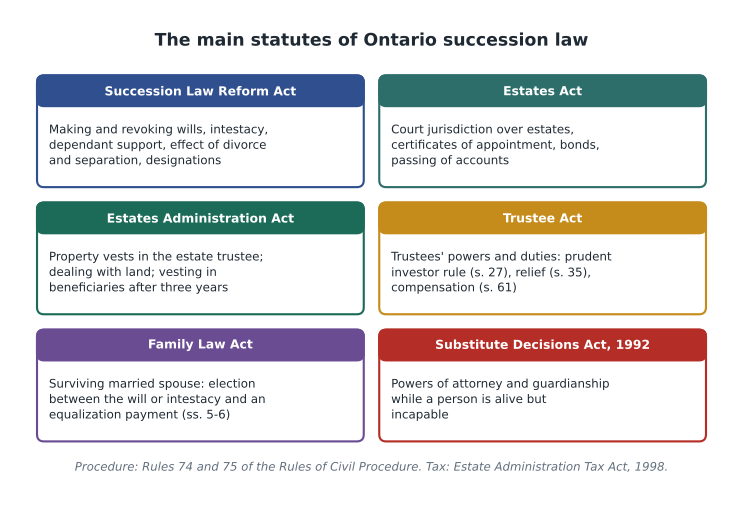
The Succession Law Reform Act, R.S.O. 1990, c. S.26, is the core statute and the one students will cite most often. Its parts follow the shape of the course. Part I deals with wills: who may make one, the formal requirements, revocation and revival, the effect of marriage, divorce and separation, and the rules of construction such as lapse and anti-lapse. Part II sets out intestate succession. Part III deals with designations of beneficiaries of certain plans, such as pensions and registered retirement savings plans. Part V gives dependants a right to apply for support from the estate. The Act was substantially amended by the Accelerating Access to Justice Act, 2021, with most of the changes to wills taking effect on January 1, 2022.
The Estates Act, R.S.O. 1990, c. E.21, gives the Superior Court of Justice its jurisdiction over estates. It covers the issuing of certificates of appointment of estate trustees, security in the form of bonds, the passing of accounts and the court's powers over estate trustees. The Estates Administration Act, R.S.O. 1990, c. E.22, provides that the property of a deceased person vests in the estate trustee, and it governs how an estate trustee deals with real property, including how land passes to beneficiaries if it is not dealt with within three years of death. The Trustee Act, R.S.O. 1990, c. T.23, applies to trustees in general, including estate trustees. It sets out the prudent investor standard in section 27, the court's power to relieve an honest and reasonable trustee from liability, and the court's power to fix a trustee's compensation.
Three more statutes complete the picture. The Family Law Act, R.S.O. 1990, c. F.3, matters on death because section 5(2) gives a surviving married spouse a potential equalization claim and section 6 requires the spouse to choose between that claim and what they receive under the will or on intestacy. The Substitute Decisions Act, 1992 governs powers of attorney and guardianship, which concern a person while they are alive but lacking capacity. The Estate Administration Tax Act, 1998 imposes a tax on the value of estates for which a certificate of appointment is issued. Procedure is in Rules 74 and 75 of the Rules of Civil Procedure, which set out the forms for applying for certificates, objecting to them, passing accounts and running contested estate proceedings.
Federal law appears at the edges. The Income Tax Act treats a person as having disposed of their capital property at fair market value immediately before death, which can produce a large tax bill on a farm, a cottage or a portfolio of shares. The Act allows a rollover to a surviving spouse or a trust for the spouse, which defers that tax. The Divorce Act matters because a divorce revokes gifts to a former spouse under the Succession Law Reform Act. The Indian Act governs the wills and estates of First Nations individuals ordinarily resident on reserve, and its estate provisions are administered by Indigenous Services Canada; Ellerby flags this as a specialized area and does not cover it in detail.
The courts
Estate matters in Ontario are heard by the Superior Court of Justice. In Toronto, a dedicated estates list handles contested matters, and court-connected mediation is mandatory in contested estates proceedings in Toronto, Ottawa and Windsor under Rule 75.1. Elsewhere, including Corwin, estates matters are heard by the Superior Court in the ordinary way, with applications under Rules 74 and 75. Appeals go to the Divisional Court or the Court of Appeal for Ontario depending on the nature and amount of the order, and important questions sometimes reach the Supreme Court of Canada, which has decided several leading cases in the course, including Vout v. Hay on suspicious circumstances and Pecore v. Pecore on joint accounts.
Most estates never see a courtroom. A certificate of appointment is usually issued on paper by court staff after the application is reviewed, and many estates are administered without any certificate at all, because the assets can be collected or passed without one. Ellerby estimates that in her practice fewer than one estate in twenty became contested. 'The other nineteen are where the work is,' she says. 'Somebody has to find the bank accounts, file the tax returns, sell the house and answer the phone when a sister calls to ask why her cheque has not arrived.'
The vocabulary
Succession law has a vocabulary of its own, some of it modern and some of it centuries old. The person who makes a will is the testator. A person who dies without a valid will dies intestate, and one who leaves a will that does not dispose of all their property dies partially intestate. The person appointed by the will to administer the estate was traditionally called an executor, and a person appointed by the court where there is no will, or no willing executor, was called an administrator. Ontario's rules now use a single term, estate trustee, for both, and distinguish an estate trustee with a will from an estate trustee without a will. Older documents and cases use the traditional terms, so students must know both.
A beneficiary is a person who takes under a will or on intestacy. A gift of real property, such as land, is traditionally called a devise, and a gift of personal property a bequest or legacy. A specific gift is a gift of a particular item, such as 'my sapphire brooch' or 'my shares in Severn Valley Grain Co-operative'. A general gift is a gift of an amount, such as 'twenty thousand dollars to my granddaughter Emma', payable from the estate's general assets. The residue is what is left after debts, taxes, expenses and the specific and general gifts have been paid. A residuary gift is a gift of the residue, and in most estates it is by far the most valuable gift in the will.
Issue means descendants of every degree: children, grandchildren, great-grandchildren and so on. Per stirpes, or by representation, means that the issue of a person who has died take the share their parent would have taken. A codicil is a document that amends a will and must itself be executed with the formalities of a will. A holograph will is one wholly in the testator's own handwriting and signed by the testator, without witnesses. A testamentary document is one that takes effect only on death and can be revoked until then; an inter vivos transfer, by contrast, takes effect during life. A certificate of appointment of estate trustee, still often called probate, is the court document that confirms the estate trustee's authority to deal with the estate.
The Holloway estate
Students who took property law with Professor Asante already know the Holloway family of Ferncliffe Farm, an eighty-acre farm on the Severn Road outside Corwin. Margaret Holloway inherited the farm in 1984 and died last spring. Her will, made in 2019, gives her husband Walter, now seventy-four, a life estate in the farm, with the remainder to her children Ruth and Colin in equal shares. It gives the narrow lot on Pike Lake to Severn Township so long as it is used as a public park, twenty thousand dollars to her granddaughter Emma on condition that she not marry before twenty-five, a scholarship at Brannock for a United Church student from Severn Township who intends to farm, and her shares in the Severn Valley Grain Co-operative to such of her grandchildren as reach twenty-five. Ruth, who lives in Corwin and runs the farm's roadside produce stand, is the estate trustee.
Asante's class looked at these gifts as property interests: a life estate, a remainder, a determinable fee, a condition in restraint of marriage and a class gift. Ellerby's class will look at the same estate from the other side, as an estate that Ruth must administer. She has to decide whether she needs a certificate of appointment, how much estate administration tax will be payable, what to do about the credit union account that Margaret put in joint names with Colin, whether Walter should make an election under the Family Law Act, how to manage the farm for Walter during his lifetime while protecting the remainder for herself and Colin, and how to keep the grain co-operative shares invested until the grandchildren reach twenty-five. Ellerby promises that the estate will come back in nearly every lesson.
A second file: Rika Vandermeer
The class also meets a living client. Hendrika Vandermeer, known as Rika, is eighty-three, a retired pharmacist and a widow who lives alone in a brick house on Alder Street in Corwin. Her son Pieter lives in Calgary and calls on Sundays. Her daughter Maeve, forty-two, has multiple sclerosis, works part-time and has relied on her mother for help with rent since her diagnosis. For the past eighteen months a neighbour, Nolan Prowse, has driven Rika to appointments, picked up her groceries and, more recently, helped her with her banking. Rika has a will from 2008 that divides everything equally between Pieter and Maeve. She has told her doctor that she wants a new one, and that Nolan has been 'more of a son than Pieter ever was'.
Ellerby uses Rika's file to teach the making of wills: formal validity, capacity, undue influence, the duties of the drafting lawyer, and the limits that dependant support places on what Rika can do with her property. 'Rika is entitled to leave her house to Nolan if that is what she truly wants and she has the capacity to decide,' Ellerby says. 'Your job is to make sure that is what she truly wants, that she has the capacity, that the will is executed properly, and that if anyone challenges it later, your file shows exactly how you knew.'
From death to distribution
An estate moves through recognizable stages. First, someone must find the will, if there is one. Wills are kept in lawyers' vaults, safety deposit boxes, desk drawers and occasionally freezers. Ontario has no mandatory central wills registry, so a lawyer may need to write to firms in the area asking whether they hold a will. Second, the estate trustee identifies what belongs to the estate and what passes outside it. Jointly held property usually passes to the surviving joint owner by right of survivorship, and life insurance, pensions and registered plans with a named beneficiary usually pass directly to that beneficiary. These assets are outside the estate, although they may still be relevant to tax and to dependant support claims.
Third, the estate trustee decides whether to apply for a certificate of appointment. Banks, investment firms and the land registry often insist on one before they will release or transfer assets, but small estates and estates of jointly held property can sometimes be administered without one. If a certificate is needed, the estate trustee applies to the Superior Court and pays estate administration tax on the value of the estate. Fourth, the estate trustee collects the assets, pays the deceased's debts and the estate's expenses, files the deceased's final income tax returns and deals with any claims, such as a spouse's election under the Family Law Act or a dependant's application for support. Finally, the estate trustee distributes what is left to the beneficiaries and accounts to them for what was done.
Worked problem
Ruth's first week as estate trustee
Margaret Holloway has died. Ruth has found the 2019 will in the farmhouse desk and a copy at the Corwin law firm that drafted it. Margaret's property includes the farm, the Pike Lake lot, a chequing account in her sole name, the credit union savings account in joint names with Colin, her Severn Valley Grain Co-operative shares, a life insurance policy naming Walter as beneficiary, and a registered retirement income fund naming Walter. Sort the assets and identify Ruth's first tasks.
Show solution
- Confirm the will. Ruth should obtain the original from the law firm's vault, if the firm holds it, and check that the desk copy is only a copy. Only the original can be submitted with an application for a certificate of appointment.
- Sort the assets. Inside the estate: the farm and the Pike Lake lot (in Margaret's sole name), the chequing account and the co-operative shares. Outside the estate, at least at first sight: the insurance policy and the registered fund, which are paid to Walter as the named beneficiary, and the joint credit union account, which Colin claims by survivorship.
- Flag the joint account. Under Pecore v. Pecore, a gratuitous transfer into joint names with an adult child is presumed to create a resulting trust for the parent's estate. Colin must show Margaret meant to give him the account on her death. Ruth cannot simply treat it as his.
- Decide whether a certificate is needed. The farm and the lot are registered land, and the land registry will require a certificate of appointment, or another recognized route, before title can be dealt with. Ruth will almost certainly need a certificate and will pay estate administration tax on the value of the estate assets.
- Diarize deadlines. Walter has six months from Margaret's death to decide whether to elect an equalization payment under the Family Law Act instead of taking under the will. Ruth should tell Walter, in writing, that he should get independent legal advice.
How the course is organized
The course follows the life of a will and an estate. Lessons 2 to 4 cover making a valid will, capacity and undue influence, and revocation, revival and interpretation. Lesson 5 covers intestacy. Lesson 6 covers the two main claims against an estate by family members: dependant support under the Succession Law Reform Act and the surviving spouse's equalization election under the Family Law Act. Lesson 7 covers assets outside the will, which in many modern estates are worth more than the assets inside it. Lesson 8 covers estate administration. Lessons 9 and 10 cover trusts, which are the machinery for most long-term arrangements in wills and for many remedies the courts give. Lesson 11 covers estate litigation, the passing of accounts and powers of attorney. Lesson 12 is a capstone problem.
Ellerby closes the first class with a warning about style. 'In this course you will be tempted to answer every question with what seems fair. Do not. Wills and estates law is full of rules that produce results nobody would choose, because certainty about who owns property after death is worth more than fairness in any single case. Find the rule first. Then ask whether the statute gives anyone a way to correct the result. That is where fairness lives in this area: in the specific claims the legislature has created, not in a judge's general sense of justice.'
Common mistakes
MistakeAssuming every asset the deceased owned passes under the will.
InsteadJointly held property and assets with a named beneficiary, such as insurance and many registered plans, usually pass outside the estate. Identify them first.
MistakeTreating "executor" and "estate trustee" as different offices with different powers.
InsteadOntario's rules use "estate trustee" for both the person named in a will and the person appointed by the court; the traditional terms remain in older cases and documents.
MistakeTelling an excluded child that a court can rewrite an unfair will.
InsteadOntario respects testamentary freedom (Spence v. BMO Trust). The child's remedies are statutory, mainly dependant support under Part V, if the child qualifies.
MistakeAssuming a certificate of appointment is always required.
InsteadA certificate is needed only when a third party, such as a bank or the land registry, requires proof of authority. Many estates are administered without one.
Practice problems
Work each problem on paper first, then reveal the answer to check.
Margaret Holloway's will leaves "my shares in Severn Valley Grain Co-operative to such of my grandchildren as attain the age of twenty-five". Is this a specific, general or residuary gift, and who holds the shares in the meantime?
Show answer
It is a specific gift, because it is a gift of identified property. Until the grandchildren reach twenty-five, the estate trustee, Ruth, holds the shares in trust for the class. The gift is a class gift that will close and vest according to the rules studied in property law.
Which statute would you consult first to decide whether a will signed by Rika in front of one witness is valid?
Show answer
The Succession Law Reform Act, Part I, especially sections 3 to 7 on formal validity, and section 21.1 on the court's power to validate a non-compliant document.
Rika's house is in her sole name and her bank account is in joint names with Maeve. Which of these will Rika's will govern?
Show answer
Her will governs the house, which is in her sole name. The joint account will pass to Maeve by survivorship unless Maeve holds it on a resulting trust for the estate, a question governed by Pecore v. Pecore, covered in lesson 7.
Summary and key terms
- Ontario succession law balances testamentary freedom against family protection and creditor protection.
- The Succession Law Reform Act is the core statute, supported by the Estates Act, the Estates Administration Act, the Trustee Act, the Family Law Act, the Substitute Decisions Act and the Estate Administration Tax Act, 1998.
- Estate procedure is in Rules 74 and 75 of the Rules of Civil Procedure, and contested matters are heard in the Superior Court of Justice.
- Spence v. BMO Trust confirms that a court will not rewrite a clear private will on public policy grounds because of the testator's motives.
- An estate moves from finding the will, through identifying assets inside and outside it, a possible certificate of appointment, administration and claims, to distribution and accounting.
- Testator
- A person who makes a will.
- Estate trustee
- The person who administers an estate, whether named in a will or appointed by the court; traditionally an executor or administrator.
- Intestacy
- Dying without a valid will, or with a will that does not dispose of all the property.
- Residue
- What remains of an estate after debts, taxes, expenses and specific and general gifts are paid.
- Issue
- Descendants of every degree.
- Certificate of appointment
- The court document, often still called probate, confirming an estate trustee's authority.
- Devise and bequest
- Traditional terms for gifts of real property and personal property in a will.
Lesson quiz · 5 questions
Score 60% or more to complete this lesson.
Create a free account to save your progress, take quizzes and earn a certificate.