
LAWC-213 · Lesson 4 of 12 · 24 min
Revocation, revival and interpreting wills
▶ Video coming soon A video version of this lesson is on the way.
A will is ambulatory: it does nothing until death and can be changed or revoked at any time before then by a testator with capacity. Professor Ellerby begins the lesson with a story from her practice, with names changed. A widower made a will in his lawyer's office leaving his estate to his three children. Two years later, angry with one of them, he wrote 'CANCELLED' across the copy in his desk drawer. When he died, the original was found in the lawyer's vault, untouched. 'Which will governs?' Ellerby asks. Sophie Tremblay-Hart says the original, because he wrote on a copy. Ellerby agrees, and says that is the lesson in one sentence: revocation, like making a will, is governed by rules, and good intentions expressed the wrong way do nothing.
This lesson covers the ways a will can be revoked, the effect of marriage, divorce and separation, lost wills, revival, and the principles courts use to interpret wills, including the armchair rule, lapse and the anti-lapse rule in section 31, survivorship, ademption and abatement. Section references are to the Succession Law Reform Act unless otherwise stated.
Revocation
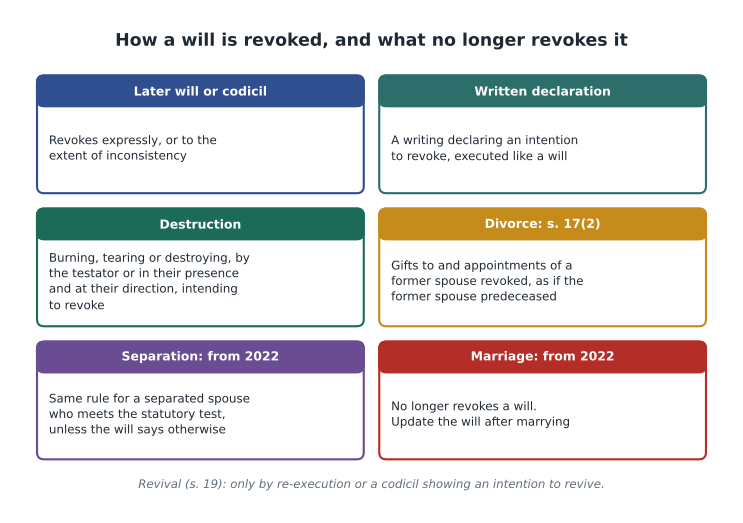
Section 15 lists the only ways a will or part of a will can be revoked. A will is revoked by another will made in accordance with the Act; by a writing declaring an intention to revoke, made in accordance with the provisions governing the making of a will; or by burning, tearing or otherwise destroying it by the testator or by some person in the testator's presence and by the testator's direction with the intention of revoking it. Until January 1, 2022, section 15 also listed marriage, discussed below.
A later will usually contains an express revocation clause: 'I revoke all wills and codicils previously made by me.' A later will without such a clause revokes an earlier will only to the extent of inconsistency, so both documents may be read together. A testator who makes a new will that deals only with a cottage, and says nothing about revoking earlier wills, leaves the earlier will in force for everything else. Lawyers who prepare primary and secondary wills, discussed in lesson 8, must take care that each will's revocation clause does not revoke the other.
Revocation by destruction requires both an act and an intention. The act must be burning, tearing or otherwise destroying the will, and courts have held that the destruction must be of the document itself, or at least of an essential part such as the signature. Striking through the text with a pen, or writing 'revoked' across it, is generally not destruction, although it may be an alteration if executed. The intention must be to revoke. A will torn up by accident, or destroyed by a testator who mistakenly believed it was already invalid, is not revoked. Destruction by another person counts only if done in the testator's presence and at the testator's direction; a son who burns his mother's will at her request over the telephone does not revoke it.
Lost wills
Where a will was last known to be in the testator's possession and cannot be found after death, the law presumes that the testator destroyed it with the intention of revoking it. The presumption is rebuttable. Evidence that the testator kept the will in a place to which others had access, that the testator spoke approvingly of the will shortly before death, or that the house was cleared out carelessly after death can rebut it. If the presumption is rebutted, the court can admit the will to probate on proof of its contents, usually from a copy or a draft in the lawyer's file. If the will was last known to be in a lawyer's vault and is missing, there is no presumption of revocation, because the testator did not have it.
Marriage no longer revokes a will
For deaths and marriages before 2022, Ontario followed the old common law rule that marriage revoked a will, with exceptions for wills made in contemplation of the marriage and certain other cases. The rule protected new spouses, who might otherwise be left out of a will made before the marriage. It also created traps for people who married late in life without realizing their wills were gone, and it was exploited in so-called predatory marriages, in which a person married an elderly and vulnerable partner whose earlier will was then revoked, letting the new spouse take on intestacy.
The Accelerating Access to Justice Act, 2021 repealed the revocation-by-marriage provisions with effect from January 1, 2022. A marriage on or after that date does not revoke a will. A will made before a marriage that took place before January 1, 2022 was revoked by that marriage, unless an exception applied, and the repeal does not revive it. A newly married spouse who is left out of a pre-marriage will is not without protection: the spouse may elect an equalization payment under the Family Law Act or claim dependant support, both covered in lesson 6. Ellerby tells the class that the reform shifts the duty to update a will onto the people who marry: a client who marries should be told that the old will still stands.
Divorce and separation
Section 17(2) provides that, unless a contrary intention appears in the will, when a testator's marriage is terminated by a judgment absolute of divorce or is declared a nullity, a gift to the former spouse, an appointment of the former spouse as executor or trustee, and a power of appointment conferred on the former spouse are revoked, and the will is construed as if the former spouse had predeceased the testator. Gifts to other people in the will are unaffected.
Since January 1, 2022, the same rule applies to separated spouses. The amended section 17 provides that, unless a contrary intention appears, a will is construed as if a separated spouse had predeceased the testator. Spouses are separated for this purpose if, before the testator's death, they lived separate and apart as a result of the breakdown of their marriage for the three years immediately before the death, or they entered into a separation agreement, obtained a court order or received a family arbitration award settling their rights arising from the breakdown of the marriage, and in either case they were living separate and apart as a result of the breakdown at the time of death. A parallel rule in section 43.1 removes a separated spouse's entitlement on intestacy.
The separation rule does not remove the separated spouse's family law rights. A separated spouse may still have an equalization claim under the Family Law Act, and may be able to claim dependant support if the deceased was supporting them. The rule removes only the benefit under the will or on intestacy. Hannah Kowalczyk, who took family law with Professor Ferreira, points out that the test differs from the family law test for the valuation date. Ellerby agrees: the Succession Law Reform Act uses its own definition, and students must apply it rather than the family law separation date.
Revival
Section 19 provides that a will or part of a will that has been revoked is revived only by its re-execution or by a codicil that shows an intention to give effect to it. Revoking the will that revoked it does not revive it. Suppose a testator makes will A, then will B which revokes A, then tears up B intending to restore A. A is not revived. Unless the testator re-executes A or makes a codicil showing an intention to revive it, the testator dies intestate. Courts have occasionally avoided this result through the doctrine of dependent relative revocation, which holds that a revocation conditional on another will taking effect fails if that will does not take effect.
Interpreting wills: the basic approach
The goal of interpretation is to determine the testator's intention from the words of the will, read as a whole and in light of the circumstances known to the testator when the will was made. Courts read the will as an ordinary person in the testator's position would have understood the words, giving technical terms their technical meaning if the testator used a lawyer, and giving effect, as far as possible, to every part of the will. Where the words are clear, the court applies them, even if the result seems odd. Where they are ambiguous, the court looks for the most likely meaning in context.
The armchair rule allows the court to place itself in the testator's position at the time the will was made: to sit in the testator's armchair and consider the testator's family, property and relationships, and what the testator knew. Evidence of surrounding circumstances is admissible for this purpose. Direct evidence of what the testator intended, such as instructions to the lawyer or statements to family, is generally not admissible to contradict or add to the words of the will. It is admitted only in narrow cases, such as an equivocation, where the will describes a person or thing in words that apply equally well to two or more people or things, such as 'my nephew John' where the testator had two nephews named John.
Section 22 provides that, unless a contrary intention appears, a will speaks and takes effect as if it had been made immediately before the testator's death with respect to the property, so a gift of 'all my shares' includes shares acquired after the will was made. The will does not speak from death as to people, however: 'my wife' means the person who was the testator's wife when the will was made. Under section 23, unless a contrary intention appears, property in a gift that fails or is void falls into the residue.
Words describing family members have statutory meanings. Under the Succession Law Reform Act and the Children's Law Reform Act, references to children and issue include children born outside marriage and adopted children, and, since the All Families Are Equal Act, 2016, legal parentage follows the rules for children born through assisted reproduction. A will that leaves property to 'my grandchildren' therefore includes adopted grandchildren and grandchildren born to unmarried parents unless the will clearly says otherwise.
Lapse and anti-lapse
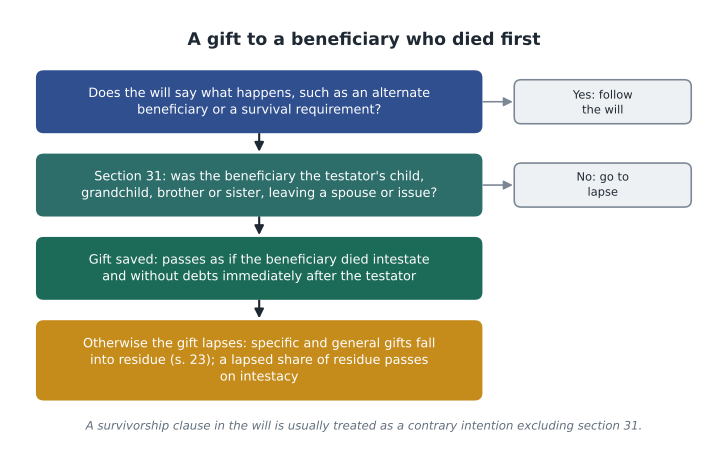
A gift lapses if the beneficiary dies before the testator. A lapsed specific or general gift falls into the residue under section 23, and a lapsed gift of a share of the residue passes as on an intestacy, unless the will provides otherwise. Lawyers prevent lapse by naming alternate beneficiaries, such as 'to my son Colin, but if he does not survive me, to his children who survive me in equal shares'.
Section 31, the anti-lapse rule, prevents lapse in one important group of cases. Unless a contrary intention appears, where a gift is made to a child, grandchild, brother or sister of the testator who dies before the testator, leaving a spouse or issue surviving the testator, the gift does not lapse. It takes effect as if it had been made directly to the persons among whom, and in the shares in which, the beneficiary's estate would have been divisible if the beneficiary had died intestate and without debts immediately after the testator's death. The gift therefore passes under the intestacy rules of the beneficiary's estate, not the testator's.
Section 31 can surprise families, because the beneficiary's surviving spouse may take part or all of the saved gift. If Colin Holloway had died before his mother, leaving a wife and two sons, his share of the remainder in the farm would not lapse; it would pass as if Colin had died intestate immediately after Margaret, which means his wife would take the first 350,000 dollars as a preferential share and then share the rest with the boys. Many wills contain a survivorship clause, such as a requirement that a beneficiary survive the testator by thirty days, and courts have treated such clauses as a contrary intention that excludes section 31.
Survivorship and common disasters
Where two people die at the same time, or in circumstances that make it uncertain which survived the other, section 55 provides that the property of each is disposed of as if each had survived the other. A husband and wife killed in the same car accident are each treated, for their own estate, as having outlived the other, so neither inherits from the other. Where they owned property as joint tenants, they are treated as having held it as tenants in common. A thirty-day survivorship clause in a will avoids the awkward case where one spouse survives the other by hours and the estates pass twice through probate.
Ademption and abatement
A specific gift adeems, or fails, if the property is not part of the estate at death. If Margaret's will had left 'my 1951 tractor' to Colin and the tractor had been destroyed and not replaced, Colin would take nothing, even if Margaret had received insurance money for it. Ademption is not a question of intention: it applies even if the testator forgot about the gift. Section 36 softens the rule where property subject to a specific gift was disposed of by the testator's attorney under a power of attorney or by a guardian of property: the beneficiary has the same right to any remaining proceeds as they would have had to the property. Lawyers sometimes avoid ademption by drafting gifts of 'my car, or any car I own at my death'.
Abatement is the order in which gifts are reduced when the estate is not large enough to pay all debts and gifts. Unless the will provides otherwise, the residue is used first, then general gifts abate proportionately, and specific gifts are used last. A testator who leaves a house to one child and the residue to another, and dies with large debts, may unintentionally leave the residuary beneficiary with nothing. Section 32 provides that, unless a contrary intention appears, a beneficiary of land subject to a mortgage takes it subject to the mortgage, rather than having the mortgage paid from the residue.
Worked problem
Reading Margaret Holloway's will
Ruth and Colin disagree about three clauses of their mother's 2019 will. (a) The remainder in the farm goes 'to my children Ruth and Colin in equal shares'; Colin asks whether, if he dies before Walter, his share goes to Ruth. (b) The co-operative shares go 'to such of my grandchildren as attain the age of twenty-five'; Margaret acquired more shares in 2023 under a co-operative reinvestment plan. (c) The will leaves 'my late mother's silver tea service' to Emma; the tea service was stolen in 2022 and never recovered.
Show solution
- (a) Margaret has died, so there is no lapse question: Ruth and Colin both survived her, and their remainder interests vested at her death, subject to Walter's life estate. If Colin dies before Walter, his vested half passes under Colin's own will or intestacy, not to Ruth. Section 31 is irrelevant because both beneficiaries survived the testator.
- (b) Under section 22 the will speaks from death as to property. 'My shares' includes shares acquired after 2019, so the 2023 shares pass under the class gift.
- (c) The tea service was not part of the estate at death. The gift adeems, and Emma takes nothing under that clause. If there was an insurance payment, it fell into Margaret's general assets; ademption applies whatever Margaret intended. Section 36 does not help, because the property was not disposed of by an attorney or guardian.
- Interpretation note. In each case the court would use the armchair rule only to understand the words in light of Margaret's circumstances in 2019. Colin's recollection that his mother 'always said the farm should stay with the family' is not admissible to change the clear words of clause (a).
Common mistakes
MistakeTelling a client who married in 2024 that her marriage revoked her earlier will.
InsteadSince January 1, 2022, marriage does not revoke a will. Her earlier will stands, and she should update it.
MistakeAssuming a separated spouse takes under the will until divorce.
InsteadSince January 1, 2022, a spouse who meets the separation test in section 17 is treated as having predeceased, unless the will shows a contrary intention.
MistakeTreating "CANCELLED" written on a will as revocation.
InsteadRevocation requires a later will, an executed writing, or destruction with intention to revoke. Writing on a will, especially a copy, does not revoke it.
MistakeAssuming revoking a later will revives an earlier one.
InsteadUnder section 19, a revoked will is revived only by re-execution or a codicil showing an intention to revive it.
MistakeForgetting that section 31 may give a saved gift partly to the beneficiary's spouse.
InsteadThe gift passes as if the beneficiary died intestate immediately after the testator, so the beneficiary's spouse may take a preferential share.
Practice problems
Work each problem on paper first, then reveal the answer to check.
A testator's will leaves her estate "to my brother Tom". Tom dies before her, leaving no spouse but one daughter. Who takes?
Show answer
Section 31 applies because Tom was the testator's brother and left issue. The gift passes as if Tom had died intestate immediately after the testator; with no spouse, his daughter takes it.
A testator's will leaves a gift "to my friend Ana". Ana dies first. What happens to the gift?
Show answer
Section 31 does not apply to friends. The gift lapses and, if it is a specific or general gift, falls into the residue under section 23.
A couple separated in 2023 and signed a separation agreement. The husband dies in 2026 without changing his will, which leaves everything to his wife. They were living apart at his death. Does she take?
Show answer
No, unless the will shows a contrary intention. They had a separation agreement and were living apart at death, so under section 17 the will is read as if she had predeceased. She may still have family law claims.
A testator's original will was kept in his bedroom and cannot be found at his death. His lawyer has a signed copy. What is the starting presumption?
Show answer
That the testator destroyed the will with the intention of revoking it. The presumption can be rebutted by evidence, and if it is, the will can be proved from the copy.
Summary and key terms
- Under section 15 a will is revoked only by a later will, an executed writing, or destruction with the intention to revoke.
- Since January 1, 2022, marriage does not revoke a will, and separated spouses who meet the statutory test are treated as having predeceased under the will and lose their intestate share.
- Divorce revokes gifts to and appointments of a former spouse unless the will shows a contrary intention (section 17(2)).
- A revoked will is revived only by re-execution or a codicil (section 19).
- Courts interpret wills by the words read as a whole, using the armchair rule; direct evidence of intention is admissible only in narrow cases.
- Gifts to predeceasing beneficiaries lapse, except that section 31 saves gifts to a child, grandchild, brother or sister who leaves a spouse or issue. Specific gifts adeem if the property is gone; residue abates first.
- Ambulatory
- Describes a will, which has no effect until death and can be changed until then.
- Revival
- Restoring a revoked will by re-execution or by a codicil.
- Armchair rule
- The principle that a court interprets a will in light of the circumstances known to the testator when it was made.
- Lapse
- The failure of a gift because the beneficiary died before the testator.
- Anti-lapse
- The rule in section 31 that saves gifts to certain relatives who die first leaving a spouse or issue.
- Ademption
- The failure of a specific gift because the property is not in the estate at death.
- Abatement
- The reduction of gifts when the estate cannot pay all debts and gifts.
Lesson quiz · 5 questions
Score 60% or more to complete this lesson.
Create a free account to save your progress, take quizzes and earn a certificate.