
LAWC-213 · Lesson 2 of 12 · 26 min
Making a valid will
▶ Video coming soon A video version of this lesson is on the way.
Rika Vandermeer arrives at the office of Joelle Tobin, a sole practitioner on Front Street in Corwin, on a Tuesday morning. Nolan Prowse drives her and offers to come into the meeting. Tobin thanks him and asks him to wait in the reception area. Professor Ellerby uses that small moment to begin the lesson. 'Before we talk about capacity or undue influence, which come next week, we need to know what a will is and how one is made. The formal rules are the part of wills law that looks the most technical and causes the most avoidable grief. A will can be perfect in every other way and still fail because the witnesses were in the wrong room.'
This lesson covers who may make a will, the requirement of writing, the formal will with two witnesses, the holograph will, the position of the signature, virtual witnessing, witnesses who take gifts, alterations, the court's power under section 21.1 of the Succession Law Reform Act to validate a document that does not comply, and the drafting lawyer's role. All section references are to the Succession Law Reform Act unless otherwise stated.
Why formalities exist
A will speaks only after the person who made it can no longer explain it. Formal requirements do several jobs at once. They provide evidence that the document is genuine and is the testator's own. They mark the difference between a draft or a note and a final decision, which lawyers call the cautionary function: going through a ceremony reminds the testator that the document matters. They protect the testator against fraud and pressure by putting independent witnesses in the room. And they channel wills into a recognizable form, so that estate trustees, banks and courts can deal with them quickly.
For most of Ontario's history, the formal requirements were applied strictly. A will that did not comply was invalid, however clear the testator's wishes. Since January 1, 2022, the court has had a power to validate a non-compliant document, discussed below. That power does not make the formalities optional. A will that complies is valid without any court application, while a will that needs section 21.1 requires an application, evidence and often a fight. Ellerby's advice to future drafting lawyers is blunt: 'Section 21.1 is a lifeboat. Do not plan your voyage around it.'
Who may make a will
Under section 8, a will made by a person under eighteen is not valid, with narrow exceptions: a minor who is or has been married, a minor who makes a will in contemplation of a marriage and states that in the will, and a member of the Canadian Forces on active service or a sailor at sea. The testator must also have testamentary capacity when the will is made, which is the subject of lesson 3, and must know and approve of the contents. A will must be the testator's own free act; a will procured by undue influence or fraud is invalid, also covered in lesson 3.
The requirement of writing
Section 3 provides that a will is valid only when it is in writing. Oral wills are not recognized in Ontario, whatever the circumstances. A video recording of a person stating what they want done with their property is not a will, although it may be evidence of intention or capacity. Ontario also does not recognize a will made and kept only in electronic form. A document typed on a computer and printed can be a will if properly executed, but a file on a phone or an unsigned email cannot be a formal will. Whether section 21.1 could validate a purely electronic document is limited by the statute, and students should treat electronic wills as not yet available in Ontario.
The formal will
Section 4(1) sets out the requirements for a formal or attested will. The will must be signed at its end by the testator, or by another person in the testator's presence and by the testator's direction. The testator must make or acknowledge the signature in the presence of two or more attesting witnesses who are present at the same time. The witnesses must then subscribe the will in the presence of the testator. Each requirement has generated case law, but the core is simple: three people, the testator and two witnesses, together at the moment of the testator's signature, and the two witnesses signing while the testator is present.
A witness need not read the will or know its contents. The witness attests to the signature, not to the terms. Witnesses should be adults who are not beneficiaries and not spouses of beneficiaries. They should be people who can be found years later if the will is challenged. For that reason, law firms usually use their own lawyers, clerks and assistants as witnesses, and one of them swears an affidavit of execution soon after the signing. The affidavit, in the form required by Rule 74, says that the deponent was present with the testator and the other witness when the will was signed and that both witnesses signed in the testator's presence. Without one, the estate trustee may have to track down a witness after death.
Section 7 deals with the position of the signature. A will is not invalid merely because the signature does not follow immediately after the last words, or because there is a blank space between them, so long as the signature is at, after, following, under, beside or opposite the end of the will and it is apparent that the testator intended to give effect to the will by the signature. However, nothing written below or after the signature, and nothing added after the signature was made, is given effect. A testator who signs at the bottom of the first page of a two-page will may have validly executed only the first page.
Signing does not require a full name. Initials, a mark or an 'X' can be a signature if the testator intended it as one. A testator who cannot write may direct another person to sign on their behalf in their presence. Where the testator is blind or cannot read, the lawyer should read the will aloud in the presence of the witnesses and record that it was done, because the propounder of the will must later prove that the testator knew and approved of its contents.
The holograph will
Section 6 allows a testator to make a valid will wholly by their own handwriting and signature, without formality and without witnesses. Ontario is one of several provinces that recognize holograph wills. The best-known Canadian example is from Saskatchewan: in 1948 a farmer trapped under his tractor scratched 'In case I die in this mess I leave all to the wife' on the fender, and the fender was admitted to probate. Ontario holograph wills are more often written on lined paper, in diaries and on the backs of envelopes.
Two requirements cause most disputes. First, the will must be wholly in the testator's handwriting. A pre-printed will form filled in by hand is not a holograph will, because the printed words are not in the testator's handwriting, although courts have sometimes admitted the handwritten portions where they make sense on their own. Second, the document must show a deliberate or fixed and final expression of intention about the disposal of property on death. In Bennett v. Toronto General Trusts Corporation, [1958] S.C.R. 392, the Supreme Court of Canada held that a handwritten letter in which the writer said what she intended to do in a future will was not itself a will. Notes, wish lists and letters to family members often fail on this ground.
A holograph codicil can amend a formal will. A testator who writes in her own hand on a sheet of paper 'I change my will so that my car goes to my nephew Sam' and signs it has made a valid holograph codicil, if the court accepts that the note expresses a fixed and final intention. Handwritten changes on the face of a typed, witnessed will are different; they are alterations, discussed below, and are generally not effective unless executed.
Virtual witnessing
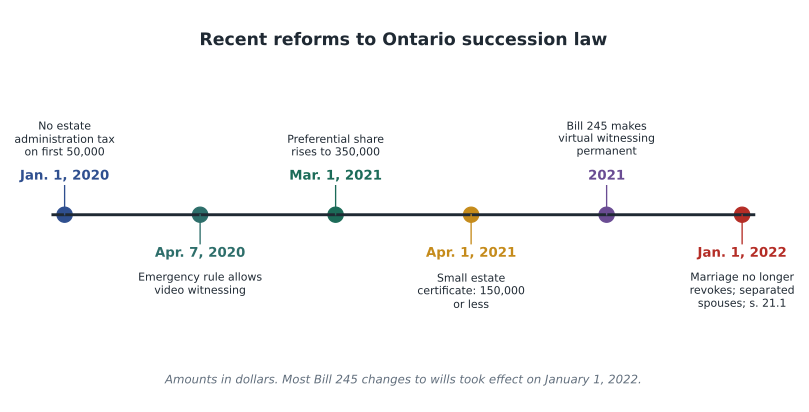
During the COVID-19 pandemic, an emergency regulation made on April 7, 2020 allowed wills and powers of attorney to be witnessed by audio-visual communication technology, such as a video call, provided at least one witness was a licensee under the Law Society Act, which means a lawyer or paralegal licensed by the Law Society of Ontario. The Accelerating Access to Justice Act, 2021 made this permanent. Under the amended section 4, the requirement that the testator and witnesses be in each other's presence can be satisfied by audio-visual communication that lets them see, hear and communicate with each other in real time, if at least one witness is a licensee. The parties may sign complete, identical copies of the will, which together form the will.
Remote execution raises practical risks. The lawyer must be satisfied that the testator is alone or that anyone else present is not exerting pressure, that the testator can see and hear clearly, and that the document being signed is the same document on every screen. Good practice is to ask the testator to show the room, to keep the camera on the testator's hands during signing, and to record what was done in a detailed memorandum. Ellerby points out that the rule requires a licensee as a witness precisely because a lawyer or paralegal can be expected to notice and record these things.
Witnesses who take gifts
Section 12 deals with interested witnesses. If a witness, or the spouse of a witness, is a beneficiary under the will, the gift to that witness or spouse is void, but the rest of the will stands. The same applies to a person who signs on behalf of the testator. The rule protects testators against people who might procure a gift to themselves while acting as a witness. Under section 12(3), the court may nevertheless allow the gift if it is satisfied that neither the witness nor the spouse exercised any improper or undue influence on the testator. Under sections 13 and 14, a creditor of the testator or a person named as executor may act as a witness without losing their debt or the right to act.
The interested witness rule is a classic trap in home-made wills. A testator who asks her daughter and son-in-law to witness a will leaving everything to the daughter has made a valid will, but the daughter's gift is void unless the court relieves against the rule, and the property will pass as on an intestacy or to whoever takes the residue. Ellerby adds that a will prepared by a beneficiary, even if properly witnessed by strangers, raises suspicious circumstances, which lesson 3 covers.
Alterations
Section 18 provides that an alteration made in a will after it has been made is not valid unless it is executed in the same manner as a will. In practice, that means the testator and two witnesses initial the alteration in the margin or near it. An unexecuted alteration has no effect, except that where the original words have been made not apparent, such as by being thoroughly blacked out, they are treated as revoked if that was the testator's intention. The law presumes that unexecuted alterations in a will were made after execution. A careful drafting lawyer has the testator and witnesses initial each page and any handwritten change made at the signing.
Substantial compliance under section 21.1
Section 21.1, added by the Accelerating Access to Justice Act, 2021, allows the Superior Court, on application, to order that a document or writing that was not properly executed or made under the Act is as valid and fully effective as the will of the deceased, if the court is satisfied that it sets out the testamentary intentions of the deceased. The section applies where the deceased died on or after January 1, 2022, regardless of when the document was made. It was modelled on similar provisions already in force in other provinces, including British Columbia and Manitoba.
Early Ontario decisions show the range. In Vojska v. Ostrowski, 2023 ONSC 3894, a lawyer-witness had failed to sign a wife's will through human error, and everyone involved believed it had been properly executed; Justice Myers called it a textbook case for the power and validated the will. In Grattan v. Grattan (2023), an unreported decision referred to in later cases, the deceased had instructed a lawyer, reviewed a draft and approved minor changes, and died fifteen days later without signing; the court validated the draft as reflecting her fixed and final intentions. In Groskopf v. Rogers, 2023 ONSC 5312, the court validated an undated, unwitnessed, handwritten fill-in-the-blank document. In Kertesz v. Kertesz, 2023 ONSC 7055, the court validated a handwritten note by a man who understood his assets and knew he was dying.
The cases ask two questions. Is the document authentic? And does it record the deceased's deliberate or fixed and final intentions about the disposal of their property on death, as opposed to a draft, a note of possibilities or a stage in a process the deceased had not finished? The closer the document comes to compliance, the easier it is to validate. An unsigned draft prepared by a lawyer will be harder to validate where there is evidence that the client was still thinking about changes. The court looks at all the evidence, including what the deceased said and did afterward.
Worked problem
Three execution problems
Tobin's office handles three signings in one week. (a) Rika signs her new will in Tobin's boardroom; Tobin and her assistant, Abdi, watch her sign; Abdi is called to the phone and signs as a witness ten minutes later at his own desk, while Rika is still in the boardroom. (b) A client signs a will on a video call; Tobin witnesses on screen, and the second witness, the client's neighbour, sits beside the client. (c) A client dies in 2025 leaving a handwritten note, signed but not witnessed, beginning 'My last will' and leaving everything to his partner, but the first two lines are printed on a will kit form.
Show solution
- (a) Section 4(1) requires the witnesses to subscribe in the presence of the testator. Abdi signed at his own desk, out of Rika's sight. The execution is defective. Because Rika is alive, the fix is simple: re-execute the will properly, with both witnesses signing in her presence. If she had died first, the estate trustee would need to apply under section 21.1; the facts resemble Vojska, and the application would likely succeed.
- (b) Under the amended section 4, remote witnessing is permitted if at least one witness is a licensee and the parties can see, hear and communicate in real time. Tobin is a licensee. The neighbour, physically present, is a valid second witness. Tobin should record the steps, confirm the document is identical on both sides and check that the neighbour is not a beneficiary or a beneficiary's spouse.
- (c) The note is not a holograph will, because the printed words are not in the deceased's handwriting, unless the handwritten words make sense alone. Because he died after January 1, 2022, the partner can apply under section 21.1. The court will ask whether the note is authentic and records a fixed and final intention. 'My last will' and a signature are strong evidence. Groskopf and Kertesz suggest the application has good prospects.
The drafting lawyer's role
A lawyer who takes instructions for a will owes duties to the client and, in some circumstances, to the intended beneficiaries. The lawyer should meet the client alone, at least for part of the meeting, especially where a family member or friend who benefits under the will has arranged the appointment. The lawyer should take detailed notes of the client's instructions, the client's reasons for any significant changes from a previous will, and the client's understanding of their property and family. Where capacity is in doubt, the lawyer should ask questions designed to test it and should consider asking the client's doctor for an assessment.
Courts in Canada and England have held that a lawyer who negligently fails to have a will properly executed, or who unreasonably delays preparing it, can be liable to a beneficiary who loses a gift as a result. Ellerby tells the class that this is one of the most common sources of claims against wills lawyers, along with missed deadlines in estate litigation. The cure is mechanical: a checklist for execution, an affidavit of execution sworn on the day, and a reporting letter to the client confirming what was done and where the original is kept.
Tobin's meeting with Rika illustrates good practice. She speaks with Rika alone for an hour, takes notes in Rika's words, and asks her to describe her property and her family. Rika says her house is worth 'about six hundred thousand, the agent says', that she has investments at the bank 'around three hundred thousand', and that she wants to leave the house to Nolan and divide the rest between Pieter and Maeve. Tobin asks why. Rika says Pieter has not visited in three years and that Nolan is the only person who comes by. Tobin asks about Maeve. Rika pauses, then says Maeve will be 'fine, she has her disability money'. Tobin writes it down and does not draft the will that day. Lesson 3 explains why.
Common mistakes
MistakeLetting a witness sign in another room "because the testator already signed".
InsteadSection 4(1) requires both witnesses to sign in the testator's presence, after the testator signs or acknowledges the signature in front of both of them together.
MistakeTreating a filled-in will kit as a holograph will.
InsteadA holograph will must be wholly in the testator's handwriting. A form with printed words is not, although section 21.1 may save it for deaths on or after January 1, 2022.
MistakeUsing a beneficiary's spouse as a witness.
InsteadUnder section 12 the gift to that beneficiary is void unless the court is satisfied there was no improper or undue influence. Use independent witnesses.
MistakeRelying on section 21.1 instead of proper execution.
InsteadSection 21.1 requires a court application and evidence. Execute properly and swear an affidavit of execution on the day.
MistakeAssuming any lawyer can witness remotely with any second witness.
InsteadRemote witnessing is valid if at least one witness is a licensee and real-time audio-visual communication lets everyone see and hear each other.
Practice problems
Work each problem on paper first, then reveal the answer to check.
A testator signs the last page of her will. Below her signature, she later writes and initials "and my car to my nephew". Is the gift of the car effective?
Show answer
No. Under section 7, nothing written below or after the signature, or added after it, is given effect. The added words would need to be executed as a codicil, or, if wholly in her handwriting and signed with a fixed and final intention, could take effect as a holograph codicil.
A will leaves a gift to the testator's friend Lin and is witnessed by Lin's husband and a stranger. What is the effect?
Show answer
The will is valid, but the gift to Lin is void under section 12 because her spouse is a witness, unless the court is satisfied under section 12(3) that neither Lin nor her husband exercised improper or undue influence.
A woman died in 2021 leaving a will her lawyer forgot to sign as a witness. Can section 21.1 save it?
Show answer
No. Section 21.1 applies only where the deceased died on or after January 1, 2022. The will is formally invalid, and her estate passes under any earlier valid will or on intestacy.
What is the purpose of an affidavit of execution?
Show answer
It is sworn by a witness and records that the testator signed in the presence of both witnesses together and that both witnesses signed in the testator's presence. It is filed with an application for a certificate of appointment and avoids having to find a witness after death.
Summary and key terms
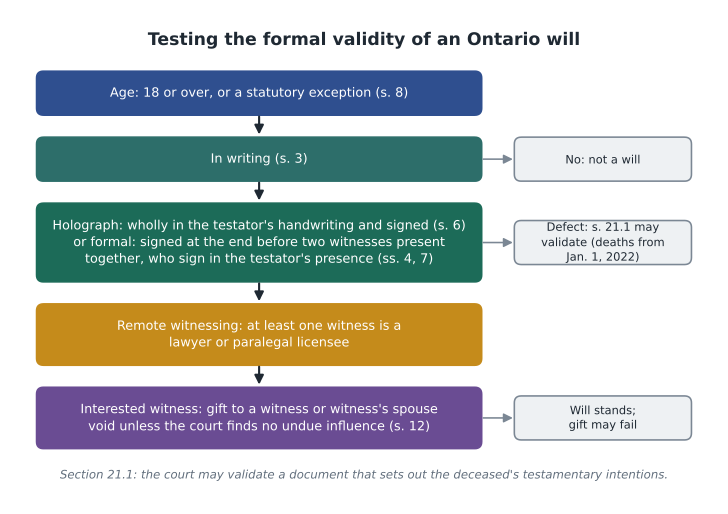
- A will must be in writing (section 3), and the testator must be eighteen or within a statutory exception (section 8).
- A formal will is signed at its end by the testator in the presence of two witnesses present at the same time, who sign in the testator's presence (sections 4 and 7).
- A holograph will must be wholly in the testator's handwriting and signed, and must show a fixed and final testamentary intention (section 6; Bennett v. Toronto General Trusts).
- Virtual witnessing is permanent if at least one witness is a lawyer or paralegal licensee.
- Gifts to a witness or a witness's spouse are void unless the court finds no undue influence (section 12); unexecuted alterations are ineffective (section 18).
- For deaths on or after January 1, 2022, section 21.1 lets the court validate a document that sets out the deceased's testamentary intentions.
- Attested will
- A formal will signed by the testator and two witnesses under section 4.
- Holograph will
- A will wholly in the testator's handwriting and signed, needing no witnesses.
- Affidavit of execution
- A witness's sworn statement that the will was properly signed and witnessed.
- Interested witness
- A witness who, or whose spouse, takes a gift under the will.
- Codicil
- A document that amends a will, executed with the formalities of a will.
- Substantial compliance
- The court's power under section 21.1 to validate a non-compliant document that sets out testamentary intentions.
- Licensee
- A lawyer or paralegal licensed by the Law Society of Ontario.
Lesson quiz · 5 questions
Score 60% or more to complete this lesson.
Create a free account to save your progress, take quizzes and earn a certificate.