
LAWC-213 · Lesson 12 of 12 · 24 min
Capstone: solving a wills and estates problem
▶ Video coming soon A video version of this lesson is on the way.
For the final class, Professor Ellerby distributes a fact pattern and gives the class ninety minutes to prepare a memorandum. Before they start, she lists six steps on the board and explains them. 'List the assets and sort them. Find every instrument and test whether it is valid. Apply the valid instruments to the assets. Identify every claim against the estate. Deal with administration: who acts, what tax, what deadlines. Then tell the client what to do on Monday morning.' She adds that estate problems reward patience: most of the marks are for issues spotted, and the issues hide in the assets. The fact pattern is entirely fictional.
The facts
Bertrand Lachapelle, sixty-seven, owned and ran a hardware store in Corwin for thirty years and sold it in 2021. He married Danielle Lachapelle in 1990. They have two children: Sylvie, thirty-four, a nurse, and Étienne, thirty-one, who works in Toronto. Bertrand and Danielle separated in May 2022. In 2023 they signed a separation agreement under which Danielle kept the former matrimonial home, each released any claim to equalization, and Bertrand agreed to pay Danielle spousal support of 1,500 dollars a month until December 2028. They never divorced. Bertrand was making the support payments until his death.
In June 2023 Bertrand moved into a condominium owned by his partner, Greta Lindahl. They had no children together. Bertrand paid half the condominium expenses. He also owned, in his sole name, a cottage on Loon Bay, north of Corwin, worth about 380,000 dollars. Over 2024 and 2025, Greta spent about 35,000 dollars of her own savings and most of her summer weekends renovating the cottage's kitchen and deck, on Bertrand's assurance that 'this will be our place'.
Bertrand's will, signed in 2015 in a lawyer's office and properly witnessed, leaves everything to Danielle and appoints her as estate trustee, but provides that if Danielle does not survive him, Sylvie is to be estate trustee and the estate is to be divided equally between Sylvie and Étienne, after a gift of 25,000 dollars to the Corwin Hospice Society. In 2024 the Corwin Hospice Society merged with another charity to form Severn Valley Palliative Care, which continues to run the same hospice. In January 2026, after a cardiac scare, Bertrand typed a document on his computer headed 'Codicil to my will', which reads: 'I leave my cottage at Loon Bay to Greta Lindahl, who has made it what it is.' He printed it, signed and dated it, and asked Étienne, who was visiting, to sign it as a witness. No one else witnessed it. Bertrand put it in an envelope marked 'Will stuff' in his desk.
In 2024, after a heart attack, Bertrand gave Sylvie a continuing power of attorney for property and added her name to his investment account, then worth about 420,000 dollars, as a joint owner with right of survivorship. He told Greta that Sylvie was on the account 'so she can pay the bills if I'm in hospital, and look after things for everyone'. In February 2026, acting under the power of attorney, Sylvie transferred 30,000 dollars from the account to herself, noting it as 'caregiving, two years'. Bertrand's registered retirement income fund, worth about 260,000 dollars, names Danielle as beneficiary under a form he signed in 2012. A life insurance policy of 150,000 dollars names his estate as beneficiary. He also had a chequing account of 30,000 dollars, a truck worth 40,000 dollars and credit card debt of 12,000 dollars.
Bertrand died suddenly in March 2026. Danielle did not file anything under the Family Law Act. Greta found the codicil in the desk in April. Sylvie consults the Brannock legal clinic in October 2026 and asks: Who is the estate trustee? Does Greta get the cottage? What must she do about the investment account and the 30,000 dollars? What claims should she expect from Danielle and Greta? What happens to the hospice gift? What tax and deadlines apply?
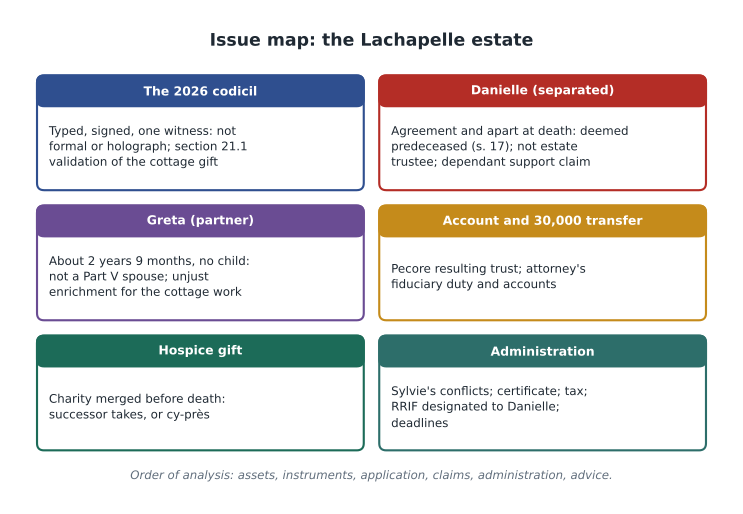
Step one: the assets
Sophie Tremblay-Hart starts by sorting the assets. Inside the estate: the cottage, the chequing account, the truck and the life insurance, which is payable to the estate. Outside the estate, at least on their face: the investment account, which passed to Sylvie by survivorship subject to a possible resulting trust, and the RRIF, payable to Danielle as named beneficiary. The condominium belongs to Greta and is not Bertrand's at all. The debts include the credit card and Bertrand's income tax for the year of death, which will include a deemed capital gain on the cottage and possibly the RRIF, discussed below.
Step two: the instruments
The 2015 will is a formal will, properly executed, and there is nothing to suggest a capacity problem. It is valid. The 2026 codicil is not a valid codicil under the formal rules. It is typed, so it cannot be a holograph codicil under section 6. It was witnessed by one person, not two, so it does not comply with section 4. Because Bertrand died after January 1, 2022, Greta, as the person who benefits, can apply under section 21.1 for an order that the document is as valid and fully effective as if it had been properly executed.
Theo Marchetti argues Greta's application. The document is authentic: it is signed and dated, it was found among Bertrand's papers, and Étienne saw him sign it. It is headed 'Codicil to my will' and uses the language of a final gift. It is consistent with what Bertrand told Greta and with her work on the cottage. The case is closer to Vojska v. Ostrowski, where the only defect was a missing witness, and to Kertesz v. Kertesz, where a handwritten note was validated, than to the case of a mere draft. Arjun Mehta, for the children, argues that Bertrand put the document in an envelope marked 'Will stuff', suggesting he meant to take it to a lawyer, and that he had a lawyer and knew how to make a proper will. Ellerby says both arguments are fair, but that on these facts the application has strong prospects: the question is whether the document records a fixed and final intention, and a signed, dated document headed 'Codicil' is strong evidence of one.
A second point about the codicil: Étienne, a residuary beneficiary under the will, witnessed it. Section 12 voids gifts to a witness in the document they witness, but the codicil gives Étienne nothing, so section 12 does not affect it. Étienne is a useful witness for Greta, because he can confirm that his father signed the document intentionally.
Step three: applying the instruments
Hannah Kowalczyk takes Danielle's position under the will. Danielle and Bertrand had a separation agreement settling their rights arising from the breakdown of the marriage, and they were living separate and apart as a result of that breakdown at his death. Under section 17 of the Succession Law Reform Act, as amended effective January 1, 2022, the will is therefore construed as if Danielle had predeceased Bertrand. The gift of everything to her fails, and so does her appointment as estate trustee. Because the will is read as if she predeceased, the gift over takes effect: Sylvie is the estate trustee, and the residue goes to Sylvie and Étienne equally after the hospice gift. If the codicil is validated, the cottage goes to Greta first.
Section 17 applies to gifts and appointments in a will. It does not, on its terms, revoke a beneficiary designation made in a separate instrument under Part III of the Act. Danielle therefore appears to remain the beneficiary of the RRIF under the 2012 designation, and will receive about 260,000 dollars outside the estate. The children may argue that the separation agreement's release of property claims covers the RRIF; that depends on its exact wording, which Sylvie should obtain. Unless the RRIF is rolled over to a qualifying spouse, the income tax on its value falls on the estate. Whether a rollover is available to a separated spouse in Danielle's position is a tax question requiring specialist advice, and its answer will affect the estate by a large amount.
Step four: claims against the estate
Danielle's claims. Danielle's equalization claim was released in the separation agreement, and her six-month period to elect under section 6 of the Family Law Act expired in September 2026 without an election, so she is deemed to have elected to take under the will, which, because of section 17, gives her nothing. The more important claim is dependant support. Bertrand was under a legal obligation to support Danielle under the separation agreement immediately before his death, so she is a dependant under section 57. The agreement's support term does not end with his death unless it says so; even if it does, section 63 allows the court to make an order despite any agreement. She has six months from the grant of a certificate of appointment to apply. A court would likely award a lump sum reflecting the remaining support of about 1,500 dollars a month to December 2028, adjusted for her other means, including the RRIF.
Greta's claims. Greta lived with Bertrand from June 2023 to March 2026, about two years and nine months. To be a spouse for Part V, an unmarried partner must have cohabited continuously for at least three years, or in a relationship of some permanence as the parents of a child. Greta meets neither test, so she is not a dependant as a spouse, however close the relationship. If the codicil is validated, she takes the cottage and her other claims largely fall away. If it is not, Greta has a strong unjust enrichment claim. Bertrand's estate was enriched by her money and work on the cottage; she suffered a corresponding deprivation; and there is no juristic reason, because she did not intend a gift but acted on his assurance that it would be 'our place'. Under Kerr v. Baranow, a monetary award is the default, probably based on the value of her contribution, about 35,000 dollars plus the value of her labour. A constructive trust over a share of the cottage is possible if a monetary award is inadequate and there is a link between her contribution and the property.
The investment account. Daniel Whitecloud addresses the account. Bertrand added Sylvie, an adult child, to the account for no payment, so under Pecore v. Pecore the presumption is that Sylvie holds it on a resulting trust for the estate. The evidence of Bertrand's intention at the time of the transfer supports the presumption: he gave Sylvie a power of attorney at the same time, which suggests the joint ownership was for convenience; he told Greta that Sylvie was on the account to pay bills and 'look after things for everyone'; and the account is the largest asset, so treating it as Sylvie's would defeat the equal division in his will. Sylvie's claim to the survivorship gift is weak. The account is likely estate property, to be shared with Étienne under the residue.
The 30,000 dollar transfer. As attorney for property, Sylvie was a fiduciary who could not benefit herself without authority. A payment to herself for caregiving may be justifiable if the power of attorney authorizes compensation or the regulation's fee scale applies, but a lump sum described as two years' caregiving, paid a month before death, is likely to be challenged by Étienne, and she must account for it. Because the power of attorney ended on Bertrand's death, the estate trustee can require her to pass her accounts as attorney; here Sylvie is herself the estate trustee, which is a direct conflict.
The hospice gift. The Corwin Hospice Society no longer exists as a separate entity, having merged in 2024 into Severn Valley Palliative Care, which continues the same work. Courts generally treat a gift to a charity that has merged or amalgamated before the testator's death, and whose purposes continue in the successor, as a gift to the successor, rather than a failed gift. If that approach does not apply, the gift has failed from the start, and the court could apply it cy-près only if Bertrand had a general charitable intention, which a gift to a local hospice may well show. Either way, the likely result is that Severn Valley Palliative Care receives the 25,000 dollars. Sylvie must give notice of the charitable gift to the Public Guardian and Trustee.
Step five: administration
Who acts. Sylvie is the estate trustee under the will because Danielle is treated as having predeceased. But she has serious conflicts: she claims the investment account personally, and she must account for the 30,000 dollars she paid herself as attorney. Ellerby's advice is that Sylvie should not decide these questions in her own favour. She should either seek directions from the court on the account and her accounts as attorney, with Étienne represented separately, or consider whether an estate trustee during litigation should be appointed, at least for those issues. A professional neutral may also make the dispute with Greta easier to settle.
Certificate and tax. The cottage is registered land in Bertrand's sole name, and the insurance is payable to the estate, so a certificate of appointment will be needed. On these figures, if the investment account is estate property, the estate's value for estate administration tax is the cottage at 380,000 dollars, the chequing account at 30,000, the truck at 40,000, the insurance at 150,000 and the account at 420,000, or 1,020,000 dollars. The credit card is not deductible. Tax is 15 dollars on each of the 970 thousands above 50,000 dollars, or 14,550 dollars. If the account were Sylvie's, the estate would be 600,000 dollars and the tax 8,250 dollars. If the codicil is validated, the cottage remains estate property that passes under it, so it stays in the calculation. Sylvie must file the Estate Information Return within 180 days of the certificate.
Income tax. Bertrand's terminal return will include the deemed capital gain on the cottage, and, unless a rollover applies, the RRIF's full value. These liabilities fall on the estate. Sylvie must file the returns, pay or secure the tax, and obtain a clearance certificate before making a final distribution, or she will be personally liable.
Deadlines. Danielle's dependant support claim must be brought within six months of the certificate. A challenge to the codicil, or Greta's section 21.1 application, and her unjust enrichment claim are subject to the two-year limitation period under the Limitations Act, 2002, running at the latest from April 2026 when she found the codicil, and arguably from Bertrand's death in March 2026. Sylvie should not distribute until those periods and the claims are resolved, and should keep the estate's assets insured and preserved in the meantime, including the cottage, which is likely vacant.
Step six: advice to Sylvie
Ellerby asks the class to write the last paragraph of the memorandum in plain language, as a letter to Sylvie. Their joint draft reads: 'You are the estate trustee because your mother is treated by law as if she had died before your father. Please apply for a certificate of appointment and give notice to everyone with an interest, including Greta, your mother, Étienne, the hospice charity and the Public Guardian and Trustee. Greta is likely to ask the court to validate the codicil, and she has a good chance of success; if she does not succeed, she probably has a money claim for her work on the cottage. Your mother is likely to claim support from the estate. The investment account is probably estate property, and you will need to account for the 30,000 dollars you took as attorney. Because you have a personal interest in these questions, we recommend that you ask the court for directions and that Étienne get his own lawyer. Do not distribute anything until we advise you that the tax and claims are settled.'
Ellerby's closing
Ellerby ends the course where she began, with her three questions on the board: who gets what, who decides, who can complain. She tells the class that every estate problem they will ever see can be organized under those questions. Who gets what is answered by the instruments, the intestacy rules and the assets outside the estate. Who decides is answered by the law on estate trustees, attorneys, guardians and the court. Who can complain is answered by the statutes and doctrines that let family members and others reach the estate: dependant support, the spouse's election, resulting and constructive trusts, and the court's supervision of fiduciaries. 'Read the will,' she says, 'then read the family. And then read the deadlines.'
Worked problem
Marking scheme highlights
Ellerby shares the points on which most marks were awarded. Which issues did the best answers identify that weaker answers missed?
Show solution
- Section 17 and separated spouses: the best answers saw that the separation agreement and living apart at death made Danielle a deemed predeceased spouse, so the gift over and Sylvie's appointment took effect.
- The RRIF designation: section 17 affects the will, not the 2012 designation; the tax consequence for the estate is large.
- Greta's spousal status: two years and nine months without a child is not enough for Part V; her claim lies in section 21.1 and unjust enrichment.
- Danielle as a dependant: the legal obligation under the separation agreement made her a dependant despite the release of property claims.
- Pecore and the power of attorney: the power of attorney given at the same time pointed toward a convenience account.
- Conflicts: Sylvie's position as estate trustee, joint account holder and former attorney called for directions or a neutral estate trustee.
Common mistakes
MistakeTreating Danielle as entitled under the will because the couple had not divorced.
InsteadSince January 1, 2022, a separation agreement plus living apart at death makes a separated spouse deemed predeceased under section 17.
MistakeTreating the typed codicil as a holograph codicil.
InsteadA typed document is not in the testator's handwriting. It needs section 21.1 to be validated.
MistakeTreating Greta as a spouse for dependant support.
InsteadWithout three years' cohabitation or a child, Greta is not a spouse under Part V.
MistakeLeaving the investment account out of the estate because the bank form says "survivorship".
InsteadUnder Pecore, a gratuitous transfer to an adult child is presumed to be held on resulting trust; the form is only evidence.
MistakeLetting a conflicted estate trustee decide disputes in her own favour.
InsteadSeek directions, ensure other beneficiaries are separately represented, or consider an estate trustee during litigation.
Practice problems
Work each problem on paper first, then reveal the answer to check.
If Bertrand and Danielle had separated in May 2022 without any agreement, court order or arbitration award, would section 17 have applied at his death in March 2026?
Show answer
Yes, if they had lived separate and apart because of the breakdown of the marriage for the three years immediately before his death, which from May 2022 to March 2026 they had, and were living apart at death.
If Greta and Bertrand had lived together for three years and two months, how would her position change?
Show answer
She would be a spouse for Part V and, if he was supporting her immediately before death, a dependant who could claim support within six months of the certificate. She would still have no intestate share or Family Law Act election.
If Bertrand had died in 2021, what would happen to the codicil?
Show answer
Section 21.1 would not apply. The codicil would be invalid for lack of a second witness, and Greta would be left with an unjust enrichment claim.
Summary and key terms
- A structured approach to estate problems: sort the assets, test the instruments, apply them, identify claims, deal with administration, and advise.
- Section 21.1 can validate a typed, singly witnessed codicil that records a fixed and final intention, for deaths on or after January 1, 2022.
- A separated spouse with a separation agreement who was living apart at death is treated as predeceased under the will, but a separate beneficiary designation may still stand.
- Dependant support depends on a listed relationship and support or a legal obligation immediately before death; an unmarried partner must meet the three-year or child test.
- Pecore resulting trusts and attorneys' fiduciary duties are central to many disputes about money moved before death.
- Estate trustees with conflicts should seek directions, and every deadline should be diarized from the first meeting.
- Issue map
- A list of every legal question raised by a fact pattern, organized before writing.
- Gift over
- A gift that takes effect if an earlier gift fails, such as when a beneficiary predeceases.
- Directions
- Court orders guiding an estate trustee on a disputed question or on procedure.
- Deemed predeceased
- Treated by law as having died before the testator, as with a divorced or separated spouse.
- Value survived
- A measure of an unjust enrichment award based on a share of wealth accumulated in a joint family venture.
Lesson quiz · 5 questions
Score 60% or more to complete this lesson.
Create a free account to save your progress, take quizzes and earn a certificate.